.svg)
.svg)
Sales and Operations Planning (S&OP) aligns demand, supply, finance, and operations into one decision-ready plan. The traditional monthly cycle was built for stable markets. In 2026, the real differentiator is reaction time, not the calendar, and AI changes what humans actually do in the room.
Most S&OP guides describe the monthly cycle. The companies winning in 2026 don't wait for the next meeting. The cycle still exists, of course, but the decisions that move the business now happen in days, sometimes in hours, between the formal review and the next one. The question is no longer how to run a monthly Sales and Operations Planning meeting. It is how to keep the plan alive between two of them, and that changes what S&OP looks like, which Sales and Operations Planning software to buy, and how to measure success.
What S&OP is and why it exists
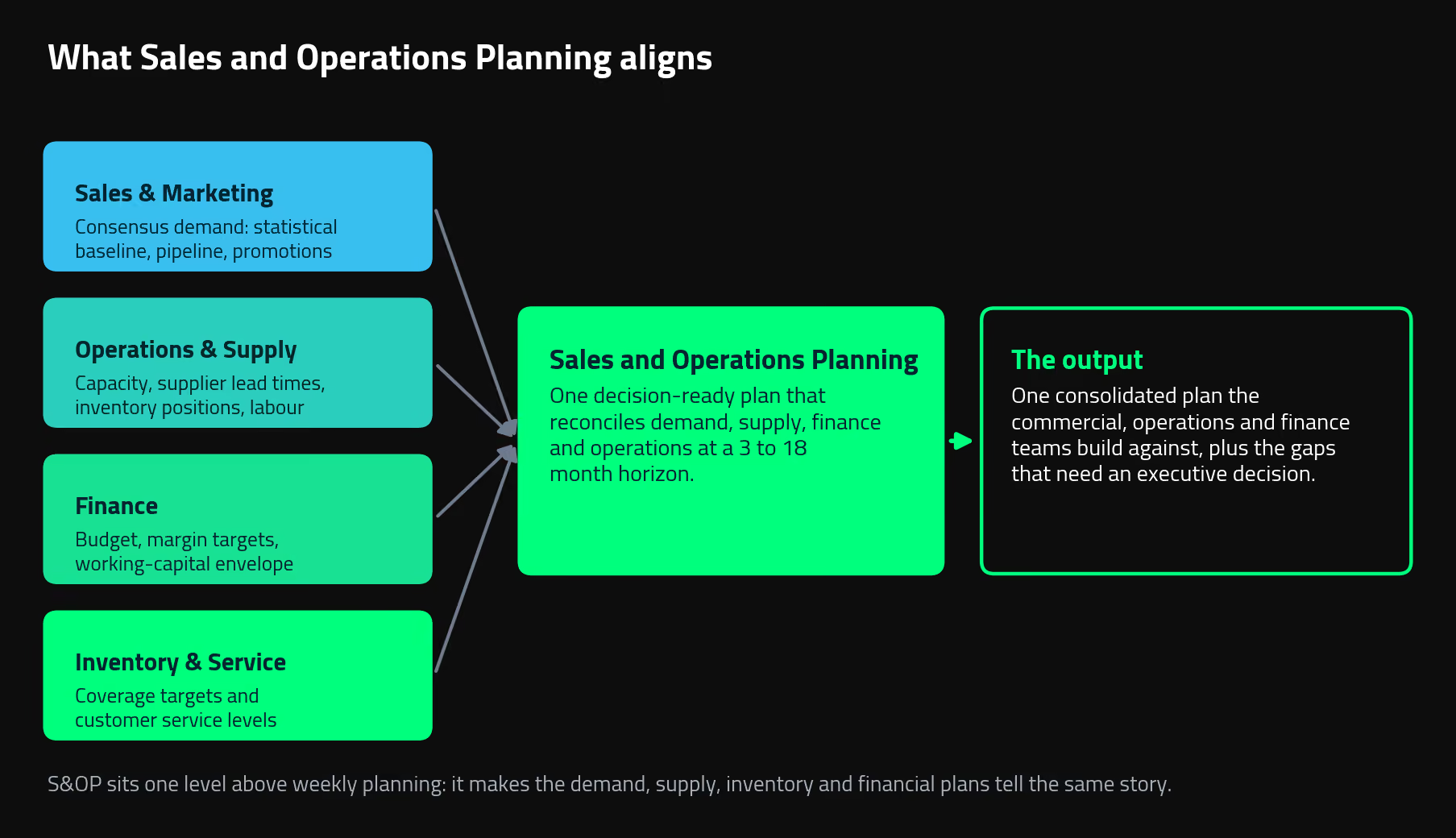
Sales and Operations Planning is the cross-functional process that reconciles what the commercial side expects to sell with what the operational side can supply, inside the financial envelope the business has committed to. The American Production and Inventory Control Society, now part of the Association for Supply Chain Management, defines it as:
"a process to develop tactical plans that provide management the ability to strategically direct its businesses to achieve competitive advantage on a continuous basis".
That definition matters because it places S&OP one level above the weekly planning grind. The point is not to draft a forecast or run an Material Requirements Planning (MRP) explosion. The point is to make sure the demand plan, the supply plan, the inventory plan, and the financial plan tell the same story, and to surface the gaps that need an executive decision.
For mid-market manufacturers and distributors, the absence of S&OP shows up in predictable ways:
- sales commits to a quarter the plant cannot deliver;
- inventory drifts upward in some regions while service levels collapse in others;
- finance discovers the working capital hit at quarter-end.
S&OP is the meeting where those disconnects are forced into the open, and the cadence at which they get resolved. Done well, it is also the foundation for Integrated Business Planning (IBP).
The traditional S&OP 5-step process
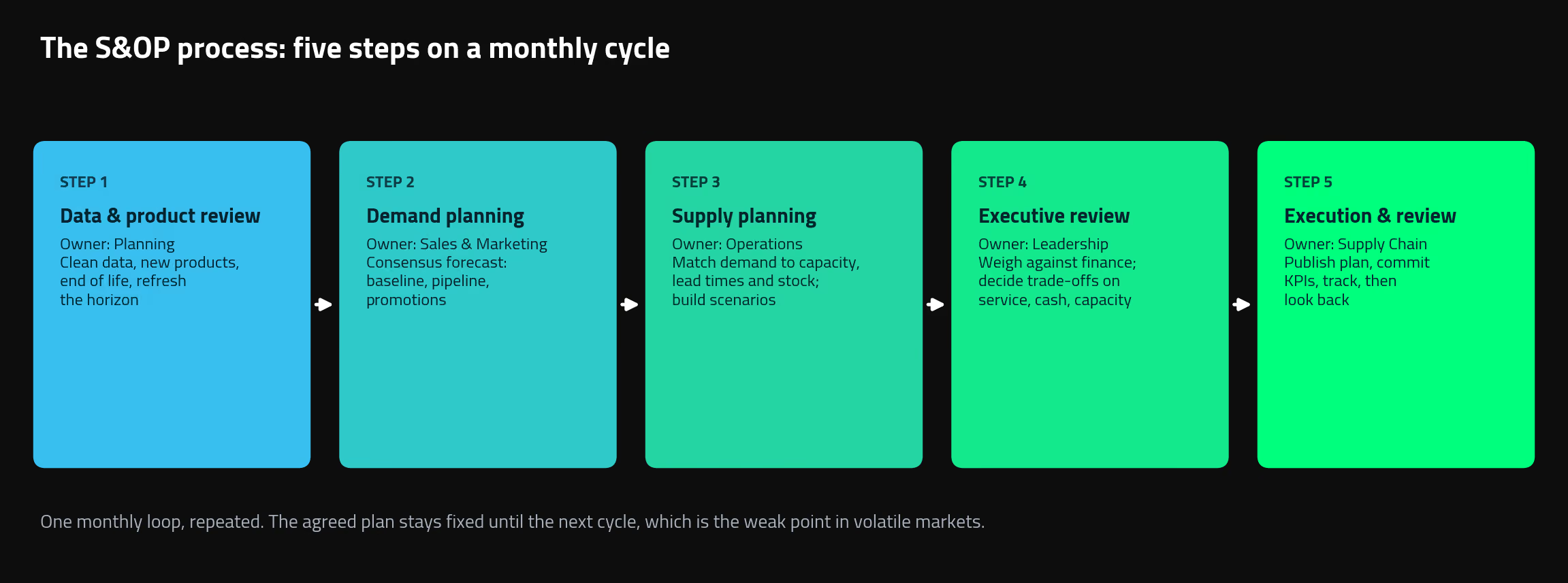
Across the dominant guides, the Sales and Operations Planning process is built around five steps that run on a monthly cycle. The exact labels vary, but the substance is consistent.
- Data and product review. New product introductions, end-of-life decisions, and historical performance are consolidated. The data is cleaned, lifecycle changes are flagged, and the planning horizon is refreshed.
- Demand planning. The sales and marketing teams build a consensus forecast that blends statistical baseline, commercial pipeline, and known events such as promotions or tenders. The output is an unconstrained view of expected demand.
- Supply planning. Operations checks the demand plan against production capacity, supplier lead times, inventory positions, and labour availability. Gaps between demand and supply are identified, with scenarios prepared where capacity is tight.
- Pre-S&OP / executive review. Cross-functional leaders compare the demand and supply plans against the financial plan. Trade-offs are framed: do we accept a service hit, expand capacity, build inventory ahead of a peak, or push commercial to reshape the mix?
- Execution and continual improvement. The agreed plan is published, key performance indicators (KPIs) are committed, and execution is tracked. The next cycle starts with a look-back at what worked.
This five-step Sales and Operations Planning process is the canonical version, and for many businesses it is still a meaningful upgrade from the no-S&OP baseline. It forces the conversation that needs to happen. The problem is what it cannot do once the meeting ends.
Benefits of an effective S&OP process
A well-run S&OP delivers four benefits that most planners can name from memory.
Cross-functional alignment
Sales, operations, finance, and Supply Chain stop running on parallel spreadsheets and converge on one plan. The number that finance reports to the board is the same one the plant manager builds against.
Healthier inventory and working capital
When demand and supply share the same horizon, inventory stops absorbing the gap between them. Coverage falls where demand is steady, and is concentrated where risk is real.
Higher service levels
The cross-checking that happens during the supply review catches mismatches before they become stockouts. Customer commitments line up with what can actually be delivered, which is how S&OP protects the service level you promise.
Faster, more confident decision-making
Trade-offs are made by the right people with the right data, instead of by whoever escalates loudest at the end of the quarter.
The benefits are real, and that is precisely why S&OP became standard practice for any business above a certain scale. It is also why the conversation in 2026 is no longer about whether to run S&OP, but about whether the monthly cadence is still the right one.
Why the monthly S&OP cycle is broken in 2026
The monthly S&OP cycle was built for a world where lead times, demand patterns, and capacity were stable enough that a 30-day plan held. That world is gone. Demand spikes arrive between two reviews. A supplier delay surfaces on day eight of a 30-day cycle. A competitor's stockout reshuffles a category in 48 hours. By the time the next monthly meeting starts, the data on the table is already two weeks old.
The structural issue is not the meeting itself. It is the gap between meetings. A traditional Sales and Operations Planning cycle assumes that the decisions taken in the executive review will still be valid 30 days later. In a volatile environment, half of them are stale by week two. The team then spends the next monthly review re-litigating decisions that should have been adjusted in flight.
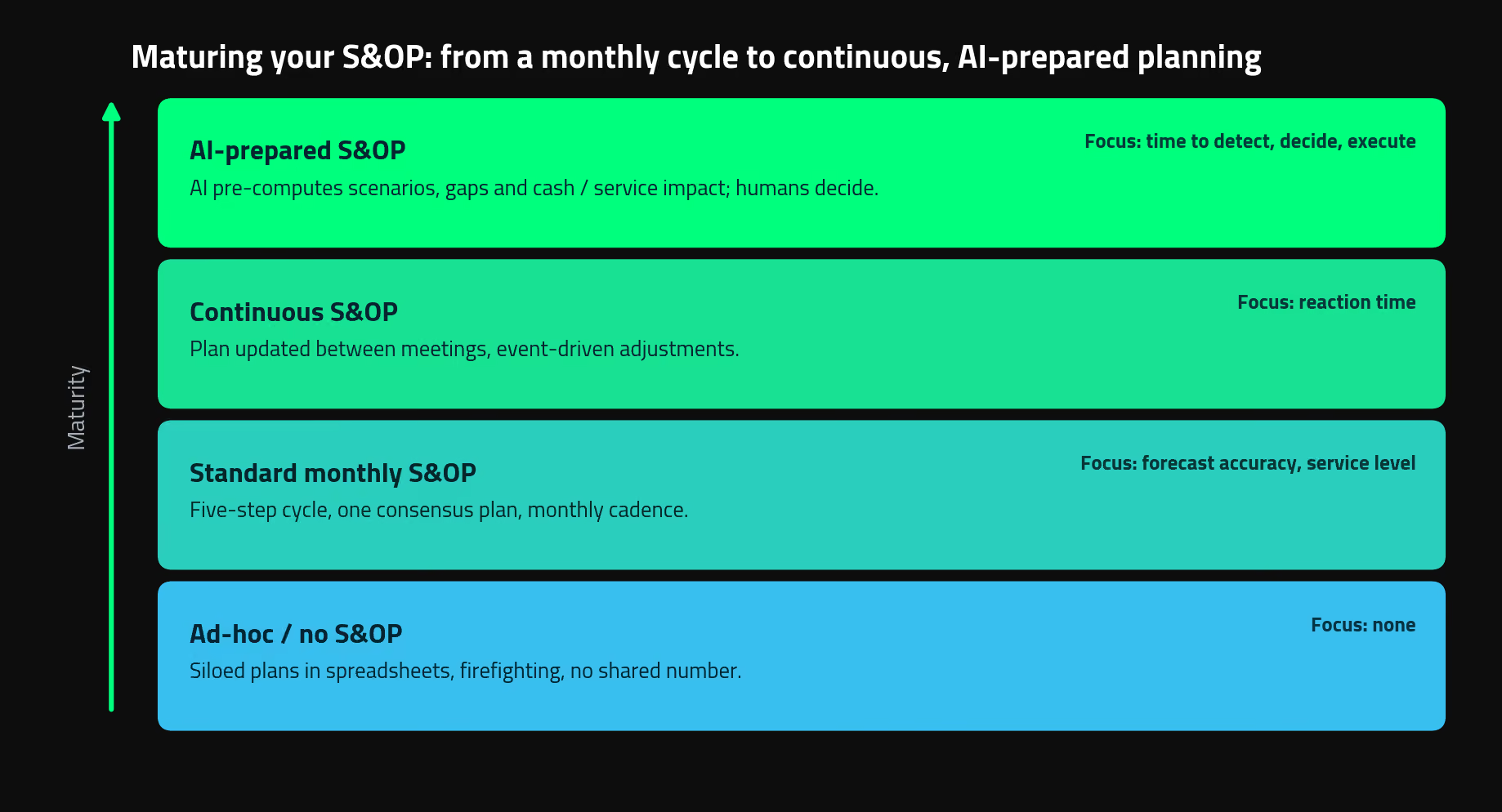
What works instead is a continuous S&OP loop. The monthly executive meeting still anchors the strategic decisions, but the plan is updated as the data changes, scenarios are simulated when an event hits, and the team commits to an adjustment in real time rather than holding it for the next cycle. The cadence becomes event-driven, not calendar-driven.
Camif, a French furniture retailer, is a useful illustration of what this looks like in practice. After moving its planning to a continuous, AI-driven workflow on Flowlity, the team absorbed 44% growth and added two warehouses without scaling the planning department. That kind of agility does not come from a sharper monthly forecast. It comes from a planning process that no longer waits 30 days to react.
What AI actually does in S&OP: it prepares the battlefield
Here is the Flowlity thesis, and it runs opposite to the usual vendor caution: the vast majority of a planner's routine work can and should be automated today, and that is exactly what Flowlity does. What stays with people is the judgement, the trade-offs between service and cash, the commitments to a customer, the escalations to the board. Magotteaux, a worldwide industrial group, moved to continuous AI-driven planning on Flowlity and cut inventory value by 13%, stock coverage by 22% and stockouts by 8% across its full scope.
What AI does well is the prep work. The two weeks of analyst time that go into a typical S&OP cycle (consolidating data, building scenarios, running supply-demand match exercises, computing the inventory and cash implications of each option) is exactly the kind of work probabilistic algorithms can compress to minutes. The humans then walk into the meeting with the gaps already framed, the scenarios already costed, and the risks already quantified.
This is where AI in Supply Chain planning earns its keep. Instead of producing a single forecast, it produces a demand distribution per Stock Keeping Unit (SKU), sizes dynamic safety buffers against the uncertainty range, and surfaces the exceptions that need human judgement. The S&OP meeting becomes a decision forum, not a status update. Humans decide; AI prepares the battlefield.
That is the operating philosophy behind AI-driven Supply Chain planning solutions like Flowlity: more than 95% of a planner's routine work can and should be automated, so the team spends its time deciding rather than preparing. For the full operating model, how a digital, AI-run S&OP replaces monthly batch planning end to end, see our deep dive on digital S&OP with AI and automation.
The shift is not about replacing the planner. It is about removing the work that should never have been on the planner's desk in the first place.
The real S&OP KPI isn't forecast accuracy, it's reaction time
Every S&OP project starts with a forecast accuracy target, and most of them quietly miss it. The reason is not that forecasting is hopeless. The reason is that, past a certain point, marginal accuracy gains stop translating into operational gains. Two businesses with identical Mean Absolute Percentage Error (MAPE) numbers can produce very different service and inventory outcomes, depending on how fast they react when the forecast is wrong.
Provocative version: a company with average forecasts and fast decision-making will outperform a company with sharper forecasts but a slow loop. The real Sales and Operations Planning KPI is the time it takes the team to react to an unforeseen event, not the accuracy of the prediction that missed it.
In practice, that means measuring three things alongside the usual forecast accuracy and service level scoreboard.
- Time-to-detect. How long between a deviation appearing in the data and the planning team being aware of it.
- Time-to-decide. How long between awareness of a gap and a committed decision on how to handle it.
- Time-to-execute. How long between the decision and a corresponding change in supplier orders, production schedules, or commercial commitments.
These metrics tell you whether your S&OP process is a meeting or a muscle. A company that measures and improves them ends up with a planning function that absorbs disruption rather than getting absorbed by it.
Why invest in Sales and Operations Planning software
Why invest in Sales and Operations Planning software at all? Because past a certain size, spreadsheets stop holding the demand, supply and financial plans together, and the cost of misalignment (excess stock in one place, stockouts in another, a working-capital surprise at quarter-end) quickly outweighs the price of a tool. The point of software is not a longer feature list, it is to keep the plan alive between meetings, not just to prepare the next one. A few principles matter more than any checklist.
- Probabilistic, not deterministic. A single-number forecast hides the risk. A demand distribution per SKU shows how wide the uncertainty is, and lets the planner size buffers and trade-offs against it. This is the mathematical foundation that makes dynamic safety stocks possible.
- Continuous recalculation. The plan should update as the data changes, not on a fixed monthly cycle. Look for engines that can recompute forecasts and replenishment recommendations in near real time.
- Scenario simulation as a first-class feature. The pre-S&OP review is fundamentally a scenario exercise. Dedicated scenario simulation software lets a planner test a demand spike, a supplier delay, or a capacity reduction in seconds, and see the inventory and cash implications immediately.
- ERP-native integration, bidirectional. The Enterprise Resource Planning (ERP) system is still the system of record. The S&OP layer needs to read from it and write back to it, so that decisions taken in the platform flow into actual purchase orders, production plans, and stock policies.
- A user interface a planner can use without certification. Some legacy platforms still require a six-month training programme. Flowlity is built to be operated directly by Supply Chain teams, which matters more than any feature list when you account for staff turnover and the realistic time the team has to spend in a tool.
A useful test is to ask a vendor what happens to the plan between two S&OP meetings. If the answer is "the team waits for the next cycle", the tool is the wrong vintage.
Running S&OP the way a Supply Chain leader should in 2026
Sales and Operations Planning is not a meeting on a calendar. It is the way a Supply Chain function holds the rest of the business to one plan, and adjusts that plan when the world refuses to cooperate. The monthly cycle worked when the world cooperated. It cooperates less every year.
The version of S&OP that works in 2026 looks different from the textbook version. The five-step process is still there, but the plan lives between meetings. AI takes over the prep work that used to consume the planning team. The KPI on the wall is reaction time, not forecast accuracy. The software stack is built around probabilistic, continuous, scenario-ready logic instead of monthly batch consolidation. For more on the operating shift, the webinar about S&OP best practices walks through the same logic with planners who have made the transition.
Level up your supply chain with AI.
Get a demo

FAQ
Find everything you need to know right here.
How to implement an effective S&OP process?

An effective Sales and Operations Planning process is less about exotic techniques and more about disciplined execution of a handful of basics. Most failed S&OP rollouts trip on the same predictable issues: weak executive sponsorship, unreliable data, or a monthly cycle that becomes a reporting ritual rather than a decision forum.
The 5 key practices to implement an effective S&OP process are:
1) Define sponsor & objectives;
2) Map demand/supply data;
3) Choose a dedicated tool (e.g., Flowlity) to consolidate forecasts and capacities;
4) Formalize a monthly cycle (Demand Review → Supply Review → Exec S&OP);
5) Measure results and continuously adjust.
Applied together, these five practices turn S&OP from a recurring presentation into a genuine management tool. The cycle consolidates the same numbers every month, trade-offs are made explicit rather than implicit, and improvements compound because each iteration inherits the learning from the previous one. This is also where a dedicated platform delivers its clearest return: consistency, speed, and shared context across functions.
Why implement an S&OP process?
S&OP matters because it is the only recurring process that forces commercial, operational, and financial teams to agree on a single plan and commit to it. Without that cadence, each function ends up optimizing locally — with predictable cross-functional friction and working-capital waste.
A structured S&OP allows:
- to increase profitability (reduced inventory, less waste, better customer service);
- to improve the quality of decisions thanks to a shared vision of constraints and opportunities;
- to anticipate supply chain risks and increase agility in the face of market fluctuations.
The three benefits above compound over time. Profitability improves as inventory and service discipline take hold; decision quality improves as the monthly cycle builds shared context; and resilience improves as the organization develops the habit of looking 6 to 18 months ahead and stress-testing the plan against likely disruptions. Teams stop firefighting and start steering.
What tools can facilitate or improve S&OP?
Running S&OP well means closing the gap between signal and decision. Spreadsheets were sufficient when planning cycles were slow and data was scarce — today, both assumptions have flipped, and the tooling has to flip with them.
Supply chain managers are turning to cloud platforms that combine AI forecasting, simulated scenarios, and collaborative workflows.
These solutions:
- replace Excel spreadsheets,
- automate data collection,
- and offer real-time dashboards for rapid decision-making (e.g., demand fluctuations, capacity shortages).
The practical effect is a monthly cycle that starts from clean, consistent numbers, where scenarios can be compared side-by-side and the conversation stays focused on decisions rather than reconciliation. Flowlity goes one step further by integrating probabilistic forecasting and strategic simulation directly into the S&OP flow, so each cycle benefits from the same decision engine that runs the rest of planning. Choosing the right platform also means comparing AI-driven planning with a structured S&OP cycle approach, since the two models lead to very different planning rhythms.
What is a “good” S&OP process?
A good S&OP process is surprisingly easy to recognize: decisions get made, they stick, and the plan improves month after month. Behind that simple outcome sits a small set of disciplines that most mature S&OP programs share, regardless of industry.
A high-performing S&OP process relies on:
• reliable, up-to-date data;
• clear governance (roles, responsibilities, meeting calendar);
• aligned KPIs (customer service, margin, cash);
• “what-if” scenarios to support medium-term decision-making;
• a collaborative tool that centralizes information and workflows.
Notice what is not on this list: elaborate models, dedicated data science teams, or complex scoring systems. A good S&OP process is defined by consistency, transparency, and the willingness to surface hard trade-offs rather than smooth them over. Once those foundations are in place, more sophisticated capabilities — probabilistic forecasting, simulation, IBP-style financial integration — layer on naturally.
What is S&OP?
S&OP sits at the crossroads of commercial ambition and operational reality. Its job is to turn what the company wants to sell into a plan the Supply Chain can actually execute, and to do so inside the financial envelope set by the business.
Sales & Operations Planning (S&OP) is an integrated management process that synchronizes demand (sales, marketing) and capacity (procurement, production, finance) to deliver a single, agreed-upon plan.
Typically conducted monthly, it aims to balance supply and demand while aligning with the company's financial objectives.
Done well, S&OP becomes the backbone of cross-functional execution. It replaces ad hoc escalations with a predictable decision forum, gives each function early visibility on upcoming trade-offs, and produces a plan that is genuinely owned — not just received. When it drifts into a reporting ritual, the typical culprits are stale data, unclear governance, or no real decisions on the agenda.
How often should an S&OP cycle run?
The canonical answer is monthly, with a quarterly strategic review. The 2026 answer is that the formal cycle should still be monthly, but the plan itself should be updated continuously. The monthly meeting anchors strategic trade-offs. Tactical adjustments happen as the data changes, often weekly or daily, depending on the volatility of the business. The right cadence is event-driven, not calendar-driven.
Can S&OP improve service level without inflating inventory?
Yes, and that is increasingly the point. Static safety stock rules force a trade-off: more service requires more stock. Probabilistic buffers, recalculated against demand uncertainty, change the equation by concentrating coverage where risk is real and trimming it where it is not.
Saint-Gobain Sekurit AGR is one example, moving its service level from 95.8% to 97.2% while cutting inventory by 9.25%. The lever is the sizing logic, not the budget.
Do I need to be a large enterprise to run S&OP?
No. Mid-market manufacturers, distributors, and retailers benefit from S&OP at least as much as enterprise groups, because their planning teams are smaller and the cost of misalignment is felt faster. The right tool matters more at mid-market scale: a platform that needs a six-month rollout and dedicated experts will struggle, while a Sales and Operations Planning workflow built to be run by the existing Supply Chain team can deliver impact in weeks rather than quarters. That’s why we built Flowlity Lite, our plug-and-play tool specially designed for SMBs, without an implementation project needed.