.svg)
AI Agents Suite – Autonomous Forecasting & Planning
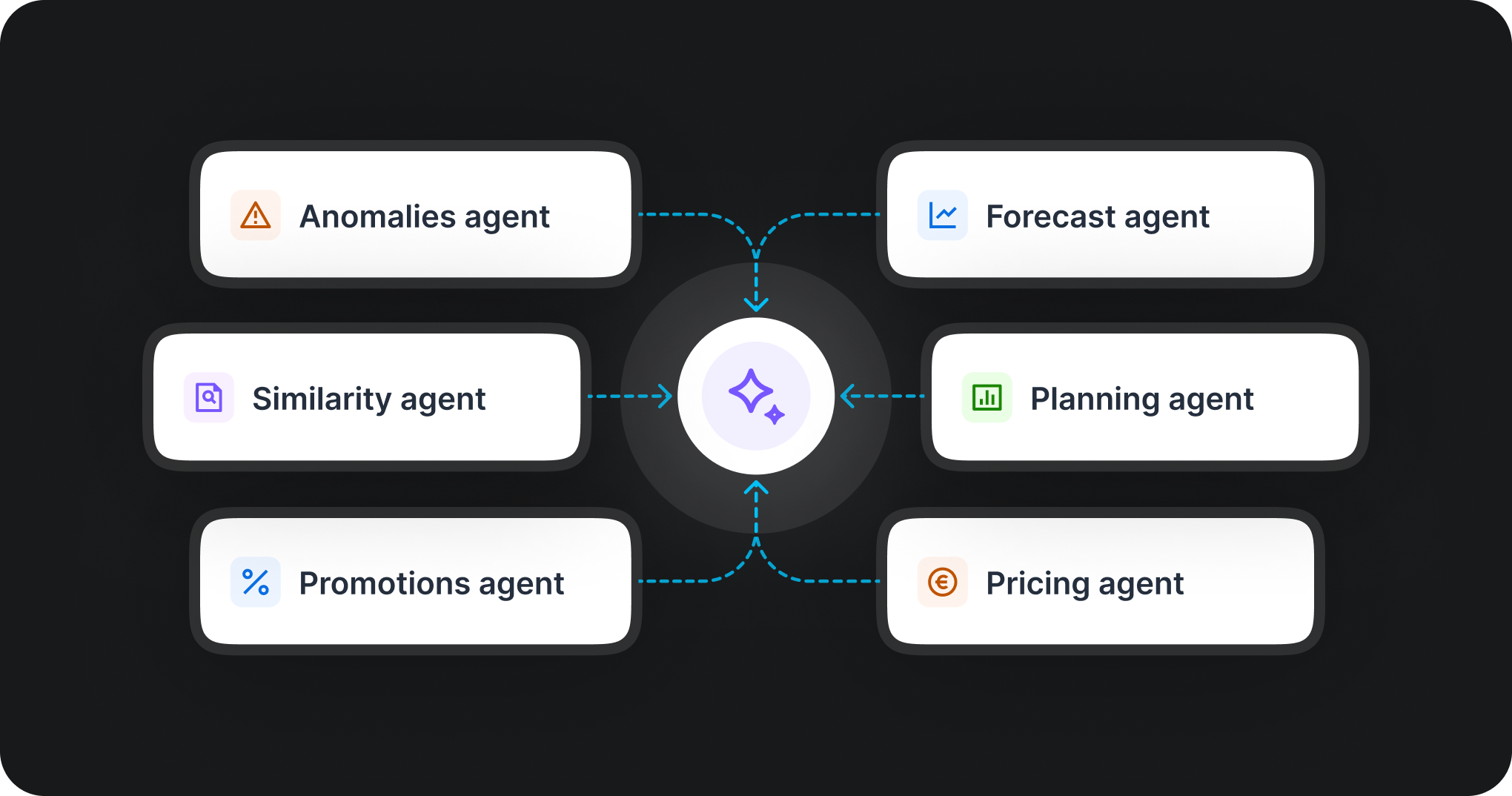
One command centre, many specialised agents.
Get a Demo
Why AI Agents?
Traditional planning tools still rely on manual data prep and static rules, leaving planners firefighting instead of strategising. Flowlity’s AI Agents Suite automates the full cycle – from demand cleansing to order generation – so your team focuses on growth, not spreadsheets.

.svg)
“With Flowlity’s agents we slashed wastes by 18 % and cut planning time by 5.”
Meet the Agents
Anomalies Agent – Trust Your Data

Forecast Agent – AI in the Driver’s Seat
Similarity Agent – Accelerate New Items
Planning Agent – Automated Supply Execution
Simulation Agent – Automated Inventory Strategy Simulations
"The repetitive tasks you do every day can be automated straight from Flowlity — that's a big win.
There's an agent that watches demand anomalies. You get an outlier alert right away and all you have to confirm is: is this a one-off, or something likely to repeat? The analysis is already done for you."
Koen Ferket
Chief Operating Officer, Trixie Baby

What’s New
Designed for modern supply chain teams.


More about Supply Chain automation
What is Supply Chain automation in Supply Chain management?

Supply chain automation isn’t just about robots in warehouses. For planning teams, it’s about automating the workflows that eat up your week: cleaning demand, updating forecasts, balancing inventory levels, generating plans, and keeping everyone aligned—using real-time data instead of spreadsheet guesswork. The goal is simple: optimize decisions, reduce manual tasks, and keep your supply chain management running smoothly—even when disruptions hit.
Definition
Supply chain automation means using automation technologies (like artificial intelligence, machine learning, and sometimes robotic process automation (RPA)) to streamline supply chain processes end-to-end. In practical terms, it’s what turns scattered data into automated systems that can detect issues, recommend actions, and accelerate decision-making across supply chain operations—without adding more meetings.
Automation vs. static rules
Traditional automation tools often rely on rigid, static rules: “if X happens, do Y.” The problem? Real supply chains are full of exceptions, seasonality, and constant change.AI-powered automation goes further: it learns patterns, validates outcomes, and adapts to fresh signals. That means fewer “rule patch” cycles, less human error, and less time spent babysitting spreadsheets.
Benefits of Supply Chain automation
Streamline workflows and remove bottlenecks
Stop losing days to repetitive tasks, manual data entry, and spreadsheet macros. Automation helps streamline workflows, remove bottlenecks, and reduce time-consuming handoffs across teams.
Real-time visibility for faster decision-making
With real-time visibility and real-time tracking, planning becomes proactive. You get a clearer picture of inventory levels, constraints, and risks—so you can make informed decisions faster, with less friction. It also strengthens cross-functional alignment within your S&OP processes.
Fewer inefficiencies and less human intervention (where it matters)
Automation reduces inefficiencies in supply chain processes by handling the repetitive work consistently. Humans stay in control where judgment matters, while automated systems take care of the heavy lifting.
Better customer satisfaction (service level + fewer disruptions)
When supply chain automation improves order fulfillment and reduces supply chain disruptions, the impact is visible: higher service levels, fewer stockouts, and stronger customer satisfaction.
Cost savings (inventory levels + operational costs)
Optimized inventory management means less cash tied up, fewer shortages, and lower operational costs. You improve performance without simply adding headcount.
Key use cases for automation in Supply Chain
Demand forecasting automation
AI-powered demand forecasting uses real-time data, seasonality, lifecycles, and events to keep forecasts fresh. Instead of “forecast once a month and hope,” you continuously optimize accuracy and reduce bias from gut feel.
Inventory management automation
Automation in inventory management helps set the right buffers and safety stocks, align inventory levels to targets, and support end-to-end supply planning—especially when managing multi-echelon networks.
Order processing and procurement automation
From recommended purchase order quantities to constraint-aware plans, automation supports procurement and sourcing by reducing manual processes, improving reliability, and minimizing avoidable errors in order processing.
Handling disruptions with real-time tracking + scenario simulation
Disruptions are inevitable. Automated supply chain workflows help you react faster: detect issues early, simulate options, and choose the best plan based on cost, service, and feasibility.
Why Flowlity’s Supply Chain automation software is different
Agent-based automation (specialists, not one black box)
Flowlity uses a suite of specialized agents to automate supply chain management workflows. Each agent focuses on a specific job—so automation is clearer, more controllable, and easier to trust than a one-size-fits-all engine.
Real-time decision-making, with humans in control
Flowlity is built for faster decision-making—without removing accountability. Recommendations are transparent, explainable, and adjustable, so planners can approve, edit, or reject changes while still benefiting from AI-powered speed. This agent-based design is one of the reasons Flowlity was named a Gartner Cool Vendor in Supply Chain in 2025.
Works with existing systems (ERP)
Great automation software shouldn’t require ripping out what already works. Flowlity connects to existing systems (including ERP) to unify real-time data and orchestrate automated systems across your planning stack.
Supply Chain Automation implemented seemlessly
Getting started shouldn’t feel like a transformation project. Flowlity is designed to plug into your existing systems and secure data flows, so you can automate planning workflows quickly and scale at your pace.
Extend automation beyond the app with the Flowlity MCP
Flowlity's AI agents automate planning workflows inside the platform. The Flowlity MCP takes this a step further: it lets external AI assistants — Claude, ChatGPT, or Microsoft Copilot — interact with your Flowlity data directly. Planners can query stock levels, set up promotions, or trigger data imports from the same chat window they use for everything else — and combine Flowlity with their CRM, ERP, or Excel files in a single conversation.
FAQ
Find everything you need to know right here.
How do agents differ from traditional rules?
AI agents learn autonomously and continuously validate outcomes against fresh data, whereas rules are static and need to be updated manually based on gut feelings.
Can I override an agent’s suggestion?
Absolutely – every recommended change can be approved, edited, or rejected.
Do I need a data-science team to run this?
No. Flowlity provides the models and infrastructure; you just connect the data. A domain expert or key user is the ideal driver for our agent module.
What is the biggest benefit of automation for supply chains?
The biggest benefit is speed with reliability. Supply chain automation helps teams optimize decisions across the entire supply chain, reduce human error, and respond faster to disruptions—while keeping service levels high and customer expectations in check.
What do supply chain automation tools look like in action?
In practice, automation tools connect data from ERP, IoT signals, and planning systems to automate business processes like demand forecasting, inventory management, and order processing. Many providers showcase this through real case studies in retail, ecommerce, and industrial environments.
What is the role of AI in an automated supply chain?
AI uses machine learning and artificial intelligence to detect patterns, adapt to change, and support decision-making in real time. It helps planners anticipate demand, manage raw materials, and adjust plans across a global supply chain—without constant human intervention.
What are the key challenges in implementing supply chain automation?
Common challenges include data quality, integration with existing systems, and change management. Labor shortages, legacy tools, and the need to upskill human workers can also slow adoption—especially when new technology is introduced too aggressively.
How does supply chain automation impact efficiency and cost savings?
Automation improves efficiency by reducing manual work, stabilizing stock levels, and lowering labor costs. Over time, better metrics, improved quality control, and smarter use of resources also support scalability and sustainability—from warehousing to last-mile operations.