.svg)
.svg)
Anyone searching Flowlity vs Imperia is comparing two of the more credible modern challengers in Supply Chain planning, not a leader against a clone. Both describe themselves as AI-native, both target the mid-market, and both will feel like a leap for a team still planning in Excel. So the useful question in a Flowlity vs Imperia shortlist is not which one has AI. It is what each platform does at the edge of what it already covers. Imperia's answer is to generate the missing piece on request. Flowlity's is a published scope that is fixed but wide, spanning demand, supply, inventory, production capacity and pricing, with the depth spent on the quality of the decision inside it. Both are real trade-offs, and they suit different companies.
Imperia and Flowlity in brief
Imperia was founded in 2019 in Valencia, Spain, by Álvaro Bernabé, José Tomás Carrascoso and Sergio Alemany, and has grown fast, on the back of a Series A of over 10 million euros led by Burda Principal Investments and Samaipata. Its product, Supply Chain Planning, covers demand forecasting, procurement, Production Planning and S&OP governance, assembled from a core platform and a published store of features. Imperia holds a 4.7/5 rating on Capterra and, in February 2026, launched SCP Studio, which it presents as a way to build planning functionality continuously rather than through development projects.
Flowlity was founded in 2019 in France and runs an in-house research team, including PhDs working on its forecasting and optimization models. Rather than a store of features, it is a single planning engine built on a probabilistic approach: forecasts that produce a range of likely demand rather than one number, adaptive safety buffers, outlier-corrected history and tactical simulation, now extended with planning agents through the Flowlity Co-planner. It is used in more than forty countries across Europe, the Americas and Asia, by industrial manufacturers, wholesalers and a growing number of retailers. Flowlity holds a 4.9/5 rating on G2, was named a Gartner Cool Vendor in Supply Chain in 2025, and entered the 2026 Nucleus Research SMB Supply Chain Planning Value Matrix as an Accelerator, the quadrant for high usability and fast adoption.
Generated on request, or computed by the engine
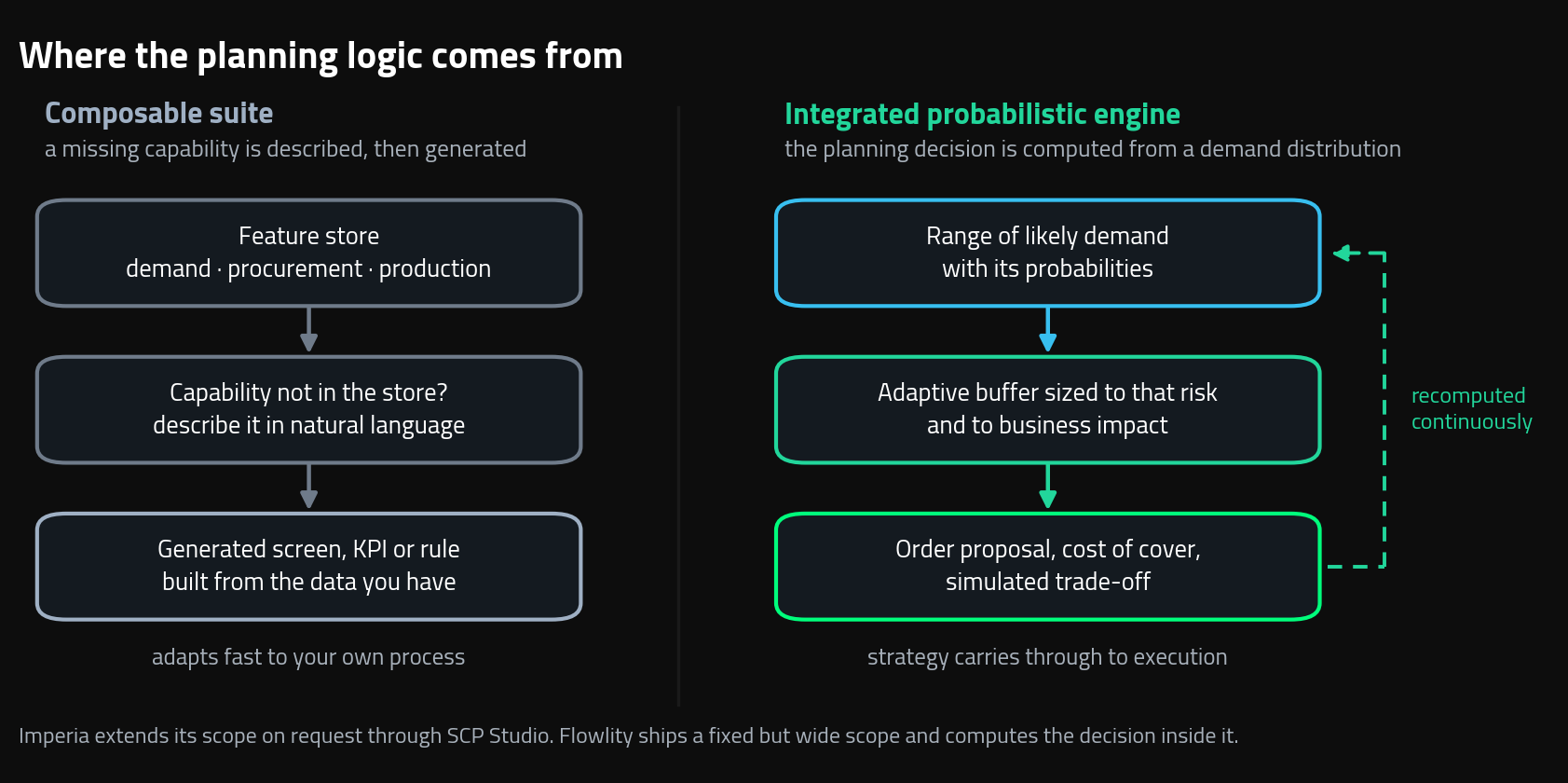
Imperia's published store covers demand, procurement and production, with features such as material requirements planning (MRP), multi-warehouse management, container optimization and financial budget. Anything outside that list is addressed by SCP Studio: a user describes the need in natural language, and the platform generates the interface, the calculation logic and the rules behind it. Imperia's own SCP Studio page promises that "Our native AI can build anything your business needs, adapting and growing with you". For a team with an unusual process, that is a real advantage, and it is fast.
Flowlity takes another route. Inside that scope, the engine produces probabilistic forecasts, sizes adaptive buffers per item, corrects history for past stockouts and cold-starts new products from similar ones.
So the distinction is not breadth against depth, it is where the reasoning lives. Generated functionality gives you the screen, the KPI and the workflow you asked for, computed from the data you have. A probabilistic engine gives you a number that already carries a view on uncertainty: how likely this demand is, how much cover that justifies, what it costs in working capital. That is why Flowlity puts its probabilistic AI engine and its inventory optimization as the core of the product rather than one feature among many.
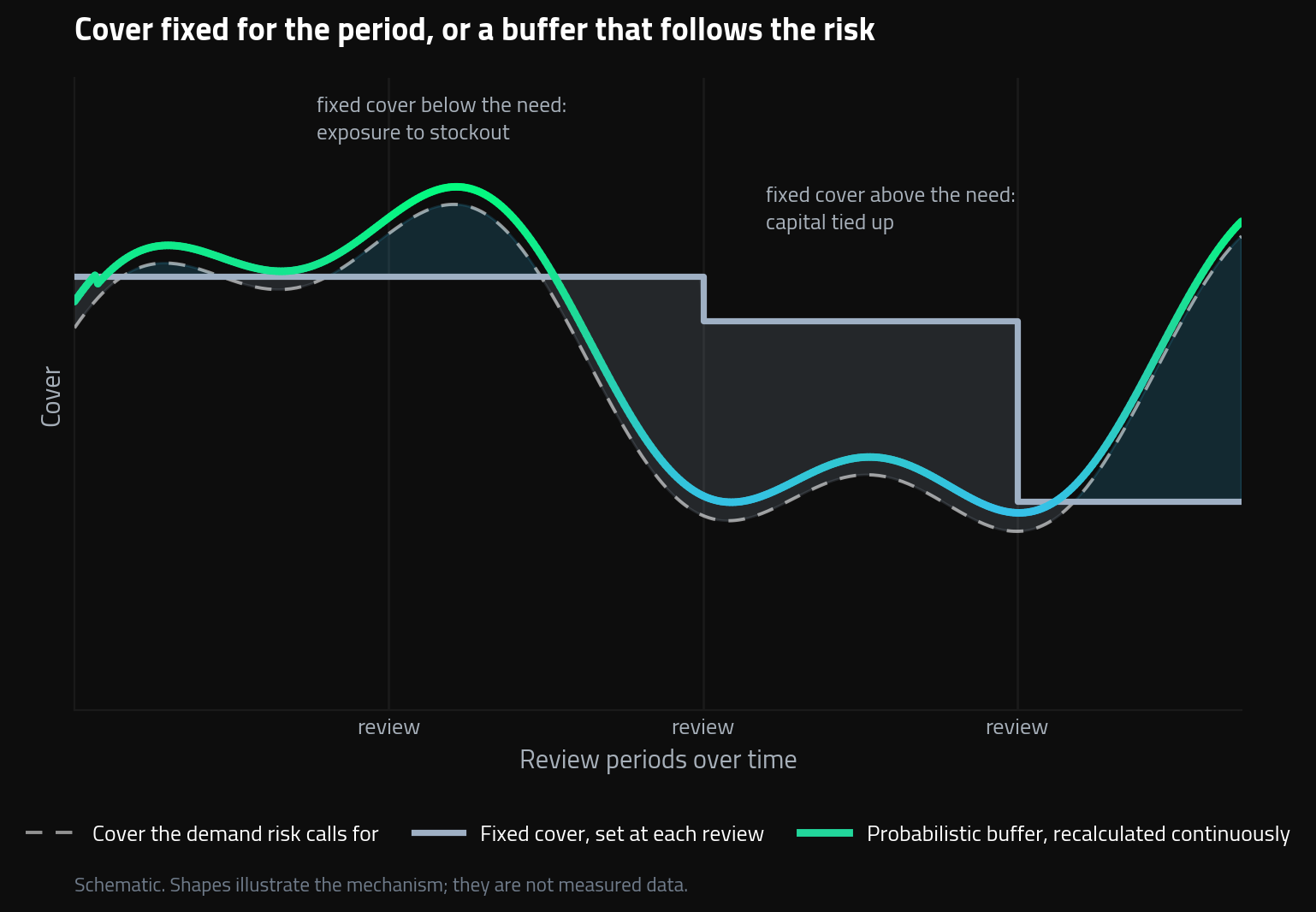
The clearest place to see the difference is how each vendor describes its own forecast. Imperia will "evaluate thousands of calculation strategies and select the most optimal and reliable forecast model", a best-fit approach across statistical and machine-learning methods that settles on one chosen model. Flowlity assigns a likelihood to every demand or lead-time scenario and returns a central case with a low and a high one, so cover can be priced against risk rather than set by a service-level rule applied on top of a single number. Both are legitimate engineering choices. They diverge exactly where demand is volatile and lead times are long.
The forecast is only half of it, and the other half is where buyers underestimate the gap. A forecast becomes a purchase order only after an optimization pass that respects every real sourcing constraint at once: lot sizes and minimum order quantities, but also the awkward ones that decide whether a plan is executable, such as minimum order quantities defined at product-family level, supplier quotas and hub prioritisation across a distribution network. Flowlity's optimization engine solves for those constraints when it proposes orders, which is what makes the output something a planner can send rather than a number they have to rework by hand.
The practical consequence shows up in how the pieces connect. When capabilities are assembled separately, the intelligence linking them, so that a change in demand reshapes the safety buffers and the buffers reshape the orders, has to be specified by someone. In an integrated engine, that chain is automatic: adjust the stock strategy in tactical simulation and tomorrow's ERP orders already reflect it.
Automation, agents and who runs the platform
The operator profile is similar on both sides: demand planners, supply planners and Supply Chain managers, not a dedicated data-science team, and neither platform requires coding. What differs is how much of the work the software takes off their hands, and this is where the two uses of generative AI separate most clearly.
Imperia points its generative AI at the software. SCP Studio turns a described need into a working screen, KPI or rule, so the platform reshapes itself around the process. Flowlity points its AI at the plan. An automation layer keeps inventory policies aligned with live operating conditions and lets routine replenishment run on its own, exception management surfaces only the items that need a human decision instead of asking a planner to scan every line, and Flowlity Co-planner connect through the Model Context Protocol to analyse demand, flag anomalies and prepare replenishment decisions inside the application, where the data, permissions and business rules already sit, rather than exporting anything to a general-purpose chatbot. Imperia publishes no equivalent agent suite today.
Both approaches shrink the manual load. One does it by making the tool easier to shape, the other by making demand planning and replenishment run themselves until something needs attention.
Pricing model, modules and time to deploy
Imperia's commercial model matches its architecture. You start with the core platform, add the features you use and pay for additional users, on a page that states you only pay for what you actually use, with a first-module implementation of around eight weeks. That entry point is accessible for a smaller company, with one thing worth modelling: a bill built from a core licence plus several features plus a user package grows as scope grows, so the comparison to run is total cost at full scope, not at the entry tier. The same applies to time. Eight weeks describes one module, and a programme covering several modules across several countries stacks those cycles.
Flowlity is sold as an integrated platform rather than per feature, with a data-model-first onboarding that includes pre-built data cleaning and automated tuning, and a plug-and-play tier for smaller teams. At the light end, SupplyCaddy, a US foodservice packaging manufacturer planning roughly 250 custom items, went live on Flowlity Lite in two weeks. Most mid-market rollouts of the full platform run a few weeks to a few months, and at Magotteaux each of four production entities went live in roughly three months.
The trade-off is familiar: buy capabilities incrementally, or deploy one connected plan and get the cross-capability intelligence from day one.
Sectors, geographies and reference depth
Geography is where the two profiles separate. Imperia's published success stories are concentrated in Spain, across food and beverage, cosmetics, home and decoration and industrial equipment, with Laboratorios Almond reporting a service level raised to 99%. The company has offices beyond Spain and is expanding across Europe on the back of its Series A. Flowlity is used in more than forty countries across Europe, the Americas and Asia, and its published customer base runs from industrial manufacturers such as Saint-Gobain, Magotteaux and Hutchinson, through wholesale and distribution, to a growing retail roster including JouéClub, Sport 2000, Ravate and Trixie Baby. Multi-site and multi-level bill-of-materials Production Planning is in scope, not replenishment alone.
The size question cuts differently from the geography one. Imperia's entry point suits a small single-country company well, but that ground is contested rather than conceded: Flowlity Lite is built for exactly that buyer, and SupplyCaddy runs 250 custom items on it as a high-growth SMB that had not yet finished its ERP. Where the two profiles genuinely separate is a group planning across borders and sites, where breadth of deployment and independent analyst coverage start to matter.
Validated results from multi-site deployments
Flowlity's published results come from multi-site operations, and both are customer-validated. At Saint-Gobain, a multi-affiliate industrial group, Flowlity raised service level from 95.8% to 97.2%, an average 97% availability across roughly thirty distribution centres, while cutting inventory 9.25%.
Magotteaux tells the other half of the story. The metallurgy manufacturer plans across European and North American markets, and its safety stocks were reviewed twice a year, disconnected from the sales forecast. Once history and demand sat in one engine, the analysis surfaced systematic over-ordering by North American customers that static reorder points had hidden, and stock coverage came down 22%. Retail and distribution references, such as a retail digital-transformation rollout at Camif, extend the same engine beyond industry. Retail is in fact the fastest-growing side of that base, with JouéClub, Sport 2000, Ravate and Trixie Baby planning on the same platform. The pattern is consistent: inventory falls while service holds or improves, because the buffer is repriced against real uncertainty rather than fixed by a rule.
Flowlity vs Imperia comparison table
Which platform fits which company, and what to test
Smaller and single-country companies that want to graduate from spreadsheets at a low entry price, activate exactly the features they need and expand gradually will find Imperia a credible, well-built fit, especially in Spain. Mid-market manufacturers, distributors and retailers that plan across multiple countries and sites, and want AI-native probabilistic planning where strategy, planning and execution move as one, tend to fit Flowlity, with a plug-and-play tier for smaller teams not ready for the full platform.
Whichever way a shortlist leans, one test separates the two models better than any demo. Take a real item with volatile demand and a long lead time, and ask each vendor to show, on your own data, how the recommended cover changes when demand shifts, why it changed, and what that costs in working capital. A generated dashboard and a probabilistic engine both answer the first question. The second and third are where the architectures show. Buyers weighing several vendors can also see how Flowlity compares with other planning platforms.
Choosing between composable breadth and integrated depth
Flowlity vs Imperia is not a contest between a leader and an imitator. It is a choice between two AI-native platforms with different philosophies: Imperia's composable breadth, where anything missing can be generated on request, and Flowlity's integrated depth, where one probabilistic engine keeps repricing risk and carrying strategy through to execution. Teams that want to shape their own screens and workflows at their own pace, especially smaller operations in Spain, have a genuine option in Imperia. Teams that want AI-native probabilistic planning with multi-country, multi-site depth, backed by independent analyst coverage, will find Flowlity the closer fit.
Level up your supply chain with AI.
Get a demo

FAQ
Find everything you need to know right here.
What is Imperia SCM?

Imperia SCM is a Spanish Supply Chain planning software company, founded in 2019 in Valencia. Its SaaS product, Supply Chain Planning, covers demand forecasting, procurement, Production Planning and S&OP governance. Companies start with a core platform and activate features from a published store, and since February 2026 can also generate custom functionality in natural language through SCP Studio, which builds the interface, calculation logic and rules for a described need. Imperia targets small and mid-size manufacturers, distributors and retailers, with its strongest published reference base in Spain, and reports a first-module implementation of around eight weeks.
What is the main difference between Flowlity and Imperia?
It comes down to where a capability comes from. Imperia is composable: a store of features a team activates, plus SCP Studio to generate whatever is missing from a plain-language description. Flowlity is one integrated probabilistic engine, where forecasting, adaptive buffers and strategic simulations feed a single plan and a change in strategy automatically reshapes downstream orders. Imperia's model suits a team that wants to buy capabilities incrementally at an accessible price and shape its own screens and workflows. Flowlity's suits a team that wants the uncertainty modelling and the links between capabilities built in from the start, especially across multiple sites and countries.
How do Flowlity and Imperia use AI in planning?
Both describe themselves as AI-native, and they apply AI at different layers. Imperia uses AI across its planning features and, through SCP Studio, uses generative AI to build functionality: a user describes a KPI, a rule or a view, and the platform produces the working component within minutes. Flowlity's AI is probabilistic at the core of the plan itself: it forecasts a range of likely demand with associated probabilities, sizes adaptive safety buffers from that distribution, corrects history for past stockouts and runs strategic simulations for trade-off decisions, so buffers flex with real uncertainty instead of relying on a fixed safety-stock rule. One accelerates how quickly the software adapts to your process. The other targets the quality of the planning decision itself.
How long does it take to implement Imperia vs Flowlity?
Imperia reports a first-module implementation of around eight weeks, with more features added over time as a company scales. That figure describes one module, so a programme covering several modules across several countries stacks those cycles and runs considerably longer at full scope. Flowlity onboards with a data-model-first approach, pre-built data cleaning and automated tuning. At the light end, SupplyCaddy went live on Flowlity Lite in two weeks; at the heavier end, Magotteaux brought each of four make-to-stock entities live in roughly three months, and most mid-market rollouts sit between the two. Both are far faster than a legacy Advanced Planning System (APS) programme, so the timeline usually comes down to how much scope a company activates rather than either platform being inherently slow.
Is Flowlity a good Imperia alternative?
For mid-market companies that plan across several countries or sites, Flowlity is a strong Imperia alternative, because it delivers AI-native probabilistic planning as one connected engine and carries multi-country references across manufacturing, wholesale and retail. It is also independently covered, as a Gartner Cool Vendor in Supply Chain in 2025 and an Accelerator in the 2026 Nucleus Research SMB Supply Chain Planning Value Matrix. For a smaller, single-country team that mainly wants an affordable, modular start, Imperia remains a credible modern option, particularly in Spain, though Flowlity Lite is built for that buyer too. The better fit depends on scope and geography more than on any single feature, so a shortlist should weigh how many sites and countries the plan has to cover.