.svg)
.svg)
Flowlity vs Colibri S&OP: probabilistic AI versus structured S&OP workflow
Flowlity and Colibri S&OP in brief
Colibri S&OP launched inside the VISEO Group around 2014 and incorporated as a SAS in late 2017. It ships a three-module suite on a multi-tenant Microsoft Azure stack with an Excel companion and REST APIs:
- VISION for demand planning
- FLOW for supply planning
- PILOTE for strategic S&OP
The vendor publicly targets three-month deployments and counts Safran, GGB Bearing Technology, Puressentiel and IZIPIZI as named references, with Toronto and Medellín offices supporting North and Latin American customers.
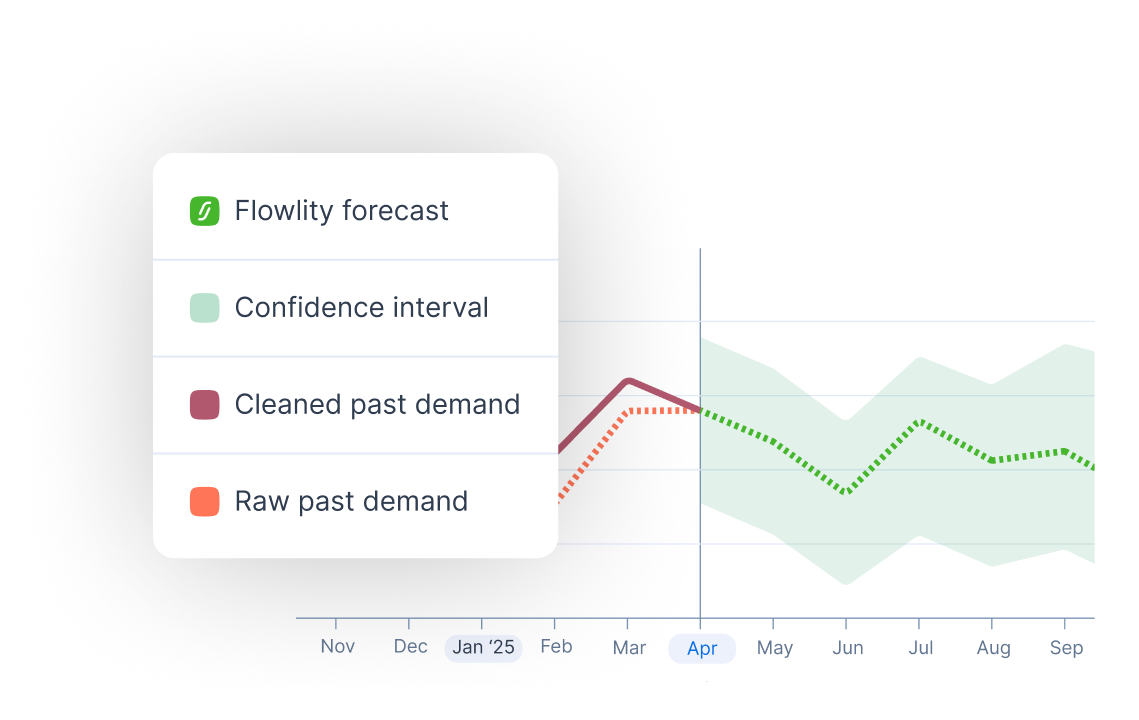
Flowlity is a Paris-headquartered Supply Chain planning platform built on AI from day one rather than retrofitted with it, with the goal of automating and simplifying Supply Chain planning for mid-market teams. The platform produces probabilistic demand distributions, sizes dynamic safety buffers and surfaces decision recommendations inside a planner-friendly UI designed to be used directly by planning teams without specific training. Gartner named Flowlity a Cool Vendor in Supply Chain Planning in August 2025. Flowlity was also recognized as an Accelerator in Nucleus Research’s 2026 SMB SCP Value Matrix, ranked among the most usable and innovative Supply Chain planning platforms for SMBs. A more recent Flowlity Co-planner MCP addition brings conversational and agentic capabilities on top of the core platform.
The standard Flowlity offering covers mid-market complexity, with Flowlity Lite as a plug-and-play option for smaller teams; implementations range from a few weeks to a few months depending on scope, with Plum Living reaching go-live in under two months and Supply Caddy operational in under two weeks on Flowlity Lite. Reference customers include Camif, Plum Living, Sport 2000, Ravate, Magotteaux, Saint-Gobain Sekurit Service, Ukal, Groupe Lemoine, Trixie Baby and EDF, with operations spanning retail, industry, distribution and energy contexts.
Excel replacement or AI-native foundation
Colibri S&OP positions itself as an S&OP platform made simple. The platform replaces a spreadsheet stack with a structured workflow, brings forecasting onto a Microsoft Azure backend, and consolidates sales, demand planners and S&OP leaders inside a single dashboard. The vendor's three-month deployment standard is a meaningful step for a mid-market team migrating off Excel.
The two vendors took different technical paths. Colibri layered structured workflows on top of established statistical forecasting families, an approach well-suited to teams that recognize their existing Excel logic in the tool.
Flowlity took the AI-native route: the platform was built around probabilistic forecasting from day one, with a planner UI designed to be intuitive and user-friendly enough to be used directly by planning teams without specific training. Plum Living reached go-live in under two months on the standard Flowlity offering and cut inventory 21% at go-live, while Supply Caddy turned first forecasts around in under two weeks on Flowlity Lite, the plug-and-play option for smaller teams. Two different technical foundations, each with their fit.
Point forecasts versus probabilistic distributions
Per Colibri's product page, the forecasting engine uses a Best Fit algorithm that selects a closest-fitting statistical model per series, supplemented by external variables, correlation analysis and intelligent clustering. The output is one forecast number per item-period pair, which feeds safety stocks, replenishment plans and the S&OP cycle downstream. Point forecasts produce a single value per period, against which safety stocks compensate for variance; the approach is well-understood and widely deployed across mid-market planning tools.
Flowlity's probabilistic AI engine generates a full demand probability distribution per SKU and per period. A planner facing a high-variance product line sees the median, the upper percentile and the tail risk simultaneously, so inventory targets are sized against the actual demand shape rather than the central estimate alone. Magotteaux, an industrial cement-mining supplier running Flowlity under an S&OP discipline, reduced inventory value by 13%, stock coverage by 22% and stockouts by 8% in parallel. The Sales and Operations Planning approach at Flowlity is designed to deliver this triplet when planning runs against distributions rather than single-point forecasts.
How inventory optimization is handled
Colibri's automation layer offers safety stock optimization, constrained-plan optimization, user-action automation and a learning loop on user behavior. In operational terms, these capabilities translate into enhanced safety stock formulas, rule-based Distribution Requirements Planning (DRP) for constrained capacity, and learned patterns from user actions inside the UI. This approach fits teams that prefer parameter-driven replenishment rules and a familiar S&OP rhythm. The trade-off lies between operational familiarity and the depth of decisions that stochastic methods can unlock.
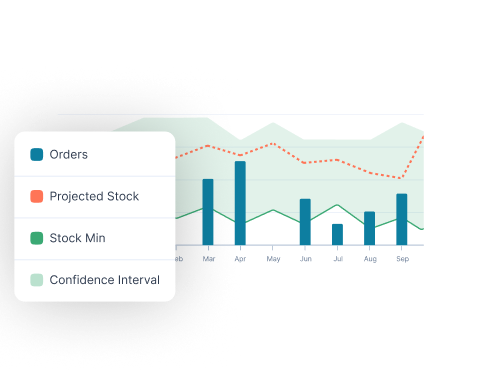
Flowlity's optimization layer sizes inventory buffers dynamically against the full demand probability distribution computed for each SKU, rather than against average lead-time and average demand values. Multi-Echelon Inventory Optimization (MEIO) rebalances stock between warehouses based on cumulative risk across the network, and the embedded DRP logic respects supplier lead-time variability rather than a fixed worst-case. Saint-Gobain Sekurit Service, an automotive glass operation, moved its service level from 95.8% to 97.2% after deploying this pipeline, with inventory down 9.25% in parallel.
Decision cadence: consensus alignment and exception management
The S&OP discipline Colibri reinforces is built on consensus: monthly cycles where demand, supply, finance and sales review forecasts, agree on a plan and commit to a number. Colibri's PILOTE module supports this cadence with scenario simulations, capacity views and financial-impact analysis, all designed to keep functional teams aligned around the same plan.
Flowlity covers the same scenario, capacity and analytics ground through dedicated Strategic Simulation and Dashboards & Analytics modules. Where the two platforms diverge is on how decisions are made between cycles. The Flowlity platform raises a notification when a forecast distribution shifts beyond tolerance, a supplier slips, or stock coverage drops below threshold, and the planner can act on the exception inside the same UI. Camif, a French furniture retailer, absorbed 44% growth, added two warehouses, freed one full-time planner and cut stockouts by six percentage points after deploying this workflow, without scaling the S&OP cadence around new participants.
Flowlity vs Colibri S&OP comparison table
Who each platform fits
Companies running a mature S&OP cadence on Excel that want to consolidate sales, demand and supply planning into a single tool, with a roadmap to AI features over time, will find Colibri S&OP a structured fit. The strengths are an Excel companion, a three-month deployment standard, and a customer base anchored in industrial manufacturing where consensus cycles map onto monthly S&OP rituals. Local support spans Paris, Toronto and Medellín.
Teams that want to upgrade the decision substance, not just the workflow, will find Flowlity built for a different operating model. Mid-market retail, distribution and industrial companies on Flowlity's roster, including Camif, Magotteaux, Saint-Gobain Sekurit Service and Plum Living, share three traits: demand volatility that breaks point forecasts, a planning team small enough that consensus cycles are friction, and a willingness to let a Customer Success Manager pair with planners during onboarding. Companies aiming at a structured S&OP workflow on a familiar UI will find Colibri S&OP. Teams aiming at exception-driven planning over probabilistic AI will find Flowlity. If you want to compare Flowlity against other AI-native entrants rather than workflow tools can continue with how Flowlity and Imperia split composable breadth from integrated depth.
Level up your supply chain with AI.
Get a demo

FAQ
Find everything you need to know right here.
How does Flowlity differ from Colibri S&OP?

Colibri focuses on tactical S&OP and demand planning, often at aggregated levels (family/category), while Flowlity:
- Covers both tactical and operational levels, down to SKU/day-level replenishment.
- Uses advanced AI and probabilistic forecasting to automate and improve accuracy.
- Optimizes inventory directly, with order suggestions and safety stock recommendations.
- Supports wider collaboration, including external partners.
- Aligns execution with strategy, offering one consistent platform from planning to action.
In short: Colibri is ideal for setting up a lightweight S&OP process; Flowlity goes further by aligning high-level planning with real-time execution.
What technology does Colibri S&OP use for forecasting?
Per Colibri's product documentation, the platform runs a Best Fit algorithm that selects a closest-fitting statistical model per demand series, supplemented by external variables, correlation analysis and intelligent clustering. The output is one forecast number per item-period pair, plus safety stock optimization, constrained-plan automation and a conversational AI assistant that, per Colibri's homepage, provides intelligent user support, application control and contextual analysis on top of the planning data. The forecasting layer stays point-based, not probabilistic.
How is Flowlity's AI different from Colibri's?
Flowlity's engine produces a full probability distribution, a dynamic safety buffer recommendation and exception alerts for each Stock Keeping Unit (SKU) and each forecast period, rather than a single point estimate. A planner sees the median demand, the upper percentile, the tail risk and the recommended buffer at the same time, and inventory and replenishment decisions follow directly from that view. The approach earned a Gartner Cool Vendor recognition in 2025.
How long does it take to deploy Flowlity compared to Colibri S&OP?
Colibri S&OP publicly targets three-month deployments for the Vision, Flow and Pilote suite. Flowlity implementations range from a few weeks to a few months depending on scope. Flowlity Lite, the plug-and-play option, reaches first forecasts within hours of signing and is fully operational in under two weeks, as observed at Supply Caddy. The standard Flowlity offering reaches go-live in 3 months at mid-market companies like Plum Living, with inventory dropping 21% at go-live.
Does Flowlity require a Supply Chain expert team to operate?
Flowlity is designed to be operated by in-house Supply Chain planners directly, without a parallel data-science team and without specific training or certification. The UI is built to be user-friendly and intuitive enough for planners to navigate forecasts, recommendations and exceptions without a learning curve typical of script-based or code-first platforms. Each customer is paired with a dedicated Customer Success Manager (CSM) during onboarding and ongoing operations, and the Co-planner MCP agentic layer reduces manual workload on routine decisions.
Which platform fits a company moving off Excel for the first time?
Companies leaving Excel with a stable demand profile and a mature monthly cycle fit Colibri S&OP well: the Excel companion, the three-month deployment standard and the PILOTE module reduce change-management friction. Companies that also want to upgrade decision substance, from rule-based safety stock to probabilistic optimization, fit Flowlity, particularly when volatility or multi-echelon networks make consensus cycles a bottleneck. The choice usually comes down to where the bottleneck lives: process maturity and adoption versus decision quality under uncertainty. Teams with clean data and high variability gain more from probabilistic logic, while teams chasing first-time discipline often gain more from a structured S&OP cadence.