.svg)
Artificial Intelligence
Flowlity’s Intelligent algorithms combine the latest machine learning, ensemble learning, and deep learning algorithms.
Get a Demo.webp)
"Single-point forecasting is no longer the right measure for a supply chain. Probabilistic forecasting gives us far deeper insight."
Koen Ferket
Chief Operating Officer, Trixie Baby

AI for the planners
The first AI-native Supply Chain Forecasting and Planning Solution
Probabilistic forecasts
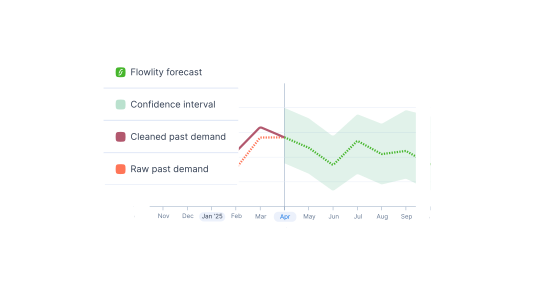
AI and constraints driven recommendations
.svg)
Past events detection
.svg)
Similar product recommendation

Lead time delay forecasting
.svg)

Bring Flowlity's AI into the AI assistant you already use
Going from static to dynamic Supply Chain Planning
Flowlity delivers real-time forecasting and continuous planning—no more sluggish weekly or monthly cycles. Your supply chain stays in sync with live data, updating plans the moment conditions change.
From Legacy Tools to AI-Driven Supply Chain Planning
Forecast
Forecast operations & cleaning
Safety stock
Planning
Workflow


Discover more about AI for Supply Chains
How artificial intelligence is transforming Supply Chain management

Artificial intelligence is no longer a futuristic concept for global supply chains. Today, AI supply chain solutions are actively reshaping how companies forecast demand, optimize inventory levels, manage disruptions, and automate decision-making across end-to-end supply chain operations.As volatility increases, traditional tools based on static rules and spreadsheets struggle to keep up. AI in supply chain management introduces a new paradigm: data-driven, adaptive, and increasingly autonomous planning—designed to support planners, not replace them.
This planner-centric approach is what earned Flowlity its place as a Cool Vendor in the 2025 Gartner Cool Vendor list in Supply Chain Management.
What is AI in the Supply Chain?
AI in the supply chain refers to the use of artificial intelligence, machine learning, and advanced algorithms to analyze vast amounts of data and support better, faster decision-making across supply chain management.
Unlike traditional automation, supply chain AI continuously learns from:
- Historical data
- Real-time data
- Market trends
- Supplier performance
AI systems can detect patterns, anticipate disruptions, and recommend actions with a level of speed and accuracy that manual processes simply cannot match. This shift enables companies to move from reactive planning to AI-driven, proactive supply chain orchestration.
How AI-powered Supply Chain software works in practice
Modern AI supply chain software connects data across the entire ecosystem—ERP systems, suppliers, warehouses, and retailers—and transforms it into actionable intelligence through secure, scalable infrastructure. Learn more about our approach to integration and security in AI supply chain systems to see how data flows safely and seamlessly across your organization.
At its core, AI-powered planning relies on:
- Machine learning models trained on historical and real-time data
- Probabilistic forecasting instead of single-point forecasts
- Optimization algorithms that balance cost, service level, and sustainability
These AI-enabled systems continuously recalculate scenarios, allowing planners to adjust inventory, production, and procurement decisions in near real-time. The result: faster workflows, fewer bottlenecks, and more resilient supply chain networks.
Core AI use cases across the Supply Chain
Demand Forecasting & Inventory Optimization
AI has become a game-changer for demand forecasting. By analyzing multiple signals simultaneously, AI improves forecast accuracy while accounting for uncertainty.
Key benefits include:
- Optimized inventory levels
- Fewer shortages and overstocks
- Cost-effective safety stock strategies
- Improved customer satisfaction
AI-powered forecasting adapts dynamically as demand patterns evolve —especially critical in retail, manufacturing, and healthcare supply chains.
Supply Chain Disruption & Risk Management
Disruptions are now the norm, not the exception. AI strengthens risk management by detecting early warning signals across global supply chains.
AI applications help organizations:
- Identify disruptions before they escalate
- Simulate alternative scenarios
- React faster to supply or demand shocks
By leveraging real-time data, AI-driven systems support resilient decision-making—even in highly volatile environments.
Procurement, suppliers & network optimization
In procurement and sourcing, AI improves visibility and performance across supplier ecosystems.
Use cases include:
- Monitoring supplier performance
- Optimizing procurement decisions
- Identifying bottlenecks across supply chain networks
- Improving delivery times and cost control
For supply chain leaders, this means smarter sourcing strategies and better collaboration with providers and retailers alike.
Automation of planning & decision workflows
Beyond automation, AI agents represent the next evolution of supply chain AI.
AI agents are autonomous, goal-oriented AI tools that:
- Monitor supply chain operations continuously
- Trigger alerts when anomalies or risks appear
- Recommend—or execute—specific actions
Instead of manually reviewing dashboards or managing data entry, planners interact with AI agents that streamline workflows, prioritize exceptions, and orchestrate decisions across planning cycles.This human-in-the-loop approach ensures that AI augments expertise while keeping planners in control.
Business impact of AI in Supply Chain management
When deployed effectively, AI delivers measurable business impact across the organization:
- Lower operating costs through better optimization
- Improved service levels and customer satisfaction
- Faster decision-making with less manual effort
- Greater sustainability through reduced waste and smarter inventory policies
- True end-to-end visibility across supply chain operations
AI adoption also enables teams to focus on high-value strategic decisions rather than repetitive planning tasks—unlocking productivity at scale.
The future of AI Supply Chain: from planning to autopilot
The future of AI in supply chain management is not about replacing humans—it’s about collaboration between planners and intelligent systems.
As AI models mature, supply chains are moving toward:
- More autonomous planning cycles
- AI-driven orchestration across functions
- Adaptive, real-time decision-making
- Stronger, data-driven ecosystems connecting suppliers, retailers, and partners
For organizations embracing this transformation, AI becomes a strategic asset—helping supply chain leaders navigate complexity, uncertainty, and growth with confidence.
AI supply chain solutions are no longer optional. They are becoming the foundation of modern, resilient, and sustainable supply chain management.
At Flowlity, we believe the future belongs to AI-powered, planner-centric supply chains—where technology works in the background, and humans stay in control.
Flowlity Co-planner: interact with your Supply Chain data through AI assistants
With the release of the Flowlity MCP serve "Flowlity Co-planner" , planners can now query stock levels, check forecast accuracy, create promotions, and trigger data imports — directly from Claude, ChatGPT, or Microsoft Copilot. No dashboards, no exports: just a conversation with your planning data.Because MCP is an open standard, the same chat window can also pull from your CRM, ERP, or Excel files, enabling cross-tool workflows that no embedded AI sidebar can match.
FAQ
Find everything you need to know right here.
Is Flowlity’s AI transparent and explainable to users?
Yes – it’s even one of Flowlity’s founding principles: providing AI that can be explained and understood by the humans who use it.
We know that in the Supply Chain, planners and managers need to trust a tool’s recommendations, and this requires understanding the “why.”
Flowlity was therefore designed not to be a black box, but rather an educational tool as well as a decision-making tool.
Concretely, how does this manifest itself?
In the Flowlity interface, each forecast and each recommendation is accompanied by explanatory elements. For example, if Flowlity recommends ordering 500 units of item X for next month, the user sees the breakdown of the expected demand: seasonality, trend, promotional effect, etc., depending on the case.
The tool also displays a confidence interval around the forecast (for example: central forecast 500, with a low scenario at 450 and a high scenario at 560), which gives an idea of the uncertainty. This allows for the justification of calculated safety stocks. Furthermore, Flowlity provides alerts and justifications. For example: "Risk of shortage in 15 days on this product because recent demand exceeds forecasts by 20%." Or: "Inventory reduction proposed on this item, because its turnover rate has decreased over the last 3 months." Technically, Flowlity's AI uses machine learning models (including deep learning), but the complexity is hidden behind a simple interface.
Ensemble learning techniques are also favored, which smooth out predictions and avoid aberrations. And above all, Flowlity sees itself as an assistant: the user always has the option to review a decision. If they don't agree with a recommendation, they can modify it (for example, order a little more or a little less), and the system will take this feedback into account to adjust in the future. It's a virtuous learning loop where the human retains final control. During training, we insist that users understand how the tool works.
Without revealing all the algorithmic details, we explain the main principles (probabilistic forecasting, dynamic buffer calculation, etc.). Very quickly, planners see that the tool reacts as they would in many cases, but better because it reacts more quickly and integrates more data. For example, the tool can detect correlations between products that humans would not have seen – but it will display “30% increase in anticipated demand for product A because it is correlated with that of product B on promotion”. This kind of explanation makes AI tangible.
Finally, on the question of technical transparency, Flowlity is open to discussing its approach:
We publish white papers and articles on our approach (e.g., use of probabilistic vs. deterministic forecasts). Our goal is not to mystify the algorithm, but to make the supply chain smarter collectively. Flowlity users become better at their jobs because they learn from AI feedback. Many report that after a few months, they have a better understanding of their supply chain dynamics (seasonality, impact of promotions, supplier behavior) thanks to the visibility the tool provides.
In short, Flowlity's AI is transparent, explainable, and human-friendly. It's a companion that informs your decisions instead of arbitrarily replacing them. This philosophy increases trust and adoption of the solution within Supply Chain teams.
If you'd like to see in practice how Flowlity presents its recommendations and what explanations are provided, we invite you to book a demo where you can judge the tool's clarity for yourself.
How is AI being used in supply chains?
AI is used to turn large volumes of historical and real-time data into better decisions—like demand forecasting, inventory optimization, replenishment recommendations, disruption detection, and workflow automation across planning, procurement, and logistics.
Will artificial intelligence ever fully take over supply chains?
Not in a way we’d recommend. At Flowlity, we believe the best results come from human intelligence + AI: automate everything that can be automated (data prep, calculations, alerts, routine decisions), so people stay focused on high-value work like strategy, trade-offs, stakeholder alignment, and exception management.
How does AI improve demand forecasting in supply chain management?
AI learns from patterns in sales history, seasonality, promotions, and external signals to generate more accurate demand forecasts than traditional statistical methods. Machine learning models continuously improve as new data arrives, detecting correlations and trends that humans might miss — such as cannibalization effects between products or the impact of weather on purchasing behavior.
This leads to better inventory decisions, fewer stockouts, and reduced excess stock across the Supply Chain. AI also automates time-consuming tasks like data cleaning, anomaly detection, and baseline forecasting, freeing demand planners to focus on exceptions and strategic decisions rather than routine data processing.
How does AI improve supply chain forecasting accuracy?
It improves accuracy by using machine learning models that detect non-obvious patterns, handle noise/outliers, and incorporate real-time updates—so forecasts stay aligned with reality, not last month’s assumptions.
What are the benefits of using AI in supply chain optimization?
AI-driven optimization helps balance service level and cost: fewer stockouts and shortages, lower excess inventory, smarter safety stocks, improved end-to-end visibility, and faster decision-making with less manual work.
How can AI improve supply chain efficiency?
By automating repetitive planning tasks, streamlining workflows, and highlighting only what needs human attention. Teams spend less time on data entry and firefighting—and more time executing the right actions at the right time.
What does probabilistic forecasting change in practice?
A traditional engine takes a single forecast number and computes plans on the assumption it is accurate. Probabilistic forecasting treats demand as a distribution and sizes decisions for the uncertainty interval. When demand is volatile, the gap shows up in stockouts avoided and inventory not parked in a warehouse waiting for a sale.