.svg)
Smarter forecasting with Flowlity's AI demand planning software
Redefine your demand planning. AI automates tasks and highlights exceptions, empowering you to focus on what truly matters.
Get a DemoAI-Enhanced precision in demand forecasting
Unlock unprecedented forecast accuracy and performance with AI. Seamlessly integrate data, track promotion impacts, and project new product sales—effortlessly.
Advanced AI forecasting with internal and external data
.svg)
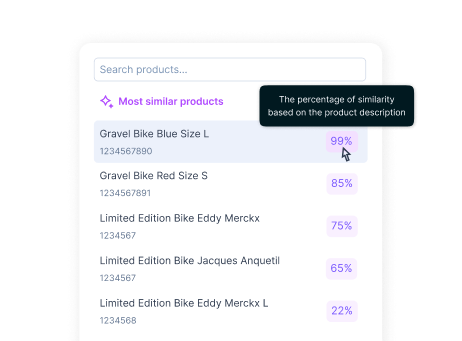
Automatic similar product recommendation
Demand forecasting made simple
Let AI handle the heavy lifting with automated tasks, while you stay in control. Effortless demand planning, with full visibility and the power to adjust anytime.

Automatic history cleaning

New product forecasting

Learn more about Flowlity’s demand forecasting software
A demand forecasting software built for real-world supply chains

Flowlity is a demand forecasting software designed for supply chain teams who need accurate demand forecasting without complexity.
Powered by AI-driven algorithms and machine learning, Flowlity's supply chain solution helps demand planners anticipate future demand, automate daily workflows, and react faster to change — all while staying fully in control.
Unlike spreadsheet-based planning or rigid legacy tools, Flowlity combines demand planning software, real-time data, and external data sources to support smarter, faster supply chain planning decisions. Telenco cut its planning time by 80% after moving from spreadsheets to Flowlity.
Why teams choose Flowlity for demand planning
Improve forecast accuracy without adding complexity
Flowlity continuously improves forecast accuracy by learning from historical sales data, seasonality, pricing effects, and demand variability.
Forecasts are generated at the SKU level while optimizing for maximum accuracy at different hierarchy levels, helping teams trust their numbers and make informed decisions. Accurate demand planning also creates a strong foundation for effective Sales & Operations Planning (S&OP), ensuring better alignment between demand, supply, and financial objectives.
Automate daily workflow, focus on exceptions
Flowlity helps automate time-consuming tasks such as baseline forecasting, anomaly detection, new product introduction forecasting and data preparation. By working by exception, demand planners spend less time on spreadsheets and more time on decision-making and business planning.
Combine internal + external data sources in one model
Flowlity’s AI-powered demand planning software integrates internal data (sales history, prices, promotions) with relevant external data such as macroeconomic indicators (GDP growth, inflation rate, interest rates), market signals (consumer confidence, retail sales trends, commodity prices), labor and income indicators (employment rate, wage growth), and climate data (temperature, precipitation).
Flowlity forecast learns on all products/SKUs at the same time, ensuring the seamless capture of cannibalization effects. This holistic approach improves demand forecasting accuracy and reduces blind spots in volatile environments.
Real-time adjustments with demand sensing
With built-in demand sensing, Flowlity adjusts forecasts using real-time data and short-term signals. This allows supply chain teams to react quickly to demand changes, limit stockouts, and avoid unnecessary excess inventory.
Core features of Flowlity demand planning software
Flowlity delivers advanced demand planning solutions built for modern supply chain management:
- AI-driven demand forecasting using machine learning, advanced deep learning and forecasting models
- Automatic history cleaning to correct anomalies in historical data
- Demand sensing for short-term forecast adjustments
- Promotion and pricing impact forecasting
- New product forecasting using similar product recommendations provided by AI
- Scenario planning and simulations to test “what-if” situations
- Multi-level forecasting across SKUs, categories, and markets and geographies
- Collaborative workflows for validation and alignment
These capabilities streamline planning processes, improve inventory levels, and support better data-driven decisions.
Fast deployment & seamless integration with your ERP
Flowlity integrates easily with your existing ERP and supply chain systems. Data flows are secured, automated, and designed to support real-time forecasting tools without disrupting operations.
Thanks to its SaaS architecture, Flowlity offers fast implementation, minimal IT effort, and a user-friendly interface that accelerates adoption across demand planners and supply chain teams.
Real-world impact: how Flowlity transforms demand planning
Companies across retail, distribution, and manufacturing trust Flowlity to transform their demand planning processes and deliver measurable results.
In retail demand planning, where product assortments are large and promotions are frequent, Flowlity helps teams anticipate demand spikes and seasonal shifts with greater precision. Retailers using Flowlity have significantly improved their forecast accuracy while reducing excess inventory — freeing up working capital without sacrificing service levels. Trixie Baby, a consumer goods brand, adopted Flowlity to replace Excel-driven forecasting and gain clearer visibility into demand deviations and dynamic inventory buffers. As Charlotte D. at Trixie Baby puts it: "It helps us eliminate the Excel-driven approach. Through visual graphs, I can easily deduce deviations and risks and assess dynamic buffer levels."
For distributors managing thousands of SKUs across multiple warehouses, Flowlity’s AI-driven forecasting replaces manual spreadsheet processes with automated, exception-based workflows. Planners focus on the products that matter most, while the system handles the rest.
In manufacturing, Flowlity supports demand driven Supply Chain planning by connecting demand forecasts directly to production and procurement schedules. This reduces lead time uncertainty and helps companies maintain the right inventory buffers without over-investing in safety stock. Saint-Gobain improved forecast accuracy by 15% and lifted service levels from 95.8% to 97.2% after deploying Flowlity’s AI-driven forecasting, translating directly into fewer missed sales and a sharper read on actual demand patterns across their distribution network.
When teams need to evaluate the impact of strategic decisions — such as entering a new market, adjusting pricing, or responding to supply disruptions — Flowlity’s S&OP software scenario planning capabilities let them model different outcomes before committing resources, supporting more confident and collaborative planning processes.
Is Flowlity the right demand planning software for your business?
Flowlity is built for companies that:
- Rely on spreadsheets or fragmented forecasting tools
- Struggle with low forecast accuracy
- Spend too much time cleaning historical data
- Do not have a team of 25 demand planners to run and maintain a traditional collaborative forecasting tool
- Face complex seasonality, promotions, or frequent NPIs
- Need AI-powered, scalable, and user-friendly demand planning software
In other words, Flowlity is built for Supply Chain professionals who need accurate, AI-driven demand forecasts without the complexity and cost of traditional enterprise planning tools.
Demand planners who spend more time cleaning spreadsheets than analyzing exceptions find immediate relief with Flowlity. The platform automates data cleaning, baseline forecasting, and anomaly detection — so even lean planning teams of two or three people can reach the forecast accuracy that previously required dedicated data science resources or a team of 20+ planners running a traditional tool.
Supply Chain Directors and COOs under pressure to reduce inventory costs while protecting service levels gain a platform that delivers measurable improvements within weeks of deployment. Instead of a 12-month implementation project, Flowlity’s SaaS architecture means teams start seeing value fast — with forecasts that continuously improve as the AI learns from your data.
Category Managers in retail and distribution who struggle with promotional forecasting and seasonal complexity benefit from Flowlity’s built-in promotion impact modeling and demand sensing. These capabilities anticipate demand shifts before they affect stock availability — a common pain point for teams managing large, fast-rotating assortments.
Whether you manage 500 or 50,000 SKUs across retail, distribution, or manufacturing, Flowlity adapts to your planning reality. And with the new Flowlity Lite plug-and-play solution, even smaller companies can get started quickly with intelligent demand planning — no data science team required.
FAQ
Find everything you need to know right here.
How does Flowlity manage New Product Introductions (NPIs)?
New product planning is challenging because there is little or no sales history.
Flowlity addresses this challenge by combining human expertise and artificial intelligence.
The solution allows the use of analogous (substitute) products or market data to build an initial demand forecast for a new product. Furthermore, Flowlity provides forecasts even for references with very little history by relying on intelligent algorithms capable of generating trends from partial information.
Concretely, the planner can manually adjust the initial demand assumptions for a new product in Flowlity (for example, based on the launch of a similar product), then the AI refines these forecasts on the fly as soon as the first actual sales data arrives. This hybrid approach ensures that new product launches are taken into account in the supply plan, avoiding stockouts during launch while avoiding overstocking a product whose success is still uncertain.
Flowlity therefore ensures agile planning of new products, highly appreciated in retail as well as in B2B trading where range renewals are frequent.
How do you clean historical data (requests, sales, etc.)?
The quality of historical data is a key factor for reliable forecasts.
Flowlity therefore offers a data cleaning process upstream of modeling.
Concretely, this involves identifying and correcting anomalies in your sales or consumption history. For example, we detect outliers (an exceptional sales spike due to a promotion or an input bug), missing or inconsistent periods, and we handle them appropriately. Cleaning involves several steps: standardizing units and formats, removing or smoothing outliers, and imputing missing data if necessary. As a general approach to data cleaning describes, it involves "identifying and correcting errors, filling in missing values, and putting the data into a consistent format" before analysis.
To do this, Flowlity uses business rules (e.g., ignoring zero sales during a factory shutdown) and algorithms: for example, a statistical method can replace an abnormal peak with a value more representative of the trend.
Furthermore, our demand forecasting AI is capable of integrating external data (market trends, weather, etc.) and detecting breaks in the history to avoid biasing forecasts. In practice, during onboarding, our teams assist you in auditing your history: we identify unreliable data with you (for example, a reference whose coding changed during the year) in order to adjust or exclude it.
This cleansing phase ensures that the forecasting model is working on a sound basis.
Finally, since Flowlity is a learning solution, the cleansing is continuous: over time, the algorithm learns new behaviors and can rule out future anomalies on its own.
You will of course retain control over validating or adjusting any processing of historical data.
Does the solution manage supplier calendars or product launch/end-of-life dates?
Yes, these elements are an integral part of the data taken into account.
Flowlity allows you to configure supplier calendars, i.e., your partners' working/non-working days. For example, if a supplier is closed in August or only delivers from Monday to Thursday, the supply plan will automatically take this into account: no deliveries will be scheduled outside of their time slots.
This avoids unnecessary overstocking or waiting for impossible deliveries.
Similarly, the solution manages product launch and end-of-life dates. Our algorithms integrate the item lifecycle: you can indicate that a new product starts on a certain date (with a possible ramp-up profile) or that an existing reference will be obsolete from a certain date.
Flowlity “tracks product lifecycles (new products, end of life, etc.)” and adapts forecasts and recommendations accordingly.
For example, as an end-of-life approaches, the tool will gradually reduce replenishment proposals and then stop generating them beyond the end date, to avoid unsold items. Conversely, during a launch, Flowlity can use analogies (similar products) or market data to initialize the forecast, so as not to start from scratch.
In short, calendar constraints – whether they come from suppliers or your product cycle – are well managed by Flowlity. This ensures realistic planning aligned with operational realities.
Does Flowlity cover promotional planning and promotion management?
Yes, Flowlity integrates promotion planning into its demand forecasting capabilities.
The solution allows you to take into account increases in demand related to promotional campaigns or price changes, in order to adjust forecasts and inventory accordingly. You can enter upcoming promotional events (sales, promotions, sales operations) so that Flowlity's AI can anticipate increased demand and offer tailored sourcing recommendations.
This allows supply chain managers in retail and B2B distribution to ensure that inventory levels are optimized to meet promotional sales peaks without creating excess inventory after the fact. Flowlity helps avoid stockouts during promotions while limiting post-event overstocks, which improves product availability and customer service rates during these critical periods.
Dive deeper
To find out how Flowlity can adapt to your promotional specifics, please request a personalized demo.
What results can we expect in terms of forecasting, inventory or ROI?
Feedback shows significant gains thanks to Flowlity, both in forecast accuracy and in inventory reduction and service rate improvement.
On average, our customers observe up to 60% inventory reduction and a 50% improvement in product availability by leveraging our solution.
For example, La Redoute was able to reduce its average inventory of packaging consumables by nearly 50% in one year of use. On the forecasting side, Flowlity continuously improves demand reliability.
During a deployment at Saint-Gobain, consumption forecast reliability reached 95.4% (measured by comparing it to actual sales at 3 months) and stockouts decreased by 27.6%, while lowering inventory levels by 11% compared to previous practice. These operational results translate into a rapid ROI:
Thales estimates the return on investment for Flowlity at less than 18 months.
Other clients, such as the Lemoine Group, aimed to reduce their inventory by €1 million and achieved this goal faster than expected, largely thanks to Flowlity. In addition to the figures, the organizational benefits are worth noting: planners save time (fewer emergencies to manage, more reliable planning), which allows them to focus on higher value-added tasks. The service rate improves, increasing customer satisfaction and revenue (fewer sales lost due to stockouts).
In short, with Flowlity, you can expect:
- less inventory,
- fewer stockouts,
- more sales – and therefore financial and operational optimization of your Supply Chain from the first year of use.
Indicators such as inventory turnover, OTIF (On Time In Full), and service level are seeing significant improvement thanks to the increased reliability of forecasts and the continuous optimization of supplies.
How is the Demand Planning and Supply Chain forecasting solution market organized?
Many solutions are available on the market, and can be sorted out by size, key industry served, type of solution or even technology.
We find more relevent to focus on tech matters as performance, expected ROIs and integration conditions vary accordingly.
Legacy ERP-Based Solutions
- Examples: SAP APO (now SAP IBP), Oracle Demantra
- Strengths: Deep integration with enterprise systems
- Weaknesses: Rigid, slow to implement, high total cost of ownership
Cloud-Native & SaaS Platforms
- Examples: Anaplan, o9, Kinaxis, ToolsGroup
- Strengths: Scalable, real-time collaboration, AI/ML-driven forecasts
- Often include digital twins, scenario planning, and real-time analytics
AI-First and Disruptive Startups
- Examples: Flowlity, Lokad, Relex, Netstock, Fivetran + Snowflake (composable stack trend)
- Strengths: Most advanced algorithms on the market, agentic AI, agile deployments, plug-and-play APIs. The product is rapidly evolving with users' needs, to reachfast ROIs and high performance
- Focus on automation, lean planning, and “lights-out” supply chains. Also includes AI agents, scenario planning
What is demand forecasting?
Demand forecasting is the process of estimating future customer demand using historical sales data, market trends, seasonality patterns, and external factors. It helps businesses plan production, manage inventory levels, and allocate resources effectively to meet anticipated demand while avoiding stockouts or excess inventory.
Modern demand forecasting increasingly relies on machine learning and AI algorithms that detect complex patterns — such as promotional effects, weather impacts, and economic indicators — that traditional statistical methods often miss. Accurate demand forecasting forms the foundation of effective Supply Chain planning, enabling companies to make data-driven decisions about procurement, production scheduling, and inventory allocation across their entire product range.
What is the difference between demand forecasting and demand planning?
Demand forecasting is one component of demand planning. It focuses on projecting future sales volumes using historical data, statistical models, and increasingly, machine learning algorithms that detect patterns like seasonality, promotional effects, and trend shifts.
Demand planning takes these forecasts and turns them into concrete action. It involves adjusting forecasts based on business knowledge, coordinating with procurement and production teams, and building consensus through processes like Sales and Operations Planning. In simple terms, demand forecasting answers "how much will we sell?" while demand planning answers "how do we prepare the Supply Chain to meet that demand?"
What is demand planning?
Demand planning is a cross-functional process that goes beyond simple forecasting. It combines statistical demand forecasts with market intelligence, sales input, and business context to build actionable plans that align procurement, production, and inventory with expected customer demand.
The goal is to have the right products, in the right quantities, at the right time — meeting customer needs while optimizing working capital and service levels. Effective demand planning requires collaboration between sales, marketing, and Supply Chain teams, supported by demand planning software that automates data processing and delivers reliable, AI-driven forecasts.
How does AI improve demand forecasting in supply chain management?
AI learns from patterns in sales history, seasonality, promotions, and external signals to generate more accurate demand forecasts than traditional statistical methods. Machine learning models continuously improve as new data arrives, detecting correlations and trends that humans might miss — such as cannibalization effects between products or the impact of weather on purchasing behavior.
This leads to better inventory decisions, fewer stockouts, and reduced excess stock across the Supply Chain. AI also automates time-consuming tasks like data cleaning, anomaly detection, and baseline forecasting, freeing demand planners to focus on exceptions and strategic decisions rather than routine data processing.
Do ecommerce brands need demand planning software?
Ecommerce brands with demand volatility, multiple sales channels, or large SKU assortments benefit significantly from demand planning software. Accurate forecasting and inventory optimization help reduce stockouts, excess inventory, and manual planning effort across the entire product catalog.
For ecommerce specifically, demand planning software addresses challenges like flash sales, seasonal peaks, marketplace channel variability, and rapid product turnover that make manual forecasting unreliable. AI-driven tools can process signals from multiple sales channels simultaneously, helping brands maintain optimal stock levels without over-investing in safety stock — especially important for businesses scaling their catalog beyond what a small planning team can manage manually.