.svg)
Gain transparency with a Supply Chain collaboration platform
Built to collaborate across teams, suppliers, and customers — breaking silos at every level.
Get a Demo.webp)

Real-time collaboration with suppliers & customers
Empower your partners with Flowlity's portal for live forecasts and order interactions. Enhance transparency and collaboration, replacing email with instant updates.
Supplier portals
.svg)
Instant monitoring

Real-time collaboration & transparency
.svg)
Joint planning
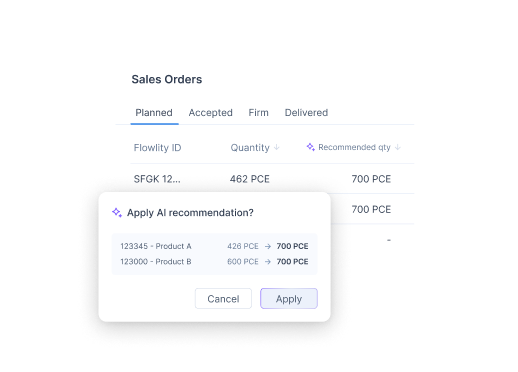
Collaboration made easy
Sneak peak on our collaboration portals to build perfect plans and forecast synchronized with your suppliers.
.svg)
VMI & co-planning
.svg)
Real-time alerts
.svg)
Business intelligence dashboards
.svg)
Integrated workflow management
Flowlity has truly redefined how we operate. We've gained substantial time, allowing us to focus our time on initiatives that truly matter.

From fragmented supplier exchanges to a real-time supply chain collaboration platform


More about Flowlity’s supplier collaboration portal
A supply chain collaboration software built for faster, real-time decisions

Flowlity’s supplier collaboration portal is designed to bring real-time collaboration, transparency, and structure to supply chain planning. Built as a true supply chain collaboration software, it enables companies to collaborate efficiently with suppliers and customers, align decisions faster, and act proactively across complex and global supply chains.
Break silos across teams, suppliers and customers
Flowlity's Supply Chain tool breaks down organizational and partner silos by connecting internal teams, suppliers, and customers on a single collaboration platform. Instead of fragmented emails, spreadsheets, and disconnected tools, all stakeholders work with the same data, the same workflows, and the same objectives. This shared foundation strengthens supplier collaboration, improves alignment across planning, procurement, and operations, and supports evolving business needs. Camif made this concrete: by replacing fragmented exchanges with shared workflows between commercial, planning and supply teams, the company generated +€40k in additional annual revenue from prevented stockouts, freed the equivalent of 1 full-time planner (1,760 hours per year), and dropped stockouts by 6 points.
Real-time collaboration to act faster on supply chain issues
With real-time collaboration and real-time visibility, planners can identify deviations early and respond before they turn into major issues. Changes in demand, supply constraints, or lead times are immediately visible, enabling faster decision-making and more effective responses to disruptions and market volatility. Flowlity helps teams move from reactive firefighting to proactive supply chain management.
What you can do with Flowlity’s Collaborative Planning portal
Real-time collaboration with suppliers and customers
Flowlity enables continuous collaboration with suppliers and customers through shared forecasts, order interactions, and contextual communication. Planning teams gain supply chain visibility across the network while partners stay aligned on priorities, constraints, and commitments—without heavy processes or manual follow-ups.
Supplier portals for forecast and order collaboration
Through dedicated supplier portals, Flowlity allows companies to instantly share forecasts, collect feedback, and collaborate on purchase orders. Suppliers access relevant information on demand, improving forecast collaboration, reducing misunderstandings, and strengthening long-term supplier relationships. This approach supports scalable collaboration across multiple providers and supply networks. Flowlity connects collaborative forecasting with execution through its Supply Order Management solution, ensuring full visibility from forecast to confirmed supply orders.
Joint planning and co-decision with partners
Flowlity supports joint planning by enabling planners and partners to co-build scenarios and align decisions together. Instead of sequential handoffs, teams collaborate in real time to optimize supply chain planning, reduce bottlenecks, and streamline execution. This shared planning process improves forecast accuracy and supports smoother coordination across the end-to-end supply chain.
CPFR-ready collaboration for shared forecasting and replenishment
Make CPFR practical with real-time collaboration
Flowlity makes CPFR supply chain processes operational by embedding collaboration directly into planning workflows. Rather than applying CPFR as a theoretical framework, teams use Flowlity to collaborate continuously on assumptions, constraints, and priorities—supported by real-time visibility and structured workflows. Flowlity complements collaborative planning with Strategic supply chain simulations, enabling teams to model disruptions, demand shifts, and sourcing constraints before they impact performance.
Shared forecasting and replenishment, powered by collaboration
With collaborative planning, forecasting and replenishment (CPFR), Flowlity enables shared demand forecasting, aligned replenishment decisions, and transparent execution. This collaborative forecasting and replenishment approach improves CPFR accuracy, reduces stockouts, and supports more resilient inventory and supply planning.
VMI, co-planning and inventory collaboration in real time
Vendor-managed inventory and inventory collaboration
Flowlity supports vendor-managed inventory (VMI) and advanced inventory collaboration by sharing targets, constraints, and inventory levels with partners. This collaborative approach improves inventory management, helps balance service and working capital, and strengthens coordination with suppliers and contract manufacturers. For companies needing deeper material planning capabilities, Flowlity also integrates advanced MRP planning software to synchronize components, raw materials, and supply constraints.
At Ukal, this VMI logic translated directly into the numbers: structured supplier collaboration cut inventory by 16% and helped the company reach its €1M working capital reduction target — without sacrificing on-shelf availability.
Real-time dashboards for inventory and supply performance
Integrated dashboards provide real-time insights into inventory performance, risks, and exceptions. By combining collaboration with advanced analytics, teams can monitor KPIs, anticipate shortages, and support better inventory optimization across the product lifecycle.
Integrated workflows, alerts and decision support
Integrated workflow management between partners
Flowlity includes integrated workflow management to support validations, adjustments, and structured collaboration between partners. These workflows replace informal communication with clear processes, improving accountability and reducing delays across supply chain planning and execution.
Real-time alerts and proactive issue management
With real-time alerts, Flowlity automatically highlights risks such as forecast deviations, supply constraints, or potential stockouts. Teams receive actionable notifications, enabling faster resolution, fewer bottlenecks, and improved performance across complex and multi-tier supply chains. On the distribution side, Ravate lifted its service level by 6.3 points by replacing reactive replenishment cycles with alert-driven, real-time coordination — proof that proactive alerts directly move the needle on availability.
Who Flowlity's Supply Chain collaboration platform is built for
Supply Chain collaboration software becomes essential when the volume of supplier and customer exchanges outgrows what email and Excel can handle — and when misalignment starts translating directly into stockouts, overstocks or penalty costs. Flowlity is built for procurement directors and purchasing managers running portfolios of strategic suppliers where forecast accuracy, lead time reliability and on-time delivery directly drive service level. It fits S&OP managers and demand planners in manufacturing and distribution who need suppliers aligned on rolling forecasts instead of spot orders, and VMI analysts coordinating vendor-managed inventory across multiple sites. And it supports Supply Chain directors in wholesale and retail who see collaboration as the next performance lever once internal planning is under control.
The common pain points: fragmented communication across emails, spreadsheets and supplier portals that don't talk to each other; forecasts shared with suppliers once a month and already stale when they arrive; manual oversight of supplier performance that consumes hours every week; firefighting between procurement and suppliers when a lead time changes. A real Supply Chain collaboration platform replaces that firefighting with continuous, structured coordination.
Why Flowlity for supply chain collaboration software
Collaboration made easy for planners and partners
Flowlity is designed for planners but built to be adopted by partners. With intuitive interfaces and simple onboarding, suppliers and customers can collaborate without heavy training or IT projects—making collaboration effective at scale.
Transparency, agility and faster decisions
By combining ai-powered planning, collaboration tools, and shared visibility, Flowlity helps organizations improve agility, respond faster to disruptions, and make better decisions across procurement, planning, and execution. This is especially critical for companies operating in the wholesale sector, where tight coordination with suppliers and customers is essential to balance availability and working capital.
A scalable collaboration solution, fast to deploy
Flowlity is a scalable collaboration solution that integrates with existing ERP systems and grows with your supply chain. Fast deployment, flexible configuration, and seamless collaboration enable rapid time-to-value—without compromising control, governance, or sustainability objectives.
FAQ
Find everything you need to know right here.
How does Flowlity facilitate collaboration between suppliers and customers in the Supply Chain?
Flowlity was designed as a collaborative platform connecting the various links in the supply chain, particularly between a client (manufacturer, distributor) and its suppliers.
In concrete terms, the solution can act as a trusted third party where suppliers and customers share information transparently.
For example, suppliers can access (via a portal or dedicated interface) consumption forecasts or supply needs that concern them, and thus better anticipate upcoming orders. Similarly, Flowlity allows suppliers to track performance (on-time performance, reliability) and trigger alerts in the event of potential delays.
This shared visibility helps quickly adjust plans: if a supplier reports a capacity constraint or a longer lead time, Flowlity readjusts recommendations to avoid a disruption downstream.
In addition, the platform offers the possibility of collaborating on supply plans: online validation of order proposals, exchange of comments, jointly approved modifications, etc. This eliminates the need for multiple email and Excel file exchanges and makes supplier-customer relationships more reliable. For both B2B distribution companies and manufacturers, this improved collaboration means fewer unforeseen events and a more agile supply chain.
Because Flowlity is a cloud-based solution, your partners can easily connect—under the control of your administrators—to share this data.
Contact us to learn how to implement supplier collaboration on Flowlity in your context.
How to implement effective collaborative planning?
Effective collaborative planning starts by identifying the partners whose performance directly impacts yours — key suppliers, strategic customers, and downstream distributors. Once those partners are mapped, align with them on a small set of shared KPIs such as service level, stock coverage, and margin contribution, so every conversation is anchored in the same metrics.
The next step is putting a cloud platform in place that allows continuous data exchange rather than monthly spreadsheet swaps. This is where frameworks like CPFR (Collaborative Planning, Forecasting, and Replenishment) or VMI (Vendor Managed Inventory) become practical to automate: alerts, order confirmations, and forecast updates flow between partners in near real time.
Finally, governance matters as much as tooling — schedule regular joint reviews to measure results, adjust playbooks, and feed improvements back into the process.
Why implement collaborative planning with suppliers?
Collaborative planning with suppliers delivers measurable benefits across the Supply Chain. When partners share forecasts, inventory positions, and operational constraints early, decisions downstream become faster and more aligned — and the structural weaknesses of uncoordinated planning start to disappear.
The benefits of implementing a collaborative planning tool include:
• End-to-end visibility of needs;
• Reduction of stockouts and overstocks;
• Optimization of transportation and production costs;
• Strengthening strategic relationships through shared objectives and improved time-to-market.
Beyond the list above, collaboration reshapes the buyer–supplier relationship itself: shared objectives replace transactional pressure, and joint performance reviews turn the Supply Chain into a continuous improvement loop rather than a source of recurring friction. In volatile markets, that discipline is what protects service levels without inflating safety stock at every node.
What are the best practices for successful collaborative planning?
Before any process or tool decision, remember that collaborative planning only works when partners genuinely treat the Supply Chain as a shared system rather than a series of handoffs. Once that mindset is in place, a handful of concrete practices separate mature programs from those that drift back into spreadsheets.
Successful collaborative planning relies on a few essential best practices that ensure alignment, transparency, and smooth execution across partners
- Build trust and transparency (data sharing + clear rules);
- Standardize exchange formats (calendar, units, KPIs);
- Use common KPIs to measure collaborative performance;
- Invest in real-time cloud platforms for continuous plan updates;
- Regularly review agreements and adjust processes.
These practices reinforce each other. Trust enables data sharing, standardization makes the data comparable, common KPIs keep everyone focused on the same outcomes, and real-time platforms turn collaboration into an ongoing routine rather than a quarterly meeting. Periodic reviews then close the loop, adjusting thresholds and governance as volumes, partners, or priorities evolve.
What tools can be used to improve collaboration with suppliers?
Supplier collaboration tooling has matured significantly in recent years, moving well beyond email and shared spreadsheets. The most effective solutions turn the Supply Chain into a single, shared workspace rather than a chain of disconnected systems, so each partner sees exactly what they need to act on.
The most sought-after solutions offer:
- Supplier/customer portal to share forecasts, orders, and confirmations in real time;
- Integrated BI dashboards;
- Alert management (delays, shortages);
- API integration with ERP/WMS to limit IT load.
- Software such as Flowlity facilitates these exchanges while guaranteeing data security.
Taken together, these capabilities reduce the latency between a change at one end of the Supply Chain and a coordinated response at the other. The right combination depends on partner maturity and data readiness, but the direction of travel is consistent: real-time visibility, automation of routine exchanges, and exception-based workflows that focus human attention where it adds the most value.
What is collaborative supply chain planning?
At its core, collaborative Supply Chain planning is about replacing fragmented local views with a single shared plan that every partner agrees to and acts on. Instead of each actor optimizing its own slice of the flow in isolation, information — and responsibility — flow across organizational boundaries.
Collaborative planning involves sharing forecasts, inventory, and constraints in real time between customers, distributors, and suppliers in order to make joint decisions (quantities, dates, priorities) and reduce the “bullwhip” effect.
The operational payoff is immediate: lower total inventory across the network, fewer stockouts at the end customer, and far less firefighting when demand shifts. It also creates a more resilient Supply Chain, because disruptions are detected and absorbed closer to the source instead of cascading through the network with amplified effects.
What is supply chain collaboration and why is it important?
Supply Chain collaboration refers to the close cooperation between the different actors in a Supply Chain — manufacturers, distributors, suppliers, and retailers — based on shared information and aligned objectives. Rather than each party optimizing its own slice of the flow, collaboration treats the Supply Chain as a single end-to-end system.
It matters because the cost of information silos is measured directly in working capital and missed sales. When partners don't share forecasts or inventory positions, each one inflates safety stock, reacts late to demand shifts, and amplifies variability upstream.
Collaboration reduces those silos, improves joint forecast accuracy, shortens lead times, and — critically — helps every partner respond faster to demand changes or disruptions. In volatile markets, that responsiveness is what protects service levels without inflating inventory across the network.