.svg)
.svg)
Nucleus ranks Flowlity among most usable SMB SCP software
Here is the counter-conventional truth the 2026 matrix makes hard to ignore: for a small and midsize business (SMB), the most advanced SMB Supply Chain planning software is rarely the one with the longest feature list. It is the one a lean team will actually use, week after week, to make faster and more confident decisions. Nucleus Research's new SMB Supply Chain Planning (SCP) Technology Value Matrix, published in July 2026, puts that idea at the center of how it ranks vendors. It is also the first time Flowlity appears in the report, entering as an Accelerator.
What the 2026 SMB SCP Value Matrix actually measures
Nucleus plots each vendor on two axes. One is functionality: the breadth and depth of planning capabilities. The other is usability: how easily a team adopts the tool and turns it into value. Those axes create four quadrants. Leaders score high on both. Experts offer deep functionality but are steeper to adopt. Accelerators are highly usable and fast to deploy, with functionality that is still expanding. Core Providers are building on both dimensions.
The important change this year is that Nucleus split the SMB market out from the enterprise one. The logic is simple: a vendor serving companies under $1B in revenue should be judged against the resources, operating models and cost constraints of those customers, not against the requirements of the largest global enterprises. As Charles Brennan, senior analyst at Nucleus Research, put it in the announcement, "SMBs have less margin for planning errors, making decision speed and financial visibility critical to technology value." Across the four quadrants, the 2026 report evaluates 17 vendors.
Nucleus Research's official 2026 SMB SCP Technology Value Matrix, showing Flowlity in the Accelerator quadrant, shared on LinkedIn.
The market shift the matrix captures: from reactive to AI-native planning
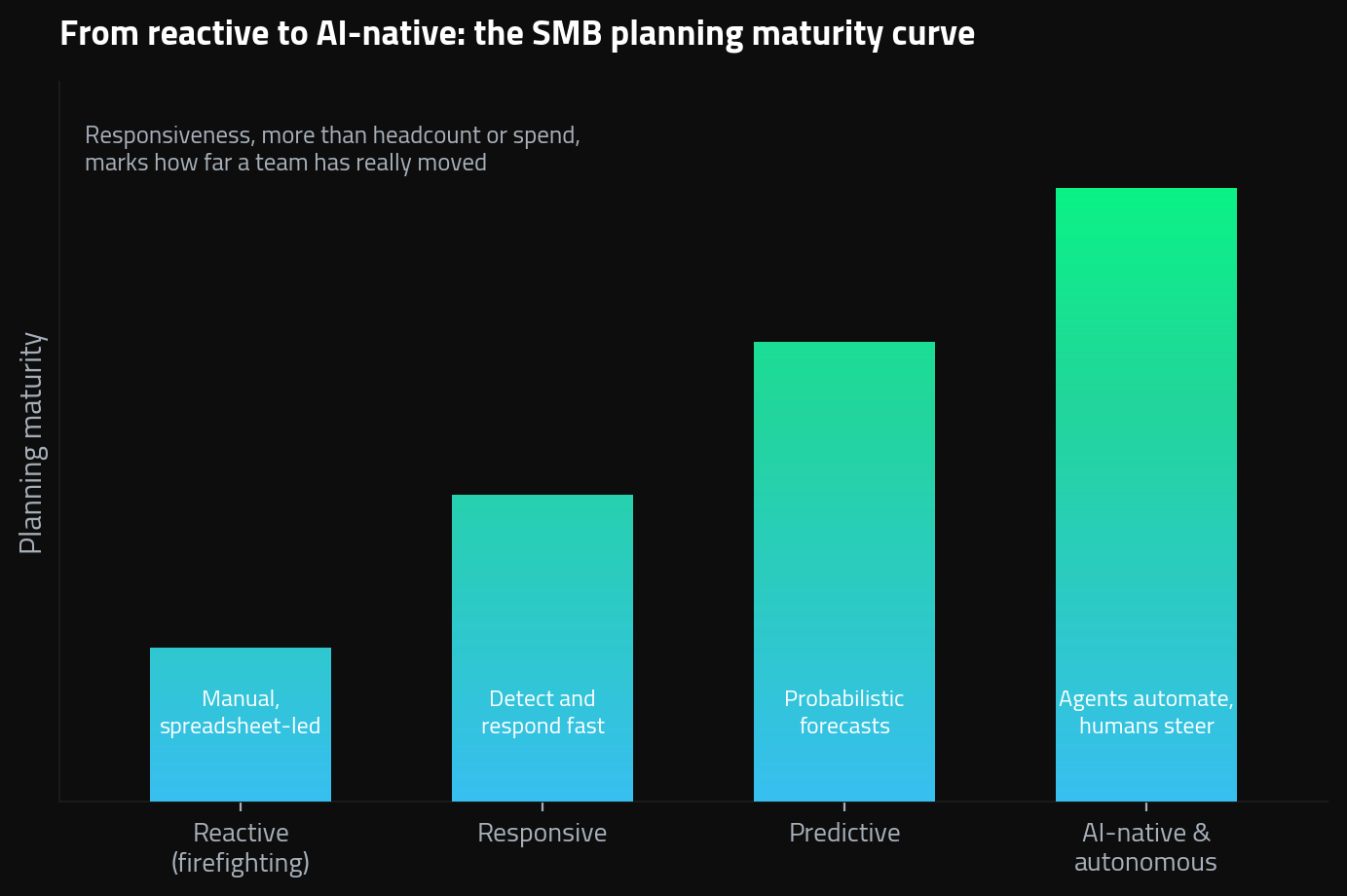
Read past the quadrants and the report is really describing a shift. Capabilities once reserved for large enterprises, probabilistic forecasting, scenario planning, external-signal ingestion, are becoming accessible to smaller teams through cloud delivery and focused implementation. That is why the SMB segment now deserves its own map.
Artificial intelligence in Supply Chain planning is at the center of the shift, but its role is changing. It is moving from forecasting support toward practical workflow assistance and faster decisions, with assistants and agents applied to demand analysis, replenishment, anomaly detection and scenario creation. Agentic AI is prominent in vendor messaging, yet the report is clear that governance and explainability are the more meaningful differentiators. A lean team will not hand consequential purchasing or inventory decisions to a black box; it needs to know why a forecast changed and to keep the ability to override. Alongside this, scenario planning and simulation are becoming core requirements, planning is connecting more tightly to execution, and external signals matter more as historical demand alone proves insufficient.
Why usability and total cost of ownership decide value for SMBs
Smaller organizations face many of the same pressures as large ones with a fraction of the resources. Planning responsibilities overlap, critical knowledge sits with a few people, and spreadsheets often remain central to demand, inventory and supply decisions. In our own conversations with mid-market planners, the same picture keeps coming up: a demand planner at a mid-market company recently described running everything in Excel, where getting an accurate forecast was difficult and inventory planning was entirely manual and, in their words, cumbersome. That is the reality most SMB buyers are trying to leave behind when they look to move Supply Planning beyond spreadsheets and legacy ERP modules.
This is why total cost of ownership (TCO) weighs so heavily in the SMB matrix. Buyers evaluate subscription price alongside implementation, integration, training, support and the internal effort needed to maintain the platform. A cheaper tool can deliver weaker return on investment (ROI) if it demands constant manual work, while a more capable one is hard to justify without an implementation model suited to a smaller team. Usability, not feature count, becomes the clearest measure of whether a platform will actually raise planning maturity, which is exactly why choosing Supply Chain software for a small business is a different exercise from buying enterprise suites.
Where Flowlity fits: an Accelerator built on probabilistic, AI-native planning
Flowlity enters the 2026 matrix as an Accelerator, in the high-usability zone, recognized for ease of deployment and quick adoption with less complexity. A new entrant rarely lands in the top spot on day one, and the Accelerator position reflects exactly what Flowlity set out to be, among the most usable options on the market, while its functionality footprint keeps broadening. The goal from here is to move the dot up and to the right.
What sits underneath that usability is a genuinely AI-native platform. Flowlity is built on probabilistic forecasting, producing demand and lead-time ranges rather than a single deterministic number, so teams plan around risk instead of false precision. Its Predictive Engine, an AI meta-model, orchestrates forecasting, replenishment, promotion and anomaly detection across time horizons and product clusters. Tactical simulations let planners weigh trade-offs across service level, inventory and working capital before committing to a plan, and an automation layer keeps inventory policies aligned with real operating conditions. The platform connects to ERP (enterprise resource planning) systems such as SAP, Oracle, Microsoft Dynamics, Sage, Cegid, Odoo, NetSuite and Infor, and ingests external signals like point of sale (POS) data, extending naturally into collaborative, multi-tier planning.
One detail deserves emphasis, because it maps directly onto a concern the report raises. Nucleus notes that SMB AI adoption is fragmented, with users routinely moving data into general-purpose tools such as ChatGPT and Claude to analyze it, which raises real questions about security and governance. Flowlity connects its AI agents through the Model Context Protocol (MCP) to those same large language models, but brings the intelligence into the application where the data, permissions and business rules already live, rather than exporting sensitive data out to a chatbot. That is the safer and more useful version of the behavior buyers are already reaching for. Flowlity is also a Gartner Cool Vendor in Supply Chain Planning (2025) and is ISO 27001 certified.
That usability translates into fast adoption. SupplyCaddy, a fast-growing US foodservice packaging manufacturer, went live on Flowlity Lite in about 2 weeks and now plans roughly 250 custom products with a single team member, work that previously took 3 to 4 people, all without a finished ERP in place.
What to look for when choosing SMB Supply Chain planning software
A value matrix is a map, not a shortlist. The quadrant tells you a vendor's profile, but the right choice depends on your own maturity and constraints. A few questions cut through the noise.
- How usable is the tool for a non-specialist planner who owns several functions at once?
- What is the true TCO once implementation, integration and support are counted?
- Is the AI explainable, so you can see why a forecast or recommendation changed and override it when needed?
- Does it connect to your ERP and external data without a large technical project?
- And how fast is time-to-value?
For a mid-market team without a large integrated business planning (IBP) function, an AI-native Accelerator that is fast to adopt often delivers more real value than a feature-heavy Expert that needs a data-science team to run. If you are early in a selection process, it helps to compare the leading AI Supply Chain planning platforms side by side, work through how to choose Supply Chain management software against your own criteria, and look specifically at demand planning software built for SMBs rather than scaled-down enterprise tools.
A new entrant with room to move up the matrix
The 2026 SMB SCP Value Matrix is a useful signal for any smaller team weighing its options: advanced planning is now within reach, and the vendors that win here will be the ones that make it usable, affordable to own and easy to trust. It is worth putting the placement in context: no vendor enters a value matrix in the top-right on its first appearance. Being recognized as an Accelerator the very first time Flowlity is evaluated is a strong result, and it reflects a deliberate choice to lead on usability and fast time-to-value first. From here, the trajectory points up and to the right as the functionality footprint keeps broadening.
Level up your supply chain with AI.
Get a demo


FAQ
Find everything you need to know right here.
What is the Nucleus Research SMB SCP Technology Value Matrix?

It is an annual analyst report from Nucleus Research that evaluates Supply Chain planning vendors serving small and midsize businesses. Nucleus plots each vendor on two axes, functionality and usability, and places them in one of four quadrants: Leader, Expert, Accelerator or Core Provider. The 2026 edition, published in July 2026, covers 17 vendors and focuses on how accessible, usable and cost-effective advanced planning has become for smaller teams.
How is the SMB SCP Value Matrix different from the enterprise version?
Nucleus publishes separate SMB and enterprise Supply Chain planning matrices. The split exists because a vendor serving companies under $1B in revenue should be judged against the resources, operating models and cost constraints of those customers, not against the needs of the largest global enterprises. The SMB matrix weights usability, total cost of ownership, fast implementation and support more heavily, because lean teams have less room for error and less appetite for long, complex deployments.
What does it mean to be an Accelerator in the Nucleus Research matrix?
An Accelerator sits in the high-usability zone of the matrix, recognized for ease of deployment and quick adoption with less complexity, while its functionality footprint is still expanding. For an SMB buyer, that profile usually signals fast time-to-value: a platform a non-specialist planner can use productively without a large implementation project. It is a strong position for a newer, focused vendor, with clear room to broaden functionality and move further up and to the right over time.
Which vendors are included in the 2026 SMB SCP Value Matrix?
The 2026 report covers 17 vendors across four quadrants. Nucleus named as Leaders Eyelit Technologies, GAINS, Infor, John Galt Solutions, RELEX Solutions and Wolters Kluwer CCH Tagetik. The Experts are Anaplan, ketteQ and Logility. The Accelerators are Blue Ridge, Board International and Flowlity. The Core Providers are AspenTech, Netstock, sedApta, Slimstock and Solvoyo. It was Flowlity's first inclusion in the report.