.svg)
Slash stockouts & overstocks with Flowlity's inventory optimization software
Achieve optimal inventory levels with Flowlity's advanced tools: probabilistic forecasting, lead time forecasting, dynamic safety stocks and inventory strategy simulations.
Get a Demo.webp)

Award-winning dynamic AI inventory optimization
Benefit from 5 years of dedicated research. Our unique algorithm slashes inventory value and minimizes stock shortages.
Dynamic probabilistic inventory management
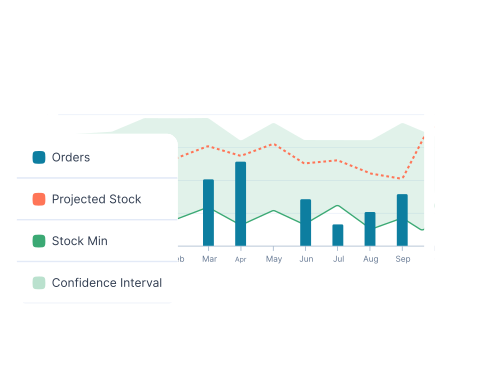
Automated stock adjustments

Inventory simulations
.svg)
Inventory Policy Control



Tailored inventory optimization for all your products
Gain complete control and access a full suite of tools to define the optimal inventory strategy for your business objectives. Whether dealing with slow-moving or fast-moving items, we provide tailored strategies to suit every product.

Dynamic Inventory Optimization
.svg)
Strategy Simulations
.svg)
Perishability Optimization

Inventory Visibility

Granular and Aggregated Strategy Control
How Flowlity’s inventory optimization software works across the entire Supply Chain
End-to-end inventory optimization powered by data and ERP intelligence
A modern inventory optimization layer that enhances your existing ERP

Flowlity is an inventory optimization software designed to help companies maintain the right inventory across the entire Supply Chain, from raw materials and suppliers to distribution centers and final points of sale. Rather than relying on static rules or spreadsheets, Flowlity acts as a modern planning software layer that enhances existing ERP systems with advanced, data-driven optimization capabilities.
By continuously analyzing demand patterns, lead times, inventory constraints, and service objectives, Flowlity enables Supply Chain teams to align inventory decisions with business priorities. The result is a more resilient approach to Supply Chain management, where inventory levels, replenishment policies, and ordering decisions are optimized holistically instead of in silos.
From demand forecasting to inventory decisions –not just dashboards
Accurate demand forecasting is a critical foundation, but forecasting alone does not solve inventory challenges. Many tools stop at dashboards and alerts, leaving planners to manually translate insights into actions. Flowlity goes further by directly connecting forecasts to inventory optimization decisions.
Using probabilistic forecasting and advanced algorithms, the platform accounts for seasonality, demand variability, and uncertainty to improve forecast accuracy. These forecasts then drive concrete recommendations for safety stock levels, order quantities, and replenishment strategies. This tight link between demand planning and execution supports faster, more confident decision-making, even in volatile environments.
Solving real inventory problems with data-driven optimization
Today’s Supply Chains face constant disruptions, increasing volatility, and growing pressure on margins. Traditional inventory management approaches struggle to adapt, often resulting in excess stock in some locations and shortages in others. Flowlity addresses these challenges with a truly inventory optimization solution built for dynamic, real-world conditions.
Reduce excess inventory without compromising service levels
Excess inventory and excess stock tie up capital, increase carrying costs, and inflate overall inventory costs. Flowlity helps companies reduce overstock while maintaining target service levels, by continuously recalibrating inventory policies based on real demand and risk.Instead of one-size-fits-all rules, the software dynamically adjusts buffers and stocking parameters to balance availability and cost. This ensures the right inventory is held at the right location, minimizing waste while protecting customer commitments.
Prevent stockouts in a volatile global Supply Chain
In a global Supply Chain affected by longer lead times, supplier variability, and unexpected demand shifts, stockouts can quickly erode revenue and trust. Flowlity anticipates risk by factoring volatility, demand uncertainty, and supplier performance into its optimization logic.
With real-time recalculations and on-demand updates, planners can respond faster to disruptions, reallocate inventory, and adapt replenishment decisions before shortages occur. This proactive approach helps protect sales and stabilize operations across complex networks. This is where structured distribution planning (DRP) becomes essential to synchronize inventory flows across warehouses and regional distribution centers.
This approach is especially critical for inventory optimization for wholesale distributors, who must manage high SKU volumes, supplier variability, and fluctuating customer demand across multiple locations.
Improve customer satisfaction while freeing working capital
Inventory optimization is not only about cost reduction—it directly impacts customer satisfaction and profitability. By aligning inventory with true customer demand, Flowlity improves availability where it matters most, supporting higher fill rates and consistent service. For retail environments in particular, optimized store replenishment strategies ensure that the right products are available on shelves without inflating backroom inventory.
At the same time, reducing unnecessary stock frees up working capital, allowing organizations to reinvest in growth initiatives, pricing strategies, or operational improvements. Executives gain clearer metrics to track performance and understand the trade-offs between service, cost, and risk. This enables a manufacturer to reduce inventory without compromising its most uncertain SKUs: at Telenco, a French manufacturer of fiber optic network equipment, daily recalculated min-max levels reduced inventory value by 11% in six months.
Key capabilities to look for in inventory optimization tools
Not all inventory optimization tools deliver the same value. To support sustainable performance, organizations need solutions that combine advanced analytics with practical workflows that planners can trust and adopt.
Multi-Echelon Inventory Optimization (MEIO) at scale
Flowlity supports multi-echelon inventory optimization, enabling companies to optimize inventory across multiple tiers of the Supply Chain simultaneously. Rather than optimizing each warehouse or location in isolation, MEIO considers interdependencies between suppliers, distribution centers, and downstream nodes.
This approach is especially critical when managing thousands of SKUs, varying lead times, and complex service requirements. By optimizing across echelons, Flowlity helps organizations achieve better service outcomes with lower overall inventory investment.
Automation that supports planners – not black-box AI
Flowlity is built to automate repetitive planning tasks while keeping humans in control. The platform streamlines workflows, prioritizes actions, and highlights exceptions, allowing planners to focus on high-value decisions rather than manual calculations.
Powered by machine learning and advanced analytics, the system provides transparent recommendations instead of opaque “black-box” outputs. This balance between automation and control builds trust and accelerates adoption across planning teams.
Real-Time inventory visibility powered by ERP data
Seamless ERP integration is a core capability of Flowlity’s inventory optimization software. By leveraging existing master data and transactional flows, the platform delivers real-time inventory visibility without disrupting core systems.This unified view of inventory, demand, and supply supports faster, more consistent decisions across procurement, planning, and operations—turning ERP data into actionable intelligence for the entire Supply Chain. Integrated supply order management capabilities ensure that optimized plans are seamlessly translated into executable purchase and transfer orders.
FAQ
Find everything you need to know right here.
Do you offer ABC/XYZ classification tools for inventory?
Yes, we can support the ABC/XYZ classification of your items.
Flowlity knows how to prioritize high-value/fast-moving products and low-impact products to adapt planning strategies.
ABC analysis classifies SKUs by importance (e.g., A = 20% of products representing 80% of the value), while XYZ analysis classifies them according to demand regularity (e.g., X = regular demand, Z = highly fluctuating demand). Combining the two (9-box matrix) yields categories such as AX (critical products, stable demand) or CZ (low-value products, erratic demand).
Flowlity can integrate these segments:
For example, apply finer replenishment frequencies to A items with stable demand, and more agile methods for highly volatile C items. In practice, our calculation engine uses a lot of data (value, variability, lead times, etc.) to automatically prioritize SKUs, which amounts to dynamic classification.
We also provide reports that highlight items by class, so you can fine-tune your parameters (higher target service level for A, etc.). This approach helps you "prioritize resources, optimize inventory levels, and improve forecast accuracy" for each product category.
In short, Flowlity integrates ABC/XYZ principles into Supply Chain optimization to treat strategic and less critical products differently, for better overall inventory control.
What results can we expect in terms of forecasting, inventory or ROI?
Feedback shows significant gains thanks to Flowlity, both in forecast accuracy and in inventory reduction and service rate improvement.
On average, our customers observe up to 60% inventory reduction and a 50% improvement in product availability by leveraging our solution.
For example, La Redoute was able to reduce its average inventory of packaging consumables by nearly 50% in one year of use. On the forecasting side, Flowlity continuously improves demand reliability.
During a deployment at Saint-Gobain, consumption forecast reliability reached 95.4% (measured by comparing it to actual sales at 3 months) and stockouts decreased by 27.6%, while lowering inventory levels by 11% compared to previous practice. These operational results translate into a rapid ROI:
Thales estimates the return on investment for Flowlity at less than 18 months.
Other clients, such as the Lemoine Group, aimed to reduce their inventory by €1 million and achieved this goal faster than expected, largely thanks to Flowlity. In addition to the figures, the organizational benefits are worth noting: planners save time (fewer emergencies to manage, more reliable planning), which allows them to focus on higher value-added tasks. The service rate improves, increasing customer satisfaction and revenue (fewer sales lost due to stockouts).
In short, with Flowlity, you can expect:
- less inventory,
- fewer stockouts,
- more sales – and therefore financial and operational optimization of your Supply Chain from the first year of use.
Indicators such as inventory turnover, OTIF (On Time In Full), and service level are seeing significant improvement thanks to the increased reliability of forecasts and the continuous optimization of supplies.
What is the Pareto Principle (80/20 rule) and how is it applied to inventory management?
The Pareto Principle, or 80/20 rule, states that approximately 80% of effects come from 20% of causes. In inventory management, this often means that a small proportion of items (the top 20%, or "A items") accounts for the majority of value or consumption (around 80%).
Applying the Pareto Principle to your inventory helps you identify the most strategic products—those that require more rigorous forecasting, closer monitoring, and higher service levels—while managing less critical items with simpler methods.
What is ABC analysis in inventory management? Why is it important?
ABC analysis is an inventory segmentation method based on the Pareto principle. It classifies items into three categories: A items (high value, ~20% of SKUs representing ~80% of value), B items (moderate value), and C items (low value but high volume). This classification helps prioritize management efforts — applying tighter controls and better forecasting to A items while using simpler methods for C items.
Modern planning teams often combine ABC with an XYZ classification based on demand variability (X = stable, Y = seasonal, Z = erratic). The resulting ABC/XYZ matrix drives different replenishment strategies for each segment — from automated reordering for stable A items to closer human oversight for volatile, high-value SKUs.
What is inventory optimization? Why is it important?
Inventory optimization consists of determining and maintaining the right stock levels to meet customer demand while minimizing tied-up working capital and storage costs. It is important because excess inventory wastes resources, while insufficient stock leads to stockouts and lost sales. Effective optimization balances service levels with cost efficiency across the entire product portfolio.
Modern inventory optimization software moves beyond static reorder points and spreadsheet rules by combining probabilistic forecasting, dynamic safety stocks, and multi-echelon logic. It continuously adapts inventory policies to real demand signals, lead-time variability, and service objectives — turning inventory management from a reactive exercise into a strategic lever for margin and cash flow.
What is safety stock? How is it calculated?
Safety stock is a buffer quantity kept on hand to absorb unexpected demand spikes or supplier delays. It is typically calculated using the desired service level, demand variability, lead time variability, and average consumption. The goal is to maintain product availability without holding excessive inventory, striking a balance between service and cost.
Classic formulas assume demand follows a normal distribution and lead times stay constant — assumptions that rarely hold in volatile markets. Dynamic safety stock models use probabilistic forecasting to recalculate buffers item-by-item as demand patterns and supplier performance shift, preventing stockouts during peaks while avoiding excess stock during quieter periods.
How does Flowlity help SMBs reduce overstock and excess inventory?
Flowlity helps SMBs regain control over stock levels by continuously adjusting inventory targets based on demand variability, lead times, and supplier reliability. Using real-time simulations and multiple demand scenarios, SMBs can anticipate risks, avoid overstock and excess inventory, and improve service levels. The result: less cash tied up in inventory, smoother operations, and higher customer satisfaction, without slowing down the planning process.
For SMBs specifically, this matters because working capital is limited and every euro tied up in slow-moving stock is unavailable for growth. Flowlity Lite delivers these capabilities with a fast, plug-and-play implementation, so smaller teams can adopt enterprise-grade inventory optimization software without a heavy IT project.
Inventory Management Software vs Demand Planning Software: What's the Difference?
Inventory management software focuses on tracking current stock levels and movements, while demand planning software forecasts future demand and optimizes inventory levels accordingly. Demand planning helps businesses anticipate stock needs rather than react after issues occur.
Is Shopify enough for inventory management?
Shopify's built-in inventory features are sufficient for small ecommerce businesses with simple needs — basic stock tracking, low-stock alerts, and manual reorder points. As complexity increases — multi-location fulfillment, seasonal demand, longer lead times, or a growing SKU catalog — businesses often require additional tools for demand forecasting and inventory planning.
A dedicated inventory optimization software layer connects to Shopify and adds probabilistic forecasting, dynamic safety stocks, and automated replenishment recommendations. This prevents stockouts during demand peaks while freeing working capital during slower periods, without forcing teams to abandon their existing ecommerce stack.
Can DDMRP and AI work together?
Yes, and the combination is increasingly common. DDMRP provides the structural framework: decoupling, buffers, exception management. Probabilistic AI replaces the heuristic factors at the heart of buffer sizing with per-SKU demand distributions and dynamic adjustments learned from data. The result is a DDMRP-shaped planning model with measured uncertainty under the hood, rather than category-level rules of thumb. B2Wise, for instance, has added machine learning forecasting on top of its DDMRP-native suite; Flowlity built probabilistic AI as the core platform and applies DDMRP-shaped logic as one mode among others.
What is the best DDMRP software?
The reference DDMRP-compliant tools include solutions from SAP IBP, B2Wise, Replenishment+, Intuiflow and Demand Driven Technologies, among others. "Best" depends on your existing ERP, your portfolio depth and your appetite for transformation.
If the goal is per-SKU buffer accuracy without a full methodology change, a probabilistic AI platform like Flowlity may be a closer fit than a DDMRP-certified suite.
How long does a DDMRP implementation take?
Most DDMRP transformations run six to twelve months when done properly, with longer programs at larger manufacturers. The work includes mapping decoupling points, designing buffer profiles, integrating with the ERP, redefining planner workflows and training the team.
A probabilistic overlay on existing systems typically deploys in a few weeks to a few months, depending on data quality and integration scope.
Is DDMRP suitable for mid-market manufacturers?
It can be. The methodology was designed for environments with deep bills of materials and long lead times, which fits many mid-market manufacturers in process and discrete industries. The constraint is implementation effort. Buffer positioning, profile sizing and team training are not light.
Mid-market teams without a dedicated planning function often look at probabilistic overlays first, since they deliver per-SKU buffer sizing without a full methodology change.