.svg)
.svg)
Digital S&OP with AI: a guide for Supply Chain leaders
Two numbers define the state of S&OP today. Inventory distortion, the combined cost of overstocks and out-of-stocks, costs the global retail sector $1.77 trillion annually, according to IHL Group research. And 81% of companies still run their S&OP process in Excel. Most organizations are investing significant resources in a process that the majority run on tools designed for a different era. The answer is not to run S&OP better. It is to run a fundamentally different kind of S&OP, one built for the volatility that has become structural, not exceptional.
What is digital S&OP and how does it differ from traditional S&OP?
Sales and Operations Planning is defined by Gartner as a medium-term management process with a 3-to-24-month horizon, designed to coordinate demand, supply, and finance around a unified production and distribution objective. The traditional process runs through five sequential steps:
- data collection across all functions,
- demand planning and product review,
- Supply Planning and financial review,
- a pre-S&OP alignment meeting,
- and a final executive decision session.
Done well, it is the most important cross-functional process a company runs. Done on a monthly cycle with legacy tools, it produces plans that are already outdated before the ink is dry.
Digital S&OP does not replace this structure. It rewires the operating model underneath it. The distinction is not about adding dashboards or automating reports. It is about shifting from a calendar-driven process to an event-driven one, where plans update continuously as demand signals, supply conditions, and financial parameters change, rather than waiting for the next monthly review.
What digital S&OP is, and what it is not
It is worth being precise, because the term is frequently misused.
Digital S&OP is:
- a decision-centric model where the output is a recommendation to act, not a report to review
- continuous and event-driven, updating as signals shift rather than on a fixed monthly cycle
- predictive and scenario-driven, evaluating multiple futures simultaneously with quantified financial impacts
- built to compress the gap between a disruption occurring and a decision being made
Digital S&OP is not:
- a traditional S&OP process with better dashboards bolted on
- a monthly meeting supported by faster spreadsheets
- a technology project managed separately from decision-making governance
- a replacement for human judgment
The distinction matters because organizations that invest in digital S&OP tools without changing the decision-making model around them typically reproduce the same limitations in a more expensive format.
Why does traditional S&OP fail under volatility?
Traditional S&OP was designed for a world where disruptions were occasional and demand patterns were relatively predictable. According to Gartner, 72% of companies with a physical Supply Chain sit at Level 3 or below on Gartner's five-stage Supply Chain planning maturity scale, meaning they have not yet reached network-wide, synchronized planning (Levels 4-5). The lower the level, the more planning stays siloed and reactive. The inventory distortion costs outlined earlier illustrate what happens when planning processes operate on monthly cycles while markets change daily.
For a deeper look at how S&OP and Control Tower limitations compare across visibility, decision-making, and operational speed, see why S&OP and Control Towers are no longer enough for today's Supply Chains.
The five structural failure points
The limitations are not random. They cluster around five specific weaknesses that compound as volatility increases.
- Decision latency is the most visible. When a key supplier announces a two-week delay, the traditional response requires projecting impacts, adjusting production plans, simulating alternatives, sharing plans with decision-makers, notifying customers and suppliers, and adjusting ERP parameters. The typical time between disruption and coordinated response: 20 to 30 days. By then, the service level damage has already occurred.
- Forecast rigidity is the structural cause. Traditional S&OP relies on single-point demand forecasts that are consolidated once a month. A forecast that is accurate on the day it is produced becomes less accurate every day thereafter. By week three of the cycle, teams are making decisions based on a plan that no longer reflects the market.
- Financial opacity compounds both. When Supply Chain and finance teams work from separate models updated at different cadences, trade-off decisions made in S&OP lack real financial grounding. The question "what does a 10% safety stock reduction cost us in service level terms?" has no fast answer in a traditional S&OP setup.
- Technology inadequacy compounds the problem. Legacy S&OP tools rely on simulations that take days to configure and produce outputs that are outdated before the next planning session begins. By the time a scenario is ready, the situation has changed. The process is designed to handle 20 variables in a monthly meeting; modern Supply Chains surface hundreds of signals daily.
- Cross-functional friction closes the loop. Coordinating sales, marketing, operations, procurement, manufacturing, and finance in a monthly meeting produces alignment overhead that consumes more organizational energy than the decisions themselves justify. The result is a process that planners view as burdensome and executives view as insufficient.
How does AI transform the S&OP process?
Artificial intelligence (AI) addresses each of the five failure points directly, not by making the traditional process faster, but by replacing the logic that makes it slow.
Real-time demand forecasting
AI-driven demand planning goes beyond historical data. It processes real-time market signals, promotional calendars, customer ordering patterns, and external indicators simultaneously, updating demand forecasts continuously rather than consolidating them monthly. The output is not a single number but a probabilistic range that quantifies uncertainty rather than averaging it away. Demand sensing capabilities allow the system to detect demand shifts within days rather than weeks, so the S&OP plan always reflects what is actually happening in the market.
Optimized replenishment and dynamic inventory management
AI recalibrates safety stock levels and predicts actual lead times based on supplier performance history rather than contractual commitments. This continuous recalibration is what makes inventory optimization and service level improvement happen simultaneously rather than as a trade-off. Saint-Gobain improved forecast accuracy by 15% after implementing AI-driven planning, with direct improvements in product availability across their distribution network. The mechanism is the same: buffers sized to actual risk rather than static coverage rules.
Financial simulation and scenario-based decision-making
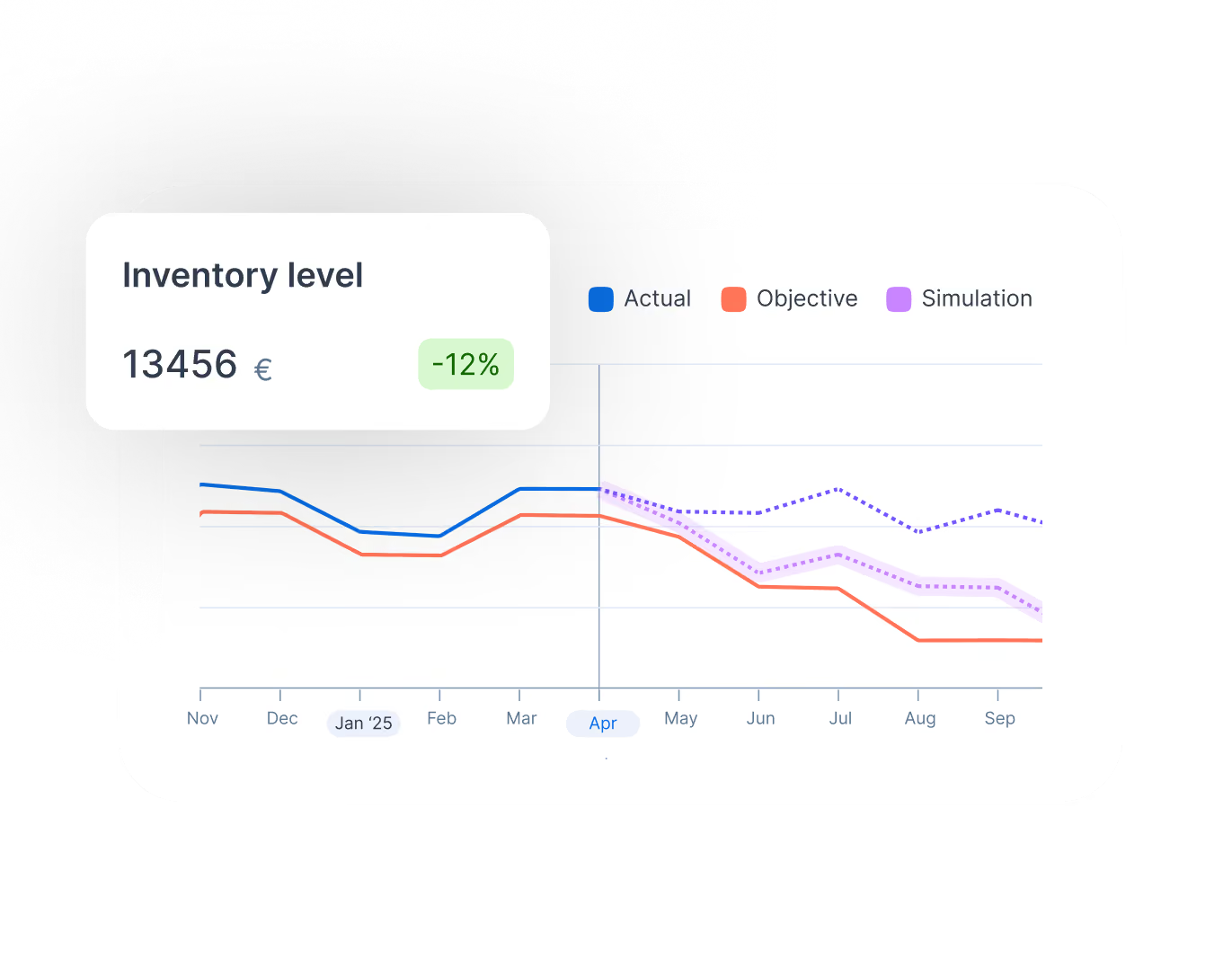
Strategic simulations allow planning teams to model the financial impact of alternative decisions in real time. What is the revenue exposure of a 15-day supplier delay? What happens to working capital if demand spikes 20% in one region? What is the margin impact of switching to an alternative supplier at a higher unit cost? In a digital S&OP model, these questions are answered in minutes, not in the days it takes to prepare a traditional S&OP scenario. Decisions that previously required a pre-S&OP meeting to prepare and an executive meeting to approve can be evaluated, approved, and implemented within a single planning session.
Enhanced supplier collaboration
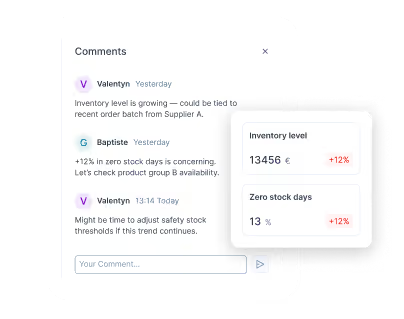
Collaborative planning automation closes the final gap. When demand forecasts update, supplier orders and communication update with them. Suppliers see the same signals the planning team sees, which reduces the lead time variability that inflates safety stock requirements and degrades service levels. Camif reduced stockouts by 6 points and freed 1,760 planner hours annually after implementing automated planning and supplier collaboration. The hours freed were redirected toward the strategic work that the traditional S&OP process had left no time to pursue.
For a practical walkthrough of how AI changes the S&OP operating model in practice, our webinar below, “S&OP Best Practices: Elevating Planning with AI” covers demand forecasting, scenario simulation, and cross-functional collaboration in concrete terms.
What does digital S&OP look like in practice?
The clearest illustration is a concrete disruption scenario. A key supplier announces a two-week delivery delay.
This compression is not incremental. It is structural. The 20-to-30-day response window in traditional S&OP is not caused by slow people. It is caused by a process architecture that requires sequential human steps at each stage. Digital S&OP automates the sequential steps and surfaces the decision that requires human judgment directly, skipping everything in between.
What does digital S&OP require beyond technology?
Transitioning to digital S&OP is a leadership and governance challenge as much as a technology one. The tools enable the model, but the model requires clear decisions about how the organization will operate differently.
Three organizational shifts are necessary.
Redefining decision rights
In a traditional S&OP, decision authority is concentrated in the monthly executive meeting. In a digital S&OP model, decisions happen continuously at the level where the information is best understood. This requires explicit clarity on which decisions can be made operationally, which require tactical escalation, and which warrant executive involvement. Without that clarity, a continuous decision model produces confusion rather than speed.
Measuring S&OP differently
Traditional S&OP is measured by process compliance: did the meetings happen, were the templates completed, were the numbers submitted on time. Digital S&OP is measured by decision quality and response speed: how quickly did the organization respond to the last disruption, how accurately did the plan reflect demand at week three of the cycle, how much working capital was released in the quarter. The KPIs change because the purpose changes.
Managing the automation boundary
Automating 95% of S&OP tasks through AI means human attention concentrates on the remaining 5%. That concentration is the point. The AI Agents layer handles routine recalculation, parameter adjustment, and exception flagging. Planners handle the strategic trade-offs, customer commitments, and supplier negotiations that require context no model fully captures. Getting this boundary right is the core governance challenge of digital S&OP implementation.
How digital S&OP connects to the broader Supply Chain planning stack
Digital S&OP does not operate in isolation. It is the strategic layer that gives direction to the operational planning decisions made continuously below it. Supply Planning executes the replenishment logic. Demand planning feeds the forward-looking signal. Dashboards and analytics give executives the visibility to make S&OP decisions with confidence. Each layer compounds the value of the others when they share the same probabilistic data model and update on the same cadence.
The organizations that realize the most from digital S&OP are those that connect the strategic alignment it provides to the operational execution layers below it, closing the gap between what the plan says and what actually happens in the warehouse, the production line, and the supplier relationship.
Why digital S&OP is now a competitive requirement for Supply Chain leaders
The companies still operating on traditional S&OP models are not behind because they lack ambition. They are behind because the case for change only becomes undeniable when the cost of staying manual becomes impossible to ignore. That cost is now visible: inventory distortion alone costs the global retail sector That cost is now visible in the growing impact of inventory distortion, and a supplier delay that a digital S&OP model resolves in minutes can take 20 to 30 days to work through a traditional planning cycle. The organizations that close this gap first gain a compounding advantage that widens every planning cycle thereafter.
The window for first-mover advantage in digital S&OP is closing. The technology is proven. The implementation timelines are short. The operational case is measurable. The question for Supply Chain leaders is not whether to make the transition, but how to sequence it to build confidence and demonstrate results before committing to full-scale deployment.
Discover how Flowlity's S&OP platform helps Supply Chain leaders transition from monthly planning cycles to continuous, AI-driven decision-making. Get a demo.
Level up your supply chain with AI.
Get a demo
FAQ
Find everything you need to know right here.
What is digital S&OP?

Digital S&OP is a transformation of the traditional Sales and Operations Planning process from a monthly, calendar-driven consensus cycle into a continuous, event-driven decision model. Where traditional S&OP consolidates demand, supply, and financial data once a month for an executive review, digital S&OP updates those signals continuously as conditions change. The output is not a monthly plan but a live, probabilistic view of the business that surfaces decisions as they become necessary, compressing the response window from weeks to minutes.
What is the difference between S&OP and digital S&OP?
Traditional S&OP is periodic, consensus-based, and backward-looking. It aligns functions around a shared plan on a monthly cadence, using historical data and single-point forecasts. Digital S&OP is continuous, event-driven, and forward-looking. It uses AI to update forecasts and simulations in real time, quantify the financial impact of decisions before they are made, and surface recommendations automatically when conditions shift. The governance structure is the same. The decision speed and accuracy are fundamentally different.
How does AI improve the S&OP process?
AI improves S&OP across four dimensions simultaneously. On demand, it moves from monthly consolidated forecasts to continuous probabilistic demand sensing. On supply, it recalibrates safety stock and lead time assumptions based on actual supplier performance rather than contractual commitments. On financial simulation, it quantifies the impact of alternative decisions in minutes rather than days. On collaboration, it updates supplier communication automatically as plans change. Together, these capabilities compress the S&OP cycle from a monthly event to a continuous operating condition.
Is digital S&OP only relevant for large enterprises?
No. Mid-sized manufacturers and distributors benefit proportionally more because they have smaller planning teams managing the same volatility with fewer resources. The time savings from automating routine S&OP tasks are disproportionately valuable for teams where each planner carries a large SKU load. Implementation timelines are also shorter for focused scopes: organizations can go live on digital S&OP for a specific business unit or product family in weeks, building confidence before extending to the full scope.