.svg)
Gestion des commandes fournisseurs alignée sur vos contraintes Supply Chain
Allez au-delà de la simple exécution. Synchronisez vos prévisions de demande, vos objectifs de niveau de stock et vos approvisionnements avec votre réalité opérationnelle.
Demander une démo.svg)
Des engagements de commande réalistes
Ne promettez que ce que votre Supply Chain peut réellement délivrer.
.svg)
Promesses de commande basées sur l’approvisionnement
Des engagements de livraison fiables
Priorisez les commandes quand la chaine d’approvisionnement est sous tension
Toutes les commandes ne doivent pas ètre traitées de la même façon.
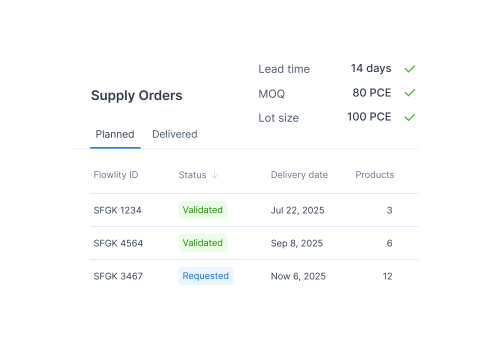
Priorisation intelligente des commandes
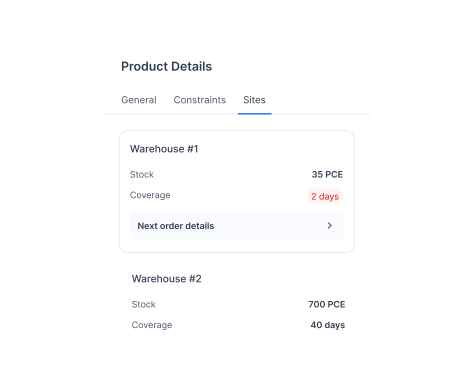
Gestion des pénuries et des allocations
Réconciliez gestion des commandes et gestion de la chaine d’approvisionnement
Ne gérez plus vos commandes en silo.
.svg)
Commandes cohérentes avec votre planification de la demande et votre stratégie de stock
.svg)
Gestion des commandes decision-driven
D’un OMS centré sur l’exécution à une gestion des commandes pilotée par la disponibilité de l’offre


Une gestion des commandes plus intelligente commence par une planification plus intelligente
Pourquoi la plupart des processus de commande gaspillent le temps des planificateurs

La plupart des équipes Supply Chain connaissent ce scénario : des dizaines de bons de commande à revoir chaque jour, la plupart routiniers, chacun nécessitant un contrôle manuel avant envoi. La cause profonde n'est pas un manque de discipline, c'est que la commande pilotée par l'ERP traite chaque réapprovisionnement de la même façon, qu'il s'agisse d'un restocking standard ou d'un engagement stratégique en pleine pénurie.
Cette approche unique a un coût réel. Les planificateurs sont noyés sous le travail transactionnel, à revalider des quantités qui auraient pu être automatisées. Pendant ce temps, les commandes qui méritent vraiment de l'attention (un fournisseur en retard, un pic de demande sur un produit clé, un risque de marge sur un gros engagement) reçoivent le même traitement expéditif que les autres. Le problème, ce n'est pas le volume de commandes. C'est l'incapacité à distinguer ce qui compte de ce qui ne compte pas.
Les équipes qui ont avancé vers un Supply Planning automatisé réalisent souvent que la prochaine étape naturelle est de fixer la couche commande : une fois que les prévisions et les objectifs de stock sont fiables, traiter chaque commande à la main n'a plus beaucoup de sens.
À qui s'adresse la solution de gestion des commandes fournisseurs de Flowlity
La gestion des commandes fournisseurs devient un sujet stratégique dès que le volume de bons de commande quotidiens dépasse la capacité d'analyse des équipes. Flowlity est conçu pour les approvisionneurs et planificateurs des entreprises mid-market du retail, de la distribution et de l'industrie manufacturière, qui pilotent un large catalogue de références réparties entre dizaines de fournisseurs aux délais et fiabilités hétérogènes. Il convient aux Demand Planners et Supply Chain Managers en charge de la cohérence entre prévisions de demande, niveaux de stock cibles et engagements de commande, qui ne peuvent plus se permettre de valider chaque ligne manuellement. Il accompagne aussi les Directeurs Supply Chain et COO d'ETI qui veulent reprendre le contrôle sur la chaîne fournisseurs sans lancer un projet de transformation lourd ni remplacer leur ERP.inventory management for frozen and chilled goods ties every order to the cold storage capacity available that week.
It fits Demand Planners and Supply Chain Managers responsible for keeping demand forecasts, target inventory levels and order commitments aligned, who can no longer afford to validate every line manually. It also supports Supply Chain directors and COOs in mid-market companies who want to regain control of the supplier flow without launching a heavy transformation project or replacing their ERP.
Les irritants sont structurels. Les équipes passent leurs journées à valider des bons de commande routiniers générés par l'ERP, sans hiérarchie entre une commande standard et un engagement critique. Les promesses de livraison s'appuient sur des règles de disponibilité figées qui ignorent l'état réel du stock entrant. Quand un fournisseur fait défaut, l'allocation se fait au cas par cas dans un tableur, en marge du système. Les planificateurs restent absorbés par le transactionnel au lieu d'arbitrer sur les exceptions à fort enjeu. Une solution moderne de gestion des commandes fournisseurs doit reléguer ces situations au rang d'exceptions remontées par l'outil, pas en faire le quotidien.
Que rechercher dans une solution de commande moderne
Intégration à la planification
Tous les outils de commande ne se valent pas. Certains se concentrent uniquement sur les workflows de bons de commande (approbations, routage, communication fournisseur) sans toucher à la logique de ce qui est commandé et quand. D'autres résident dans des ERP et héritent de leur rigidité : points de commande figés, délais statiques, aucune conscience de ce qui se passe réellement sur la demande.
Le vrai différenciateur, c'est de savoir si la solution connecte la gestion des commandes Supply Chain à votre couche planification. Peut-elle intégrer vos dernières prévisions de demande quand elle calcule les quantités ? Tient-elle compte de la variabilité des délais fournisseurs ? Peut-elle intégrer la logique MRP ou DRP au lieu de fonctionner en silo ?
Scalabilité
La scalabilité compte aussi. Beaucoup d'entreprises mid-market dans le wholesale ou l'industrie commencent par automatiser leurs principaux fournisseurs et se rendent vite compte qu'il leur faut la même intelligence sur l'ensemble du portefeuille. Une solution qui demande des mois de configuration par fournisseur ne suit pas. Pour les retailers en particulier, où la prolifération des SKUs et les variations saisonnières ajoutent une pression constante, suivre des bonnes pratiques d'automatisation Supply Chain retail fait la différence entre scaler sereinement et se noyer dans les ajustements manuels.
Automatiser le routinier, se concentrer sur ce qui compte
Le plus grand gain de productivité ne vient pas d'un traitement de commande plus rapide, il vient de l'élimination du traitement inutile. Quand un réapprovisionnement est simple (demande stable, fournisseur fiable, quantité standard), il n'y a aucune raison qu'un planificateur y consacre du temps. Il doit être calculé, validé et envoyé automatiquement.
Ce dont les planificateurs ont besoin, c'est un système qui ne fait remonter que les exceptions : une commande dont la quantité engagée dépasse un seuil de marge, un fournisseur dont la performance récente suggère un risque, un produit dont la demande a fortement bougé depuis le dernier plan. C'est là que le jugement humain crée de la valeur, pas dans le tamponnage des bons de commande routiniers.
C'est la logique de la commande par exception. Des plateformes comme Flowlity utilisent des agents IA pour gérer le cycle complet des commandes standards tout en signalant les quelques cas critiques qui méritent attention. Le dashboard du planificateur devient un cockpit de décision, pas une file de traitement.
Plum Living, marque de mobilier qui gère 630 SKUs sur deux entrepôts, a vécu cela : après avoir remplacé une commande manuelle sous tableur par Flowlity, l'entreprise a réduit son stock de 21 % dès le go-live, puis a vu sa valeur de stock baisser de 38 % au fil du temps.
Des commandes alignées sur la réalité Supply Chain
L'un des problèmes les plus fréquents en gestion des commandes Supply Chain traditionnelle, c'est que les quantités d'achat sont déconnectées de la réalité opérationnelle. Les points de commande ont été paramétrés il y a six mois. Les niveaux de stock de sécurité ne reflètent plus les évolutions récentes de la demande. Les délais fournisseurs enregistrés ne correspondent pas à ce qu'on observe sur le terrain.
Le résultat ? Des commandes "à l'heure" techniquement, mais stratégiquement erronées : trop d'un produit, pas assez d'un autre, et un quotidien passé à colmater les écarts. Comme l'a montré la recherche sur la planification et le réapprovisionnement collaboratifs, les organisations les plus performantes sont celles qui alignent l'exécution sur la planification, pas celles qui les optimisent séparément.
Flowlity répond à ce constat en générant chaque commande à partir de données vivantes : prévisions de demande pilotées par l'IA, niveaux de stock de sécurité optimisés, visibilité temps réel sur les stocks de tout le réseau et distributions de délais fournisseurs. La commande n'est plus simplement passée : elle est correctement dimensionnée, correctement positionnée dans le temps et alignée avec ce que votre Supply Chain peut réellement absorber.
Saint-Gobain Sekurit en a fait l'expérience à grande échelle : avec plus de 10 000 références de vitrages automobiles gérées sur 30 centres de distribution et 3 usines, le groupe a amélioré la disponibilité produit de 95,8 % à 97,2 % tout en réduisant ses stocks de 9,25 %, parce que chaque commande s'appuyait enfin sur des prévisions IA précises plutôt que sur des paramètres dépassés.
Comment Flowlity transforme la gestion des commandes
Une commande pensée depuis la planification
Flowlity ne se contente pas d'ajouter une couche de commande à votre ERP : la plateforme repense le processus depuis la planification. Les bons de commande sont générés depuis le même outil qui produit vos prévisions de demande et vos cibles de stock, ce qui garantit que chaque commande est cohérente avec votre stratégie Supply Chain globale.
Routine automatisée, exceptions remontées
Pour les réapprovisionnements de routine, le cycle est entièrement automatisé : Flowlity calcule la quantité optimale, la valide au regard de vos règles métier et l'envoie au fournisseur. Les planificateurs ne voient ces commandes que si une alerte est levée. Pour les situations complexes (approvisionnement contraint, engagements à fort enjeu, lancements de nouveaux produits), le système présente les arbitrages dans un dashboard clair pour décider en confiance.
Un impact concret
L'impact est tangible. Camif, pure player e-commerce engagé dans l'éco-conception, a absorbé 44 % de croissance de chiffre d'affaires sans ajouter une seule personne à son équipe Supply Chain après le déploiement de Flowlity. Les ruptures de stock ont reculé de 6 points, libérant environ 40 000 € de revenus annuels supplémentaires, et l'équipe a économisé l'équivalent d'un ETP sur le seul traitement des commandes. L'objectif n'est pas de sortir le planificateur du process, c'est de faire en sorte que son temps aille là où il a le plus de valeur.
Démarrer sans lancer un projet de transformation
Ce qui freine souvent les entreprises, c'est la crainte d'une implémentation longue et complexe. Les plateformes de commande d'envergure exigent fréquemment des mois de paramétrage, des ressources IT dédiées et une personnalisation poussée de l'ERP avant de produire le moindre résultat.
Flowlity adopte une approche différente. La plateforme se connecte à votre ERP existant (SAP, Oracle, Microsoft Dynamics, etc.) et peut être mise en service en quelques semaines. Pas besoin de remplacer vos systèmes actuels : Flowlity s'intègre à côté, en enrichissant votre processus de commande d'une intelligence de planification que votre ERP n'embarque tout simplement pas.
C'est ce qui la rend particulièrement adaptée aux équipes mid-market qui ont besoin de résultats rapides. Que vous soyez distributeur wholesale gérant des milliers de SKU ou industriel jonglant avec des réseaux fournisseurs complexes, vous pouvez démarrer avec vos flux les plus critiques et étendre la couverture progressivement, à votre rythme.
Et une fois que les planificateurs récupèrent les heures qu'ils passaient sur le traitement de commandes de routine, ils peuvent réinvestir ce temps sur ce qui crée vraiment de la performance : améliorer les conditions fournisseurs, préparer les pics saisonniers, gérer les disruptions de manière proactive et contribuer aux discussions S&OP avec des analyses concrètes et factuelles. Pour les organisations qui veulent passer d'une exécution réactive à une planification proactive pilotée par l'IA, optimiser la gestion Supply Chain et la gestion des commandes est l'un des points de départ au plus fort ROI, et avec Flowlity, l'un des plus rapides à mettre en œuvre.
FAQ
Find everything you need to know right here.
Qu'est-ce qu'un logiciel de gestion des commandes fournisseurs ?
Un logiciel de gestion des commandes fournisseurs est un système qui automatise et optimise la création, la validation et le suivi des bons de commande envoyés aux fournisseurs. Il couvre l'ensemble du cycle de vie de la commande — du calcul des besoins de réapprovisionnement à l'envoi des bons de commande et au suivi des livraisons. Les solutions avancées vont au-delà de la gestion transactionnelle en connectant les commandes aux prévisions de demande, aux politiques de stock et à la planification Supply Chain pour s'assurer que chaque commande est alignée sur les besoins réels de l'entreprise.
Quelle est la différence entre gestion des commandes et achats (procurement) ?
Le procurement couvre l'ensemble du processus stratégique de sourcing, de négociation et de gestion des relations fournisseurs. La gestion des commandes se concentre spécifiquement sur la couche d'exécution : générer les bons de commande, suivre l'exécution et gérer les exceptions. Si le procurement détermine auprès de qui acheter et à quelles conditions, la gestion des commandes détermine quand, combien et avec quelle efficacité ces commandes sont exécutées. Les plateformes Supply Chain modernes intègrent les deux pour s'assurer que les stratégies d'achat se reflètent dans chaque décision de commande.
Gestion des commandes fournisseurs vs. MRP traditionnel : quelle différence ?
Le MRP traditionnel (Material Requirements Planning) calcule les matériaux nécessaires en se basant sur les nomenclatures, les programmes de production et les niveaux de stock. Il génère des suggestions de commande, mais la logique est déterministe et ne prend pas en compte la variabilité de la demande, la fiabilité des fournisseurs ou les positions de stock en temps réel sur l'ensemble des sites. Un logiciel de gestion des commandes fournisseurs va plus loin en appliquant une optimisation pilotée par l'IA, en automatisant les commandes courantes et en signalant les exceptions — transformant les besoins bruts en matières en décisions d'achat intelligentes et orientées approvisionnement.
Quelle est la différence entre la gestion des commandes d'approvisionnement et l'order-to-cash ?
L'order-to-cash (O2C) couvre le côté vente : de la réception d'une commande client à la facturation et l'encaissement. La gestion des commandes d'approvisionnement se situe côté achat : elle gère les bons de commande envoyés aux fournisseurs pour réapprovisionner les stocks et répondre à la demande. Bien que les deux impliquent des workflows de commande, ils servent des extrémités opposées de la Supply Chain. Les entreprises ont besoin des deux pour fonctionner efficacement, mais l'intelligence de planification requise côté approvisionnement — connecter les commandes aux prévisions, aux stocks de sécurité et aux contraintes fournisseurs — est fondamentalement différente de l'optimisation des processus O2C.
Comment Flowlity automatise-t-il la gestion des commandes fournisseurs ?
Flowlity utilise l'IA pour générer des bons de commande optimaux basés sur les prévisions de demande, les objectifs de stock et les données de délais fournisseurs. Les commandes de réapprovisionnement courantes sont calculées, validées et envoyées automatiquement — sans revue manuelle. Les commandes dépassant des seuils définis (impact marge, risque d'approvisionnement, anomalies de volume) sont signalées comme exceptions pour revue par le planificateur. Cette automatisation couvre le cycle complet, de la suggestion de commande à l'envoi au fournisseur, permettant aux planificateurs de se concentrer uniquement sur les décisions nécessitant une expertise humaine.
Flowlity peut-il connecter la gestion des commandes aux prévisions de demande ?
Oui — c'est un différenciateur clé. Contrairement aux outils de gestion de commandes autonomes qui s'appuient sur des points de commande statiques, Flowlity connecte chaque bon de commande à ses prévisions de demande alimentées par l'IA et à son moteur d'optimisation des stocks. Cela signifie que les quantités et le timing des commandes reflètent la demande réellement attendue, les niveaux de confiance des prévisions et les objectifs de stock de sécurité plutôt que des règles fixes définies il y a des mois. Le résultat : des commandes systématiquement bien calibrées, réduisant à la fois les ruptures de stock et les surplus.
Quels types d'entreprises bénéficient le plus de la gestion des commandes fournisseurs par l'IA ?
La gestion des commandes fournisseurs pilotée par l'IA apporte le plus de valeur aux entreprises mid-market du retail, de la distribution et de l'industrie manufacturière qui gèrent un grand nombre de références auprès de multiples fournisseurs. Ces organisations disposent généralement d'équipes de planification réduites qui consacrent trop de temps aux commandes routinières, laissant peu de capacité pour le travail stratégique. Les entreprises confrontées à une demande saisonnière, des délais fournisseurs longs ou variables, ou un réapprovisionnement multi-sites complexe obtiennent des résultats particulièrement significatifs — réalisant souvent des réductions de stock substantielles tout en améliorant les niveaux de service.