.svg)
Planification de la distribution alignée grâce au DRP piloté par l'IA
Gérez votre Supply Chain de bout en bout en tout confiance grâce au module DRP, piloté par IA. Anticipez vos besoins, et planifiez vos flux de distribution tout en maitrisant l’incertitude de la demande.
Demander une démo
Synchronisez vos flux sur l’entièreté de vos canaux de distribution
Un système de distribution efficace n’est garanti que par une synchronisation de l’information.
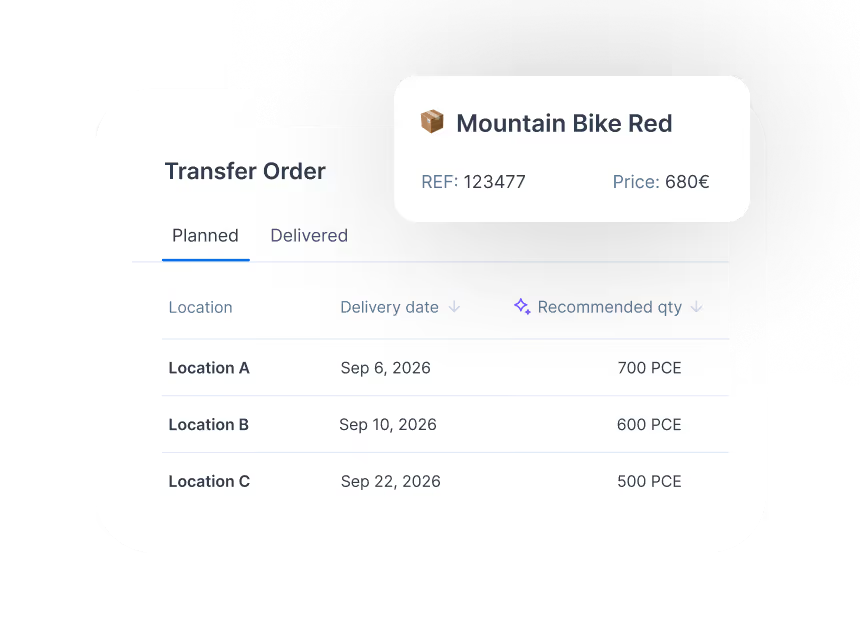
Distribution multi-échelons dans le temps
.svg)
Planification des flux tirée par la demande
Anticipez le besoin des canaux de distribution
Sachez quoi expédier, où — et quand.
.svg)
Coordination des flux multi-sites
Une exécution réseau plus fluide
Planifiez les flux de distribution face à l’incertitude de la demande
Le DRP déterministe échoue quand la réalité change.
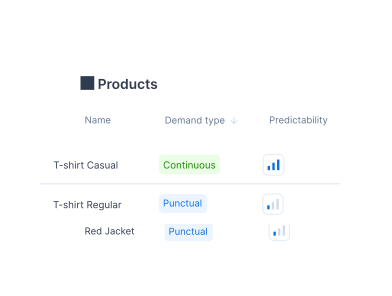
Anticipation probabiliste des flux
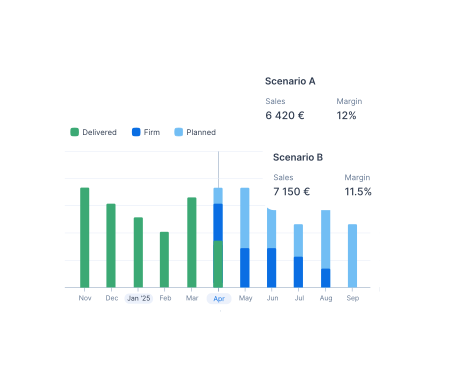
Simulation de flux par scénarios
Passez de la réaction à la proactivité pour une planification de la demande plus juste


Logiciel DRP : reprendre le contrôle de votre réseau de distribution au lieu de le subir
La plupart des Supply Chains ne manquent pas de données : elles manquent de contrôle sur la circulation des stocks à travers leur réseau.
Apporter de la clarté et du contrôle aux décisions de distribution

La plupart des problèmes de distribution ne viennent pas d'un manque d'outils. Ils viennent d'une planification fragmentée.
Un entrepôt est en surstock, un autre est en rupture. Les transferts sont déclenchés trop tard. Les décisions se prennent dans Excel parce que le système n'inspire pas confiance.
Avec le temps, les planificateurs passent plus de temps à corriger des problèmes qu'à réellement planifier.
Ce qu'un logiciel DRP change, ce n'est pas seulement le processus : c'est la manière dont les décisions sont prises.
Au lieu de réagir aux incidents après coup, les équipes peuvent répondre en continu à une question simple mais essentielle :
que faut-il déplacer, où, et quand ?
Ce changement permet aux planificateurs d'anticiper les déséquilibres avant qu'ils n'affectent le taux de service. Les stocks ne sont plus gérés en silo, mais coordonnés à l'échelle du réseau. Les flux s'alignent, et les décisions deviennent proactives plutôt que réactives.
La vraie valeur ne vient pas de l'automatisation seule. Elle vient du fait de donner aux équipes la capacité de se concentrer sur les décisions qui améliorent la performance, et non sur les corrections.
C'est là que le DRP prend toute sa puissance lorsqu'il est connecté à la gestion des stocks et à un tableau de bord opérationnel clair : la visibilité ne crée de la valeur que lorsqu'elle débouche sur de l'action.
Pourquoi les outils DRP traditionnels ne fonctionnent plus
De nombreuses entreprises disposent déjà de fonctionnalités DRP intégrées à leur ERP. Sur le papier, la fonction existe. En pratique, elle est souvent contournée.
La raison est simple : la logique sous-jacente du DRP traditionnel ne correspond plus aux conditions actuelles de la Supply Chain.
Ces systèmes ont été conçus pour des environnements relativement stables. Ils reposent sur des règles de stock de sécurité figées, des prévisions ponctuelles et des cycles de planification qui s'adaptent mal au changement.
Or, les Supply Chains d'aujourd'hui sont tout sauf stables.
La demande fluctue en permanence. Les fournisseurs sont moins prévisibles. Promotions, saisonnalité et événements externes introduisent une variabilité que les modèles statiques ne peuvent pas absorber.
Pour y faire face, les entreprises ajoutent des tampons. Plus de stock, plus de marges de sécurité, plus de « au cas où ».
Et pourtant, le paradoxe demeure : le stock augmente, mais le taux de service ne s'améliore pas forcément.
Saint-Gobain a vécu exactement cette situation. En transformant la manière dont les décisions de distribution étaient prises, en passant de règles statiques à une approche plus dynamique, l'entreprise a réussi à réduire ses stocks tout en diminuant le risque de rupture, comme le détaille cette étude de cas Saint-Gobain consacrée à l'optimisation de la planification Supply Chain.
C'est là que le DRP traditionnel atteint ses limites. Il a été conçu pour calculer, pas pour s'adapter.
Ce qui compte vraiment au moment de choisir une solution DRP (fonctionnalités, critères…)
Choisir un logiciel DRP relève moins des fonctionnalités que de l'adéquation au contexte.
La vraie question n'est pas « que fait l'outil ? » mais plutôt : fonctionnera-t-il dans la réalité de ma Supply Chain ?
D'abord, le système doit appréhender le réseau dans son ensemble. Les décisions de stock prises dans un site impactent toujours les autres. Traiter les entrepôts indépendamment conduit à des résultats sous-optimaux. C'est pourquoi des approches comme le MEIO sont déterminantes : elles garantissent que le stock est positionné là où il apporte le plus de valeur sur l'ensemble du réseau.
Ensuite, le DRP ne peut pas fonctionner en vase clos. Déconnecté du Supply Planning, le plan devient théorique. Ce qui paraît optimal sur le papier n'est pas toujours réalisable sur le plan opérationnel.
Ensuite, l'ergonomie est essentielle. Même le système le plus avancé échouera si les planificateurs n'y font pas confiance. Les recommandations doivent être compréhensibles, explicables et actionnables. Un tableau de bord Supply Chain bien conçu fait souvent la différence entre adoption et rejet.
Enfin, la rapidité de déploiement est un facteur décisif. Dans un environnement qui bouge vite, une solution qui prend plus d'un an à déployer risque d'être obsolète avant d'avoir produit de la valeur.
Ce qu'un logiciel DRP change concrètement dans vos opérations au quotidien
Il existe un point où la complexité de la distribution dépasse les capacités de la planification manuelle. Cela arrive en général progressivement. Les réseaux s'étendent, les portefeuilles produits s'élargissent, et la variabilité devient plus difficile à maîtriser. Au début, les équipes compensent. Puis les failles apparaissent.
Un entrepôt est en surstock. Un autre est en rupture. Les transferts arrivent trop tard. Les décisions se prennent dans Excel. Et les planificateurs passent leur temps à réagir au lieu d'anticiper.
À ce stade, les symptômes sont clairs : déséquilibres de stocks récurrents, recours croissant aux ajustements manuels, et pression accrue sur les équipes de planification. Ce n'est pas un problème d'outil. C'est un problème de coordination. Et il devient encore plus visible selon le contexte.
Dans la distribution retail, par exemple, maintenir les magasins alignés avec le stock central est un défi quotidien. Sans un réapprovisionnement magasin structuré, certains points de vente tombent en rupture trop tôt tandis que d'autres accumulent du surstock.
Dans le négoce et la distribution professionnelle, l'équilibre est plus serré. Le taux de service doit rester élevé, mais les marges laissent peu de place aux inefficiences. Une mauvaise décision de distribution se traduit vite par une perte de rentabilité.
Dans les Supply Chains de pièces de rechange, les enjeux sont différents mais tout aussi critiques. La demande est imprévisible, mais la disponibilité doit être garantie. Une pièce manquante peut signifier un arrêt de production, des retards ou une perte de revenus.
Dans toutes ces situations, le même constat s'impose : le réseau n'est pas synchronisé.
À quoi ressemblent les gains de performance dans la pratique
L'impact du DRP se comprend mieux à travers des résultats concrets que par des bénéfices théoriques.
Chez Camif, l'amélioration de la planification de la distribution n'a pas seulement réduit les ruptures : elle a permis à l'entreprise d'absorber sa croissance sans augmenter ses effectifs Supply Chain. Camif a généré environ +40 000 € de revenu annuel additionnel en évitant les ruptures sur des références clés lors des pics commerciaux, et a libéré l'équivalent d'un planificateur à temps plein (1 760 heures par an) auparavant consacrées à la réconciliation manuelle entre sites. Les ruptures ont diminué de 6 points sur la même période.
Chez Plum Living, le problème était différent. Le stock n'était pas forcément trop élevé partout : il était mal positionné dans le réseau. En rééquilibrant les stocks entre entrepôts, Plum a réduit la valeur de ses stocks de 38 % dans la durée (de 598 k€ à un objectif de 367 k€), dont 21 % de baisse obtenue dès la mise en production. Le réseau a commencé à fonctionner comme un système coordonné, et non plus comme un ensemble de sites indépendants.
Ces exemples mettent en lumière un point clé : le DRP ne sert pas à optimiser des indicateurs isolés. Il sert à améliorer la manière dont l'ensemble de la Supply Chain fonctionne.
Moins de friction. Moins de décisions dans l'urgence. Plus de contrôle.
Passer d'une planification réactive à une exécution maîtrisée
Sans planification structurée de la distribution, la plupart des Supply Chains fonctionnent en mode réaction. Une rupture apparaît, les équipes répondent. Un retard survient, les ajustements suivent. La demande s'envole, et le système peine à suivre.
Le DRP change le moment où les décisions sont prises.
En analysant en continu les signaux de demande, les niveaux de stock et les contraintes d'approvisionnement, le système identifie les risques plus tôt. Cela permet aux planificateurs d'agir avant que les problèmes ne se matérialisent. Au lieu de réagir aux ruptures, ils peuvent rééquilibrer les stocks de manière proactive. Au lieu d'ajuster les plans après une perturbation, ils peuvent simuler des scénarios et se préparer à l'avance.
Avec le temps, ce changement réduit la volatilité à l'échelle du réseau. Associé à la gestion des stocks et au Supply Planning, le DRP devient bien plus qu'un outil de planification. Il devient une couche de pilotage qui stabilise l'exécution et améliore la performance globale.
Pourquoi les entreprises quittent le DRP de leur ERP au profit de Flowlity
La plupart des outils DRP sont issus des ERP. Ils ont été conçus pour soutenir la planification, mais pas nécessairement pour gérer l'incertitude. Flowlity part d'un postulat différent : la variabilité.
Au lieu de s'appuyer sur des règles statiques, la plateforme s'adapte en continu à ce qui se passe dans la Supply Chain. Elle met en évidence les risques en amont, suggère des actions concrètes et permet aux planificateurs de prendre des décisions éclairées plus rapidement.
Cela transforme le rôle du planificateur. D'une personne qui ajuste les plans à la main… à une personne qui pilote la Supply Chain avec l'appui de recommandations intelligentes propulsées par l'IA.
Et tout aussi important, cela change la vitesse de transformation. Plus de projets IT lourds. Plus de déploiements pluriannuels. Les entreprises peuvent commencer à améliorer leur performance rapidement : réduire les stocks, augmenter le taux de service et libérer du temps pour leurs équipes.
Parce qu'au fond, l'objectif n'est pas d'avoir de meilleurs outils de planification. C'est d'avoir une Supply Chain plus simple à piloter et plus résiliente face au changement.
FAQ sur les logiciels de Distribution Requirements Planning
Les réponses aux questions les plus fréquentes.
Que signifie DRP dans la gestion de la Supply Chain ?
DRP signifie Distribution Requirements Planning. C'est une méthode de planification Supply Chain utilisée pour déterminer combien de stock doit être distribué, quand les produits doivent être réapprovisionnés, et où les stocks doivent être positionnés dans un réseau de distribution composé d'entrepôts, de hubs régionaux et de magasins.
La logique sous-jacente consiste à traduire la demande client attendue en un plan cohérent de transferts inter-sites et d'ordres de réapprovisionnement, afin que le stock soit positionné au plus près du point de vente sans créer de surstock sur un seul nœud du réseau.
Le DRP garantit que les flux de stock entre entrepôts, centres de distribution et magasins sont synchronisés avec la demande — évitant le schéma classique où un hub régional est en rupture pendant qu'un autre est en surstock sur le même SKU.
Quelle est la différence entre DRP et MRP ?
Le DRP et le MRP couvrent des parties différentes de la Supply Chain.
Le MRP (Material Requirements Planning) se concentre sur la planification de la production. Il détermine quelles matières premières et composants sont nécessaires pour fabriquer les produits.
Le DRP, en revanche, se concentre sur la distribution. Il détermine comment les produits finis doivent être répartis entre les entrepôts et centres de distribution.
Dans de nombreuses organisations, le DRP fonctionne en complément de :
- la planification de la demande
- l'optimisation des stocks
- la planification de l'approvisionnement
Ensemble, ces processus garantissent que les produits sont fabriqués et distribués efficacement.
À quoi sert un logiciel DRP ?
Un logiciel DRP sert à planifier la circulation des produits à travers un réseau de distribution. Il aide les entreprises à décider de la quantité de stock nécessaire à chaque emplacement, du moment de réapprovisionner, et de la façon de rééquilibrer les stocks entre entrepôts lorsque la demande locale évolue plus vite que le plan.
En pratique, un outil DRP prend en entrée les prévisions de demande, les niveaux de stock actuels, les stocks en transit et les délais d'approvisionnement, puis génère un plan de réapprovisionnement phasé dans le temps pour chaque combinaison SKU × site. L'objectif est simple : maximiser la disponibilité produit tout en minimisant le stock total du réseau.
Les logiciels DRP modernes comme Flowlity ajoutent une couche de prévision par IA et des cibles de stock probabilistes — si bien que les décisions de réapprovisionnement reflètent la variabilité réelle de la demande au lieu de reposer sur des points de commande statiques rapidement obsolètes.
Quelle est la différence entre DRP et gestion des stocks ?
La gestion des stocks (inventory management) se concentre sur le suivi et le contrôle des niveaux de stock : ce qui est disponible, ce qui est en transit, ce qui est réservé, et quand les articles sont reçus ou sortis. C'est essentiellement une vision opérationnelle et comptable du stock à un instant donné.
Le DRP va plus loin. Il planifie la façon dont les stocks doivent circuler dans le réseau au fil du temps — décider quand pousser ou tirer du stock entre les nœuds, quelles quantités réapprovisionner, et comment séquencer les commandes pour que chaque site reste équilibré à mesure que la demande évolue.
Dans la pratique, le DRP s'appuie sur la gestion des stocks : l'ERP ou le WMS conserve la trace de ce que vous avez, pendant que le DRP décide de ce qu'il faut faire ensuite pour aligner ce stock sur la demande future.
Qui utilise un logiciel DRP ?
Un logiciel DRP est utilisé par les professionnels de la Supply Chain responsables de la gestion des stocks et des réseaux de distribution.
Les utilisateurs typiques incluent :
- les directeurs Supply Chain
- les planificateurs de la demande
- les responsables des stocks
- les planificateurs de distribution
Les secteurs qui utilisent couramment des solutions DRP incluent :
- le retail
- la distribution en gros
- l'industrie manufacturière
- les réseaux de pièces détachées
Ces organisations s'appuient sur le DRP pour maintenir un haut niveau de service tout en maîtrisant les coûts de stockage.
Comment un logiciel DRP réduit-il les stocks et les ruptures en même temps ?
Cela semble contradictoire, mais réduire les stocks et réduire les ruptures revient à résoudre le même problème : un mauvais positionnement des stocks.
La plupart des entreprises tentent d'éviter les ruptures en ajoutant du stock de sécurité partout. Résultat ? Plus de stock… mais toujours des pénuries aux mauvais endroits.
Un logiciel DRP adopte une approche différente. Au lieu de protéger chaque entrepôt individuellement, il optimise les stocks sur l'ensemble du réseau. Il analyse en continu :
- les signaux de demande (par site et par SKU)
- les niveaux de stock actuels sur tous les nœuds
- les délais et contraintes d'approvisionnement
Sur cette base, il détermine où les stocks sont réellement nécessaires, et pas seulement où ils se trouvent.
En pratique, cela signifie :
- moins de stock excédentaire dans les sites à faible demande
- une meilleure disponibilité là où la demande est réelle
- une détection plus précoce des pénuries potentielles
- des transferts intelligents entre entrepôts au lieu de commandes d'urgence
Par exemple, des entreprises comme Camif ont réduit les ruptures tout en développant leurs opérations, et d'autres comme Plum ont significativement diminué la valeur de leurs stocks — non pas en coupant aveuglément, mais en positionnant le stock là où il crée de la valeur.
L'essentiel est simple : pas plus de stock — du stock mieux distribué.
Un logiciel DRP est-il pertinent pour les PME ?
Absolument — et dans beaucoup de cas, ce sont les PME et ETI qui en tirent le plus grand bénéfice. La raison : la complexité de la Supply Chain croît plus vite que les effectifs. Un nouvel entrepôt, quelques lignes de produits supplémentaires, une expansion internationale — et la planification sur tableur atteint rapidement ses limites. Ces mêmes entreprises n'ont pourtant souvent ni le budget ni la bande passante IT pour une suite de planification enterprise.
Les outils DRP modernes comblent cet écart. Des plateformes cloud-native comme Flowlity se connectent aux ERPs existants en quelques semaines, ne nécessitent aucune équipe data science dédiée, et délivrent des recommandations de réapprovisionnement pilotées par IA sans configuration lourde.
Cela permet aux PME de structurer leur Supply Chain avec une logique de niveau enterprise — stocks de sécurité dynamiques, visibilité multi-échelons, workflows par exception — sans la complexité opérationnelle des plateformes legacy.
Combien de temps faut-il pour déployer un logiciel DRP ?
Le délai de déploiement dépend fortement du type de solution. Les modules DRP intégrés aux ERPs prennent généralement 6 à 18 mois pour être opérationnels, parce qu'ils exigent une configuration poussée, des intégrations de données sur mesure et un programme de conduite du changement impliquant plusieurs équipes.
Les solutions cloud-native modernes comme Flowlity sont pensées pour un tout autre calendrier. Connecteurs pré-intégrés vers les principaux ERPs, interface intuitive pour les planificateurs, architecture SaaS qui supprime l'installation d'infrastructure — la plupart des déploiements mid-market passent en production en quelques semaines plutôt qu'en mois.
Plum Living, par exemple, est passé en production sur 630 SKUs et 2 entrepôts avec 21% de réduction de stock dès le go-live. Le facteur déterminant est la maturité des données : si les commandes, ventes et stocks sont déjà captés au niveau SKU, le reste avance vite.
Quelle est la différence entre un DRP traditionnel et un DRP piloté par l'IA ?
Le DRP traditionnel et le DRP piloté par l'IA résolvent le même problème — mais de manières très différentes.
Les systèmes DRP traditionnels (généralement intégrés dans un ERP) reposent sur :
- des règles fixes (stock de sécurité, points de commande)
- des prévisions déterministes (une seule « meilleure estimation »)
- des cycles de planification statiques
Ils fonctionnent raisonnablement bien dans des environnements stables. Mais dès que la variabilité augmente, ils deviennent rigides et nécessitent des ajustements manuels constants.
C'est pourquoi les planificateurs finissent souvent par s'appuyer sur Excel.