.svg)
Demand sensing : anticipez la volatilité de la demande
Optimisez votre taux de service dans un environnement incertain grâce à la détection de la demande en temps réel, pilotée par l'IA.
Demander une démo.webp)
Transformez les signaux faibles de demande en leviers actionnables
Volatilité extrême. Demande imprévisible. Décisions sous pression.
Les promotions, perturbations et événements externes créent des variations brutales que les prévisions traditionnelles ne peuvent plus absorber. Résultat : stocks déséquilibrés, taux de service menacés. Laissez l'IA libérer votre performance

Ajustement continu des prévisions
Détection des signaux intrinsèques et extrinsèques
.svg)
Alertes et priorisation pilotées par l'IA
.svg)

Optimisez votre taux de service et préservez votre niveau de stock grâce aux prévisions IA en temps réel
La prévision de la demande construit la baseline. Le demand sensing la maintient pertinente en temps réel — surtout quand la demande devient imprévisible.
Prévisions IA en temps réel
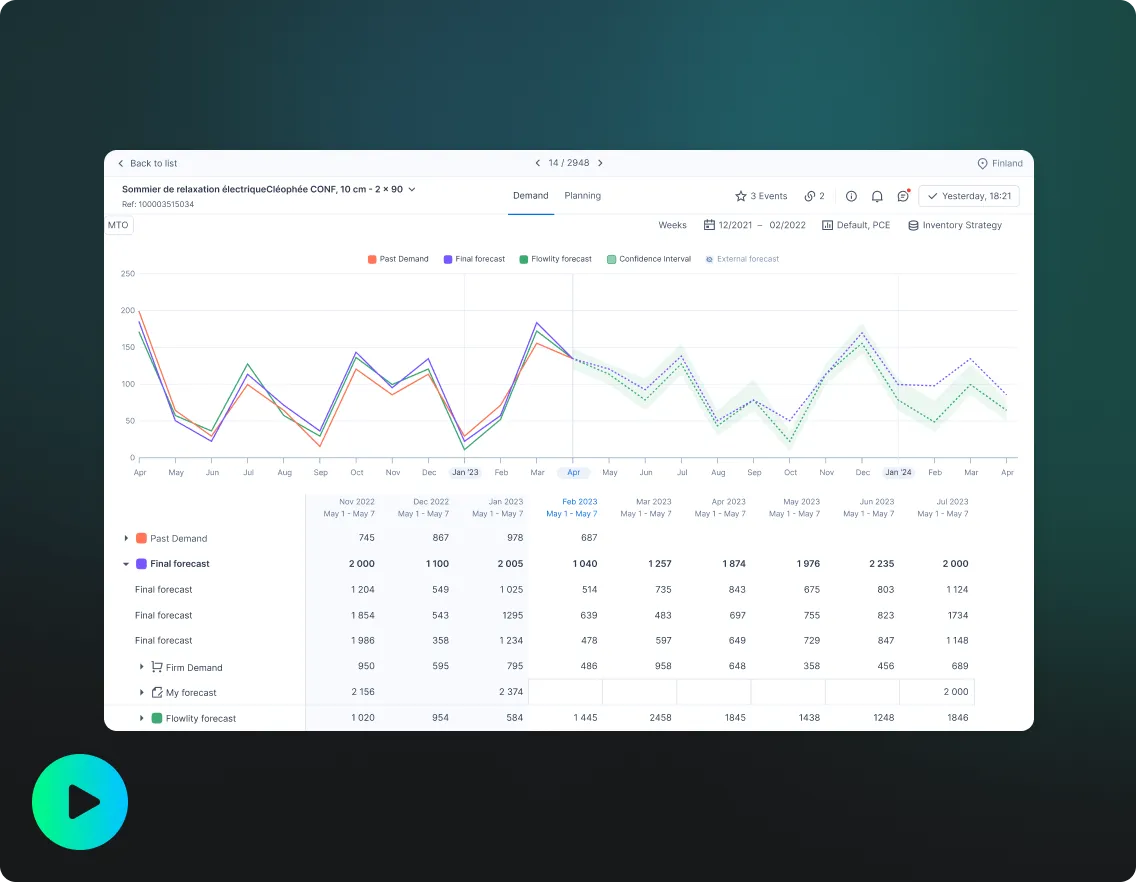
Découvrez comment la demande passée est automatiquement dépolluée (pénuries et anomalies passées), les prévisions automatiquement créées et ajustables à tous niveaux de granularité.

Réagissez plus vite à la volatilité de la demande

Évitez les ruptures et le surstock

Moins de gestion de crise pour les planificateurs
Comment les logiciels de demand sensing captent les signaux en temps réel pour ajuster votre Supply Chain
Pourquoi la volatilité de court terme est la vraie menace pour vos taux de service

La plupart des disruptions Supply Chain n'arrivent pas avec plusieurs semaines de préavis. Un pic soudain de sell-through dans un point de vente clé, un événement météo inattendu qui modifie le comportement consommateur, une rupture chez un concurrent qui redirige la demande vers vos produits : ces variations se jouent en quelques jours, parfois quelques heures. Et quand un cycle de planification mensuel traditionnel rattrape son retard, le mal est fait : les ruptures dégradent le taux de service, ou le surstock immobilise du BFR.
C'est ici que le demand sensing prend toute sa place dans la Supply Chain. Contrairement aux méthodes de planification long terme qui s'appuient sur des historiques projetés sur plusieurs mois, le demand sensing opère sur un horizon beaucoup plus court : typiquement quelques jours à quelques semaines. Il ingère en continu des signaux temps réel (données POS, schémas de commandes, indicateurs externes) pour détecter les changements dès qu'ils émergent. L'objectif n'est pas de remplacer votre processus global de prévision de la demande, mais d'affiner la vision court terme pour que vos équipes agissent avant que la volatilité ne se transforme en perte de chiffre d'affaires ou en gaspillage.
Pour les entreprises du retail et du e-commerce, où les promotions, la saisonnalité et les tendances de consommation évoluent rapidement, cette réactivité est essentielle. Mais la même logique s'applique aux environnements industriels, où les délais matières premières et les plannings de production exigent une visibilité précoce sur les évolutions de demande pour éviter des ajustements coûteux en aval.
Comment le processus de demand sensing fonctionne en pratique
Le processus de demand sensing peut se décomposer en quelques étapes clés, chacune s'appuyant sur la précédente pour réduire le délai entre un signal de marché et une réponse opérationnelle.
Ingestion des signaux
C'est le point de départ. Les solutions de demand sensing récupèrent des données depuis un large éventail de sources :
- Sell-through et données POS
- Commandes en cours et suivi d'expéditions
- Positions de stock sur l'ensemble du réseau
- Indicateurs externes comme la météo, les indices économiques ou les calendriers d'événements
Plus les données sont granulaires et fréquentes, plus le système détecte précisément les patterns émergents.
Détection des patterns et ajustement
Les algorithmes d'IA et de machine learning analysent ces signaux entrants par rapport au plan court terme existant. Plutôt que de reconstruire une prévision depuis zéro, le système identifie les écarts (une accélération soudaine de la vitesse de vente sur un SKU précis dans un site précis, par exemple) et ajuste la vision court terme en conséquence. Cela se fait automatiquement et à un niveau de granularité (SKU × site × jour) qui serait impossible à atteindre manuellement.
Output actionnable
C'est ce qui distingue un vrai demand sensing d'un simple monitoring de signaux. La vue court terme ajustée alimente directement les décisions de réapprovisionnement, l'ordonnancement de production et les processus de gestion des stocks. Les planificateurs n'ont pas à revoir chaque ajustement : ils se concentrent sur les exceptions et les écarts à fort impact signalés par le système, ce qui correspond exactement au fonctionnement des alertes et de la priorisation pilotées par l'IA chez Flowlity.
Pour explorer comment les modèles probabilistes alimentent ce type d'ajustement temps réel, le webinaire sur les modèles de prévision Supply Chain IA et l'approche probabiliste approfondit la méthodologie.
Que rechercher dans une solution de demand sensing
Toutes les solutions de demand sensing ne créent pas la même valeur. Lors de l'évaluation, plusieurs capacités séparent les outils efficaces de ceux qui ajoutent de la complexité sans amélioration réelle.
Granularité et fréquence des mises à jour
Les meilleures solutions de demand sensing opèrent au niveau SKU-site et se rafraîchissent au jour le jour, voire en intra-day. Si un outil n'actualise que chaque semaine ou ne travaille qu'au niveau famille de produits agrégée, l'avantage de réactivité disparaît.
Étendue et flexibilité des signaux
Votre solution doit être capable d'ingérer des données internes (POS, commandes, expéditions, stocks) en parallèle de signaux externes (météo, indicateurs de marché, événements) sans exiger des mois d'intégration sur mesure. Les ETI ont particulièrement besoin de solutions qui se connectent rapidement à leurs ERP et sources de données existants : c'est un principe de design central de l'architecture plug-and-play de Flowlity.
Explicabilité et confiance des planificateurs
Le demand sensing ne fonctionne que si les planificateurs comprennent et acceptent les signaux ajustés. Les algorithmes boîte noire qui produisent des changements inexpliqués génèrent de la résistance. Cherchez des solutions qui exposent le "pourquoi" derrière chaque ajustement :
- Quel signal a déclenché le changement
- Quel est le niveau de confiance du modèle
- Quel est l'impact attendu
Flowlity répond à cet enjeu via des dashboards et analytics transparents qui montrent exactement quels facteurs pilotent chaque recommandation.
Intégration au workflow de planification global
Le demand sensing ne doit pas exister comme module isolé, déconnecté du reste de votre planification Supply Chain. Il doit alimenter sans friction les processus S&OP, l'optimisation des stocks et l'approvisionnement des points de vente, créant une boucle continue plutôt qu'un flux de données séparé.
Demand sensing par secteur : des rayons retail aux lignes de production
Le demand sensing dans la Supply Chain n'est pas une capacité "taille unique". Les signaux qui comptent, la vitesse de réponse attendue et les actions en aval varient fortement selon le secteur.
Retail et e-commerce
Dans le retail et le e-commerce, le demand sensing est principalement piloté par les données POS et de sell-through. Les promotions, les ajustements de prix concurrents et même les tendances sur les réseaux sociaux peuvent provoquer des changements rapides du comportement d'achat. Pouvoir détecter qu'une promotion surperforme (ou sous-performe) en 24 à 48 heures et ajuster le réapprovisionnement en conséquence peut faire la différence entre capter du chiffre d'affaires incrémental et faire face à des rayons vides, ou à des montagnes d'invendus.
Pour les retailers qui évaluent des outils de planification IA, l'article sur les meilleurs logiciels de demand planning pour les PME fournit un cadre de comparaison utile.
Industrie
Dans l'industrie, les signaux sont différents mais tout aussi sensibles au temps. Les schémas de prises de commande, les niveaux de stock chez les distributeurs et la disponibilité matières premières influencent tous la façon dont les plannings de production doivent être ajustés à court terme. Un industriel qui détecte une hausse soudaine de commandes d'un distributeur clé peut sécuriser de manière proactive les matières premières et ajuster les séries de production, en évitant retards et coûts d'expédition urgente.
Pour aller plus loin sur le lien entre détection temps réel et réapprovisionnement matières premières, le livre blanc sur la gestion de la volatilité et l'impact Supply Chain via un réapprovisionnement matières plus intelligent explore ce sujet en détail.
Dans les deux cas, le fil rouge est la vitesse : réduire la latence entre l'apparition d'un signal de demande sur le marché et la réponse de la Supply Chain.
L'impact mesurable du demand sensing sur la performance Supply Chain
Le business case du demand sensing repose sur des améliorations concrètes et mesurables sur plusieurs dimensions.
Amélioration de la précision court terme
Les entreprises qui déploient le demand sensing observent généralement une amélioration de 20 % à 40 % de leur précision court terme (1 à 14 jours) par rapport à un plan de base seul. Il ne s'agit pas d'être "plus juste en moyenne" : il s'agit de capter les moments précis où la réalité diverge du plan.
C'est exactement ce que délivre le moteur probabiliste de Flowlity. Saint-Gobain, par exemple, a amélioré sa précision de prévision de 15 % et porté son taux de service de 95,8 % à 97,2 % après le déploiement de Flowlity, ce qui se traduit par moins de ventes manquées et une lecture plus fine de la demande court terme réelle sur l'ensemble de son réseau de distribution.
Protection du taux de service
Lorsque le système détecte qu'une demande s'accélère au-delà du plan sur un site précis, il peut déclencher des actions de réapprovisionnement avant que la rupture n'arrive. Ravate, retailer multi-catégories, a amélioré son taux de service de 6,3 % après avoir déployé les capacités de demand sensing de Flowlity, ce qui se traduit directement par du chiffre d'affaires protégé et une meilleure disponibilité en rayon.
Efficience des stocks
Mieux capter la demande ne veut pas dire stocker plus : cela veut dire stocker plus intelligemment. En identifiant les phases de décélération de la demande, les entreprises évitent le sur-approvisionnement et réduisent les excédents. Magotteaux, par exemple, a réduit la valeur de son inventaire de 13 % et sa couverture de stock de 22 % tout en diminuant ses ruptures de 8 %, parce que le système distingue les vrais déplacements de demande du bruit.
Productivité des planificateurs
Sans demand sensing, les planificateurs passent un temps significatif à revoir manuellement les prévisions, à traquer des signaux entre tableurs et dashboards, et à éteindre des incendies quand surviennent les surprises. Un demand sensing automatisé réduit cette charge réactive et libère les planificateurs pour des activités à plus forte valeur ajoutée comme la gestion des exceptions et les décisions stratégiques.
Comment Flowlity aborde le demand sensing différemment
La capacité de demand sensing de Flowlity s'appuie sur un moteur IA probabiliste qui ne fournit pas seulement un chiffre ajusté unique : il livre une plage d'issues probables pour chaque SKU sur chaque site, assortie d'un niveau de confiance. C'est essentiel parce que tous les signaux n'ont pas le même poids et toutes les variations de demande n'appellent pas la même réponse.
Des alertes priorisées, pas du bruit
Plutôt que d'obliger les planificateurs à valider aveuglément ou à corriger manuellement chaque ajustement, l'approche Flowlity ne met en avant que les écarts significatifs : les signaux qui méritent vraiment une attention. Le système capte les signaux faibles issus des tendances de vente, des promotions, des ruptures, de la météo et des événements externes, puis les remonte sous forme d'alertes priorisées. Les planificateurs voient exactement ce qui a changé, pourquoi et quelle est l'action recommandée.
Conçu pour les ETI, pas seulement pour les grands groupes
Ce design reflète un principe fondateur : le demand sensing doit réduire la complexité, pas l'ajouter. Beaucoup de solutions enterprise sur ce segment exigent des mois d'implémentation et des équipes data science dédiées pour fonctionner. Flowlity est conçu pour les ETI qui veulent le même niveau de réactivité pilotée par l'IA, sans la lourdeur :
- Déploiement rapide, grâce à des connecteurs ERP pré-intégrés
- Outil intuitif, sans équipe data science requise
- Intégration fluide dans les workflows de planification quotidiens, aux côtés de l'optimisation des stocks et du Sales and Operations Planning
Interrogez vos signaux de demande via une IA conversationnelle
Avec le serveur MCP Flowlity Co-planner, les planificateurs peuvent désormais poser des questions sur la précision des prévisions, les écarts de demande et les niveaux de stock directement depuis Claude, ChatGPT ou Microsoft Copilot, en langage naturel. Aucun dashboard à naviguer, aucun rapport à exporter : l'assistant IA interroge vos données Flowlity en temps réel et explique ce qui se passe, y compris la raison pour laquelle un SKU précis dévie du plan.
FAQ
Find everything you need to know right here.
Qu'est-ce que le demand sensing ?
Le demand sensing est une capacité Supply Chain à court terme qui utilise l'IA, le machine learning et des signaux de données en temps réel pour détecter et réagir aux variations de la demande au moment où elles se produisent. Contrairement aux approches de planification traditionnelles qui s'actualisent mensuellement ou hebdomadairement sur la base de moyennes historiques, le demand sensing analyse en continu les signaux du marché — données de vente en point de vente, schémas de commandes, niveaux de stock et facteurs externes — pour ajuster les prévisions à court terme à un niveau granulaire (typiquement SKU × site × jour).
L'objectif n'est pas de prévoir la demande à plusieurs mois, mais d'affiner les 1 à 14 prochains jours du plan afin que les décisions de réapprovisionnement, de production et d'allocation reflètent ce qui se passe réellement sur le marché. C'est un complément puissant au processus de prévision de la demande global. Le moteur probabiliste de Flowlity est conçu précisément pour cela : il recalibre en continu les prévisions court terme au niveau SKU-site, offrant aux planificateurs une vision de la demande toujours actualisée sans retravail manuel.
Quelle est la différence entre demand sensing et prévision de la demande ?
Le demand sensing et la prévision de la demande remplissent des rôles différents mais complémentaires dans la planification Supply Chain.
La prévision de la demande opère généralement sur un horizon plus long — de plusieurs semaines à plusieurs mois — et s'appuie fortement sur les historiques de ventes, la saisonnalité et l'analyse de tendances pour construire un plan de base. Elle répond à la question : à quoi s'attend-on en termes de demande sur la période à venir ?
Le demand sensing opère sur un horizon beaucoup plus court — de quelques jours à deux semaines — et se concentre sur la détection des écarts par rapport au plan grâce à des signaux en temps réel. Il répond à une autre question : que se passe-t-il réellement maintenant, et comment s'ajuster ?
Autrement dit : la prévision fixe le cap, et le demand sensing effectue les corrections de trajectoire en temps réel. Flowlity combine les deux dans une seule plateforme — le moteur probabiliste construit la prévision de base et l'ajuste en continu avec le sensing temps réel, pour que les planificateurs travaillent à partir d'une vue unifiée plutôt que de réconcilier deux outputs séparés.
Quels types de données le demand sensing utilise-t-il ?
Les solutions de demand sensing ingèrent un large éventail de données internes et externes :
Signaux internes : données de vente en point de vente et sell-through, commandes clients en cours, données d'expédition et de livraison, niveaux de stock en temps réel sur l'ensemble du réseau, calendriers promotionnels.
Signaux externes : données météorologiques, indicateurs économiques, tendances sur les réseaux sociaux, activité concurrentielle, événements locaux et jours fériés, évolutions d'indices de marché.
L'essentiel réside dans la fréquence et la granularité. Le demand sensing fonctionne au mieux lorsque les données sont actualisées quotidiennement ou plus fréquemment, et lorsqu'il opère au niveau SKU-site individuel plutôt que par catégories agrégées. La plateforme Flowlity ingère tous ces signaux via des connecteurs ERP pré-intégrés, ce qui signifie que les entreprises n'ont pas besoin de pipelines de données sur mesure ni de ressources dédiées en data engineering pour commencer à tirer parti du demand sensing.
Comment le demand sensing améliore-t-il la gestion des stocks ?
Le demand sensing a un impact direct et mesurable sur la performance des stocks. En détectant les accélérations de demande de manière précoce, il déclenche des réapprovisionnements en temps voulu pour prévenir les ruptures. Tout aussi important, lorsque la demande décélère, il empêche le sur-approvisionnement qui génère des excédents, des démarques ou du gaspillage — un enjeu critique dans l'alimentaire, les boissons et les produits périssables.
L'effet net est un alignement plus fin entre les niveaux de stock et la demande réelle du marché : une meilleure disponibilité avec moins de stock total. Saint-Gobain, par exemple, a obtenu une réduction de 9,25 % de ses niveaux de stock avec Flowlity, car le système recalibre en continu la position de stock optimale sur la base de signaux temps réel plutôt que de règles de stock de sécurité statiques.
Le demand sensing fonctionne-t-il pour les ETI, pas seulement les grands groupes ?
Absolument — et c'est précisément le terrain de jeu quotidien de Flowlity. Historiquement, le demand sensing n'était accessible qu'aux grandes entreprises disposant d'équipes data science dédiées et de budgets d'implémentation pluriannuels. Aujourd'hui, Flowlity rend le demand sensing accessible aux ETI grâce à une architecture plug-and-play qui se connecte aux systèmes ERP existants sans projets IT lourds.
Les clients Flowlity vont d'entreprises de 45 personnes comme Plum Living, une marque digitale d'ameublement gérant environ 1 000 SKUs, à des industriels comme Magotteaux et des distributeurs multi-catégories comme Ravate. Ce qu'ils partagent, c'est le besoin d'une réactivité pilotée par l'IA sans la lourdeur des outils enterprise. Pour les équipes encore plus petites, Flowlity Lite offre un accès accéléré au forecasting IA avec un setup minimal.
Le demand sensing remplace-t-il le S&OP ?
Non — le demand sensing renforce le S&OP, il ne le remplace pas. Le S&OP est un processus transversal qui aligne les plans commerciaux, opérationnels et financiers sur un horizon moyen à long terme. Le demand sensing opère sur un horizon beaucoup plus court et alimente ce processus avec des signaux court terme plus précis.
En pratique, le demand sensing améliore la qualité de l'input demande qui entre dans le cycle S&OP. Quand la vision court terme est plus précise, les discussions S&OP peuvent se concentrer sur les décisions stratégiques et les exceptions plutôt que de débattre de la fiabilité des chiffres. Flowlity est conçu avec cette intégration en tête — le demand sensing alimente directement le workflow S&OP, faisant passer la conversation de « est-ce que la prévision est juste ? » à « que fait-on face aux écarts détectés ? ».
En combien de temps peut-on déployer le demand sensing ?
Les délais de déploiement varient selon la maturité des données et la complexité de la Supply Chain. Les plateformes enterprise peuvent prendre 6 à 12 mois voire plus. Flowlity est conçu pour un time-to-value rapide, et les déploiements terrain le prouvent.
Plum Living, une entreprise de design d'intérieur de 45 personnes, est passée en production avec Flowlity sur 630 SKUs et 2 entrepôts — et a obtenu une réduction de stock de 21 % dès le go-live. Supply Caddy, client Flowlity Lite, a généré ses premières prévisions IA instantanément après la signature et était pleinement opérationnel en moins de deux semaines.
Les déploiements classiques pour les ETI prennent des semaines plutôt que des mois, grâce aux connecteurs pré-intégrés pour les principaux ERP et une architecture cloud-native qui élimine les besoins en infrastructure IT lourde.