

Flowlity vs B2wise is a choice between two ways of sizing the same buffers. B2wise applies Demand Driven Material Requirements Planning (DDMRP), a demand-driven approach: buffers are sized from recent consumption, through rules that planners maintain and adjust. Flowlity is uncertainty-driven: it sizes each buffer from a probabilistic forecast that measures how volatile demand and supplier lead times really are, item by item. Teams exposed to volatile markets usually fit Flowlity; teams committed to the DDMRP doctrine, B2wise.
DDMRP was born from a simple observation: forecasts are always wrong, so planners should stop chasing them and protect flow with buffers instead.
Today, the most convincing answer to volatility turns that logic around. A probabilistic forecast does not pretend to know the future: instead of one number, it gives the full range of likely demand and the odds of each outcome. That is exactly the information a buffer needs, as our comparison of DDMRP, MRP and probabilistic AI explains in detail.
This is where B2wise and Flowlity part ways. Both replace forecast-driven push planning with buffers, and both target manufacturers and distributors tired of being overstocked and out of stock at the same time. The difference is what the buffer knows about the future.
“Rules are not intelligence. DDMRP is demand-driven, but not demand-aware: its buffers react to what consumption just did, adjusted by planners, rather than to the measured odds of what comes next.”
Jean-Baptiste Clouard, CEO and co-founder of Flowlity
For a mid-market Supply Chain team facing volatile demand and variable lead times, and wanting per-SKU buffers without a multi-quarter methodology change, Flowlity is the closer fit. For a team that has chosen DDMRP as its planning doctrine and wants software and certified training built around it, B2wise is a legitimate specialist.
This guide compares both on the same grid: buffer logic, today's Supply Chain pressures, operating model, AI, deployment and fit.
B2wise and Flowlity in brief
B2wise in brief
B2wise is a DDMRP specialist that sells software, training and support together, and describes itself as a training company before a software editor.
- Founded in 2016 by Kevin and Trevor Boake with DDMRP pioneer Laurent Vigouroux, with UK and French roots
- Suite: DDMRP materials planning, scheduling and execution, demand forecasting and Sales and Operations Planning (S&OP), plus CommWise, an AI studio to build planning apps, dashboards and workflows
- Training: Demand Driven Institute, ASCM and in-house programs, with more than 12,000 people trained
- Market: 200+ clients reported, public references including LVMH, Legrand, Air Liquide and Johnson Controls, and a 2026 growth partnership with Sundance Growth to launch in the United States
- Rating: 4.6/5 on G2 across 5 reviews
Flowlity in brief
Flowlity is an AI-native Supply Chain planning platform where AI agents run the routine plan and planners lead by exception. Probabilistic forecasting is one of its core capabilities: it plans from the range of likely outcomes rather than a single number.
- Founded in 2019 in France, with an in-house research team including PhDs in statistics and optimization
- Engine: demand and supplier lead times forecast as ranges of likely outcomes, buffers sized from that uncertainty, planning agents handling routine decisions
- Scope: demand planning, inventory optimization, supply planning and production capacity, collaborative planning with suppliers, Supply Chain strategy and Sales and Operations Planning (S&OP), plus pricing, promotion and assortment planning for retail
- Customer size: Flowlity's customers range from small businesses on Flowlity Lite to bigger companies with high Supply Chain complexity on Flowlity Core
- Recognition: 4.9/5 on G2, Gartner Cool Vendor in Supply Chain 2025, Accelerator in the Nucleus Research SMB Supply Chain Planning Value Matrix
Same diagnosis, different cure: how each platform sizes a buffer
Both platforms start from the same idea: buffers placed at the right points protect flow better than a single forecast pushed through the bill of materials. Independent work backs that idea: a capstone at the MIT Center for Transportation & Logistics found that DDMRP outperforms heuristics-based planning and comes close to solver-based planning under uncertainty. The difference lies in who, or what, decides how big each buffer should be.
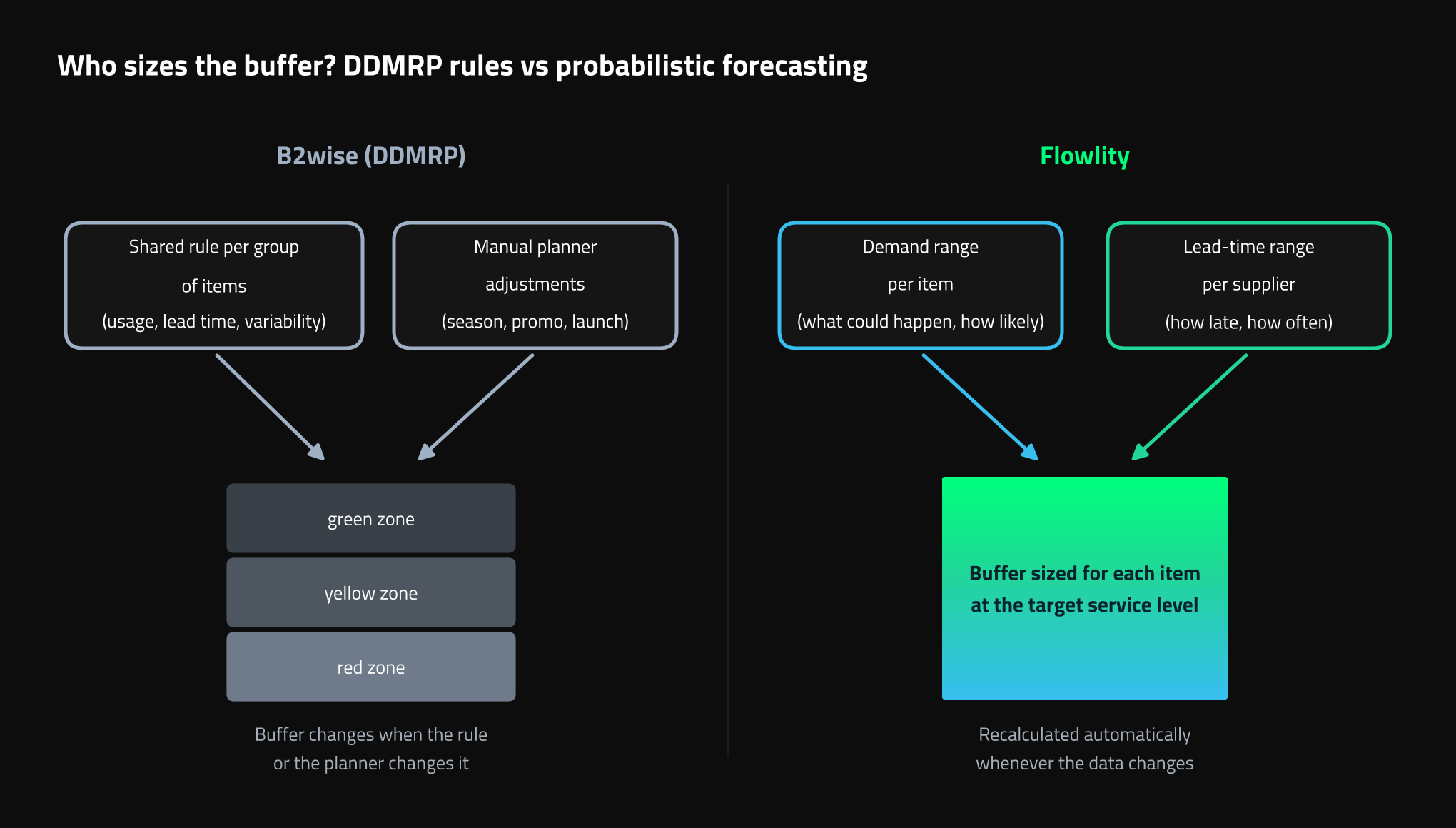
With B2wise, the buffer follows the DDMRP rules defined by the Demand Driven Institute. It is calculated from average daily usage (ADU), meaning the average quantity consumed per day over a recent or planned period, multiplied by the lead time and adjusted by a variability setting shared by a group of similar items. When planners know something is coming, a promotion, a season or a launch, they adjust the buffer by hand.
B2wise does use machine learning, but around the buffer rather than inside it: to forecast demand for planning and S&OP views, and to help decide where buffers should sit. How big each buffer is still comes from the DDMRP formula and the planner's adjustments.
In Flowlity, however, the forecast is the buffer: the same probabilistic model that predicts demand also sizes the stock that covers it.
With Flowlity, the buffer comes from the forecast itself. For every item, the engine estimates how much demand could reasonably vary and how late the supplier could be, then holds just enough stock to reach the target service level. When the data changes, the buffer changes, without anyone editing a setting. A shared rule tends to over-protect stable items and under-protect volatile ones; a per-item buffer avoids both, which is how inventory optimization can lower stock and raise service at the same time.
Want to see how the three DDMRP zones add up on your own numbers? Try our DDMRP buffer zone builder.
Where rules lag: tariffs, moving lead times and the long tail
The conditions DDMRP was designed for, relatively stable usage behind well-chosen decoupling points, are what 2026 has eroded. Trade-policy changes reshape sourcing and prices, and Gartner expects disruptions to keep rising, to the point of predicting that 60% of them will be resolved without human intervention by 2031.
Gartner also expects that autonomy to arrive first in routine decisions such as replenishment, while strategic choices like inventory policy stay with people. Both trends favor buffers that recalculate themselves.
Let’s explore three situations where the two approaches diverge.
When demand changes regime
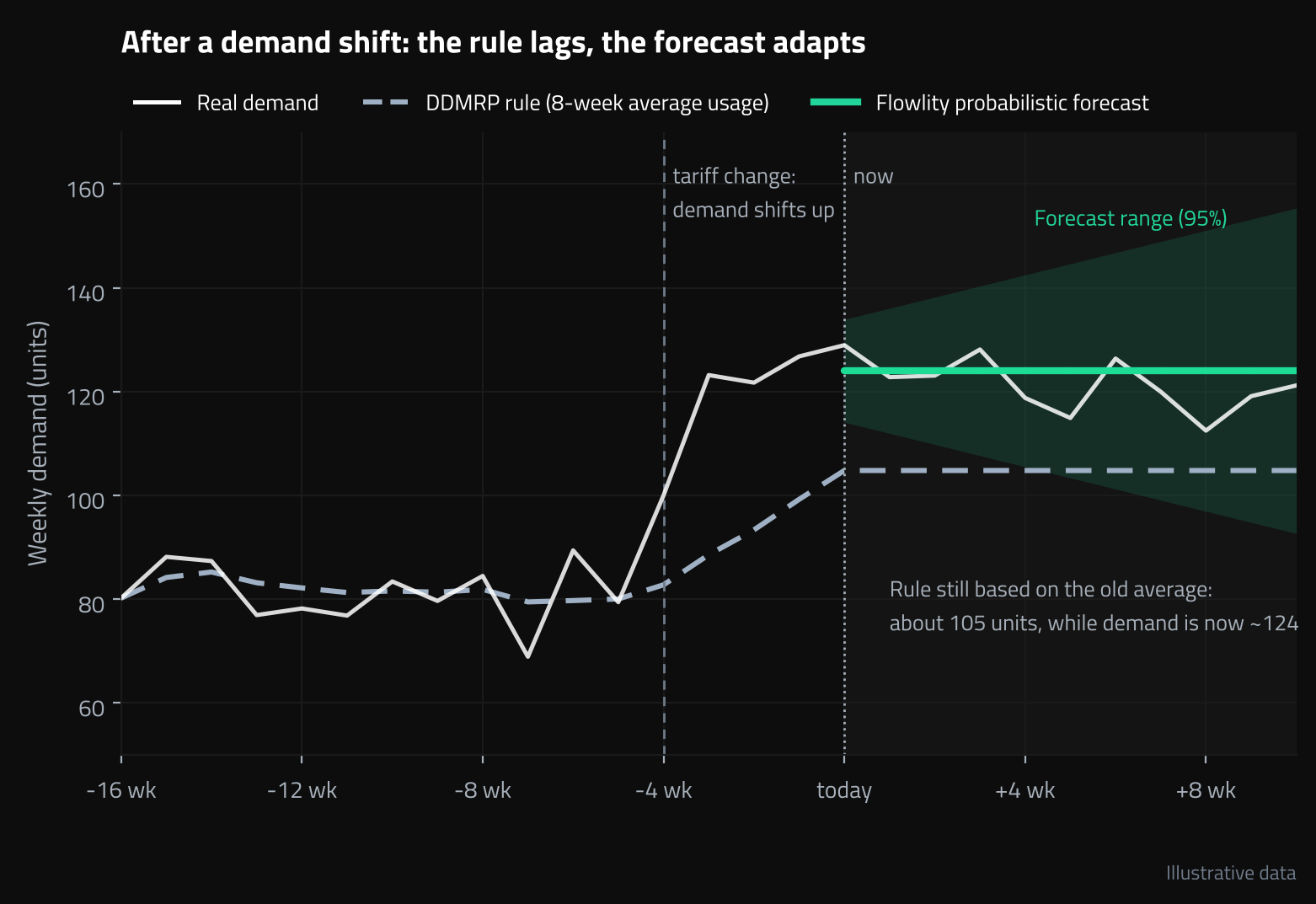
When a tariff or a price change shifts demand durably, a DDMRP buffer only catches up as ADU drifts or once a planner enters an adjustment. A probabilistic model re-estimates the distribution as soon as the new pattern shows, and scenario simulation lets the team test a sourcing shift before committing to it.
When lead times move
DDMRP treats lead time as a qualified parameter plus a supply variability factor per profile. Flowlity forecasts it per supplier.
Imagine a supplier that systematically ships later in one month of the year. For instance, a supplier in Asia whose usual lead time is 30 days, but who ships in about 45 days every year in late January and February, when factories close for Lunar New Year.
A DDMRP buffer uses a qualified lead time of 30 days plus a variability factor set for the whole profile. Unless a planner remembers to adjust it, orders placed in early January arrive two weeks late and the item runs out in February.
Flowlity forecasts lead time per supplier from past receipts, so it learns that seasonal pattern. From December, the recommended orders already account for the slower supplier, and the stockout never happens.
In a nutshell: a learned lead time anticipates the delay, while a fixed one discovers it at the stockout.
When demand is sparse or history is censored
ADU is fragile on intermittent items, and consumption history is censored whenever supply was rationed or out of stock: a week with zero sales because the shelf was empty looks like a week with zero demand.
In Flowlity, a dedicated Anomalies Agent cleans the history first. It flags and replaces stockouts, lost sales, promotional spikes and one-off outliers, so the forecast learns from real demand. The engine then models intermittent demand as a distribution, which matters most on the slow movers that quietly turn into dead stock.
Assisted manual planning vs automated planning
DDMRP is a planner-centric method. Planners maintain buffer settings, review zones and act on priorities, which is why B2wise pairs its software with certification programs. Done well, it builds real Supply Chain discipline, but the workload grows with every new item, site and supplier.
Flowlity automates the routine instead. Planning agents propose replenishment and recalculate buffers every night, and planners spend their time on the exceptions where their judgement matters. That is what lets a team absorb growth without adding headcount: Camif absorbed 44% growth with a constant logistics headcount, and SupplyCaddy's co-founder Bradley Saveth sums it up: “Flowlity has enabled us to do the job of three or four people without needing three or four people.”
No certification program is needed either, because the platform is built for everyone in the team. Nucleus Research ranks Flowlity among the most usable Supply Chain planning solutions for SMBs.
At Telenco, the Supply Chain Planning Manager sums up the day-to-day difference: “Every month, planning took me a full week. Today I do the same work in a single day.”
The results follow quickly: over its first 6 months on Flowlity, Telenco reduced its stock value by 11% across the 486 items it plans.
CommWise vs Flowlity Co-planner: two ways to put AI in planners' hands
Both vendors now offer an AI layer that planners talk to, but the two products are built for different jobs. CommWise, B2wise's AI studio, is designed to build things around the DDMRP core: small planning apps, dashboards, workflows and algorithms, generated from conversational inputs and governed by the company. The Flowlity Co-planner is designed to work on the plan itself: planners ask questions about live forecasts, buffers and orders, test a scenario or accept a recommended order, in plain language.
That openness is already concrete: the Co-planner is today the only Supply Chain planning solution available in OpenAI's ChatGPT app directory.
In short, CommWise makes the DDMRP software easier to extend, while the Co-planner makes the planning engine easier to use and act on. For a team short on planners, the second changes the daily workload more; for a team with very specific reporting or process needs, the first adds flexibility.
Deployment: what each approach asks of your team
What really separates the two deployments is the effort each approach asks of the organization. A DDMRP rollout is also a change of method: B2wise combines education, transformation, software and support, so planners are trained and certified, and buffer positions and settings are designed with the team across the network.
Flowlity onboards data-model-first, with pre-built data cleaning and automated tuning, so most of the work is connecting data rather than retraining people. Plum Living, a direct-to-consumer furniture retailer, went live in three months and cut inventory 21% at go-live. For smaller companies, Flowlity Lite needs no heavy integration project: teams import a file and can be live in two weeks, as SupplyCaddy, a US foodservice packaging manufacturer, was.
Flowlity vs B2wise comparison table
Which platform fits which company
B2wise is a purpose-built choice for manufacturers that have adopted DDMRP as their planning doctrine. They are typically process and discrete manufacturers in industrial products, building materials, chemicals or cosmetics, with deep bills of materials and long lead times, and often larger groups that want certified training for their planners and a demand-driven community around them.
Flowlity fits mid-market manufacturers, distributors and retailers whose portfolios mix fast movers with long-tail, seasonal or erratic items, and whose suppliers' lead times move. These companies want per-SKU buffers and routine planning automated without a methodology program, and would rather spend planner time on decisions than on settings, which is where an AI-driven demand planning approach like Flowlity pays off. Smaller companies leaving spreadsheets, with no planning team or ERP project to spare, can start on Flowlity Lite.
Whatever the shortlist, one test separates the two models better than any demo. Take a seasonal SKU from a supplier whose lead time varies, and ask each vendor to show on your own data how the buffer moves when demand shifts, why it moved, and what it costs in working capital. Buyers weighing other rule-based tools can also read how Flowlity compares with Slimstock.
Choosing between a DDMRP specialist and a probabilistic engine
The Flowlity vs B2wise decision is not about which product runs DDMRP better. It is a choice between two answers to the same good idea. B2wise is the specialist for teams that have adopted DDMRP as a doctrine and want software, training and a community built around its rules. Flowlity is the AI-native engine for teams that want the demand-driven benefit, buffers instead of forecast-chasing, sized from per-SKU probability rather than profile rules, run by agents, and live in weeks or months rather than after a methodology program. Match the model to your portfolio, your volatility and your appetite for transformation.
Our position is clear: DDMRP was a real step forward from classic MRP, but rules maintained by hand cannot keep pace with today's volatility.
“Buffers, yes; static rule-based buffers, no. An AI-driven buffer is the DDMRP philosophy taken to its logical conclusion with modern mathematics.”
Jean-Baptiste Clouard, CEO and co-founder of Flowlity
See how Flowlity sizes adaptive, per-SKU buffers on your own data. Book a demo.
Level up your supply chain with AI.
Get a demo

FAQ
Find everything you need to know right here.
What is B2wise?

B2wise is a Supply Chain planning software and training company founded in 2016, specialized in Demand Driven Material Requirements Planning (DDMRP). Its suite covers DDMRP materials planning, scheduling and execution, demand forecasting and Sales and Operations Planning (S&OP), plus CommWise, an AI studio for building dashboards, workflows and planning apps. It integrates with more than 40 ERPs, including SAP, Microsoft Dynamics 365, NetSuite and Sage X3.
Training is a core part of the offer: B2wise runs Demand Driven Institute, ASCM and in-house programs and reports more than 12,000 people trained. Its public references include LVMH, Legrand, Air Liquide and Johnson Controls, and a 2026 growth partnership with Sundance Growth supports its launch in the United States.
What is the main difference between Flowlity and B2wise?
It comes down to how each platform sizes a buffer. B2wise applies DDMRP: buffers are sized in red, yellow and green zones from average daily usage, a qualified lead time and variability factors set per buffer profile, with planners adding adjustments for known events.
Flowlity sizes each buffer from a probabilistic forecast of demand and supplier lead time computed for that specific SKU, so the buffer reflects the item's measured risk and recomputes as new data arrives.
The operating model follows from that choice: B2wise relies on certified planners maintaining profiles, while Flowlity lets AI agents handle routine replenishment and brings only exceptions to planners.
Does B2wise use AI?
Yes, in three places. Its demand forecasting module uses machine learning, running on the Forecast Pro engine, to produce forecasts that feed tactical and S&OP views. AI agents help clean data, recommend aggregation levels and position DDMRP buffers. And CommWise, its AI studio, lets companies build custom apps, dashboards and workflows from conversational inputs, connected to approved AI tools.
What AI does not change in B2wise is the core buffer logic: buffer sizes still come from DDMRP rules and planner adjustments. That is the main contrast with Flowlity, where AI sits inside the planning decision: probabilistic forecasts of demand and lead time size every buffer directly, planning agents run routine replenishment, and the Co-planner gives planners a conversational way to query and act on the plan.
Which is better for a small or mid-size company, Flowlity or B2wise?
It depends on the company's resources and method. A mid-size manufacturer already committed to DDMRP, with planners available for training and certification, can get a lot from B2wise's combination of software and education. A company without a dedicated planning team, or one moving off spreadsheets, usually needs a tool that does more of the work itself.
Flowlity Core serves mid-market companies with automated, per-SKU buffers and exception-based planning, and Flowlity Lite is built for small businesses: no heavy integration project, no ERP required, a file import to start, and go-live in about two weeks. Supply Caddy, a US foodservice packaging manufacturer, was live on Flowlity Lite in under two weeks.

