

Telenco: from Excel to automated demand planning


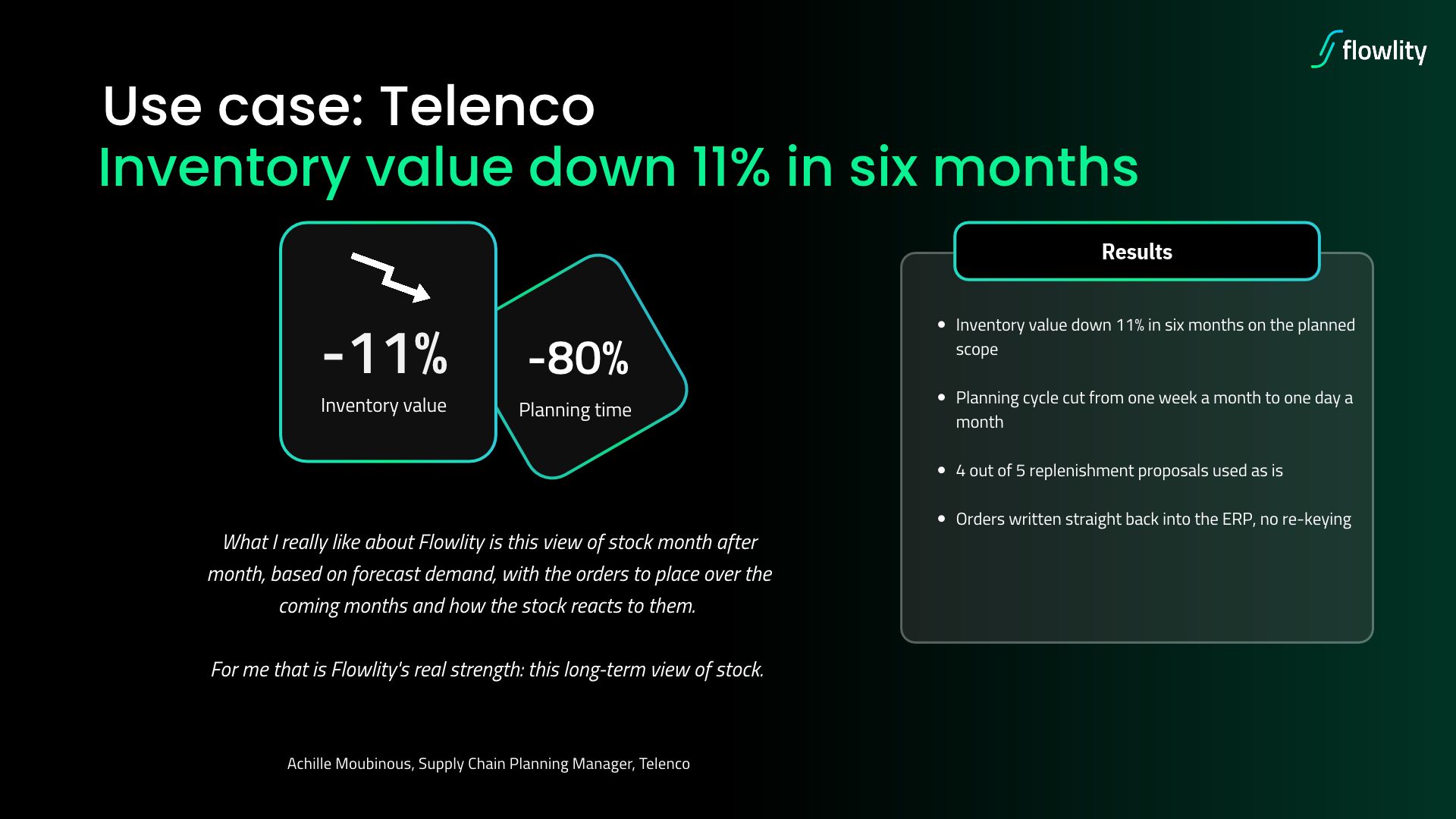
Telenco replaced Excel with Flowlity, a tool designed to automate demand planning connected to its Dynamics 365 ERP. The time needed to produce the monthly plan dropped from one week to a single day, representing an 80% reduction in planning time. Over the first six months of use, inventory value across the planned scope came down 11%.
Scope: 486 proprietary SKUs, manufactured in-house and outsourced, managed through planning at the Moirans site. Flowlity has been in production there for a year; inventory value was measured over the first six months of use. Approximately 1,600 trading SKUs have been managed on the supply side since summer 2026.
At a glance
Telenco, a French manufacturer of fiber-optic network equipment, previously managed its demand planning using Excel on a monthly cycle alongside its Dynamics 365 ERP. Within a year of adopting Flowlity, the time required to produce the plan dropped from one week per month to a single day, an 80% reduction in planning time for products Telenco manufactures in-house or outsources. Forecasts are now recalculated weekly instead of being rebuilt manually. Over six months, the inventory value within this scope decreased by 11%.
This case study outlines how Telenco moved away from spreadsheets, what automation changed in their planning routine, and the metrics the team measures today.
Context & industry: a fiber market that has reached maturity
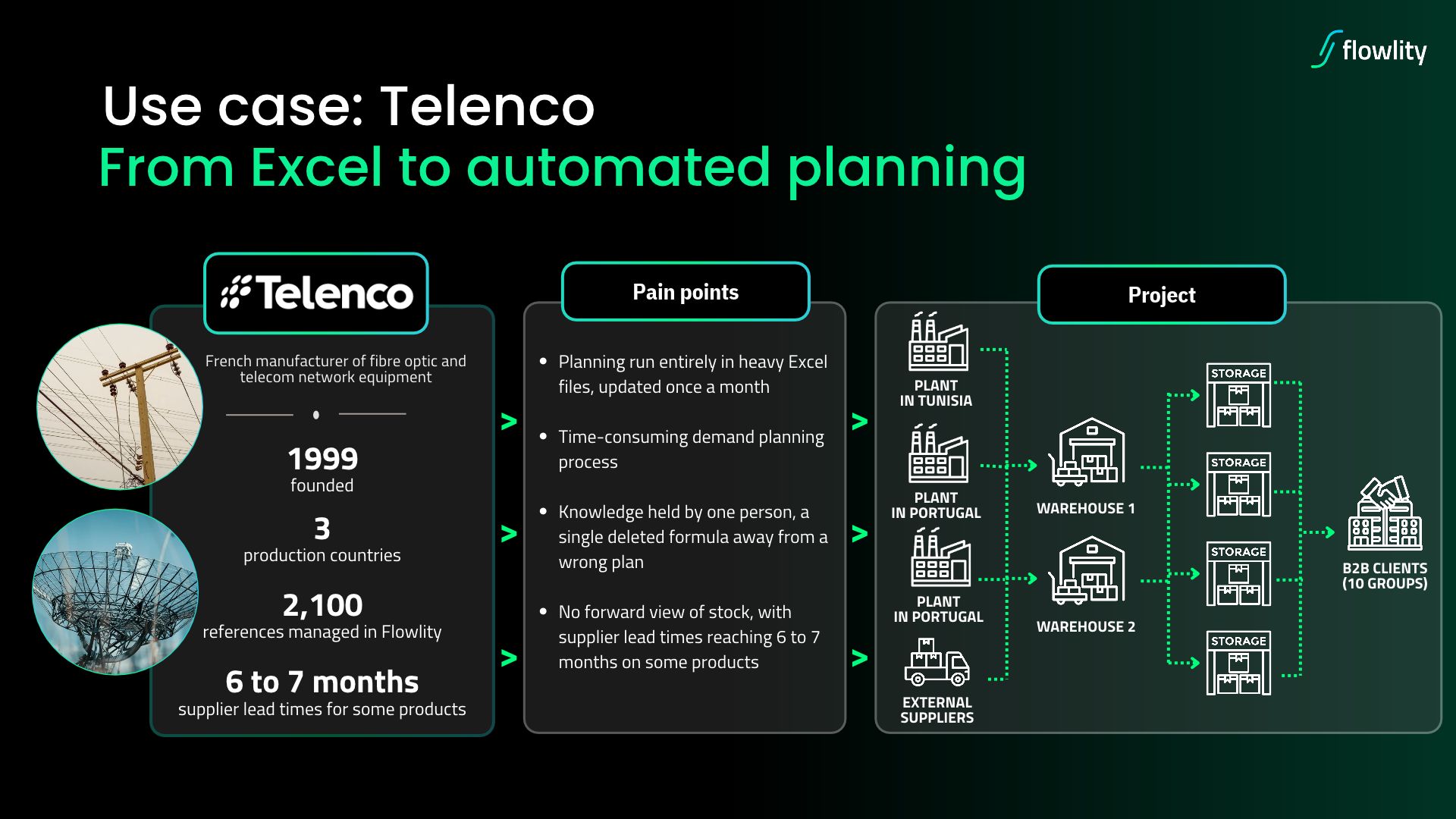
Since 1999, Telenco has manufactured telecom and datacom network equipment, including anchoring clamps, optical termination points, patch cords, and splice boxes. The company specialized in fiber optics starting in 2010. Home connection deployment drove strong growth post-COVID, but that expansion phase is now winding down: since 2020, French fiber rollouts have stabilized. As of June 30, 2026, 95.3% of premises were connectable (43.1 million out of 45.2 million, according to Arcep figures).
As a result, demand patterns are shifting toward export markets (led by Germany and Africa), maintenance and replacement, new segments like data centers, and new product lines like the composite poles Telenco has produced for the past year to replace wooden poles. These growth avenues bring new customers, altering the planning landscape: volumes are frequently driven by one-off projects, and supplier lead times reaching 6 to 7 months on certain items leave minimal room for late adjustments. It requires long lead time planing.
How Telenco planned demand before Flowlity
Heavy Excel files, and a process that ate the month
Every planning decision at Telenco lived in Excel: heavy workbooks, dense with formulas, dependent on a single person, and carrying replenishment against supplier lead times that reach 6 to 7 months on some products. Transactions were recorded and executed in the ERP, Dynamics 365 (Microsoft), but nothing was dedicated to planning.
"Before Flowlity, we worked with heavy Excel files, the knowledge sat with one person, and there were formulas all over the place. The smallest slip, a single deleted formula, could have fairly dramatic effects."
Achille Moubinous, Supply Chain Planning Manager, Telenco
This is the part tool comparisons leave out. The plan those files produced was not wrong. It relied entirely on one person's knowledge, and it costs a week of work to refresh every month. That is where the fragility sits: the day that person is gone, or a formula breaks, the whole process stops, on references whose replenishment can take six months.
A monthly cycle in a market that moves weekly
The second problem was rhythm. Rebuilding the plan meant pulling every sale of the month, analyzing it, comparing it against stock and open orders, then deducing what to order. Roughly a week of work, every month.
Between two cycles, the analysis stayed frozen on the last extract. An ERP is not built to answer that question: Dynamics 365 shows the orders already placed, not where inventory is heading over the coming months. Material requirements planning returns needs line by line, but it never shows the curve coming down, or the moment it crosses the threshold.
"In our ERP, we only saw the orders that had been placed. We had no view of the inventory curve coming down."
Achille Moubinous, Supply Chain Planning Manager, Telenco
Cédric Favre, Supply Chain Director for France, Tunisia and Portugal, summed up the blind spot before the rollout: a stockout does not announce itself, it shows up two months too late, when the only option left is emergency air freight.
Why Telenco chose Flowlity
Telenco selected Flowlity based on licensing costs, the quality of proposals submitted during evaluation, tool performance, and the overall flexibility of both the product and its team. Achille Moubinous also points to ergonomics, and above all ease of use: a powerful tool that stays simple enough for everyone to understand and use, not just an expert.
Technically, the principle is a planning layer sitting on top of the existing ERP, not a replacement. Flowlity reads required data directly from Dynamics 365, namely demand history, stock, open orders, and item and supplier parameters. It calculates forecasts and order proposals, then writes validated orders back into the ERP. Dynamics 365 remains the system of record and execution: nothing was replaced, a layer was added above.
What Flowlity changed for Telenco
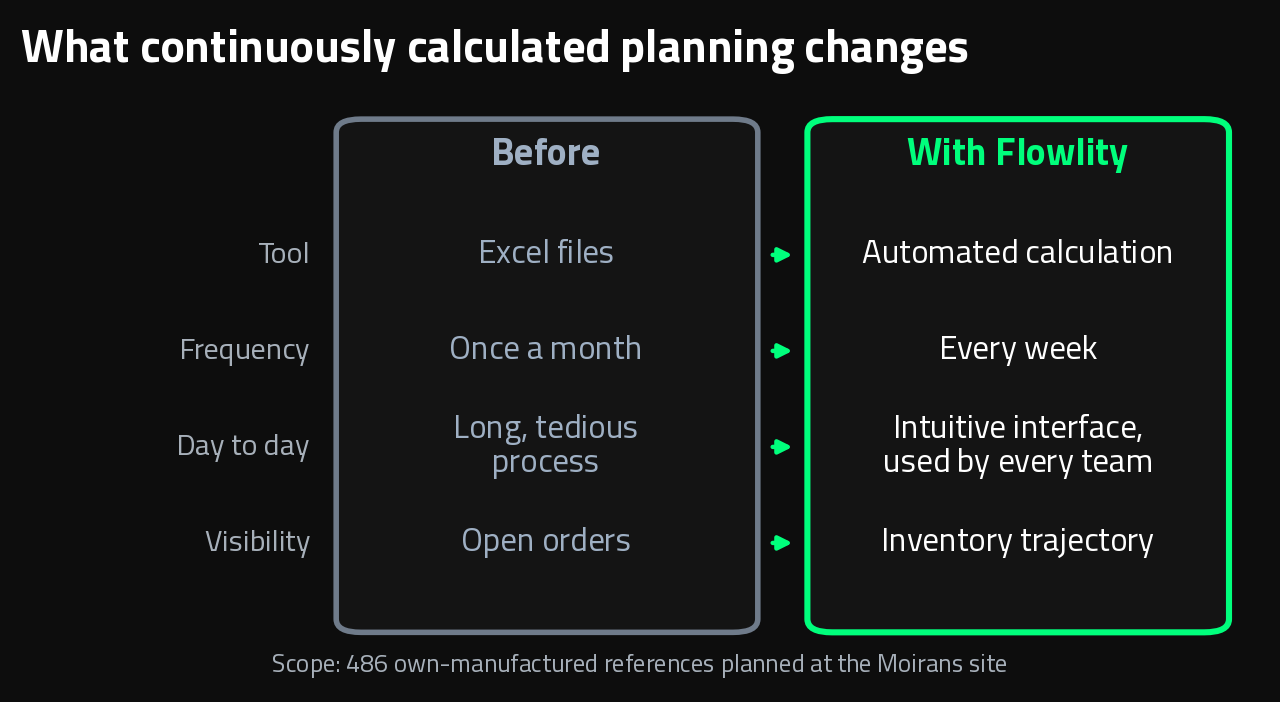
Forecasts recalculated every week
Data is no longer frozen: forecasts are pulled and analyzed by the system. Imports and calculations moved to a weekly rhythm, where everything used to depend on a monthly extract on a fixed date.
"Today with Flowlity, regular imports and weekly calculations make analysis much smoother."
Achille Moubinous, Supply Chain Planning Manager, Telenco
The monthly planning work that used to take a week now fits into a day.

But the shift is not only about time saved, it is about latency. A drop in demand shows up within days rather than weeks, which still leaves room for a useful decision on an item whose replenishment lead time runs to six months.
Which leaves the question that decides everything in automated planning: can you trust what the tool proposes? Achille Moubinous puts a number on it.
"In 80% of cases, the proposal matches what we would have done on the planning side. So that works well."
Achille Moubinous, Supply Chain Planning Manager, Telenco
That ratio is what turns automated calculation into real time saved. If one proposal in two had to be reworked, the tool would simply shift labor rather than reduce it. At 4 out of 5, the planner is not redoing the tool's job: they validate, and spend their attention on the fifth.
Seasonality, where algorithms beat the human
"Flowlity has a better read on every seasonal item. It anticipates month-to-month demand swings better than I did, because in the past I tended to smooth that data out."
Achille Moubinous, Supply Chain Planning Manager, Telenco
On this specific point, the gap with manual work is not about time, it is about forecast quality. The reason is mechanical: a professional handling several hundred references has no time to model the seasonality of each one, so they smooth, because smoothing is the only workable option by hand. The algorithm takes each reference individually and keeps the monthly swings that smoothing erased. This is the textbook case where automation does not replace judgement, it makes a level of detail possible that available time ruled out.
Inventory sized on uncertainty

Rather than a safety stock set once and for all, every reference gets a coverage level calculated from the probable distribution of demand. That inventory optimization under uncertainty logic is why coverage can be cut without leaving uncertain references more exposed: it tightens on stable references and holds where the risk is real, instead of applying uniformly.
Inventory value down over the first six months
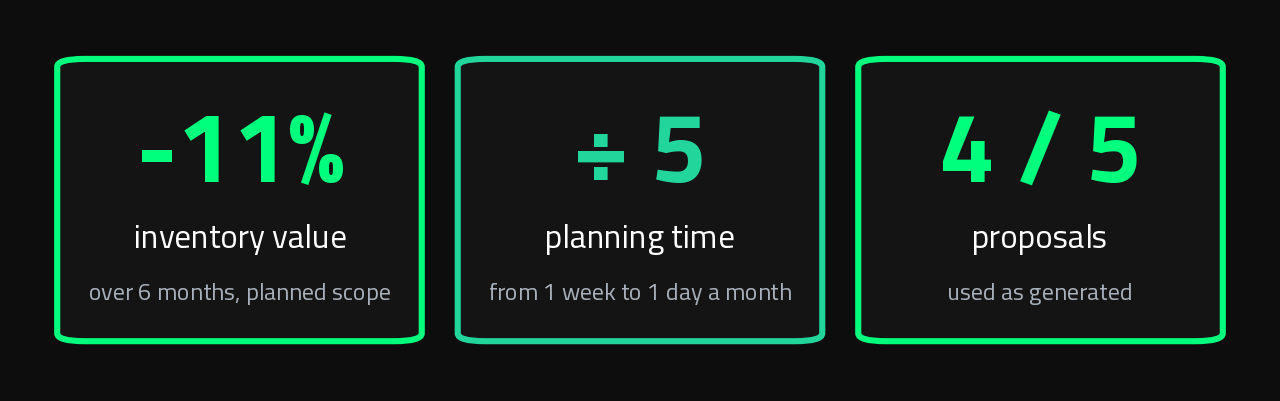
Over the first six months of use, inventory value across the planned scope came down 11%.
The lever the tool acts on is the coverage level. Instead of a safety stock decided once and applied uniformly, every reference gets min and max levels recalculated daily from the probable distribution of its demand and from supplier lead times, which reach 6 to 7 months on some products. Coverage tightens where demand is regular and holds where uncertainty is real.
That is what separates this way of working from a blanket reduction target. An across-the-board cut also thins out the most uncertain references, exactly where it costs the most in stockout risk.
A catalogue that keeps moving generates excess stock on its own: the mix shifts faster than replenishment rules get revised, and references whose profile changes keep a coverage calibrated on their old rhythm. With min and max levels reassessed daily, that gap no longer builds up.
The planner no longer executes, they arbitrate
The time saved is what the team sees first.
"Every month, planning took me a full week. Today I do the same work in a single day."
Achille Moubinous, Supply Chain Planning Manager, Telenco
That 80% cut in planning time follows directly from the reliability described above: the planner validates the large majority of proposals and only steps in on exceptions.
The process has also left one person's head. Telenco has since rolled Flowlity out on supply planning too: the team manages around 1,600 traded references there, and validated proposals go back into Dynamics 365 without re-keying, which removes the step where the spreadsheet and the ERP drift apart.
"We use Flowlity precisely to push orders straight through and pick them up in our own system."
Achille Moubinous, Supply Chain Planning Manager, Telenco
A probabilistic forecast rather than a single number
On a market that has become harder to read, with lead times reaching 6 to 7 months on some products and ruling out any late correction, the only variable you genuinely control is the quality of the anticipation. That is why demand forecasting automation software fits here better than a deterministic model. A single-number forecast assumes you know what is going to happen. Reasoning in probability distributions means accepting that you do not, and sizing coverage on that measured uncertainty.
In short, at Telenco, automating planning freed up 4 days a month, took the process out of one person's head, and brought inventory value down 11% in six months.
If your planning still lives in a spreadsheet, book a demo to see what Flowlity can automate in your Supply Chain.
Level up your supply chain with AI.
Get a demo


FAQ
Find everything you need to know right here.
Does Flowlity replace the ERP's MRP calculation at Telenco?

It does not replace it, it comes before it and corrects what feeds it, and at Telenco Dynamics 365 remained the system of execution. Material requirements planning runs a forecast through the bill of materials, applying fixed lead times and parameters. The arithmetic is sound, but it inherits the quality of what it is given: one forecast number and frozen lead times.
A probabilistic planning tool works upstream on those inputs, producing a range of probable demand and a coverage level tuned to measured uncertainty, including uncertainty in supplier lead times. The order proposals that come out of it go back into the ERP, which stays the system of record and execution. At Telenco, orders validated in Flowlity are written straight into Dynamics 365, with no re-keying.
How did Telenco bring inventory value down 11% in six months?
By acting on coverage levels rather than issuing a blanket reduction target. A fixed setup applies the same safety margin to items whose demand profiles have nothing in common: it over-covers regular references and under-covers uncertain ones.
At Telenco, min and max levels are recalculated daily from the probable demand distribution of each reference, factoring in supplier lead times that reach 6 to 7 months on some products. Coverage tightens where demand is predictable and holds where the risk is real. That is the lever Telenco has pulled since go-live, where an across-the-board cut would also have thinned out the most uncertain references.
Telenco already ran a recent ERP. Why add a planning tool?
Because a recent ERP does not produce better replenishment decisions, it executes more cleanly the ones it is given. An ERP and a planning tool work on different layers: the ERP records transactions, planning decides what to do next.
Telenco had run Dynamics 365 for years and still rebuilt its plan in Excel every month, because the ERP showed the orders already placed and never where inventory was heading. That is the gap the planning layer filled, without replacing anything.
A planning layer reads a small, stable set of tables and reconnects to a new system at cutover, which is a few days of configuration rather than a second implementation. Waiting for an ERP program to finish usually means giving up 12 to 24 months of better decisions. We set out that reasoning in our analysis of which comes first, ERP migration or supply chain planning.
How did Telenco move from Excel to automated demand planning?
Moving from Excel to demand planning software was never about rebuilding the spreadsheet inside a nicer interface. Three things changed.
Frequency first: forecasts and inventory levels are recalculated continuously instead of being rebuilt by hand on a monthly cycle. Then the calculation itself: a single-number forecast paired with a fixed safety stock gives way to a range of probable demand and a coverage level sized on each reference's own uncertainty. And finally the planner's role, which shifts from producing the plan to arbitrating the exceptions.
In practice, the project starts by connecting a handful of tables already sitting in the ERP: demand history, stock, open orders, and item and supplier parameters. At Telenco the result is a week of planning work compressed into a single day, 4 days freed every month, across 486 own-manufactured references whose supplier lead times reach 6 to 7 months on some products.

