.svg)
.svg)
SupplyCaddy


Key takeaways: AI Supply Chain planning is no longer reserved for large enterprises. SupplyCaddy, a fast-growing foodservice packaging manufacturer, replaced manual spreadsheet planning across roughly 250 custom products with Flowlity Lite: automated forecasting and replenishment, exception-based review, and probabilistic planning built for volatility. The payoff is a leaner, faster planning process that gives the team its time back.
Most people assume AI Supply Chain planning belongs to large enterprises with a dedicated Integrated Business Planning (IBP) team and a seven-figure software budget. SupplyCaddy is the counter-example. This fast-growing manufacturer put AI Supply Chain planning to work with none of that overhead, and it started from the same place as most small businesses: a spreadsheet.
The challenge: 250 custom products managed in one spreadsheet
SupplyCaddy is a contract manufacturer of custom foodservice packaging, the bags, boxes and disposables that carry meals for restaurant and quick-service restaurant brands. They make the bags, boxes, cups and straws, everything that comes through a drive-thru window minus the food, for iconic fast casual and quick-service restaurant (QSR) brands, acting as a one-stop shop for both branded and generic packaging. Nearly every product is bespoke, roughly 250 active items with only about twenty of them generic. That variety is the business, and it is also what made planning hard.
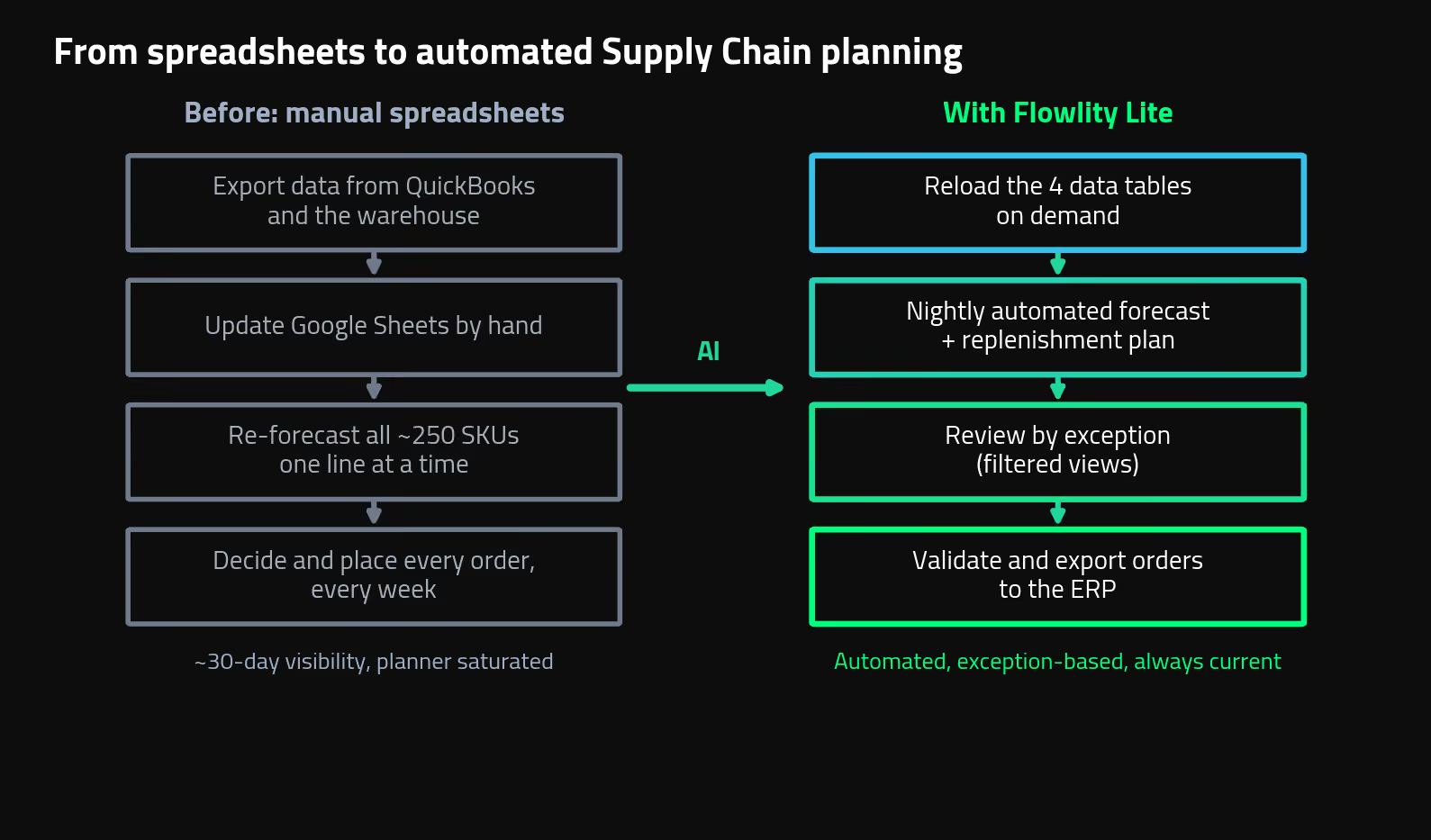
For a long time the entire forecasting and replenishment process ran in Google Sheets. Warehouse data did not talk to the demand sheets, so visibility rarely extended beyond thirty days. Sourcing added another layer: SupplyCaddy buys purchase order by purchase order from about twenty recurring suppliers spread across Turkey, the United States, China and South America, each with its own lead time. The report a customer gives on day one, in the company's own experience, is never correct, sometimes off by 5 to 30%. It's just a question of how wrong it is.
None of this scales. Planning 50 products by hand is manageable, a hundred is tense, and 250 custom products is a full-time job that leaves no room for anything else.
Why a growing SMB chose AI Supply Chain planning
SupplyCaddy did not need an enterprise-grade rollout. It needed something accessible that would work alongside its existing team while it finished building its own ERP. That is exactly the gap Flowlity Lite is built for: a lighter version of Flowlity organized around four simple data tables, demand, inventory, supplier information and open purchase orders, that a small team can feed and refresh on demand.
The explicit goal, in co-founder Bradley Saveth's words, was to get the planner's time back. Not to add a tool the team would have to babysit, but to remove the manual work so the operations lead could focus on decisions instead of data entry.
"Flowlity has enabled us to do the job of three or four people without needing three or four people."
Bradley Saveth, co-founder and President, SupplyCaddy
The engine underneath is probabilistic forecasting. A single-number forecast is always wrong, so rather than betting on one figure, Flowlity plans across the full range of likely outcomes and recommends the buffer and replenishment that best cover that range. For a business where the day-one number is routinely off by a third, planning for the distribution rather than the point estimate is the difference between a plan that survives contact with reality and one that does not.
How Flowlity Lite works for SupplyCaddy day to day
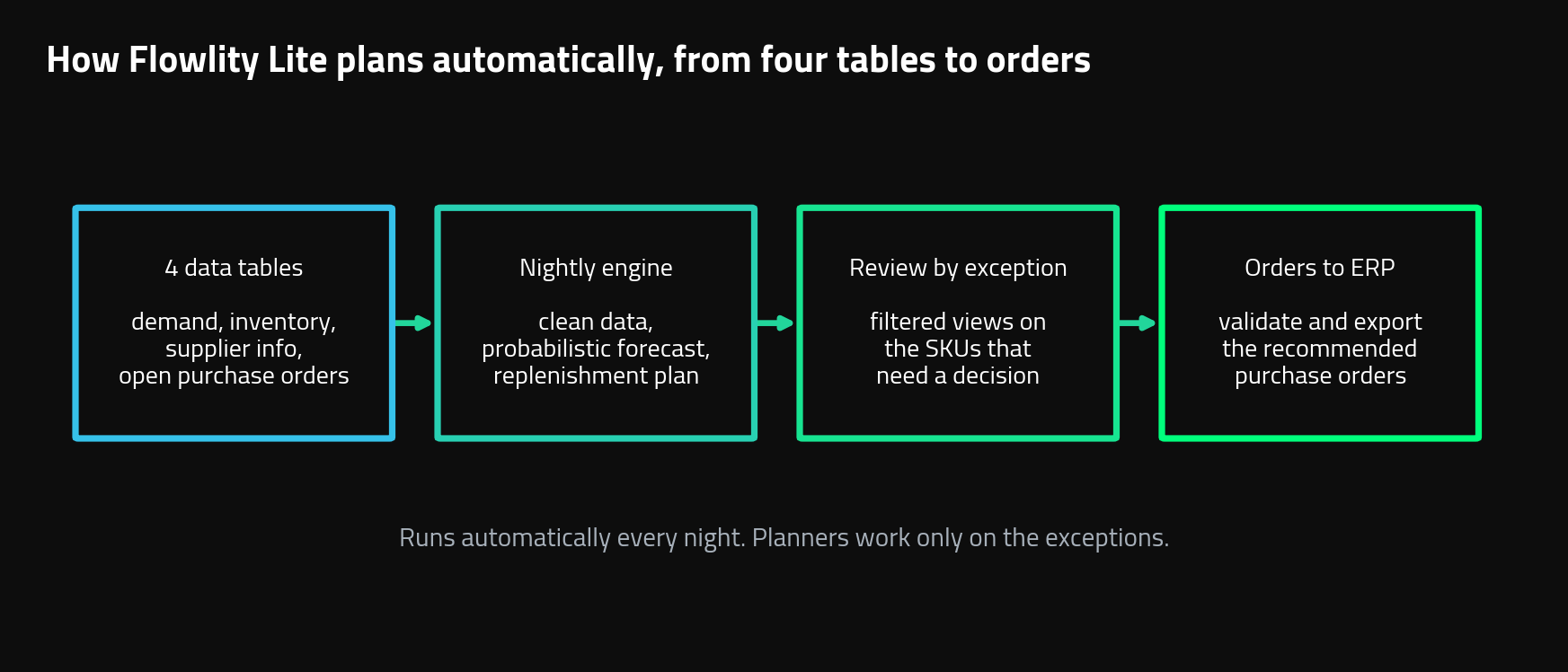
Every night, Flowlity ingests the latest data and automatically produces, for every product, a cleaned demand history (outliers and past shortages flagged and corrected), a forecast, and a replenishment plan that already respects each supplier's minimum order quantity (MOQ), lot size and lead time.
The team then works by exception. Instead of reviewing all 250 products, they open a filtered view, for example best sellers at risk of running low in the next thirty days, and act only where it matters. When a supplier date shifts or a disruption hits, they reload the data and the plan re-forecasts and re-plans on the spot. When they are happy with an order, they validate it and export it to the ERP. The manual spreadsheet loop becomes an exception queue.
"I'm honestly just amazed at the software and what we can do with it."
Geraldine Sanchez, VP of Operations, SupplyCaddy
The Supply Chain stakes in foodservice packaging
In foodservice packaging, availability is everything. Packaging often costs less than the product it protects, yet a missing bag or box can halt a customer's production line and cost far more than the packaging itself. That asymmetry makes responsiveness on the producer side non-negotiable: run out and you can lose the account, but hold too much of a high-mix, custom catalog and working capital disappears into slow-moving stock. SupplyCaddy feels this acutely: it carries a couple of million dollars of inventory at any time, so ordering too much ties up cash the business needs, while ordering too little can halt a customer's line.
Demand visibility in the industry is thin. As SupplyCaddy puts it, most players still rely on a distributor's usage report that is frequently wrong, so knowing your own consumption, and planning against it intelligently, is a real competitive edge rather than a back-office chore.
"It's a game changer. What you built takes information out of a spreadsheet and puts it into a visually stunning platform. We just love it."
Bradley Saveth, co-founder, SupplyCaddy
SupplyCaddy invited Flowlity onto their podcast, Delivered. Watch SupplyCaddy co-founders Bradley Saveth and Zack Stein talk AI Supply Chain planning with Flowlity CEO Jean-Baptiste Clouard.
What SupplyCaddy's example means for other SMBs
"Really, the thing Flowlity has given us back is time. The more our business grows, the harder it is to do a good job manually, so we implemented it at exactly the right time: we keep the same level of service, with far less time spent to get there."
Bradley Saveth, co-founder and President, SupplyCaddy
The lesson is not that SupplyCaddy is unusual. It is that a lean, high-growth business can adopt AI Supply Chain planning without an IBP team, without a finished ERP, and without an enterprise budget, and see the manual workload shrink almost immediately. If your planning still lives in spreadsheets and your product range keeps growing, the barrier to modern planning tools built for smaller teams is far lower than it used to be.
If your team still plans in spreadsheets and your catalog keeps growing, see how AI Supply Chain planning built for SMBs can automate the busywork and give your planners their time back.
Level up your supply chain with AI.
Get a demo
.avif)

FAQ
Find everything you need to know right here.
Can other foodservice packaging makers get similar value from Flowlity Lite?

Very likely. SupplyCaddy's situation is common in foodservice packaging: high-mix custom catalogs, purchase-order-by-purchase-order sourcing across several countries, and demand signals that are frequently wrong. Any SMB producer or distributor whose planning still lives in spreadsheets, and whose product range keeps growing, is a strong fit for AI Supply Chain planning built for SMBs, without the cost or complexity of a traditional enterprise project.
What changed for SupplyCaddy's team after moving off spreadsheets?
The manual spreadsheet loop became an exception queue. Instead of rebuilding a forecast for every product each week, SupplyCaddy's operations team now works from filtered views, for example best sellers heading for a stockout, and acts only where a decision is needed. The stated goal was to give the planner her time back, so she can focus on decisions rather than data entry. SupplyCaddy reports that Flowlity now does the work of three to four people while one team member runs the account, and that the same service level is held with far less manual effort.
How does SupplyCaddy plan around 250 custom products without a finished ERP?
Flowlity Lite ingests four data files (demand, inventory, supplier information and open purchase orders) that SupplyCaddy exports and refreshes on demand. Every night it cleans the demand history, forecasts each product and builds a replenishment plan that respects each supplier's minimum order quantity (MOQ), lot size and lead time. The team then reviews only the exceptions. As SupplyCaddy's ERP comes online, those files are simply swapped for direct extracts, and the planning layer keeps working.
Why did SupplyCaddy choose Flowlity Lite rather than a full enterprise system?
SupplyCaddy is a fast-growing small and medium-sized business (SMB) that did not need, or want, a heavy enterprise rollout. It was still building its own enterprise resource planning (ERP) system and needed something its existing team could run right away, alongside that project. Flowlity Lite fit because it is organized around four simple data tables and automates forecasting and replenishment without requiring a dedicated planning department to operate it.
How was SupplyCaddy planning before Flowlity?
Before Flowlity, SupplyCaddy ran its entire forecasting and replenishment process in Google Sheets, across roughly 250 custom packaging products. Warehouse data was disconnected from the demand sheets, so visibility rarely reached beyond thirty days, and the day-one usage numbers from new customers were often off by 5 to 30%. Planning was a manual, full-time job that grew heavier with every product SupplyCaddy added.