.svg)
.svg)

Flowlity and Slim4 from Slimstock both promise less inventory and fewer stockouts, but they get there through very different platforms. Slim4 sits next to an ERP, leans on 30 years of inventory expertise, and asks the customer to certify its key users. Flowlity runs a probabilistic engine, was named Gartner Cool Vendor in 2025, and is operated directly by the planning team. This article explains where the two diverge and why the gap matters at adoption time.
Most buyers comparing Flowlity vs Slim4 from Slimstock walk in asking which one forecasts better. It is rarely the question that decides the deal. Two others tend to: what is actually inside each vendor's AI label, and once the platform is live, who really runs it day to day? Slim4 brings 1,500 customers and a long catalogue of inventory wins. Flowlity, recognized in Gartner's 2025 Cool Vendor list for Supply Chain Planning, brings a probabilistic engine and a planner-led model. It has since been named an Accelerator in the 2026 Nucleus SMB SCP Value Matrix, among the most usable planning tools for lean teams. The article below compares both with the same critical eye.
Flowlity and Slim4 in brief
Slimstock is a Dutch company founded in 1993 in Deventer. Its flagship product Slim4 is an AI-powered Supply Chain planning suite covering demand forecasting, inventory optimization, multi-echelon inventory optimization (MEIO), Sales and Operations Planning (S&OP), Integrated Business Planning (IBP) and replenishment. Public reference customers span retail, distribution and FMCG: Sephora, Whitebridge Pet Brands, Flauraud, UpFresh, Fabory, DORC. G2 rates Slim4 4.7 out of 5, and Slimstock is widely credited for the depth of its inventory expertise.
Flowlity is a much younger company since it was founded in 2018 in Paris. It is an AI-driven Supply Chain planning platform built around a probabilistic engine that models demand as a distribution rather than a single point. Public customers include Camif, Plum Living, Sport 2000, Ravate, Saint-Gobain and EDF. Flowlity recently released a Co-planner MCP module for the AI assistants planners already use, and G2 rates the platform 4.9 out of 5. The two companies sit at different ends of the planning software curve, which makes the comparison useful.
Behind the AI label: what each platform actually publishes
Both vendors put AI on the front of the page. The test is what each one documents when a buyer scrolls deeper.
Slim4 sits high on review sites for a reason: 4.7 out of 5 on Gartner Peer Insights, with consistent praise for exception management, S&OP visibility and dependable replenishment. Slimstock has been doing this for 30 years and the polish shows in the workbench. The technical layer of the documentation is less detailed. Slim4's product pages and white papers do not publicly describe the underlying forecasting methodology, model architecture or benchmarks. Buyers are asked to trust an engine that markets AI but keeps its mathematical foundations off the page.
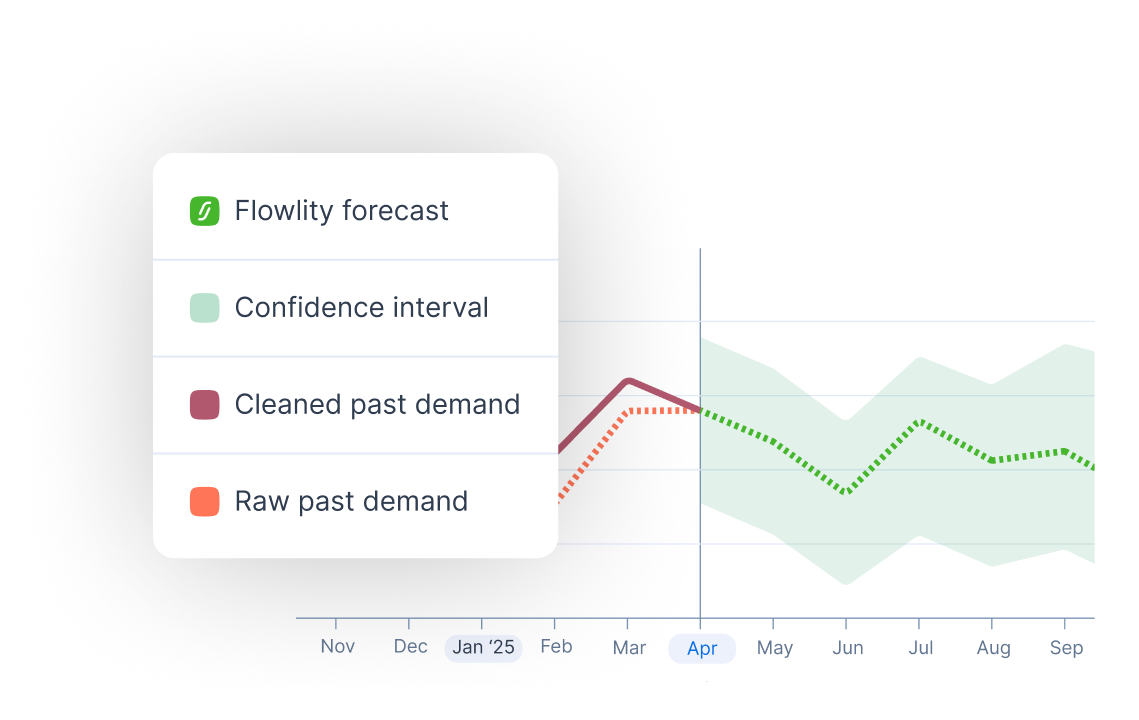
Flowlity takes the opposite stance: it publishes how the forecasting model works. Every Stock Keeping Unit (SKU) gets a full probability distribution, which the engine turns into a forecast plus a dynamic safety stock that moves with demand variability and lead-time risk. The output is not a single number to trust, it is a confidence range a planner can interrogate. At Plum Living, a DTC interior design brand running Flowlity Core, inventory dropped from €598k to €367k at the same demand. The 21% reduction at go-live is documented in the case study as the outcome of moving from rule-based replenishment to probability-driven buffers. Teams that want to understand the underlying algorithm can read Flowlity's explainer on AI-driven planning.
Architecture: planning layer next to the ERP, or continuous decision system
The second axis of comparison is architectural, visible from the day the system goes live. As described by Slimstock, Slim4 integrates with the ERP as a planning layer: data flows out, plans compute in Slim4, recommendations flow back. The setup works well when master data is clean and refresh cycles are predictable, which is why Slimstock invests so heavily in master-data preparation during onboarding. The integration is batch-driven, with scheduled refresh cycles between the two systems.
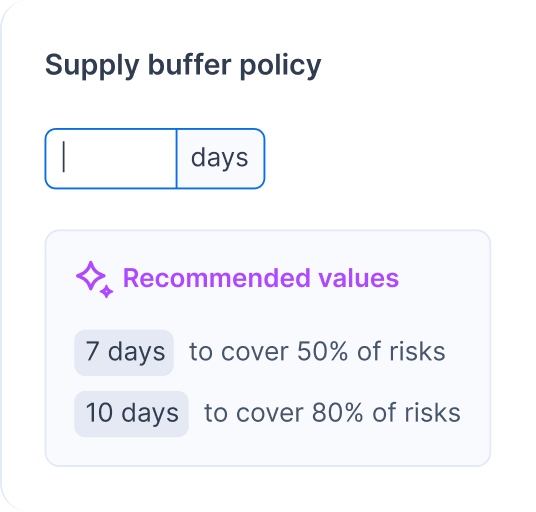
Flowlity is built as the decision layer itself. The probabilistic engine refreshes continuously, exceptions surface the moment they appear, and the planner stays inside one tool rather than reconciling two. The Flowlity Co-planner MCP pushes this further: it connects the platform directly to the AI assistants planners use to query data or draft a plan, so the system meets them in their flow instead of pulling them into a separate workbench. Architecture decides what tool the planning team is actually using after go-live, not just what the demo shows.
Adoption math: who really runs the tool after go-live
Slimstock's Academy ships a structured training programme with four levels (Essentials, Basic User, Key User, Advanced User), and a team that goes through it ends up with deep product knowledge. The structural risk is the one any enterprise planning rollout knows: when expertise concentrates in two or three certified planners, the tool quietly becomes their tool, and knowledge walks out the door with them. The dependency on clean ERP master data is publicly emphasized by Slimstock as a precondition for a successful deployment.
Flowlity takes the opposite path: the platform is intuitive and user-friendly enough that no training programme is needed to operate it. The interface follows the rhythm of a planning cycle (demand, supply, exceptions, decisions), and the AI confidence index, recommended actions and tooltips carry the weight a multi-day training would otherwise need. Planners are productive within their first sessions, and a dedicated Customer Success Manager (CSM) joins from kickoff to support onboarding and continuous improvement. Camif, a sustainable furniture e-commerce business, freed a full-time planner (1,760 hours per year) and absorbed 44% growth without scaling its planning team.
Time-to-value: 3 to 4 months vs a few weeks
Slimstock publicly states Slim4 implementations take three to four months before go-live, depending on Supply Chain complexity. The window covers ERP integration, master-data cleansing, module configuration, scenario rules and the training cycle. Customers committing to the programme report durable value at the end of it, and the published timeline is honest about the work involved.
Flowlity compresses that window aggressively. The tool goes live in a few weeks to a few months depending on scope. At Plum Living, the team was running on AI recommendations in two months. Flowlity Lite, the plug-and-play tier for smaller teams without ERP integration overhead, pushes it further: at Supply Caddy, the platform produced its first AI forecast right after signing and was fully operational in under two weeks. Teams that want a deeper read can dig into Flowlity's perspective on innovative planning strategies beyond legacy tools.
Flowlity vs Slim4 comparison table
Who each platform fits
Slim4 fits large distribution networks and multi-site retailers running thousands of SKUs on a clean ERP backbone, with the appetite to invest in a three to four month rollout and a dedicated key-user team afterwards. The customer list (Sephora, Flauraud, Whitebridge) shows the scale Slimstock supports comfortably.
Flowlity fits mid-market retailers, distributors and industrial manufacturers that want a probabilistic engine and a planner-led operating model without paying a multi-quarter onboarding tax. Teams attracted to an AI-driven demand planning approach like Flowlity tend to value the speed at which the tool becomes part of the daily flow. Companies running a thousand-user planning function with deep ERP customization will find Slim4 closer to their reality. Companies that want forecasts inside the quarter and adoption that survives a planner's departure will find Flowlity closer to theirs. Shortlists that also include a structured S&OP workflow vendor can extend the analysis with a closer read on Flowlity and Colibri.
Level up your supply chain with AI.
Get a demo

FAQ
Find everything you need to know right here.
What technology does Slim4 use for demand forecasting?

Slimstock markets Slim4 as AI-powered and references machine learning for forecasting and demand sensing. Its product documentation does not publicly disclose probabilistic methods, distribution modeling or stochastic optimization. The suite covers forecasting, inventory optimization, MEIO, S&OP and replenishment, and reviewers report results depend heavily on clean ERP master data.
How does Flowlity's probabilistic AI compare to Slim4?
Flowlity computes a probability distribution per SKU and turns it into dynamic safety stocks calibrated to demand variability and lead-time risk. Every forecast comes with a published AI confidence index. Slim4 produces forecasts and stock recommendations inside its workbench, but keeps the math behind the AI label off its public pages.
How long does it take to implement Slim4 compared to Flowlity?
Slimstock publicly states Slim4 takes at least three to four months before go-live. Flowlity Core, the version for mid-market and enterprise scopes, typically goes live in a few weeks to a few months (Plum Living went live in two months). Flowlity Lite, a plug-and-play tier for smaller teams without ERP integration overhead, was fully operational in under two weeks at Supply Caddy. The difference is structural: Flowlity does not require ERP master-data hardening before producing forecasts.
Who operates Slim4 inside a customer organization?
Slim4 runs through certified key users trained via Slimstock Academy (Essentials, Basic User, Key User, Advanced User certifications). The model builds deep expertise inside a small group. Flowlity is built to be operated without a certification programme: the interface is intuitive enough that no training programme is needed, and a dedicated CSM supports onboarding and continuous improvement.
Which platform is better for mid-market retail?
Slim4 has strong retail credentials (Sephora, Whitebridge Pet Brands) and suits retailers with mature ERP data, certified key-user teams and a 90 to 120 day deployment window as a strong minimum. Flowlity targets mid-market retail directly: Camif absorbed 44% growth and freed a full-time planner, and Plum Living cut inventory 21% at go-live. Operating model often decides whether the tool lives or dies after go-live.