.svg)
.svg)
DDMRP: differences with MRP and probabilistic AI compared

For two decades, Supply Chain Directors have been told that DDMRP was the modern replacement for classic material requirements planning (MRP). Strategic buffers replace forecast-driven push, exceptions replace mass replanning, flow replaces firefighting. Most of that is true. But the part DDMRP rarely discusses is what its buffers actually are: heuristic rules built on a variability factor and a lead time factor, not a measured demand distribution. That gap matters when your portfolio is sparse, your demand is noisy, or your service level needs to be defended at the SKU level.
In short: DDMRP is right about the problem with MRP. It is incomplete about the answer.
This guide is for S&OP managers and demand planners evaluating DDMRP against the alternatives. It walks through what DDMRP is, what changes versus MRP, where the methodology stops short, and what a probabilistic approach adds, with or without replacing your existing systems.
What DDMRP is and why it emerged
DDMRP was published in 2011 by Carol Ptak and Chad Smith, the same authors behind the Demand Driven body of work (founders of the Demand Driven Institute). It was not invented in a vacuum. It was a direct response to the structural weaknesses of classic MRP, which had been the backbone of Production Planning since the 1970s.
Classic MRP runs forward from a forecast. The system explodes a master production schedule down through every level of the bills of materials (BOMs). It nets requirements against on-hand inventory and recommends purchase or production orders to cover the projected gap. The logic is rigorous, but it has two failure modes the floor knows well.
DDMRP keeps the structure of materials planning but decouples it. Instead of running a single forecast-driven cascade, it places strategic buffers at chosen points in the network: long-lead items, common components, finished goods exposed to volatile demand. Replenishment is pulled from those buffers, not pushed from the master schedule. The result is a planning model that is reactive to real consumption while shielding upstream operations from short-term noise.
Try it: DDMRP buffer zone calculator
Enter your average daily usage, lead time and factors below to watch the red, yellow and green DDMRP buffer zones size themselves.
➡️ Open the full-screen DDMRP buffer calculator
The 5 components of DDMRP
Demand Driven Material Requirements Planning is organized around five steps, defined by the Demand Driven Institute.
The first is strategic inventory positioning. Buffers are not placed everywhere; they sit at decoupling points selected for lead time leverage, customer tolerance and bills of materials complexity.
The second is buffer profiles and levels. Each buffer is sized using three zones (green, yellow, red) calculated from average daily usage, lead time and a variability factor. The factor is a category-level assumption, not a per-SKU measurement.
The third is dynamic adjustments. Buffers move with planned events such as seasonality, promotions and new product introductions. The system recalculates green, yellow and red zones on a defined cadence.
The fourth is demand-driven planning, executed through the Net Flow Equation:
Net Flow = On Hand + On Order - Qualified DemandWhen the Net Flow drops into the yellow zone, the system signals a replenishment order. When it drops into red, the order is prioritized.
The fifth is visible and collaborative execution. Buffers are displayed visually to operations, often in color-coded dashboards, so planners can act on exceptions rather than chase every order.
Together, these five elements move planning from "make to forecast" to "make to actual consumption, protected by buffers".
DDMRP vs MRP: what changes in practice
Comparing DDMRP and MRP at the methodology level is straightforward. Comparing them at the planner level is more useful.
Under MRP
In an MRP environment, the master schedule is the ground truth. Every replenishment recommendation derives from the forecast pushed through the bills of materials. When the forecast moves, the recommendations move with it. That gives planners a complete plan, but a fragile one. Every adjustment generates a new wave of orders, including inside frozen periods. Planners spend a non-trivial share of their week negotiating with the system to stop reacting.
Under DDMRP
In a DDMRP environment, the master schedule still exists but it is not the daily lever. The Net Flow Equation is. Replenishment decisions are taken at each buffered SKU based on actual consumption, qualified demand and current on-hand. The planner's day becomes exception-driven: act on the SKUs that breached yellow or red, leave the rest alone. Lead times are decoupled across the network, so a delay at one stage does not automatically reverberate to every downstream order.
That shift carries two practical consequences. Service levels at buffered SKUs become more stable, because dynamic buffers absorb short-term noise that MRP would have propagated. Working capital tends to drop on buffered items where the previous MRP setup over-protected through safety stock margins. It can rise elsewhere when buffers are over-sized at decoupling points. The net effect depends heavily on how the buffers were positioned and sized, which is the part that is harder than it looks.
Where DDMRP gets it right and where it stops
DDMRP is right about three things, and they matter.
Where DDMRP stops is in the quantification of uncertainty. The variability factor at the heart of buffer sizing is a category-level rule of thumb, not a per-SKU measurement of how demand actually behaves. The lead time factor is similarly heuristic. Lokad's critique of DDMRP, the most rigorous public one, frames it bluntly. The method offers numerical recipes without the formalism a probabilistic approach would require. Its sizing assumptions can be wrong by a wide margin on sparse or erratic SKUs.
That gap is not theoretical. It shows up on the SKUs that matter most: the long-tail items where heuristic buffers either over-protect (capital tied up in stock) or under-protect (stockouts on items that mattered to the customer). Our webinar on raw material replenishment beyond traditional MRP walks through how this plays out on the floor.
Heuristic buffers vs probabilistic forecasting: the real debate
The interesting debate in 2026 is not DDMRP vs MRP. Both are heuristic methodologies built before the data infrastructure required to do better was widely available. The debate is heuristic buffers versus probabilistic forecasting.
How a heuristic buffer works
A heuristic buffer asks:
given an average demand of X per day and a lead time of Y days, with a variability factor of Z%, what stock should I hold?
It returns a single number. The number is defensible, but it is also blind to the shape of the demand. Two SKUs with the same average can have radically different risk profiles. The heuristic does not see that.
How a probabilistic approach works
A probabilistic approach asks a different question.
Given everything we know about a SKU (history, seasonality, lead time variability, supplier behaviour), what is the full distribution of possible demand over the lead time?
From that distribution, you can derive the stock that covers your target service level for that specific SKU.
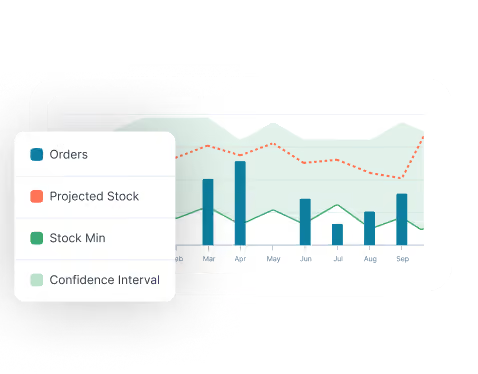
Same service level, less stock
The practical consequence is not subtle. At the same target service level, probabilistic demand forecasting sizes less buffer where the SKU is well-behaved and more buffer where it is volatile. A heuristic averages across both and over- or under-protects on either side. That is why teams running a probabilistic engine on top of their planning systems tend to see inventory come down and service level go up at the same time. There is no trade-off between the two.
Flowlity customers typically cut inventory up to 40% under this approach. The range varies with portfolio profile and starting point, but the mechanism is the same: replace category-level rules with per-SKU distributions.
A pragmatic alternative: a probabilistic layer on top of existing systems
DDMRP is a transformation. Done properly, it requires repositioning buffers across the network, redefining planner workflows, retraining the team, and often replacing or substantially reconfiguring the ERP and Production Planning layers. The Demand Driven Institute certifies practitioners through multi-day programs. The implementations that succeed are real, but they are not light.
There is a more pragmatic route. This is the territory of modern Advanced Planning Systems (APS), the layer that sits above ERP/MRP/DDMRP and handles end-to-end planning logic. The market splits in two: legacy APS built before AI was widely usable (Kinaxis, o9, Blue Yonder, Slim4), and AI-native APS built directly on probabilistic logic (Lokad, Flowlity).
Instead of restructuring the planning model, you can add a probabilistic layer on top of the existing systems. The forecast engine still produces a master schedule. The ERP still handles transactions. The MRP still runs. A probabilistic demand and inventory layer recomputes safety stock and replenishment recommendations per SKU from the actual demand distribution. The planner still works in the same interface, just with sharper recommendations.
Flowlity is an AI-native Supply Chain planning platform built on probabilistic logic. The algorithm produces a per-SKU demand forecast, sizes dynamic safety buffers against the uncertainty range, and automates routine replenishment decisions. Planners only act on the exceptions that need human judgement, inside an interface designed to be used directly by Supply Chain teams without specific training.
Magotteaux, an industrial supplier in the cement and mining sector, layered a probabilistic engine on top of its existing planning systems rather than transitioning to DDMRP. The team reduced inventory by 13%, cut stock coverage by 22% and stockouts by 8%, without changing the systems below.
In agrifood, Danone digitised its raw material and packaging replenishment the same way: automation added on top of the existing planning stack, rather than a rebuild of the underlying systems.
Choosing your approach: DDMRP, MRP, or probabilistic AI
The choice is not "which methodology wins". It is which configuration fits your portfolio, your team maturity and your runway.
MRP alone, without buffers or probabilistic logic, fits stable, low-mix, low-volatility environments where the forecast is accurate enough that nervousness rarely bites. That is a smaller share of the market than it was twenty years ago, but it exists.
DDMRP fits manufacturers with deep bills of materials, long lead times and an organization willing to invest in a methodology change. The strongest case for DDMRP is process plants and discrete manufacturers with stable category-level demand patterns, where the heuristic buffer assumptions hold reasonably well.
A probabilistic approach, whether overlay or replacement, fits teams who want to act on per-SKU risk rather than category rules. It works best when the team needs a fast deployment and runs a portfolio with long-tail SKUs where heuristic buffers misfire. For multi-stage networks, multi-echelon inventory optimization coordinates buffers across stages. AI-driven inventory optimization software sits in that lane.
Reading DDMRP the way a planner should
DDMRP is a useful diagnostic. It points at the right problem (forecast-driven push generates nervousness and over-protection) and offers a structurally sound answer (decouple, buffer, manage exceptions). It deserves credit for that.
What DDMRP does not do, and what most marketing about it skips, is quantify the uncertainty its buffers are absorbing. The variability factor is a category-level assumption. The lead time factor is similar. They are defensible heuristics, but they are heuristics, and they are the part most exposed when portfolios are sparse or demand is erratic.
For planning teams, the productive question is not "should we move from MRP to DDMRP". It is whether your buffers should be sized by category rules or by per-SKU distributions, and whether you want a multi-year methodology change or a probabilistic overlay you can deploy now. Both routes have served customers well. The probabilistic overlay tends to be lighter, faster to value, and easier on the existing ERP and MRP investments planners already rely on.
Ready to see how Flowlity replaces category-level rules with per-SKU probabilistic buffers? Book a demo.
Level up your supply chain with AI.
Get a demo

FAQ
Find everything you need to know right here.
What is the difference between the Flowlity approach and the DDMRP methodology?

Flowlity and DDMRP (Demand Driven MRP) share a common goal:
to better position buffer stocks to absorb uncertainties and avoid the bullwhip effect in the supply chain.
However, their methodological approaches differ significantly.
DDMRP is a methodology with prescribed components. Flowlity is an AI-native planning platform that runs probabilistic demand forecasting per SKU and sizes dynamic safety buffers from the actual distribution. The two are not mutually exclusive. Flowlity can sit on top of a DDMRP-shaped network and replace the heuristic factors with measured ones. Industrial customers like Magotteaux cut inventory by 13% by adding a probabilistic layer to their existing planning systems, without a full DDMRP transformation.
Flowlity vs B2Wise (DDMRP solution) what's the difference?
B2Wise is a DDMRP-native tool that follows the methodology strictly, while Flowlity offers a more flexible, AI-enhanced approach to supply chain planning.
Comparative analysis: B2Wise vs. Flowlity
| Feature | B2Wise | Flowlity |
|---|---|---|
| Approach | Pure DDMRP methodology | DDMRP + AI probabilistic forecasting |
| Forecasting | Order-driven, reacts after events | Proactive: adjusts target stock levels using predictions |
| Planning methods | DDMRP only | Hybrid: mix of DDMRP and forecast-driven planning per SKU |
| Functional scope | Inventory buffers and replenishment | End-to-end: demand planning, inventory optimization, S&OP, supplier collaboration |
| Scenarios | Limited | Simulates DDMRP vs AI-optimized strategies side by side |
| Deployment | On-premise or cloud | Cloud-native SaaS |
AI-enhanced forecasting vs order-driven DDMRP
B2Wise relies on demand-driven buffers that react to actual orders — a solid approach, but one that adjusts only after demand has changed. Flowlity adds a proactive layer: AI-powered forecasting that anticipates demand shifts and automatically adjusts target stock levels before disruptions hit. This is especially valuable for products with seasonal patterns, promotions, or erratic demand.
End-to-end scope vs inventory-focused
B2Wise focuses on DDMRP buffer management and replenishment. Flowlity covers the full supply planning cycle: from demand sensing to inventory optimization, S&OP, supplier collaboration, and strategic simulations. This means fewer tools, one shared data model, and better cross-functional alignment.
Flexibility: choose your method per SKU
One of Flowlity's key differentiators is the ability to combine DDMRP and forecast-driven planning at the SKU level. Some products benefit from demand-driven buffers; others need proactive AI forecasting. With Flowlity, you don't have to choose one methodology for your entire portfolio — you can mix and match based on each product's characteristics.
In short: B2Wise is ideal if you want a strict, purist DDMRP implementation. Flowlity is the better fit for companies that need flexibility, AI-driven forecasting, and broader functional coverage beyond just inventory buffers. Flowlity was also recognized as an Accelerator in Nucleus Research’s 2026 SMB SCP Value Matrix, among the most usable SMB planning platforms.
What is the DDMRP (Demand Driven MRP) methodology?
DDMRP (Demand Driven Material Requirements Planning) is a planning methodology that decouples the Supply Chain with strategic buffers and triggers replenishment from actual consumption rather than the forecast. Buffers are positioned at decoupling points (long-lead items, common components, finished goods exposed to volatility) and sized in three color-coded zones (green, yellow, red) using category-level heuristics for variability and lead time.
For most mid-market manufacturers, the productive question is not DDMRP versus classic MRP. It is whether buffers should be sized by category-level rules or by per-SKU probabilistic distributions. Flowlity replaces heuristic factors with full demand distributions learned per SKU, so safety buffers adapt to each item's actual risk profile rather than to a fixed category assumption. See the full comparison in our guide on DDMRP, MRP and probabilistic AI compared.
Can DDMRP and AI work together?
Yes, and the combination is increasingly common. DDMRP provides the structural framework: decoupling, buffers, exception management. Probabilistic AI replaces the heuristic factors at the heart of buffer sizing with per-SKU demand distributions and dynamic adjustments learned from data. The result is a DDMRP-shaped planning model with measured uncertainty under the hood, rather than category-level rules of thumb. B2Wise, for instance, has added machine learning forecasting on top of its DDMRP-native suite; Flowlity built probabilistic AI as the core platform and applies DDMRP-shaped logic as one mode among others.
What is the best DDMRP software?
The reference DDMRP-compliant tools include solutions from SAP IBP, B2Wise, Replenishment+, Intuiflow and Demand Driven Technologies, among others. "Best" depends on your existing ERP, your portfolio depth and your appetite for transformation.
If the goal is per-SKU buffer accuracy without a full methodology change, a probabilistic AI platform like Flowlity may be a closer fit than a DDMRP-certified suite.
How long does a DDMRP implementation take?
Most DDMRP transformations run six to twelve months when done properly, with longer programs at larger manufacturers. The work includes mapping decoupling points, designing buffer profiles, integrating with the ERP, redefining planner workflows and training the team.
A probabilistic overlay on existing systems typically deploys in a few weeks to a few months, depending on data quality and integration scope.
Is DDMRP suitable for mid-market manufacturers?
It can be. The methodology was designed for environments with deep bills of materials and long lead times, which fits many mid-market manufacturers in process and discrete industries. The constraint is implementation effort. Buffer positioning, profile sizing and team training are not light.
Mid-market teams without a dedicated planning function often look at probabilistic overlays first, since they deliver per-SKU buffer sizing without a full methodology change.