.svg)
.svg)
Long lead time planning: frozen horizons and containers

Almost everything written about long lead times is about how to shorten them. Dual-source, nearshore, negotiate, audit the bottlenecks. That advice is useful right up to the point where the lead time is not a defect in your Supply Chain but a description of it. For an import distributor, six months is production time plus a sailing, plus customs, plus inland distribution, and no amount of supplier development compresses an ocean. Long lead time planning starts by accepting the number and asking a harder question: what does a six-month horizon do to the way a plan has to be built?
Six months is not six weeks with more waiting
The intuitive model is that a longer lead time just means ordering earlier: order in January instead of March, and carry a bit more safety stock. That model breaks for a reason that has nothing to do with quantity.
Forecast error grows with horizon. At six weeks out, a distributor usually knows its order book, its promotional calendar and its seasonality with reasonable confidence. At six months, it knows almost none of that. So the six-month order is placed against the least reliable part of the forecast, and it is placed for the largest quantity, because a container is not a small commitment. Long lead times concentrate the biggest bet on the worst information, and everything else in this article follows from that.
A second consequence gets less attention. When the lead time is long, the pipeline becomes bigger than the warehouse: at any moment an importer holds several months of demand in production, on water, or in customs. That inventory is paid for, uncorrectable, and invisible to most planning setups, which reason about stock on hand and treat what is in transit as an afterthought. One fiber-optic equipment manufacturer described exactly that blind spot: with supplier lead times reaching 6 to 7 months on some products, its ERP showed the orders already placed but never the inventory curve coming down, until Telenco moved its planning out of Excel.
The frozen horizon is your whole lead time, not four weeks
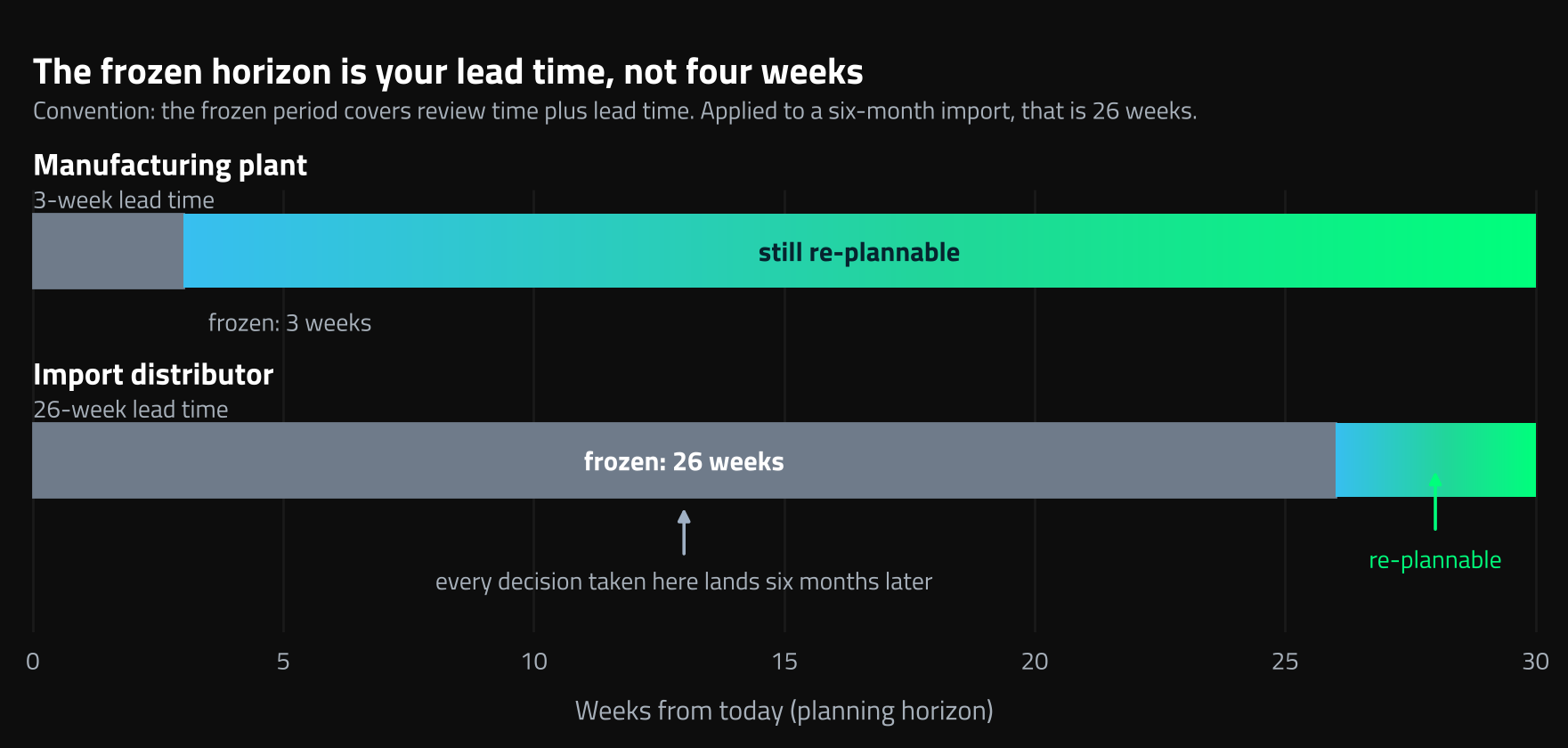
The frozen horizon, also called the frozen zone or frozen period, is the near-term window in which the plan is deliberately held still so it can be executed. The standard convention is that it should cover at least the review time plus the lead time to obtain materials, which is the window in which a change is genuinely impossible to absorb. In production and capacity planning practice that lands most plants somewhere between one and four weeks, and much of the published guidance treats a month as generous.
Apply the same rule to a six-month import and the frozen horizon is twenty-six weeks. Everything you decided in February is locked until August. That is not a configuration choice, it is arithmetic, and it has three costs that a four-week fence never exposes.
The first is that a mistake has a six-month shadow. Order too much in February and the correction is not next week's order, it is a year of markdowns. The second is that new information arrives during the frozen window and has nowhere to go: demand shifts in April, the planner sees it clearly, and can do nothing about a shipment already in production. The third is the one teams rarely name. A long frozen horizon quietly turns the planner's job into arbitration between what the system says and what they know, which is exactly the work that ends up in a spreadsheet beside the planning tool rather than inside it.
What separates good long lead time planning from bad is not a shorter frozen horizon, because you cannot have one. It is a clean separation between what is genuinely committed and what merely looks committed. A firm order in production is frozen. An order proposal six months out is not, and should be re-evaluated nightly against the latest demand signal, right up to the moment it has to be placed. Freeze too much and you create false rigidity; freeze too little and you overwrite decisions the planner already made and defended, which is how trust in a tool dies.
Container fill is a planning decision, not a logistics one
Ask most software what “container optimization” means and you will get three-dimensional load building: how to fit 50 cartons into a 40-foot box without crushing the fragile ones or breaching the axle weight. That is a real problem and it is a logistics problem. It answers “can this fit.”
The planning question is different and it comes earlier: should this container exist, and if it must, what goes in it? The version of this question that comes up in conversation after conversation with importers is arithmetic, and it is uncomfortable. The replenishment plan, driven by real requirements, calls for 2.8 containers. You cannot ship 2.8. So either you ship three, and 0.2 of a container is stock you did not need and are now financing for six months, or you ship two and knowingly accept a shortage on whatever got cut. Every importer faces this decision constantly, and almost none of them make it inside their planning system.
What happens instead is the clearest sign that container fill has been misfiled as a logistics task. A planner exports the order proposal to a spreadsheet, sorts by cubic meters, and adds items until the volume target is reached. One distributor described the process almost exactly that way: the operator gets on the phone to the port and the supplier and goes shopping. The decision about what to pull forward, six months early and financed for a full ocean crossing, is made by whoever is looking at the sheet, with no visibility into which items are closest to a stockout and which are already overstocked.
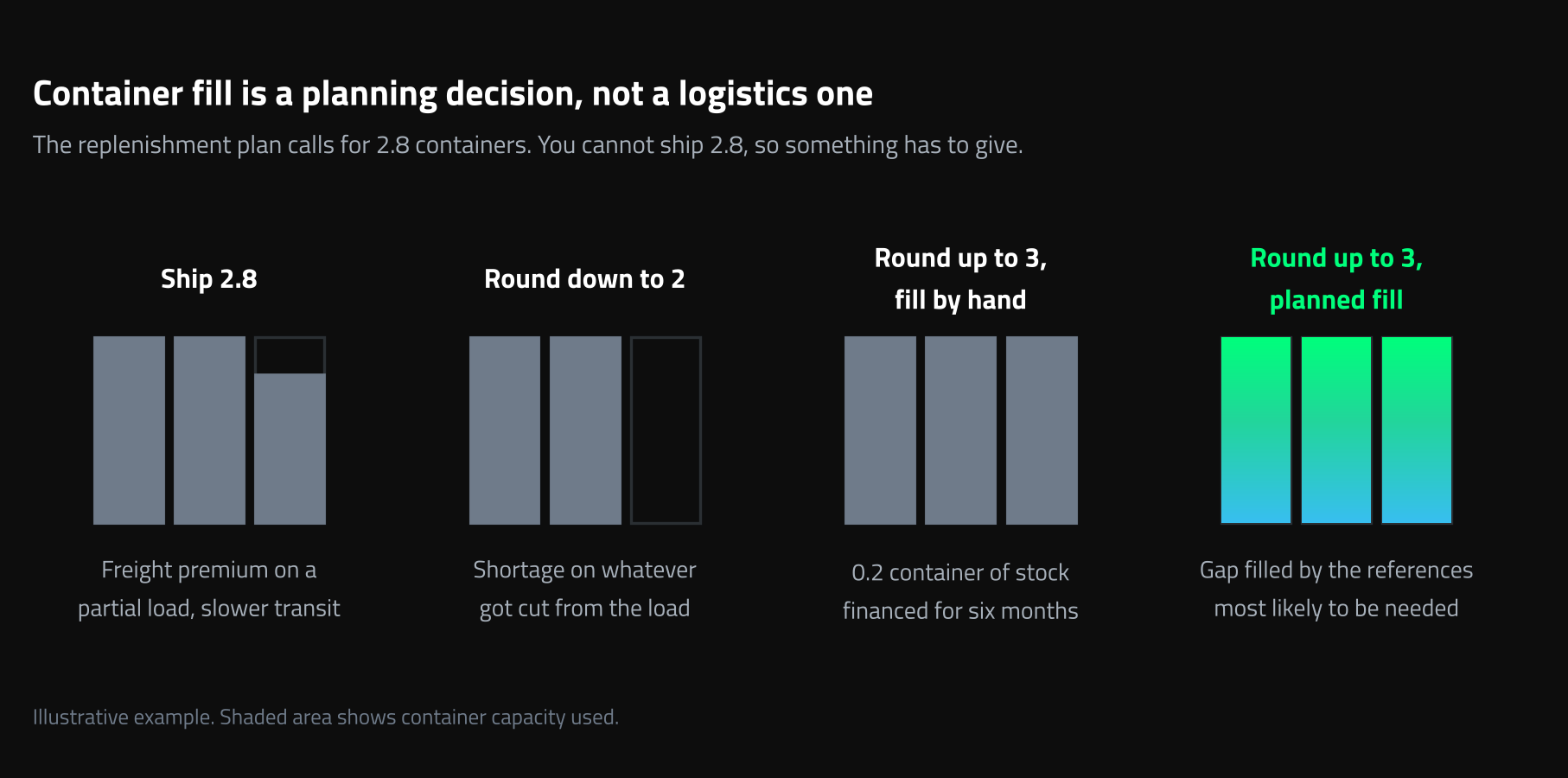
That is a genuine optimization problem with a clean structure. You have a volume or weight target, a set of candidate references, and for each one a probabilistic view of how badly it will be needed in six months. Choosing the fill means ranking candidates by the expected value of arriving early, not by whatever sorts to the top of the sheet. The same logic extends outward: several suppliers shipping from one port in the same week can be consolidated into a single container, which is a planning decision about order dates rather than a warehouse decision about stacking.
Matched references break single-SKU logic
The third constraint is the least discussed and the most likely to make a planning tool look wrong in a demo.
Most planning engines rest on an implicit assumption: each reference has its own demand, its own stock, its own reorder logic. Net requirements are computed per stock-keeping unit (SKU), and that is the end of it. A great deal of imported equipment does not behave that way. A split air conditioning system is not one reference, it is an indoor unit, an outdoor unit and the connection kit, and the front panel cannot be ordered alone because the family only functions as a set. During one product review with an equipment distributor, the order proposal listed just one of three linked references. It was arithmetically correct, since the others had stock and no net requirement of their own. It was also unusable.
Single-SKU logic fails here in both directions. It under-orders, by proposing one half of a pair, and it over-orders, by accumulating the component that sells faster as a spare while its match runs dry. Six months later you have a warehouse full of indoor units and no outdoor units, which is a warehouse full of nothing sellable.
The fix is to make the relationship a constraint rather than a naming convention. If two references must be bought in a fixed ratio, the plan needs to compute the requirement at the level of the set, propose in matched quantities, and treat imbalance as an alert in its own right. That same shape covers a surprising amount of import distribution: appliances sold by climate range, furniture sets, kits where one component is also a spare part.
How Flowlity plans around these constraints instead of ignoring them
Flowlity starts from a probabilistic forecast rather than a single number, which matters more at six months than anywhere else, because the honest answer at that horizon is a range. It also builds a probability distribution for the lead time itself, from each supplier’s actual delivery behavior rather than the contractual figure, so a supplier that is reliably three weeks late is planned as such instead of being absorbed by a manual safety stock increase.
The constraints then go into the optimizer rather than around it. Minimum order quantities, lot sizes, purchasing units, supplier-level minimums, full truck loads and full container loads are native inputs, so the order proposal that reaches the planner already respects them. Where a full container constraint applies, the plan recommends the additional references that complete the load, and can work in whole multiples with a ceiling, because no importer wants five containers landing from one supplier in the same week. Grouping rules by supplier, port of departure or delivery date allow several orders to be consolidated into one shipment, and confirmed with suppliers through a supplier collaboration portal. Orders already placed are frozen and fed back as constraints, while everything beyond the commitment keeps being re-optimized nightly, which is exactly the separation a long frozen horizon demands.
The pattern shows up in results at companies with the same underlying problem. Saint-Gobain Sekurit Service manages more than 10,000 references across 30 distribution centers, and by grounding replenishment in AI-driven forecasts rather than parameters set months earlier, it moved product availability from 95.8% to 97.2% while reducing inventory by 9.25%. At Camif, the sustainable furniture retailer, better-timed ordering cut stockouts by 6 points and absorbed 44% growth without adding logistics headcount. Neither result came from shortening a lead time.
Planning the constraint instead of planning around it
The instinct with a six-month lead time is to buy certainty with inventory: add cover, add buffer, order early, and hope the average holds. That works until the money runs out or the warehouse fills up, whichever comes first, and it never addresses the actual problem, which is that the frozen horizon, the container and the matched set are all constraints your plan is subject to whether or not it knows about them. A plan that models them produces orders a planner can send without editing. A plan that ignores them produces a spreadsheet next to the planning tool, which is where most import distributors are today.
Curious what your own order proposals would look like with container and pairing constraints planned rather than patched? Get a demo and we can run it on your data.
Level up your supply chain with AI.
Get a demo

FAQ
Find everything you need to know right here.
What is long lead time planning?

Long lead time planning is the practice of building a Supply Chain plan when the replenishment lead time is long enough that the order has to be committed well before demand is knowable, typically anything beyond about three months and commonly four to six months for goods produced in Asia and shipped by sea.
It is a distinct discipline rather than ordinary replenishment with bigger numbers, because three things change at once. The forecast covering the order horizon is much less reliable, so the decision carries more risk. The order quantity is usually dictated by a shipping or supplier constraint rather than by the net requirement, so the plan cannot simply order what it needs. And a large share of total inventory sits in transit rather than in the warehouse, so any plan that reasons only about stock on hand is missing months of coverage.
Practically, it means planning against a range of demand outcomes rather than a single forecast, modelling the constraints that set order size, and treating in-transit stock as inventory.
How long should the frozen horizon be for imported goods?
The conventional rule is that the frozen period should cover at least the review time plus the lead time to obtain the goods, because that is the window in which a change genuinely cannot be absorbed. For an importer with a six-month lead time, that arithmetic gives a frozen horizon of roughly six months, far longer than the one to four weeks typical in manufacturing.
The more useful framing is to stop treating it as a single number. What is truly frozen is what has already been committed: orders in production, on water, or in customs. What lies beyond the next order placement date is not frozen at all, even if it falls inside the lead time window, and it should keep being re-planned as demand signals arrive.
Teams that set one long fence and let the whole horizon go rigid lose the ability to react at the only point where reacting is still free, which is before the next order goes out.
Should we ship a partial container or wait?
There is no universal answer, which is exactly why it should be a calculated decision rather than a habit.
Shipping partial means a higher freight cost per unit and, if you are using less-than-container-load (LCL) shipping, often a longer and less predictable transit. Waiting means either a later arrival for everything in that shipment or filling the gap with references you do not yet need, which converts freight savings into six months of financed inventory.
The right comparison is the incremental freight cost of the partial shipment against the total cost of the alternative: the holding cost of the fill items plus the expected cost of any stockout caused by delaying. That calculation needs a probabilistic view of demand per reference, because the whole question turns on how likely each candidate item is to be needed before the next vessel. Made once with real numbers, it usually produces a policy rather than a case-by-case argument.
How do you plan products that must be ordered as matched sets?
Model the set, not just the components. The requirement should be computed at the level of the sellable combination, so demand for the finished configuration drives a matched proposal across every reference in it, in the correct ratio. Each component can still have independent demand, since one half of a pair is often also sold as a spare, so the plan needs both: the set-level requirement and the component-level one, netted together.
Two safeguards matter in practice. First, any proposal that would break the ratio should surface as an exception rather than being placed quietly, because a shipment of half-sets is worse than no shipment. Second, imbalance in existing stock should be visible as its own alert, since matched-set inventory drifts out of ratio gradually and only becomes obvious when the scarce component hits zero.
In Flowlity this is handled as a constraint and grouping configuration set up during implementation rather than something planners maintain by hand.
How does Flowlity handle container and minimum order quantity constraints?
They are inputs to the optimization rather than adjustments made afterwards. Minimum order quantities (MOQ) at product and supplier level, lot sizes, purchasing units, value-based minimums, full truck loads and full container loads are all modelled, so the order proposal a planner opens in the morning already satisfies them.
When a load needs completing, the plan recommends which additional references to add, ranked by need rather than by convenience, and can work in whole multiples with an upper limit on how many containers a single supplier ships at once. Grouping rules allow consolidation by supplier, port of departure or requested delivery date.
Because the underlying forecast is probabilistic, these constraint decisions are made against a distribution of possible demand rather than a single-point estimate, which is what makes the fill choice defensible instead of arbitrary.