

Full container load ordering: a practical guide
Every importer knows the size of their container by heart. Almost no planning tool does. Ask a buyer at a small import distributor how they build an order and you will hear about a workbook that keeps a running total of cubic metres against a target, filled line by line until the number looks right. Full container load ordering is one of the most frequent purchasing decisions an importer makes, and it is usually made in the one place that cannot see demand: a spreadsheet tab next to the plan.
Search for "full container load" (FCL) and you will learn what it means, how it compares to less than container load (LCL) shipping, and how to stack cartons so nothing gets crushed. Those are logistics answers. The buyer's question comes earlier: what goes into this container, and why? That is a planning question, and this guide answers it step by step, from net requirements to how to fill a shipping container with the right products.
Why full container load ordering still lives in a spreadsheet
The pattern is remarkably consistent across conversations with small and mid-sized importers. A packaging distributor importing from overseas on lead times of several months described building every import order to a target volume in a workbook, because their accounting system stored items and prices but had nowhere to record supplier rules or the volume of a case. A consumer goods importer described a weekly meeting where buyers and sales agree what to order next, with sea freight, air freight and trucking all running on different lead times. A European import distributor explained that it aims for one full container per supplier, but combines small suppliers located near each other when one of them cannot fill a box alone.
None of these teams lack skill. They lack a system that holds three things at once: what each product will need, how much space each case takes, and which supplier rules apply. Without that, the container gets filled by whoever is looking at the sheet, using whatever column they sorted by. The result is predictable: the box ships full, yet the fast mover runs out three weeks after it lands, while a slow mover that happened to be convenient sits on the shelf for 6 months.
The data you need before you can build to a container
Full container load ordering is only as good as the master data behind it. Before any method works, each product needs a small set of attributes that most entry-level systems never ask for.
The first is volume per case, expressed in cubic metres (m³, often called CBM) and measured on the shipping carton, not the retail unit. The second is the case pack, meaning how many sellable units sit in one carton, because you buy cartons, not units. The third is the supplier's ordering rules: minimum order quantity (MOQ), order multiples such as "always in tens", and any minimum per order line. Domestic and nearshore suppliers often add a pallet rule, for example ordering by the full pallet or capping a truck at a set number of pallets.
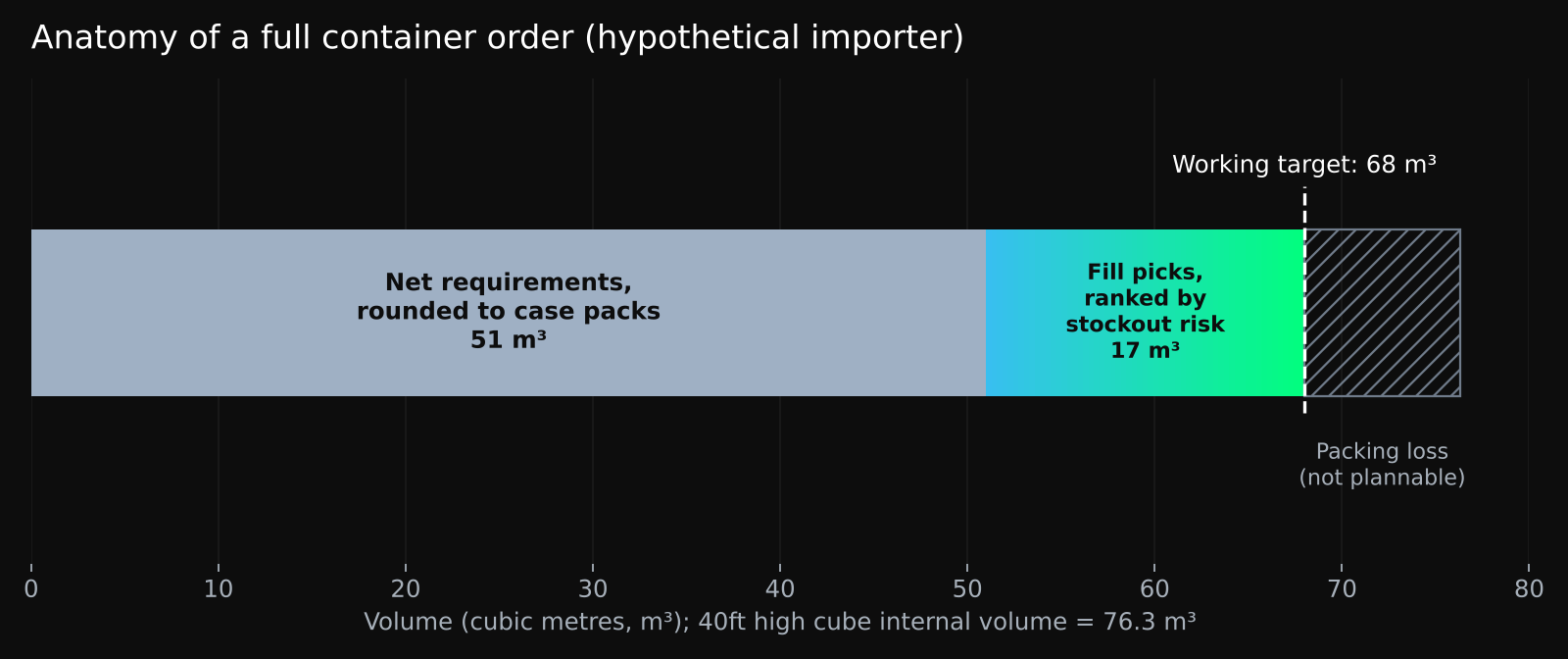
The last attribute is the one teams forget until it bites: weight. Light, bulky goods such as packaging "cube out" long before they reach the weight limit, so volume is the binding constraint. Dense goods, such as liquids, tiles or glassware, hit the payload limit while half the box is still empty. Know which constraint binds for each supplier and plan to that one. For reference, a 40-foot high cube container offers about 76.3 m³ of internal volume (iContainers), but no importer can use all of it, which is why most work to a lower volume target that reflects their own packing reality.
A 5-step method for full container load ordering
Step 1: start from net requirements, not from the container
Calculate what each product needs for the period this container must cover: forecast demand over the lead time and review period, plus a safety buffer, minus stock on hand and stock already on the water. This is the order you would place if containers did not exist. Starting here keeps the container from dictating what you buy before you know what you need.
Step 2: round each line to case packs and supplier rules
Convert each requirement to whole cartons, then apply the MOQ and order multiples. This step always adds volume, sometimes a lot of it. A product that needs 300 units but comes in cases of 48 and has a supplier minimum of 10 cases will ship 480. Doing the rounding before measuring the container prevents a common surprise: an order that looked like 60 m³ on paper and became 71 m³ once every line was rounded up.
Step 3: convert to cubic metres and compare to your target
Multiply cartons by volume per carton and add up the lines. Compare the total to your working target, not to the theoretical internal volume. Imagine an importer with a working target of 68 m³ whose rounded requirements come to 51 m³. They now have 17 m³ to decide about, and that decision is where most of the value, and most of the risk, sits.
Step 4: fill the gap by stockout risk, not by row order
This is the step spreadsheets handle the worst. The gap should be filled with the products whose stock is projected to run lowest by the time the next container could arrive, because pulling those forward avoids a future shortage. Products with plenty of projected cover should stay out, even if they are convenient to add, because they only turn freight savings into months of stock that still has to be financed.
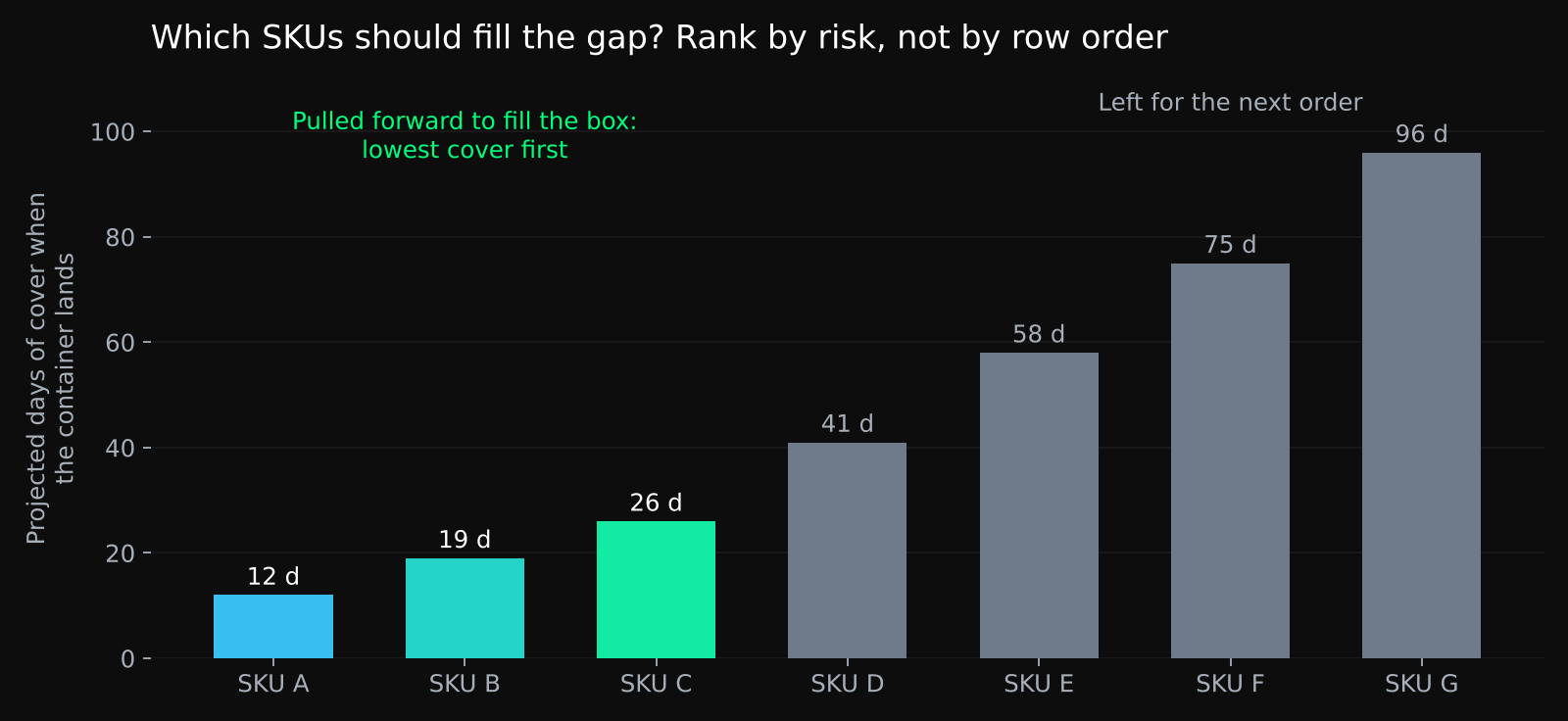
Ranking candidates this way needs a forward view per product: projected stock at arrival, ideally with a sense of how uncertain that projection is. A product with 20 days of expected cover and very volatile demand is a better fill candidate than one with 20 days and steady demand. This is where probabilistic forecasting earns its place: it tells you not just what is likely, but how wrong the plan could be for each product.
Step 5: decide what to do when the gap is too big
Sometimes the honest answer is that the container should not ship yet. If filling it means pulling forward stock you will not need for many months, three options remain: wait and consolidate with the next order, combine suppliers shipping from the same port in the same week, or ship partial and accept the higher freight cost per unit. That trade-off deserves its own calculation, and it gets more delicate as lead times grow, a topic covered in our guide to long lead time planning with frozen horizons and containers.
Where the spreadsheet method breaks
The workbook approach works when one experienced buyer manages a few dozen products from a handful of suppliers. Beyond that, container load planning in a spreadsheet starts to crack in three predictable places.
First, it is static. The tally reflects demand on the day the sheet was built, and nobody rebuilds it when a large customer order lands or a shipment slips. Second, it has no notion of risk. A spreadsheet can rank products by days of cover, but it cannot tell a steady product from a volatile one, so it treats a confident 20 days and a fragile 20 days the same way. Third, it lives in one person's head. When the buyer who built the workbook is on holiday, the container either waits or gets filled by someone guessing.
Mixed constraints make it worse. An importer buying by the container from overseas and by the pallet from domestic suppliers ends up maintaining two workbooks with different logic, and neither one talks to the demand plan. This is usually the point where small importers start looking at Supply Chain software built for small businesses.
How Flowlity builds orders to a container target
Flowlity treats the container as a constraint the optimizer has to satisfy, not as an adjustment the buyer makes afterwards. Supplier rules such as MOQ, order multiples, minimum order value and full truck or full container loads are modelled as inputs, so the order proposal a buyer opens in the morning already respects them. When an order needs completing to reach the volume target, the replenishment plan recommends which additional products to add, ranked by need rather than convenience. Because the plan is recalculated every night from the latest stock and demand, the fill picks change when the situation does.
For smaller importers that run on accounting software rather than a full enterprise resource planning (ERP) system, Flowlity Lite works from a handful of simple data tables, including a supplier information table where rules such as case volume, MOQ and order multiples can live even when the accounting system has no field for them. That is the same setup a fast-growing foodservice packaging manufacturer uses to plan around 250 custom products from about 20 suppliers across several countries, as described in the SupplyCaddy case study.
Let the plan fill the container, not the spreadsheet
A full container is not the goal. It is a constraint that every import order has to respect, and the real question is what the container should be full of. Teams that build orders from net requirements, measure them in cubic metres and fill the gap by risk get the freight savings of FCL without paying for them in excess stock and surprise shortages. Teams that fill the box from a sorted spreadsheet get the same freight bill and keep finding the wrong products on the shelf.
Want to see what your next container order would look like when the plan picks the fill? Book a demo and we will run it on your own data.
Level up your supply chain with AI.
Get a demo


FAQ
Find everything you need to know right here.
How does Flowlity handle container constraints?

Container constraints are inputs to Flowlity's supply planning optimization rather than manual corrections made afterwards. Each product can carry its volume per carton and case pack, and each supplier its rules, such as minimum order quantity, order multiples, minimum order value and a full container or full truck target.
When an order falls short of the target, the plan recommends which products to add, ranked by projected risk of running out rather than by convenience, and the whole proposal is recalculated nightly as stock and demand change. Planners review and validate the order instead of building it line by line.
For smaller importers without a full ERP, Flowlity Lite captures the same rules in a simple supplier information table, so the container logic works even when the accounting system has nowhere to store it.
How do you decide between filling by volume or by weight?
Check which limit your goods reach first.
For light, bulky products, such as packaging, textiles or furniture, the container will be full by volume long before it approaches its payload limit, so cubic metres are the constraint to plan against. For dense products, such as liquids, ceramics or metal parts, the payload limit is reached while much of the space is still empty, so weight becomes the constraint.
Many importers handle both kinds of supplier, which means the constraint should be set per supplier or per product family rather than once for the whole business. A planning system should check both limits on every order and flag whichever one binds, rather than assuming volume is always the answer.
How many cubic metres fit in a 40-foot high cube container?
A 40-foot high cube container has an internal volume of about 76.3 cubic metres, according to iContainers.
In practice, no shipment uses all of that space. Carton sizes rarely tile the container perfectly, pallets leave gaps, and some goods cannot be stacked to the ceiling. That is why most importers plan to a working target below the theoretical volume, based on how their own cartons actually load.
The right target is best set from experience: compare the planned volume of past orders with what the forwarder actually loaded, and adjust. Planning to the theoretical figure is a common cause of last-minute line cuts at the port.
Should a small importer choose FCL or LCL shipping?
It depends on volume per supplier and on how often you can afford to order.
Less than container load (LCL) shipping lets you pay for only the space you use, which suits small or irregular orders, but costs more per cubic metre, adds handling at consolidation hubs, and usually makes transit times longer and less predictable. Full container load (FCL) shipping is cheaper per unit once you can fill most of a container, and the box travels sealed from origin to destination.
A useful rule is to look at your typical order volume per supplier: if you regularly need more than about half a container, FCL with a fill strategy usually wins on total cost. Below that, LCL or consolidating several nearby suppliers into one container is often the better route. The decision should also weigh the cost of holding the extra stock needed to fill a box, not just the freight invoice.
What is full container load ordering?
Full container load ordering is the practice of building a purchase order so that its total volume or weight fills a shipping container, typically a 20-foot, 40-foot or 40-foot high cube, rather than ordering each product independently and shipping whatever results.
It sits at the boundary between purchasing and logistics, but it is fundamentally a planning decision, because filling the container means deciding which products to buy earlier or in larger quantities than their immediate need.
Done well, it starts from the net requirement of every product, rounds each line to cartons and supplier rules, converts the result to cubic metres, and then fills the remaining space with the products most at risk of running out before the next shipment. Done badly, it fills the box with whatever is easiest to add, which keeps freight costs low but quietly builds excess stock and still leaves the fast movers short.

