.svg)
.svg)
Both Lokad and Flowlity bring probabilistic AI to Supply Chain planning, but the operating model differs fundamentally. Lokad runs as a programmable platform powered by its Envision domain-specific language and operated by Supply Chain Scientists. Flowlity ships a preconfigured probabilistic AI used directly by the client's planning team, supported by a dedicated customer success manager. This article compares how each model plays out in practice.
The Flowlity vs Lokad comparison shows up on most shortlists when Supply Chain Directors evaluate AI-driven planning in 2026. Both are SaaS vendors built on probabilistic forecasting and targeting the same leaders, yet the daily life of the planning team behind each platform looks completely different. Lokad has built its reputation on what it calls Quantitative Supply Chain: code-first, automation-first. Flowlity has taken a different bet: bring the same probabilistic intelligence to the table, but put it directly in the planning team's hands without a coding layer in between.
Flowlity and Lokad in brief
Lokad was founded in 2008 and positions itself as an AI pilot for Supply Chain decisions. It claims more than $20 billion worth of merchandise optimized through its platform, and lists Air France Industries, Worten, Celio, Trek and Revima Group as public clients. The technology rests on three pillars: data engineering, probabilistic forecasting paired with differentiable programming, and a proprietary domain-specific language called Envision used to script forecasting and optimization logic.
Flowlity was founded in 2018 and focuses on AI-driven planning for mid-market companies, with retail as its primary sector and industry and distribution as adjacent markets. Public clients include Sport 2000, Camif, Ravate, EDF, Saint-Gobain Sekurit and Magotteaux. Flowlity has positioned itself on product velocity: its 2025 recognition as a Gartner Cool Vendor and the recent release of Flowlity Co-planner, an MCP-native AI agent that plugs into any major AI assistant, both signal a different pace of innovation from the broader category. That momentum was confirmed when Flowlity entered Nucleus Research’s 2026 SMB SCP Value Matrix as an Accelerator, recognized among the most usable planning platforms for smaller teams.
Both bet on probabilistic forecasting, very differently
Lokad has been publishing on probabilistic forecasting since 2016 and shaped many of the ideas now common in the category. Forecasting at Lokad is not a point estimate but a full distribution of possible futures, fed into a financial cost function that picks the decision maximizing expected outcome.
Flowlity also generates probabilistic forecasts and confidence intervals at the SKU level, then uses those distributions to size dynamic safety buffers and recommend supply decisions. The difference lies in the surface exposed to the user. Planners see demand bands, suggested buffer levels and the rationale for each recommendation in a visual interface, not in Envision code.
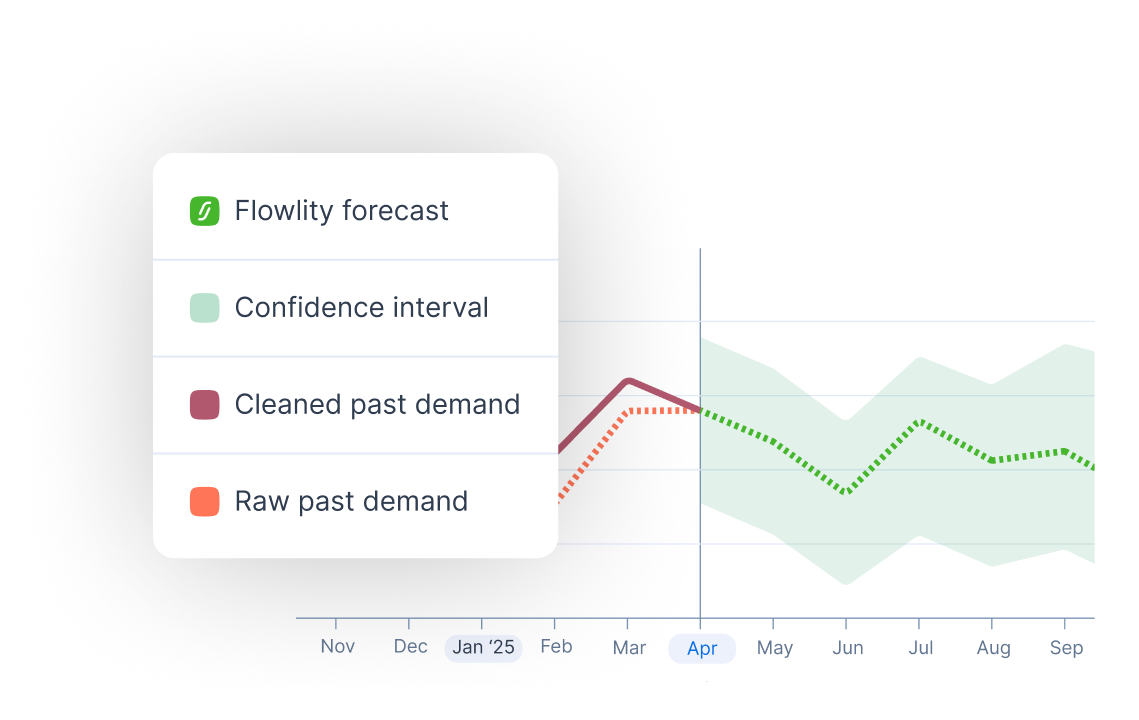
Both platforms reason about uncertainty; Lokad asks Supply Chain Scientists to encode that reasoning in scripts, Flowlity ships it preconfigured to the planning team.
Who actually operates the system?
Lokad's operating model relies on Supply Chain Scientists, either provided by Lokad as part of the contract or trained inside the client team. They write the Envision scripts, maintain them, and respond to changes in business logic by editing code. Lokad documents this openly on its technology page: the scientist is the copilot for the team.
Flowlity sits at the opposite end. The platform is operated directly by the client's planning team (demand planners, supply planners and category managers), with a dedicated customer success manager accompanying them throughout the contract. The team keeps full autonomy without writing or reading code, and the customer success manager keeps the configuration aligned with business shifts.
At Camif, a French retailer in sustainable furniture, choosing Flowlity translated into concrete numbers. The planning team absorbed 44% additional growth and added two warehouses without hiring more planners. One full-time planner was freed for higher-value work, and stockouts dropped by 6 points. Lokad could likely deliver similar outcomes on paper, but the organizational shape required to get there is fundamentally different.
The adoption signal shows up in third-party ratings too. On G2, Flowlity holds 4.9/5 across 9 reviews, while Lokad holds 4.5/5 across 2 reviews, a volume and score gap that mirrors the operating-model difference.
Time-to-value: weeks, not quarters
Lokad's timeline reflects its model. Each engagement starts with a discovery phase, then a scripting phase where Supply Chain Scientists encode the client's decision logic in Envision. The result is a tailor-made numerical recipe; the downside is a multi-month implementation tied to people who know the code, and a long-term dependency on maintaining those scripts as the business evolves.
Lokad does not publicly disclose typical implementation timelines, but the scripting-based model commonly translates into multi-month engagements before reaching full production. Flowlity's deployments cluster on the short side. The direct-to-consumer interior design brand Plum Living went live with the core platform in under two months and cut inventory 21% at go-live, before the model had fully learned the team's demand patterns. Supply Caddy, a Flowlity Lite client, generated its first AI forecasts instantly after signing and was fully operational in under two weeks. The Lite plug-and-play offer serves smaller scopes; the core platform serves mid-market complexity.
How decisions get made, and corrected
Lokad emphasizes automation. Routine decisions such as reorder quantities, multi-echelon allocations and lead time adjustments are computed and pushed automatically. The argument is sound: planners should not waste hours on calculations a machine can run in seconds.
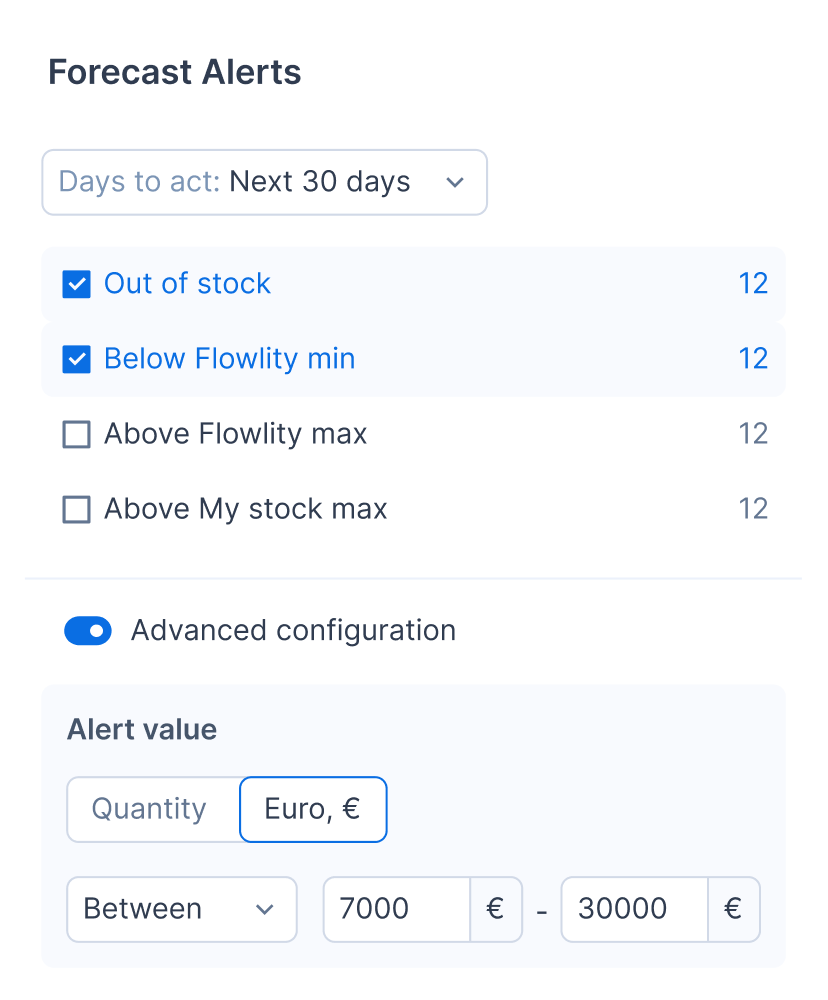
Flowlity automates routine recommendations as well, but keeps the planner in the loop on exceptions. When a supplier slips, a promotion misfires or a forecast band widens past a threshold, the platform raises a notification and routes the case to the right planner for exception management.
The underlying belief: optimization is excellent in steady state, but execution is never steady. Suppliers fail, lead times shift, demand pivots. Without a continuous adjustment loop where humans review and correct, mathematically optimal decisions degrade fast. The demand planning workflow shows how exception handling and dynamic buffers fit together in production.
Flowlity vs Lokad comparison table
Who each platform fits
Lokad makes sense for organizations with the analytical maturity, budget and patience to build a Supply Chain science capability. Aerospace operators with hundreds of thousands of parts, large retail networks balancing assortment across thousands of stores, or e-commerce players running tens of millions of SKUs need depth a packaged product can struggle to deliver.
Flowlity fits mid-market retailers, manufacturers and distributors who need probabilistic AI in production fast, without rebuilding the org around a coding team. The product was designed retail-first, and that focus shows in catalog management, store replenishment and promotion handling. For teams curious about what changes when planning shifts toward building a mature and synchronized Supply Chain planning model, the trade-offs are worth reading in full. Buyers also evaluating ERP-adjacent planning suites can review the side-by-side breakdown in Flowlity vs Slim4 (Slimstock): key differences.
The decision question is not which tool is more advanced. It is which operating model fits the company's people, budget and time horizon. Companies aiming to industrialize decision logic with a dedicated science team writing it will find Lokad has spent more than fifteen years sharpening that path. Teams aiming at quick ROI in production with their existing planners will find that Flowlity's AI-driven planning platform is built around adoption, time-to-value, and a product that keeps evolving (recent example: the Co-planner MCP agent). Teams whose shortlist crosses into S&OP-cycle tools rather than code-first platforms can extend the analysis with where Flowlity and Colibri's planning models diverge
Level up your supply chain with AI.
Get a demo

FAQ
Find everything you need to know right here.
What is Envision, and why does Lokad use a domain-specific language?

Envision is the proprietary programming language Lokad built to let Supply Chain Scientists encode forecasting, optimization and decision logic. It targets supply chain experts with basic coding skills, not software engineers. The trade-off is flexibility for those who can use it, and a learning curve for those who cannot. A team without Envision skills depends on Lokad's scientists to maintain and evolve the scripts.
How does Flowlity handle probabilistic forecasting differently from Lokad?
Flowlity generates demand distributions and confidence intervals at the SKU level, then uses them to size dynamic safety buffers and recommend supply decisions. The math is probabilistic on both sides, but Flowlity exposes the results through a planner-facing interface with visual scenario simulation rather than DSL scripts. Planners see and challenge the uncertainty range directly in their workspace.
How long does each platform take to implement?
Flowlity's core platform typically goes live in under two months, as it did at Plum Living. Flowlity Lite, designed for smaller scopes, has gone live in under two weeks at Supply Caddy. Lokad implementations are longer because each project includes a scripting phase in Envision; most enterprise deployments run several months to more than a year before reaching full production.
Who runs the system on a daily basis?
In Lokad, the daily operator is a Supply Chain Scientist, from Lokad's team or the client's. In Flowlity, the daily operators are the client's demand planners, supply planners and category managers, supported by a dedicated customer success manager. They review forecasts, adjust scenarios and validate recommendations directly in the interface, without writing code.
Can Flowlity replace Lokad for an aerospace or large retail network?
In narrow scopes, yes. For very large supply chains with hundreds of thousands of parts and unusual decision rules, Lokad's custom-script model is generally better suited. Flowlity targets mid-market complexity where standard probabilistic AI plus dynamic buffers cover most of the value at a fraction of the effort.