.svg)
.svg)

Anyone comparing Flowlity vs Relex is weighing two capable, retail-focused AI planning platforms that now overlap across much of the retail planning stack. Relex earned its reputation with the largest retailers, planning at store level across thousands of stores and fresh-food ranges.
For Supply Chain directors, demand planners and category managers in mid-market retail, distribution and industry, the real question is narrower: which scope fits the business, and how much of the daily planning should the software run on its own?
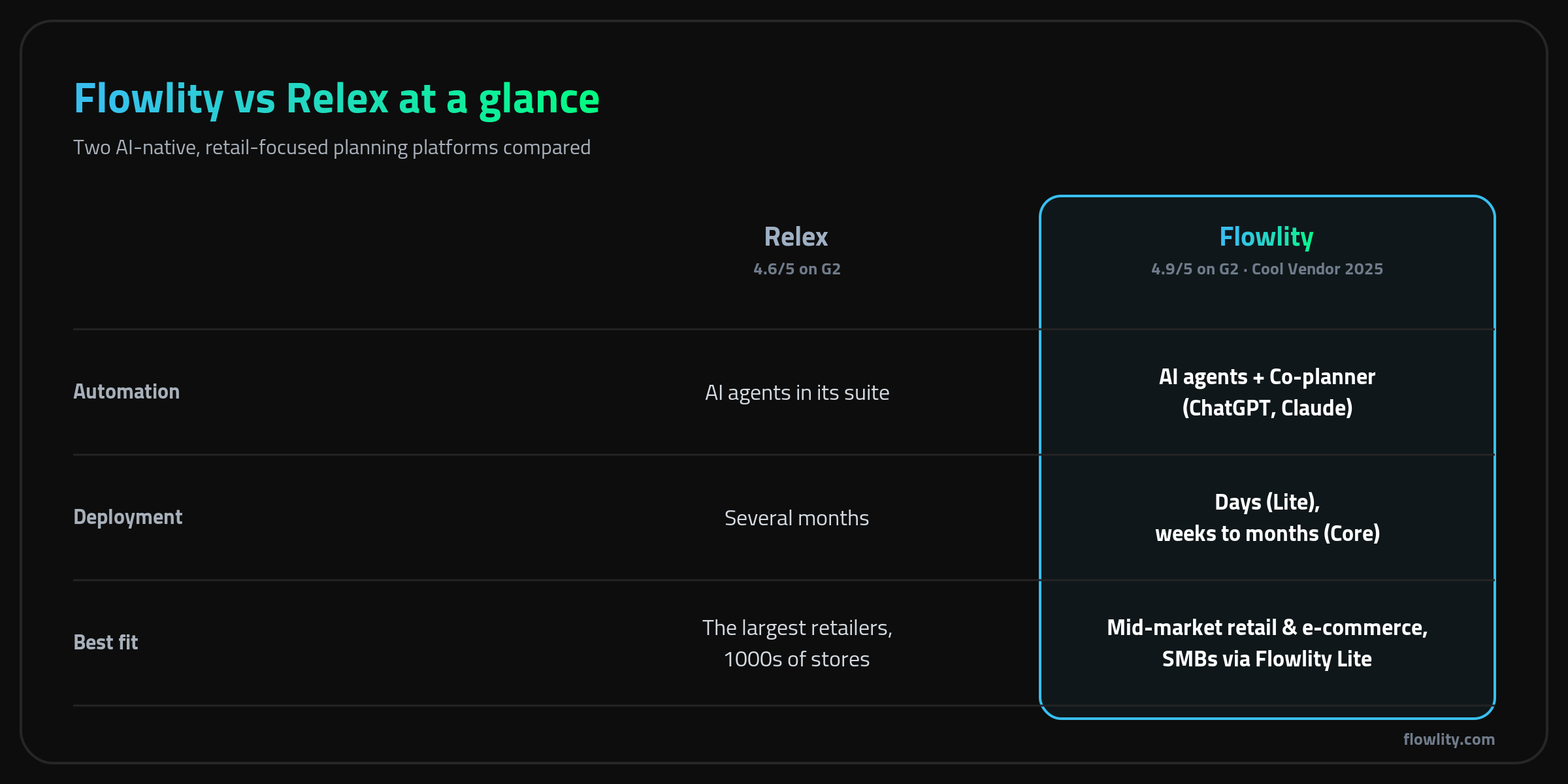
Relex and Flowlity in brief
Relex in brief
Relex Solutions is a unified retail and Supply Chain planning platform used by companies in more than 60 countries, and it positions itself explicitly as AI-native. Its distinctive strength is depth at store level, the kind of shelf-level planning a grocery chain needs across thousands of stores and fresh-food ranges. Its scope runs end to end across retail:
- demand forecasting and replenishment
- merchandising, space and assortment, and planograms
- pricing and promotions
- supply and production planning
Public reference customers include Coop Denmark, Franprix and Morrisons, and the platform is widely credited for the depth of its store-level and fresh-food capabilities. On G2, Relex holds a 4.6/5 rating across 21 reviews.
Flowlity in brief
Flowlity is an AI-native Supply Chain planning platform built on a simple conviction: more than 95% of a planner's routine work can and should be automated. In practice, the engine:
- produces a predictive, probabilistic demand forecast per item, a range of likely demand rather than a single number
- sizes safety stock dynamically against that uncertainty
- automates supplier orders
- increasingly uses AI agents (agentic AI) to handle routine decisions and surfaces only the exceptions that need a human, in an interface designed for Supply Chain teams to use without specific training
Flowlity first built its base in manufacturing and automotive spare parts (aftermarket). Its shift toward retail and e-commerce is now confirmed by new retail logos such as JouéClub and by dedicated retail features released in 2026: pricing optimization, promotion management and assortment planning.
Reference customers span retail, industry and distribution, including Sport 2000, Camif, Saint-Gobain and EDF. Flowlity holds a 4.9/5 rating on G2 across 9 reviews and was named a Gartner Cool Vendor in Supply Chain in 2025.
Retail planning scope: where the two platforms overlap
A year ago the short summary was breadth against depth. That has changed: Flowlity has widened its retail footprint, and the two platforms now overlap across most of the retail planning stack:
- demand forecasting
- inventory optimization and store replenishment
- pricing and promotion optimization
- assortment planning
Where Relex still goes further is at the shelf: merchandising, planograms, and space and assortment planning tuned for retailers running thousands of stores and fresh-food ranges. For that kind of store-level complexity, Relex's depth is a genuine fit.
For mid-market retailers and e-commerce operations that need the retail planning stack without shelf-level 3D across a very large estate, Flowlity now covers the same ground with a lighter footprint. So the first question is simply how much store-level merchandising depth the business actually needs.

Automation and the AI Co-planner: how much the software runs on its own
The sharpest difference between the two is less a feature checkbox than how much of the daily planning the software takes off the team. Flowlity is built to automate the majority of routine planning: it sizes buffers, proposes supplier orders and surfaces only the exceptions that need judgement, so a small team can run a large scope.
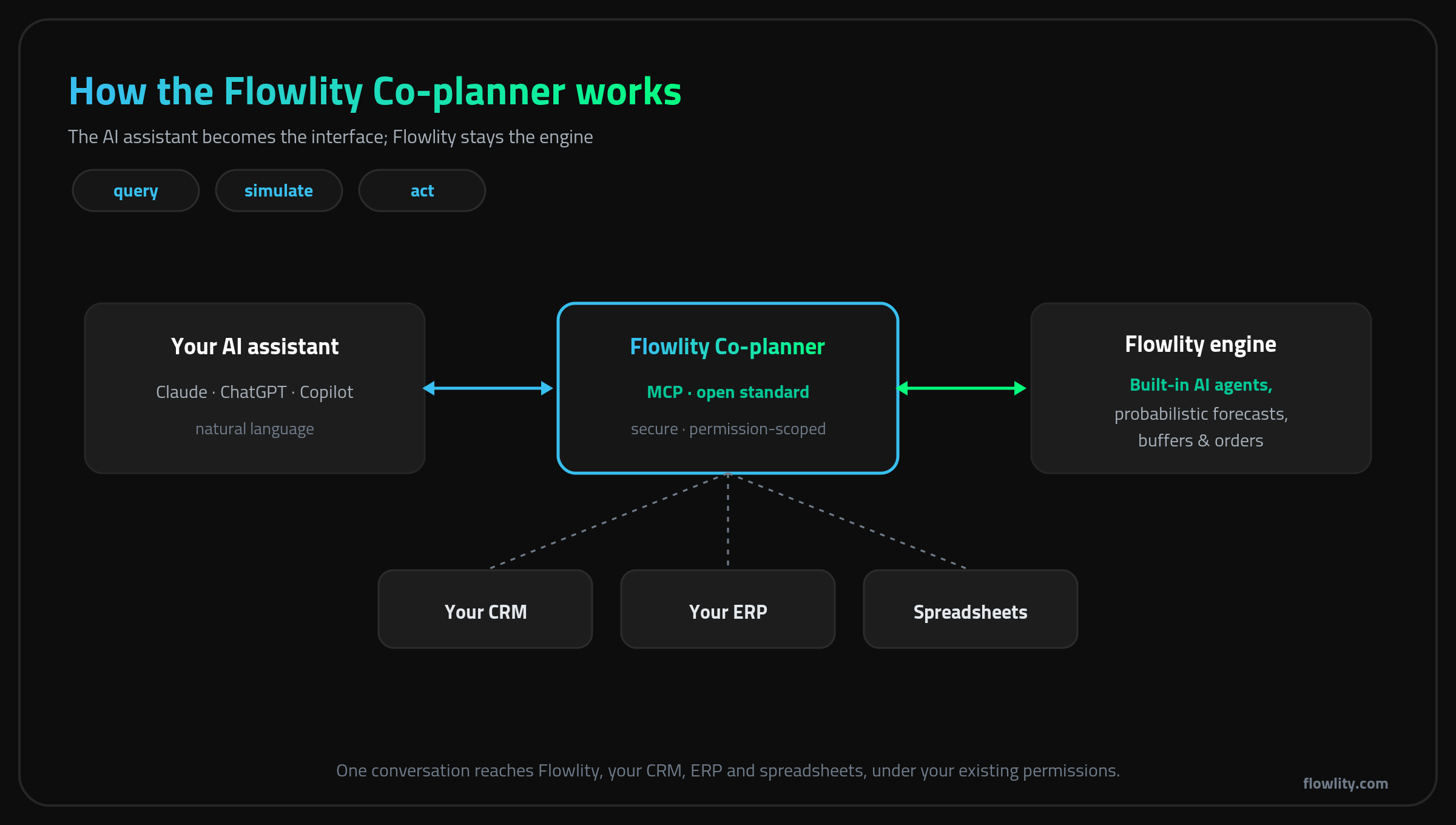
The Flowlity Co-planner extends that further. It connects live Flowlity data to the AI assistants planners already use, Claude, ChatGPT or Copilot, so instead of switching between tabs and dashboards, a planner can:
- ask a question about stock, forecasts or KPIs in plain language
- stress-test a promotion before committing to it
- accept a recommended order from a single chat
Because it is built on the Model Context Protocol, an open standard, the same conversation can also reach a CRM, an ERP or a set of spreadsheets, with every action running against real data under the planner's existing permissions.
Relex also invests in automation and agentic AI. The difference is more architectural than functional. In both platforms the AI agents are built into the product, and Flowlity is even built around them. What sets Flowlity apart is that it makes this data and these agents accessible from an AI assistant (the Co-planner), which makes them easy to use day to day for everyone involved, a real advantage for strategic decisions.
Forecasting and replenishment: where the platforms meet
On the capabilities most mid-market buyers actually shortlist for, demand forecasting and store replenishment, the two platforms sit closer than their brand profiles suggest. Practitioners who have run both describe the planning and parameterization experience as broadly comparable.
Relex draws consistent praise for the polish of its workbench and the depth of its retail replenishment logic. Flowlity leans on exception management: it surfaces only the anomalies that need a decision and routes them through a guided workflow.
Both reach the same goal of a reliable replenishment plan. They differ in how much of the daily scan the system takes off the planner's desk, which is where a product evaluation on a buyer's own data separates the two more than a brand evaluation does.
Budget: matching spend to complexity
Price often decides a mid-market shortlist, yet neither vendor publishes list pricing, so any figure depends on scope.
As a large-enterprise suite, Relex is generally the heavier investment: its breadth, store-level merchandising, planograms, space and assortment, is built for retailers that use those modules across thousands of stores, and a suite that broad also carries a heavier implementation. A mid-market retailer or manufacturer that does not run that complexity can end up funding modules it never switches on.
The practical test is fit: match the spend to the scale a company actually operates, and validate total cost in a real RFP rather than on a feature list.
Deployment and time-to-value: from weeks to multi-quarter programs
Licence cost is only part of the total. A large-enterprise suite implies a large-scale program: longer timelines, heavier IT involvement, and systems-integrator support to configure the breadth of modules.
Flowlity is built around a data-model-first approach, with pre-built data cleaning and automated tuning, which compresses the path to a working plan. In practice this ranges from a few weeks to a few months depending on scope:
- Small and mid-size businesses have a dedicated, plug-and-play option in Flowlity Lite, which is unusual in a market built mostly for large enterprises: SupplyCaddy generated its first AI forecasts immediately after signing and was live in under two weeks.
- Plum Living, a direct-to-consumer furniture retailer, went live on Flowlity Core in three months, and the dynamic buffers calibrated during the rollout cut inventory 21% at go-live.
A dedicated customer success manager accompanies the deployment from the first week, which answers the common mid-market worry of being left to operate a new system alone. Good Supply Chain change management is what turns a fast go-live into lasting adoption.
Flowlity vs Relex comparison table
Which platform fits which company
Companies running the largest retail estates, thousands of stores, fresh-food ranges, shelf-level space and assortment, and promotion mechanics tied to store layouts, will find Relex a strong match. The depth of its suite is built precisely for that complexity.
Mid-market retailers, e-commerce operations, wholesalers and manufacturers that want the retail planning stack with most of the routine work automated, and without a multi-quarter program, tend to fit an AI-driven demand planning approach like Flowlity, run in-house and extended by the Co-planner. Smaller businesses that want the same AI engine without a full rollout have a dedicated, plug-and-play entry point in Flowlity Lite, an option a large-enterprise suite like Relex does not set out to serve.
The deciding factor is rarely which engine forecasts better on a slide. It is how much store-level merchandising depth the business needs, and how much of the planning it wants the software to run on its own.
Ready to compare Flowlity on your own data? Book a demo.
Level up your supply chain with AI.
Get a demo
FAQ
Find everything you need to know right here.
Is Flowlity an APS like Relex?

Yes. Both are AI-native, retail-focused Advanced Planning Systems (APS). The difference is shape: Relex is a broad retail suite that goes deep into merchandising, planograms and space and assortment for very large store estates, while Flowlity is an AI-native platform focused on automating demand, inventory and Supply Planning, now extended across retail revenue features such as pricing and promotions.
What is the main difference between Flowlity and Relex?
Two things: store-level depth and automation. Relex goes deeper at the shelf, planograms, space and assortment and fresh-food planning for retailers with thousands of stores. Flowlity covers the same core retail planning stack for mid-market and e-commerce, with the emphasis on automating most of the routine work and letting planners act through the Flowlity Co-planner from assistants like Claude or ChatGPT.
Does Flowlity offer pricing, promotion and assortment planning like Relex?
Pricing and promotion optimization and assortment planning are all part of Flowlity's retail range today. Relex still offers greater depth in shelf-level merchandising, planograms and space and assortment for very large store networks. For mid-market retail and e-commerce, Flowlity covers the retail planning stack without that store-level 3D layer.
Is Relex better than Flowlity for retail?
It depends on the retail problem. For the largest store estates with fresh-food ranges, planograms and space and assortment across thousands of stores, Relex's depth is a strong fit. For mid-market retailers and e-commerce operations focused on inventory, service and automation, Flowlity covers the retail planning stack, deploys faster, and runs more of the planning on its own.
How long does it take to implement Flowlity compared to Relex?
Flowlity is built for speed: the plug-and-play Flowlity Lite can be operational in under two weeks, as it was at Supply Caddy, and full Flowlity Core rollouts typically run a few weeks to a few months, three months at Plum Living. Large-enterprise Relex deployments are multi-quarter suite programs that involve heavier IT and systems-integrator support to configure the breadth of the platform.
How much does Relex cost compared to Flowlity?
Neither vendor publishes list pricing, so cost depends on scope. As a large-enterprise suite, Relex is generally the heavier investment, reflecting the breadth of modules it includes. For a focused mid-market scope, part of that breadth can go unused, so buyers should compare total cost against the modules they will actually deploy.
Can a small business use Flowlity?
Yes, and it is one of Flowlity's strengths. Flowlity Lite is a plug-and-play edition built specifically for small and mid-size businesses: it connects quickly, generates its first AI forecasts almost immediately, and goes live in weeks, as it did at Supply Caddy. Relex is designed for large retail operations, so Flowlity fits a wider range of company sizes, from small businesses on Flowlity Lite to mid-market and larger teams on Flowlity Core.