.svg)
.svg)
Pharmaceutical wholesalers: when regulation dictates your Supply Chain

The pharmaceutical wholesaler's paradox: being required to hold inventory you can't buy
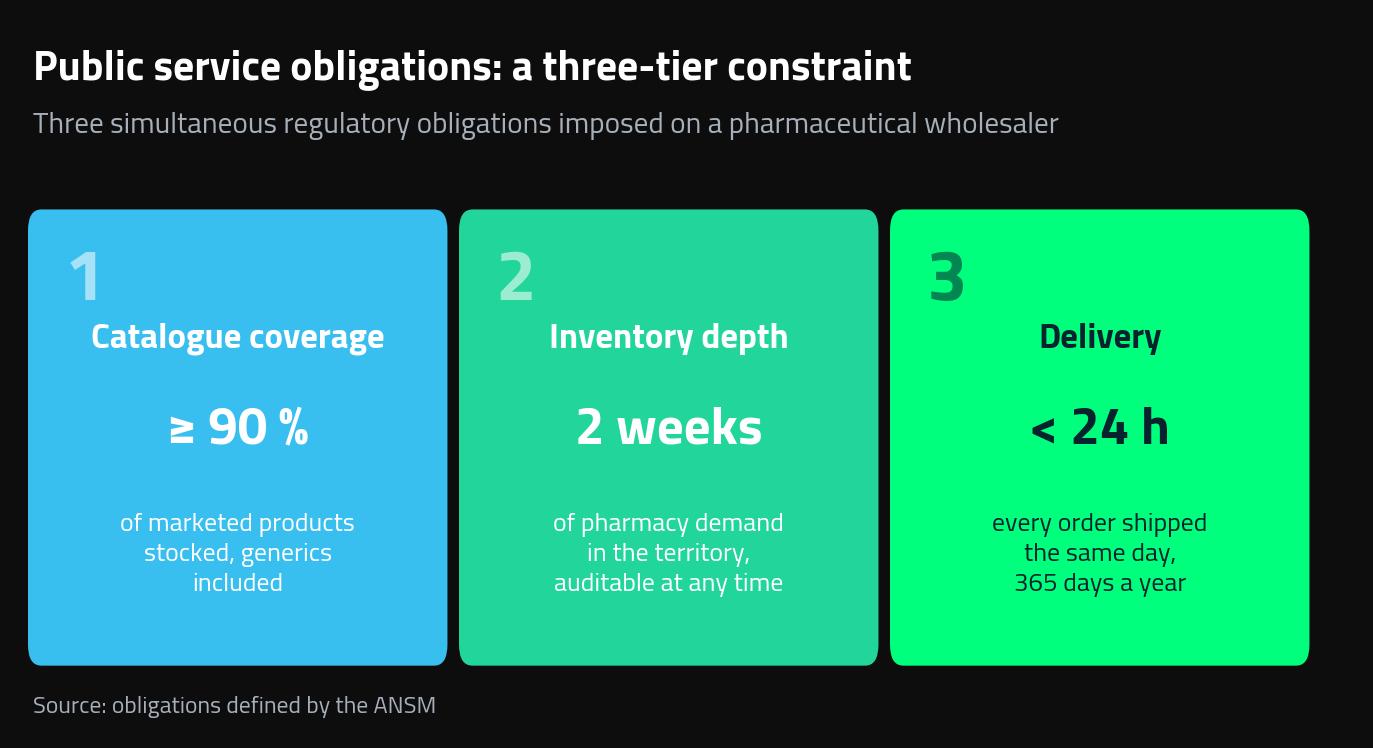
A pharmaceutical wholesaler isn't simply another distributor. By law, it must stock at least 90% of all medicines marketed in France, maintain a minimum of two weeks of inventory for reimbursable medicines, and deliver to every pharmacy within its territory in less than 24 hours, 365 days a year. These Public Service Obligations (PSOs), defined by the French National Agency for Medicines and Health Products Safety (ANSM), leave virtually no room for flexibility.
At the same time, pharmaceutical manufacturers are increasingly restricting deliveries through quota and allocation systems as global supply constraints persist. The result is a planning challenge that generic Supply Chain software simply wasn't designed to solve. You are legally required to maintain inventory that your suppliers may refuse to sell you.
The regulatory constraints unique to pharmaceutical wholesalers
Public Service Obligations (PSOs): three regulatory requirements to manage simultaneously
Public Service Obligations impose three distinct requirements, each of which must be met at all times.
Catalogue coverage. Wholesalers must carry at least 90% of all pharmaceutical products available on the French market, including generic medicines. Compliance is measured at warehouse level and is subject to regular regulatory inspections.
Inventory depth. For every listed medicine, wholesalers must maintain inventory equivalent to two weeks of pharmacy demand within the territory they serve. More importantly, they must be able to demonstrate compliance at any time. That requires complete traceability of demand forecasts, purchasing decisions and available inventory, not simply maintaining the stock itself.
Delivery performance. Orders placed before the regulatory cut-off time must be delivered the same day. For emergency medicines, required delivery times can fall to only a few hours. Unlike many commercial distribution networks, this service level cannot be relaxed because of supplier shortages or operational constraints.
Medicines of Major Therapeutic Interest (MITIs): an additional regulatory layer
Medicines classified by the ANSM as Medicines of Major Therapeutic Interest (MITIs) are subject to even stricter rules. These products cannot be exported as long as domestic demand cannot be fully covered. During shortage situations, every order involving an MITI must be individually tracked and documented, creating a significant reporting burden for wholesalers.
Compliance means being able to prove your decisions
One of the least visible, but most demanding, regulatory requirements is the burden of proof. During an ANSM inspection, or when challenged by a pharmaceutical manufacturer, wholesalers must be able to demonstrate retrospectively that every purchasing decision was justified and that any stockout resulted from supplier constraints rather than poor inventory management. Doing so requires a detailed history of purchase orders, supplier deliveries, demand forecasts, inventory positions, and the discrepancies between expected and actual supply. In many organisations, producing this evidence still requires days of manual extraction and spreadsheet work. When regulators ask for proof, assembling it in real time is often impossible.
Operational challenges: a Supply Chain under constant pressure
Manufacturer quotas: when half your business is still managed manually
For wholesalers operating in the most constrained markets, quota-managed products can account for up to half of total distribution revenue. Yet the process is still surprisingly manual. Every month, pharmaceutical manufacturers communicate product allocations via email, fax or CSV files, often with no standardised format. Supply planners must manually import the data, allocate quantities across distribution centres, apply manufacturer-imposed packaging constraints (cases, bundles, etc.), verify freight thresholds, and submit purchase orders within ordering windows that may last only a few hours.
The process is repeated hundreds of times every month. It keeps entire planning teams busy with low-value administrative work, without guaranteeing reliable execution. Data-entry errors, missed updates and overlapping ordering schedules frequently lead to costly inventory imbalances.
Balancing inventory across distribution centres: the hidden logistics challenge
Most pharmaceutical wholesale networks consist of a central warehouse supplying multiple regional distribution centres through daily transport routes. When one branch runs short while another has excess inventory, the obvious solution is an internal stock transfer. In France, these transfers are commonly referred to as dépannages or vias. Identifying those opportunities in real time, however, is anything but straightforward. With tens of thousands of SKUs spread across a dozen or more warehouses, traditional planning systems struggle to determine where inventory should be moved, and when.
As a result, transfers often happen too late (after the pharmacy has already sourced the product from a competitor), too frequently (generating unnecessary transportation costs), or not at all. Procurement teams end up spending a significant portion of their day making these decisions manually, often with incomplete visibility across the network.
Forecasts distorted by supply constraints
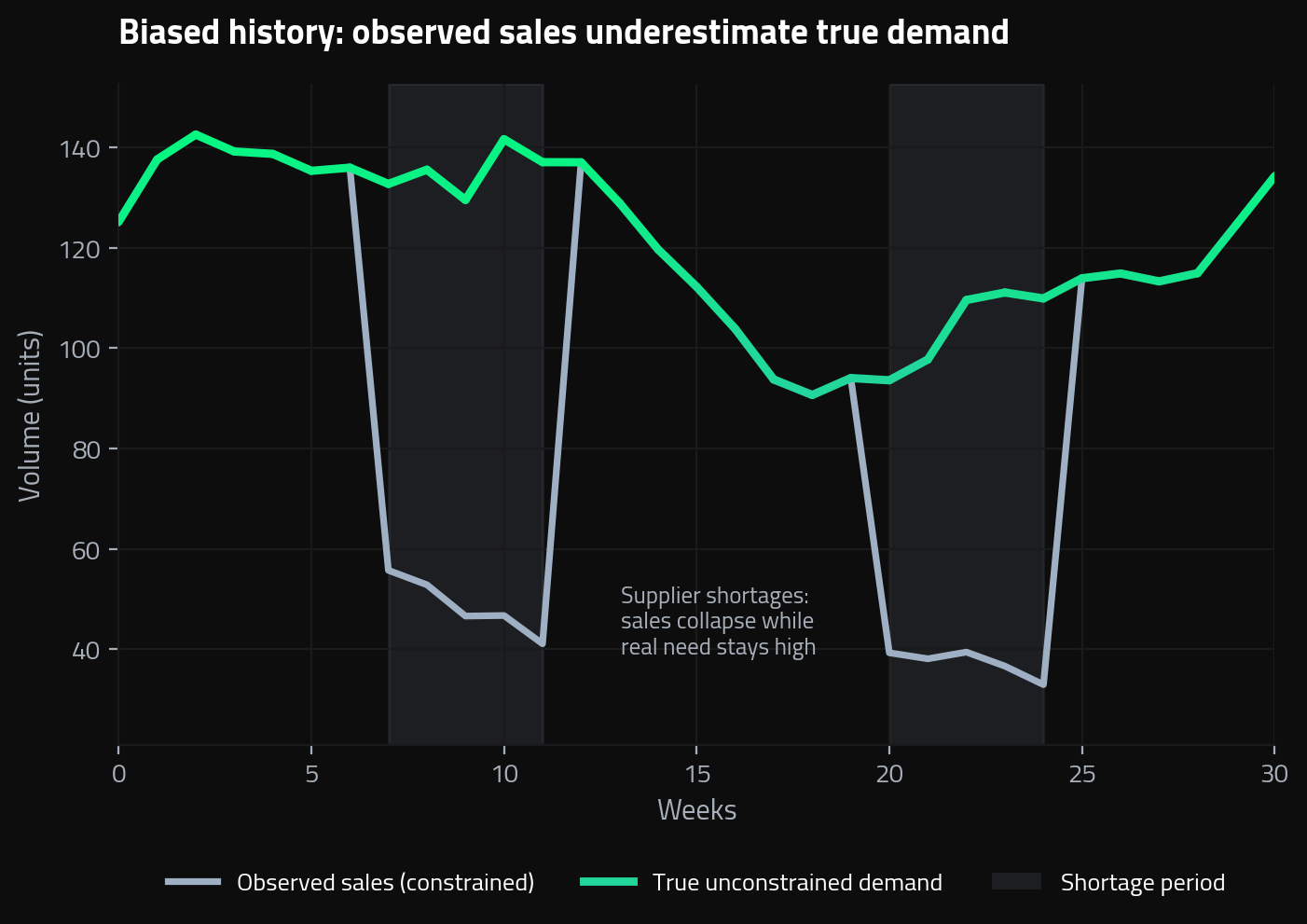
Forecasting demand in pharmaceutical wholesale presents another unique challenge. Sales history is rarely a reliable reflection of actual market demand. A product under allocation will naturally generate fewer sales than customers actually wanted to buy. Conversely, a competitor experiencing a stockout may temporarily push demand far above normal levels. The launch of a new generic medicine can cause demand for the branded product to collapse within weeks. These events aren't exceptional. They're part of day-to-day operations in a market shaped by constant regulatory changes, recurring shortages and frequent product substitutions.
Any forecasting algorithm that treats historical sales as an objective representation of demand will inevitably produce biased recommendations. The result is predictable: inventory recommendations that are too conservative, leading to avoidable stockouts, or too aggressive, increasing working capital requirements and expiry risks.
Managing international subsidiaries: planning across customs and regulatory boundaries
For pharmaceutical wholesalers operating subsidiaries in the French overseas territories (DROM-COM) or across Africa, planning becomes even more complex. Supply chains must account for maritime lead times ranging from several weeks to several months, Import Authorisations required before certain products can be ordered, different customs regimes depending on destination, and export restrictions affecting Medicines of Major Therapeutic Interest. These subsidiaries cannot rely on the same distribution planning logic as mainland France. At the same time, they still need to remain aligned with the group's overall inventory strategy. Balancing local constraints with global inventory optimisation quickly becomes impossible using spreadsheets or generic planning software.
Flowlity's approach: planning built for pharmaceutical distribution
From manual quota allocation to supervised automation
Flowlity's quota management engine has been designed specifically for the realities of pharmaceutical distribution. As soon as a manufacturer's allocation is received, it is imported into the platform and automatically distributed across the network according to configurable business rules. Allocations can be optimised based on historical market share, target inventory coverage, or minimum stock thresholds required to guarantee local product availability.
Instead of spending hours calculating how a monthly quota should be split across twelve warehouses, planners simply review the proposed allocation, validate it, or make adjustments where business knowledge is required. The difference is significant. Planning teams move away from repetitive administrative work and focus instead on managing the genuine exceptions that require human judgement.
Every allocation decision, purchase order, supplier delivery and variance is automatically recorded. If a regulatory inspection takes place, the required audit trail is available in seconds, not after days of manual reconstruction.
Automated inventory balancing across distribution centres
Flowlity continuously analyses inventory positions across the entire distribution network to identify multi-echelon rebalancing opportunities. Several times a day, the platform detects products that are at risk of stockout in one warehouse while being overstocked in another. It then recommends stock transfers based on multiple criteria, including inter-site transportation lead times, logistics costs and the impact on overall network coverage.
Rather than starting from a blank spreadsheet, planners receive a prioritised list of transfer recommendations ready for review. The decision criteria are fully transparent and can be configured to match each company's operating model. Routine transfers can be automated, while more complex situations remain under planner control. The outcome is twofold: fewer unnecessary inter-branch transfers and higher service levels for products under supply pressure.
Probabilistic forecasting designed for pharmaceutical distribution
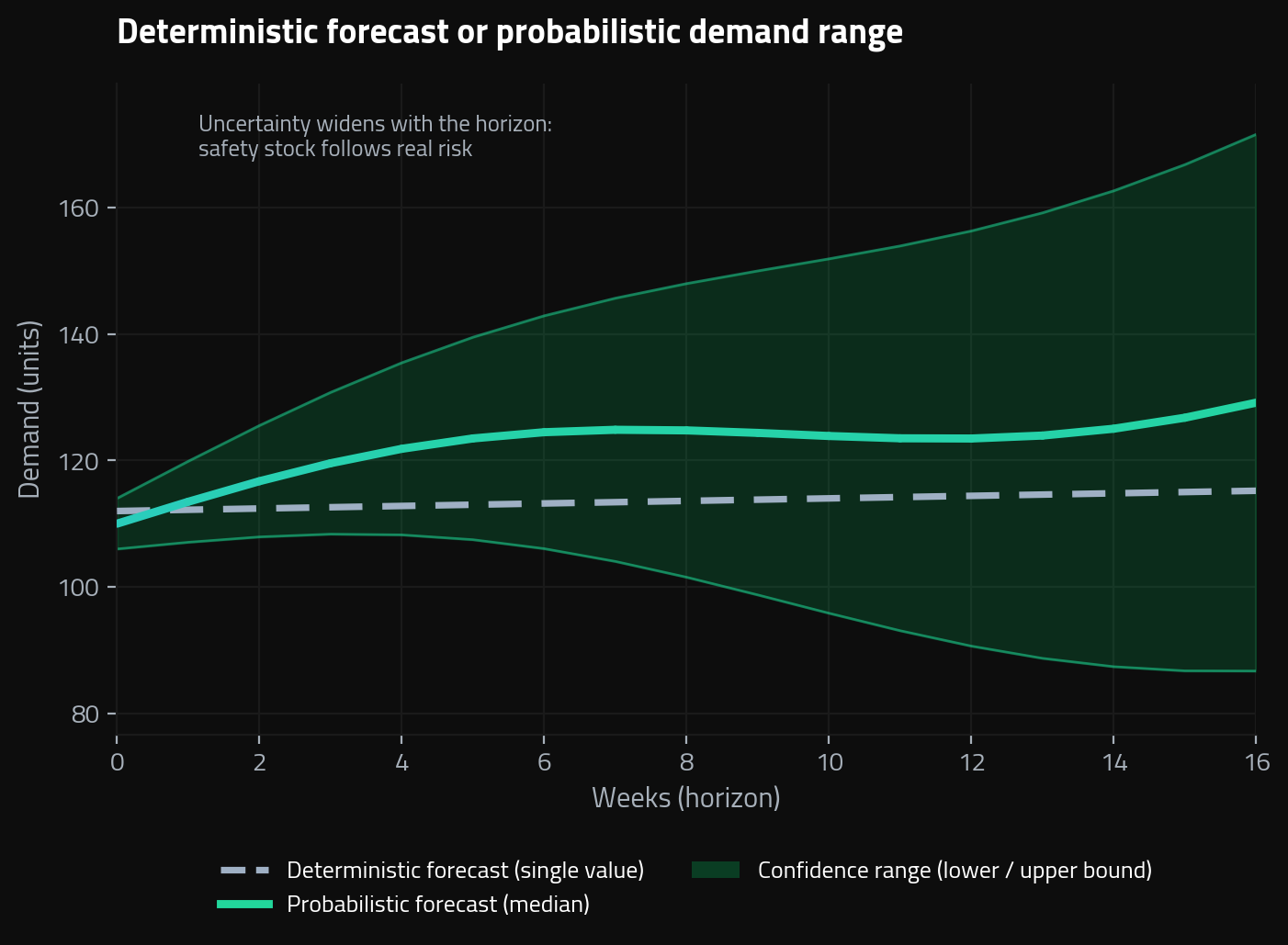
Pharmaceutical wholesale is one of the most volatile planning environments in any industry. A deterministic forecast simply isn't enough. Instead of generating a single demand forecast, Flowlity produces a probabilistic demand range for every SKU, with upper and lower confidence bounds and a probability distribution across all likely outcomes.
This allows inventory to be sized according to actual uncertainty rather than fixed coverage rules. A medicine subject to Public Service Obligations and experiencing high demand volatility will automatically receive a larger safety buffer than a stable product with predictable consumption and no regulatory constraints. Just as importantly, supplier stockouts and allocation periods are identified and excluded from the forecasting model. Rather than interpreting constrained sales as weak demand, the platform reconstructs unconstrained demand and plans inventory accordingly.
For international subsidiaries, Flowlity also incorporates transport-specific lead times, including air freight and ocean shipping, into replenishment calculations, allowing orders to be triggered well before shortages become visible locally.
The MCP Connector: planning through natural language
Planning is only one part of the equation. Flowlity also provides an MCP (Model Context Protocol) Connector, allowing Supply Chain teams to interact with the platform through generative AI assistants such as ChatGPT, Claude and Microsoft Copilot. Instead of navigating dashboards or exporting spreadsheets, a Supply Chain Director can simply ask:
Which Medicines of Major Therapeutic Interest are expected to fall below our Public Service Obligation thresholds across mainland France this week?
Within seconds, the platform returns a structured answer based on live operational data. No reports to build, no spreadsheets to export, no specialist planning interface required. This fundamentally changes the way Supply Chain teams operate: the right people receive the right alerts at the right time, decisions are made faster, and collaboration between procurement, operations and commercial teams becomes significantly smoother.
Can pharmaceutical wholesalers reduce inventory without compromising service levels?
Yes, and that's precisely where a probabilistic planning platform delivers the greatest value. Most pharmaceutical wholesalers are simultaneously overstocked and understocked. Inventory is excessive on some products because planners build in extra safety to compensate for uncertainty. At the same time, other products remain understocked because weak demand signals aren't detected early enough. The issue isn't simply inventory volume, it's inventory allocation. By modelling uncertainty at SKU level, probabilistic planning allows wholesalers to reduce excess inventory where risk is low while strengthening coverage where it matters most. The result is lower working capital, fewer stockouts and improved regulatory compliance, all at the same time.
The next step: stop choosing between compliance and performance
For years, pharmaceutical wholesalers have operated under the assumption that regulatory compliance and operational performance are competing objectives. Public Service Obligations require more inventory. Service-level commitments require faster deliveries. Manufacturer quotas make both increasingly difficult to achieve. Optimisation has therefore often meant making trade-offs, and accepting additional risk.
A planning platform that understands pharmaceutical distribution changes that equation. Instead of treating regulations as exceptions that planners must manage manually, it embeds them directly into the planning model. Public Service Obligations, manufacturer quotas, Medicines of Major Therapeutic Interest and regulatory lead times become planning parameters rather than operational constraints layered on top of the process. This native integration makes it possible to pursue three objectives simultaneously: reduce inventory, improve service levels, and strengthen regulatory compliance, without sacrificing one to achieve the others.
Turn regulatory constraints into a competitive advantage
Discover how Flowlity helps pharmaceutical wholesalers automate quota allocation, optimise inventory across distribution centres and maintain compliance with Public Service Obligations through AI-powered probabilistic planning.
Book a personalised demo and see how Flowlity can transform quota management across your distribution network.
Level up your supply chain with AI.
Get a demo

FAQ
Find everything you need to know right here.
What are quota-managed products in pharmaceutical wholesale?

Quota-managed products are medicines for which pharmaceutical manufacturers deliberately limit the quantities they allocate to each wholesaler over a given period, typically on a monthly basis. These quotas are usually introduced in response to global supply constraints, such as shortages of raw materials, limited manufacturing capacity or strategic allocation decisions. For wholesalers, this means inventory can no longer be replenished purely according to demand. Instead, planners must distribute a fixed allocation across multiple distribution centres and pharmacy customers while continuing to meet Public Service Obligations. In many pharmaceutical distribution networks, managing quota-controlled products accounts for more than half of total wholesale activity, yet the process remains largely manual.
How can an Advanced Planning System (APS) help pharmaceutical wholesalers comply with Public Service Obligations?
A pharmaceutical-specific APS supports Public Service Obligations in three key ways. First, it continuously monitors inventory coverage against regulatory thresholds and alerts planners before compliance is at risk, giving teams time to act proactively rather than reactively. Second, it automates the allocation of manufacturer quotas across warehouses using configurable business rules, reducing a process that often takes several hours to just a few minutes. Finally, it provides a complete audit trail of purchasing decisions, inventory movements and supplier deliveries, making it possible to produce the documentation required during regulatory inspections without manual reconstruction.
What's the difference between an emergency stock transfer and a "via" transfer?
Both involve moving inventory between distribution centres, but they are triggered differently. An emergency stock transfer is initiated manually by a planner when one warehouse runs short of inventory and another has available stock. A via transfer, by contrast, is triggered automatically by a customer order. If the customer's assigned distribution centre cannot fulfil the order, it is redirected to a neighbouring warehouse, which ships the product directly. Both mechanisms generate additional transportation costs and should therefore be optimised carefully. An advanced planning platform helps by identifying transfer opportunities before shortages become critical, reducing unnecessary emergency movements while maintaining service levels.
How do you forecast demand when historical sales are distorted by shortages or supply restrictions?
This is one of the most challenging aspects of pharmaceutical Supply Chain planning. Historical sales data often underestimates true market demand because periods of supplier shortages, product allocations or sales restrictions suppress actual sales. Using this data without adjustment inevitably leads to under-forecasting, insufficient replenishment recommendations and recurring stockouts. The correct approach is to identify constrained periods, exclude them from the forecasting model and reconstruct unconstrained demand instead. Probabilistic forecasting goes one step further by explicitly modelling the uncertainty surrounding each forecast, allowing safety stock to be sized according to actual risk rather than fixed inventory rules.
How does Flowlity support international subsidiaries in overseas territories and Africa?
International subsidiaries operate under planning constraints that are fundamentally different from those of domestic distribution networks. Ocean freight lead times may extend to several weeks or even months. Certain products require Import Authorisations before they can be shipped. Customs procedures vary by destination, and Medicines of Major Therapeutic Interest remain subject to export restrictions whenever domestic supply cannot be guaranteed. Flowlity incorporates these constraints directly into its planning models. Transport lead times are included in replenishment calculations, regulated medicines follow dedicated planning rules, and inventory visibility is consolidated across the entire network, including international subsidiaries. This enables organisations to optimise inventory globally while respecting the operational realities of each local market.