.svg)
Planifica y sincroniza los flujos de distribución con DRP basado en IA
Gestiona el movimiento de existencias a través de la red con total confianza gracias al software de Planificación de Requisitos de Distribución (DRP) basado en IA de Flowlity. Anticipa las necesidades de cada punto de la red y planifica la distribución incluso bajo incertidumbre de la demanda.
Agenda una demo
Sincroniza los flujos en toda la red de distribución
La distribución solo funciona cuando la red se mueve de forma coordinada.
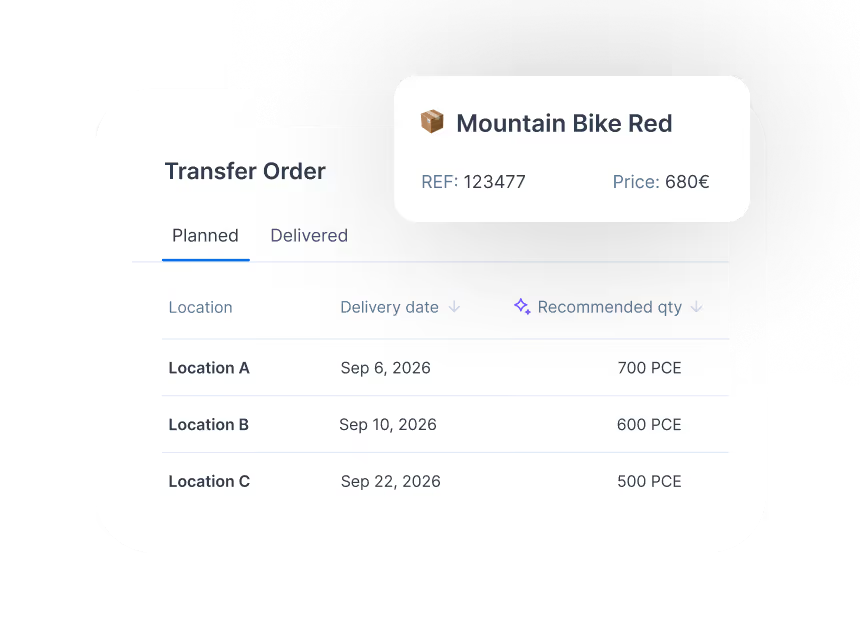
Requisitos de distribución por periodos
.svg)
Planificación de flujos orientada a la demanda
Anticipa las necesidades de distribución en cada punto de la red
Sabe qué enviar, dónde y cuándo.
.svg)
Coordinación de flujos multi-nodo
Ejecución de red más fluida
Planifica los flujos de distribución bajo incertidumbre de la demanda
El DRP determinista falla cuando la realidad cambia.
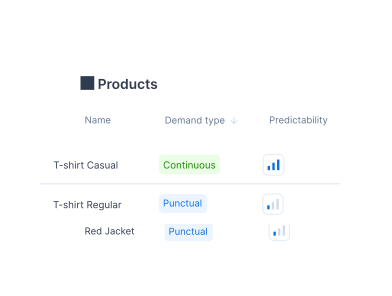
Anticipación probabilística de flujos
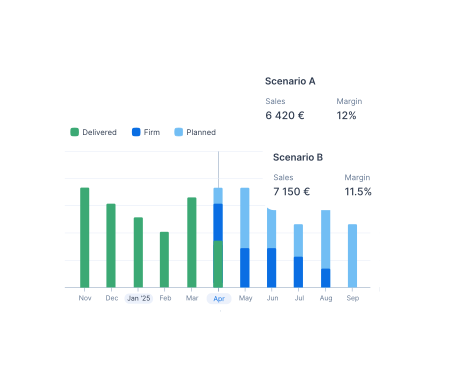
Simulación de flujos basada en escenarios
De transferencias reactivas a una planificación proactiva de la distribución


DRP software: take control of your distribution instead of reacting to it
Most Supply Chains don’t lack data — they lack control over how inventory flows across their network.
Bringing clarity and control to distribution decisions

Most distribution issues don’t come from a lack of tools. They come from fragmented planning.
One warehouse is overstocked, another is running out. Transfers are triggered too late. Decisions are made in Excel because the system can’t be trusted.
Over time, planners end up spending more time fixing problems than actually planning.
What DRP software changes is not just the process — it changes how decisions are made.
Instead of reacting to issues after they occur, teams can continuously answer a simple but critical question:
What should we move, where, and when?
This shift allows planners to anticipate imbalances before they impact service levels. Inventory is no longer managed in silos but coordinated across the network. Flows become aligned, and decisions become proactive rather than reactive.
The real value doesn’t come from automation alone. It comes from giving teams the ability to focus on decisions that improve performance, not just corrections.
This is where DRP becomes truly powerful when connected with Inventory Management and a clear operational dashboard — because visibility only creates value when it leads to action.
Why traditional DRP tools don’t work anymore
Many companies already have DRP capabilities embedded in their ERP. On paper, the functionality exists. In reality, it is often bypassed.
The reason is simple: the logic behind traditional DRP no longer matches today’s Supply Chain conditions.
These systems were designed for relatively stable environments. They rely on fixed safety stock rules, single-point forecasts, and planning cycles that don’t adapt quickly to change.
But Supply Chains today are anything but stable.
Demand fluctuates constantly. Suppliers are less predictable. Promotions, seasonality, and external events introduce variability that static models cannot absorb.
To cope with this, companies add buffers. More stock, more safety margins, more “just in case”.
And yet, the paradox remains: inventory increases, but service levels don’t necessarily improve.
Saint-Gobain experienced this exact situation. By changing how distribution decisions were made — moving away from static rules toward a more dynamic approach — they were able to reduce inventory while simultaneously lowering stockout risk, as detailed in this Saint-Gobain case study on Supply Chain Planning optimization.
This is where traditional DRP reaches its limits. It was designed to calculate — not to adapt.
What really matters when selecting a DRP solution (features, criteria…)
Choosing a DRP software is less about features and more about fit.
The key question is not “what does the tool do?” but rather: Will it work in the reality of my Supply Chain?
First, the system needs to understand the network as a whole. Inventory decisions made in one location always impact others. Treating warehouses independently leads to suboptimal results. This is why approaches like MEIO are critical — they ensure inventory is positioned where it brings the most value across the network.
Second, DRP cannot operate in isolation. If it is disconnected from Supply Planning, the plan becomes theoretical. What looks optimal on paper may not be feasible operationally.
Third, usability is essential. Even the most advanced system will fail if planners don’t trust it. Recommendations must be understandable, explainable, and actionable. A well-designed Supply Chain dashboard is often the difference between adoption and rejection.
Finally, implementation speed is a decisive factor. In a fast-moving environment, a solution that takes over a year to deploy risks becoming obsolete before it delivers value.
What DRP software actually changes in your day-to-day operations
There is a point where distribution complexity outgrows manual planning. It usually happens gradually. Networks expand, product portfolios grow, and variability becomes harder to control. At first, teams compensate. Then the cracks start to show.
One warehouse is overstocked. Another is out of stock. Transfers happen too late. Decisions are made in Excel. And planners spend their time reacting instead of anticipating.
At that stage, the symptoms are clear: recurring inventory imbalances, growing reliance on manual adjustments, and increasing pressure on planning teams. This is not a tooling problem. It’s a coordination problem. And it becomes even more visible depending on your context.
In retail, for example, keeping stores aligned with central inventory is a daily challenge. Without structured Store Replenishment, some locations run out too early while others accumulate excess stock.
In wholesale, the balance is tighter. Service levels must remain high, but margins leave little room for inefficiency. Poor distribution decisions quickly translate into lost profitability.
In Spare Parts Supply Chains, the stakes are different but just as critical. Demand is unpredictable, yet availability must be guaranteed. A missing part can mean downtime, delays, or lost revenue.
In all these situations, the same issue appears: the network is not synchronized.
What performance gains look like beyond theory
The impact of DRP is best understood through real outcomes, not theoretical benefits.
En Camif, la mejora de la planificación de la distribución no solo redujo las roturas de stock: permitió a la empresa absorber su crecimiento de actividad sin sumar recursos de Supply Chain. Camif generó aproximadamente +40 000 € de ingresos anuales adicionales al evitar roturas en SKU clave durante los picos comerciales, y liberó el equivalente a un planificador a tiempo completo (1 760 horas al año) antes dedicadas a la reconciliación manual entre centros. Las roturas de stock cayeron 6 puntos en el mismo periodo.
En Plum Living, el reto era distinto. El stock no era necesariamente demasiado elevado en todos los puntos: estaba mal posicionado en la red. Reequilibrando el stock entre almacenes, Plum redujo el valor del inventario un 38 % a lo largo del tiempo (de 598 k€ a un objetivo de 367 k€), con una bajada del 21 % alcanzada desde el arranque. La red empezó a funcionar como un sistema coordinado y no como un conjunto de nodos independientes.
These examples highlight a key point: DRP is not about optimizing isolated metrics. It's about improving how the entire Supply Chain operates.
Less friction. Fewer urgent decisions. More control.
Moving from reactive planning to controlled execution
Without structured distribution planning, most Supply Chains operate in reaction mode. A shortage appears, and teams respond. A delay occurs, and adjustments are made. Demand spikes, and the system struggles to keep up.
DRP changes the timing of decisions.
By continuously analyzing demand signals, inventory levels, and supply constraints, the system identifies risks earlier. This allows planners to act before problems materialize. Instead of reacting to shortages, they can rebalance inventory proactively. Instead of adjusting plans after disruptions, they can simulate scenarios and prepare in advance.
Over time, this shift reduces volatility across the network. When combined with Inventory Management and Supply Planning, DRP becomes more than a planning tool. It becomes a control layer that stabilizes execution and improves overall performance.
Why companies move away from ERP-based DRP toward Flowlity
Most DRP tools originate from ERP systems. They were designed to support planning — but not necessarily to handle uncertainty. Flowlity was built with a different starting point: variability.
Instead of relying on static rules, it continuously adapts to what is happening in the Supply Chain. It highlights risks early, suggests concrete actions, and allows planners to make informed decisions faster.
This changes the role of the planner. From someone who adjusts plans manually… to someone who pilots the Supply Chain with the support of AI-powered intelligent recommendations.
And just as importantly, it changes the speed of transformation. No heavy IT projects. No multi-year deployments. Companies can start improving their performance quickly — reducing inventory, improving service levels, and freeing up time for their teams.
Because at the end of the day, the goal is not better planning tools. It’s a Supply Chain that is simpler to run and more resilient to change.
FAQ about distribution requirements planning software
Find everything you need to know right here.
¿Qué significa DRP en la gestión de la Supply Chain?
DRP significa Distribution Requirements Planning (planificación de necesidades de distribución).
Es un método de planificación de Supply Chain utilizado para determinar:
- cuánto inventario debe distribuirse
- cuándo deben reponerse los productos
- dónde debe ubicarse el stock en las redes de distribución
El DRP garantiza que los flujos de inventario entre almacenes, centros de distribución y tiendas estén sincronizados con la demanda prevista.
¿Cuál es la diferencia entre DRP y MRP?
El DRP y el MRP abordan partes diferentes de la Supply Chain.
El MRP (Material Requirements Planning) se centra en la planificación de la producción. Determina qué materias primas y componentes se necesitan para fabricar productos.
El DRP, por otro lado, se centra en la distribución. Determina cómo deben asignarse los productos terminados entre almacenes y centros de distribución.
En muchas organizaciones, el DRP funciona junto con:
- la planificación de la demanda
- la optimización de inventario
- la planificación de aprovisionamiento
Juntos, estos procesos garantizan que los productos se fabriquen y distribuyan de manera eficiente.
¿Para qué se usa un software DRP?
Un software DRP se utiliza para planificar cómo se mueven los productos a través de una red de distribución.
Ayuda a las empresas a decidir:
- cuánto stock se necesita en cada ubicación
- cuándo reabastecer
- cómo equilibrar el inventario entre almacenes
El objetivo es simple: maximizar la disponibilidad de productos minimizando el inventario.
¿Cuál es la diferencia entre DRP y gestión de inventario?
La gestión de inventario se centra en el seguimiento y control de los niveles de stock.
El DRP va más allá.
Planifica cómo debe fluir el inventario a través de la red a lo largo del tiempo.
En la práctica, el DRP se apoya en la gestión de inventario para tomar mejores decisiones.
¿Quién usa un software DRP?
Un software DRP es utilizado por profesionales de Supply Chain responsables de gestionar inventario y redes de distribución.
Los usuarios típicos incluyen:
- directores de Supply Chain
- planificadores de demanda
- responsables de inventario
- planificadores de distribución
Las industrias que comúnmente usan soluciones DRP incluyen:
- retail
- distribución mayorista
- manufactura
- redes de repuestos
Estas organizaciones confían en el DRP para mantener altos niveles de servicio controlando los costes de inventario.
¿Cómo reduce un software DRP el inventario y las roturas de stock al mismo tiempo?
Parece contradictorio, pero reducir el inventario y reducir las roturas de stock resuelven el mismo problema: un mal posicionamiento del inventario.
La mayoría de las empresas intentan evitar las roturas añadiendo stock de seguridad en todas partes. ¿El resultado? Más inventario… pero aún escasez en los lugares equivocados.
Un software DRP adopta un enfoque diferente. En lugar de proteger cada almacén individualmente, optimiza el inventario en toda la red. Analiza continuamente:
- señales de demanda (por ubicación y SKU)
- niveles de stock actuales en todos los nodos
- plazos de entrega y restricciones de aprovisionamiento
Con base en esto, determina dónde se necesita realmente el inventario, no solo dónde se encuentra.
En la práctica, esto significa:
- menos stock excedente en ubicaciones de baja demanda
- mejor disponibilidad donde la demanda es real
- detección más temprana de posibles escaseces
- transferencias inteligentes entre almacenes en lugar de pedidos de emergencia
Por ejemplo, empresas como Camif han reducido las roturas mientras escalaban sus operaciones, y otras como Plum han reducido significativamente el valor de su inventario — no recortando a ciegas, sino posicionando el stock donde crea valor.
La clave es simple: no más stock — stock mejor distribuido.
¿Es relevante un software DRP para pequeñas y medianas empresas?
Absolutamente.
De hecho, las empresas medianas suelen ser las que más se benefician porque:
- crecen rápidamente
- su complejidad aumenta rápido
- pero no tienen los recursos para sistemas de planificación pesados
Las herramientas DRP modernas les permiten estructurar su Supply Chain sin añadir complejidad.
¿Cuánto tiempo se tarda en implementar un software DRP?
Depende de la solución.
Las herramientas tradicionales basadas en ERP pueden tardar meses o años.
Las soluciones cloud modernas como Flowlity están diseñadas para implementarse mucho más rápido, permitiendo a los equipos empezar a mejorar el rendimiento de planificación en semanas.
¿Cuál es la diferencia entre un DRP tradicional y un DRP impulsado por IA?
El DRP tradicional y el DRP impulsado por IA resuelven el mismo problema — pero de maneras muy diferentes.
Los sistemas DRP tradicionales (generalmente integrados en un ERP) se basan en:
- reglas fijas (stock de seguridad, puntos de pedido)
- previsiones deterministas (una única « mejor estimación »)
- ciclos de planificación estáticos
Funcionan razonablemente bien en entornos estables. Pero en cuanto la variabilidad aumenta, se vuelven rígidos y requieren ajustes manuales constantes.
Por eso los planificadores terminan a menudo apoyándose en Excel.