.svg)
Pianifica e sincronizza i flussi di distribuzione con il DRP basato sull’IA
Sposta le scorte nella rete con sicurezza grazie al software DRP basato sull’IA di Flowlity. Anticipa le esigenze a valle e pianifica i flussi di distribuzione in condizioni di incertezza della domanda.
Richiedi una demo
Sincronizza i flussi nell’intera rete di distribuzione
La distribuzione funziona solo quando la rete si muove all'unisono.
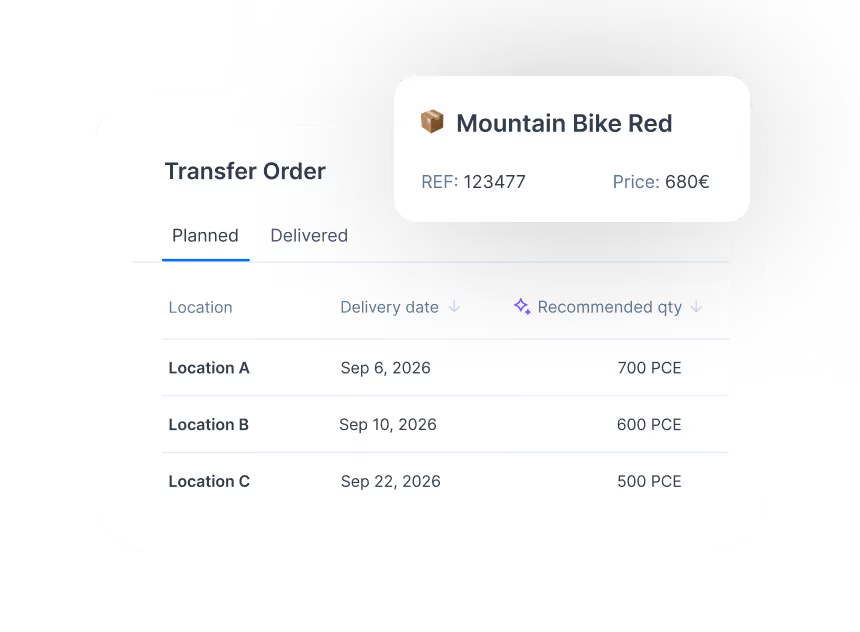
Fabbisogni di distribuzione pianificati nel tempo
.svg)
Pianificazione dei flussi guidata dalla domanda
Anticipa i fabbisogni di distribuzionea valle
Scopri cosa spedire, dove — e quando.
.svg)
Coordinamento dei flussi multi-nodo
Un’esecuzione di rete più fluida
Pianifica i flussi di distribuzione in condizioni di incertezza della domanda
Il DRP deterministico fallisce quando la realtà cambia.
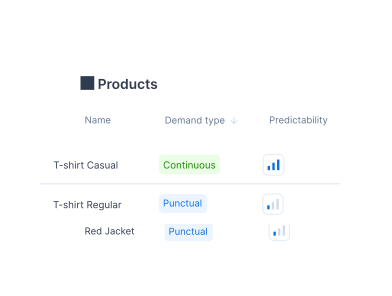
Anticipazione probabilistica dei flussi
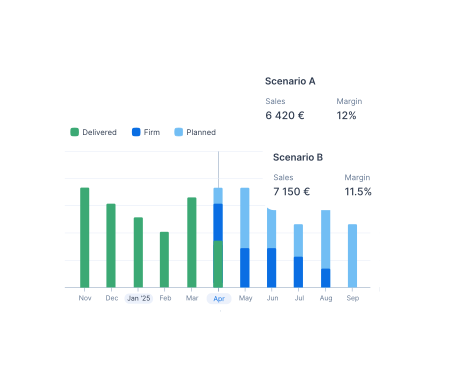
Simulazione dei flussi basata su scenari
Dai trasferimenti reattivi a una pianificazione proattiva dei flussi di distribuzione


DRP software: take control of your distribution instead of reacting to it
Most Supply Chains don’t lack data — they lack control over how inventory flows across their network.
Bringing clarity and control to distribution decisions

Most distribution issues don’t come from a lack of tools. They come from fragmented planning.
One warehouse is overstocked, another is running out. Transfers are triggered too late. Decisions are made in Excel because the system can’t be trusted.
Over time, planners end up spending more time fixing problems than actually planning.
What DRP software changes is not just the process — it changes how decisions are made.
Instead of reacting to issues after they occur, teams can continuously answer a simple but critical question:
What should we move, where, and when?
This shift allows planners to anticipate imbalances before they impact service levels. Inventory is no longer managed in silos but coordinated across the network. Flows become aligned, and decisions become proactive rather than reactive.
The real value doesn’t come from automation alone. It comes from giving teams the ability to focus on decisions that improve performance, not just corrections.
This is where DRP becomes truly powerful when connected with Inventory Management and a clear operational dashboard — because visibility only creates value when it leads to action.
Why traditional DRP tools don’t work anymore
Many companies already have DRP capabilities embedded in their ERP. On paper, the functionality exists. In reality, it is often bypassed.
The reason is simple: the logic behind traditional DRP no longer matches today’s Supply Chain conditions.
These systems were designed for relatively stable environments. They rely on fixed safety stock rules, single-point forecasts, and planning cycles that don’t adapt quickly to change.
But Supply Chains today are anything but stable.
Demand fluctuates constantly. Suppliers are less predictable. Promotions, seasonality, and external events introduce variability that static models cannot absorb.
To cope with this, companies add buffers. More stock, more safety margins, more “just in case”.
And yet, the paradox remains: inventory increases, but service levels don’t necessarily improve.
Saint-Gobain experienced this exact situation. By changing how distribution decisions were made — moving away from static rules toward a more dynamic approach — they were able to reduce inventory while simultaneously lowering stockout risk, as detailed in this Saint-Gobain case study on Supply Chain Planning optimization.
This is where traditional DRP reaches its limits. It was designed to calculate — not to adapt.
What really matters when selecting a DRP solution (features, criteria…)
Choosing a DRP software is less about features and more about fit.
The key question is not “what does the tool do?” but rather: Will it work in the reality of my Supply Chain?
First, the system needs to understand the network as a whole. Inventory decisions made in one location always impact others. Treating warehouses independently leads to suboptimal results. This is why approaches like MEIO are critical — they ensure inventory is positioned where it brings the most value across the network.
Second, DRP cannot operate in isolation. If it is disconnected from Supply Planning, the plan becomes theoretical. What looks optimal on paper may not be feasible operationally.
Third, usability is essential. Even the most advanced system will fail if planners don’t trust it. Recommendations must be understandable, explainable, and actionable. A well-designed Supply Chain dashboard is often the difference between adoption and rejection.
Finally, implementation speed is a decisive factor. In a fast-moving environment, a solution that takes over a year to deploy risks becoming obsolete before it delivers value.
What DRP software actually changes in your day-to-day operations
There is a point where distribution complexity outgrows manual planning. It usually happens gradually. Networks expand, product portfolios grow, and variability becomes harder to control. At first, teams compensate. Then the cracks start to show.
One warehouse is overstocked. Another is out of stock. Transfers happen too late. Decisions are made in Excel. And planners spend their time reacting instead of anticipating.
At that stage, the symptoms are clear: recurring inventory imbalances, growing reliance on manual adjustments, and increasing pressure on planning teams. This is not a tooling problem. It’s a coordination problem. And it becomes even more visible depending on your context.
In retail, for example, keeping stores aligned with central inventory is a daily challenge. Without structured Store Replenishment, some locations run out too early while others accumulate excess stock.
In wholesale, the balance is tighter. Service levels must remain high, but margins leave little room for inefficiency. Poor distribution decisions quickly translate into lost profitability.
In Spare Parts Supply Chains, the stakes are different but just as critical. Demand is unpredictable, yet availability must be guaranteed. A missing part can mean downtime, delays, or lost revenue.
In all these situations, the same issue appears: the network is not synchronized.
What performance gains look like beyond theory
The impact of DRP is best understood through real outcomes, not theoretical benefits.
In Camif, il miglioramento della pianificazione della distribuzione non si è limitato a ridurre le rotture di stock: ha permesso all'azienda di assorbire la crescita dell'attività senza aggiungere risorse di Supply Chain. Camif ha generato circa +40 000 € di ricavi annuali aggiuntivi evitando rotture sugli SKU chiave nei picchi commerciali, e ha liberato l'equivalente di un pianificatore a tempo pieno (1 760 ore l'anno) prima dedicate alla riconciliazione manuale tra siti. Le rotture di stock sono scese di 6 punti nello stesso periodo.
In Plum Living, la sfida era diversa. Lo stock non era necessariamente troppo elevato ovunque: era posizionato male sulla rete. Riequilibrando lo stock tra magazzini, Plum ha ridotto il valore dell'inventario del 38 % nel tempo (da 598 k€ a un obiettivo di 367 k€), con un calo del 21 % ottenuto fin dal go-live. La rete ha iniziato a funzionare come un sistema coordinato anziché come una raccolta di nodi indipendenti.
These examples highlight a key point: DRP is not about optimizing isolated metrics. It's about improving how the entire Supply Chain operates.
Less friction. Fewer urgent decisions. More control.
Moving from reactive planning to controlled execution
Without structured distribution planning, most Supply Chains operate in reaction mode. A shortage appears, and teams respond. A delay occurs, and adjustments are made. Demand spikes, and the system struggles to keep up.
DRP changes the timing of decisions.
By continuously analyzing demand signals, inventory levels, and supply constraints, the system identifies risks earlier. This allows planners to act before problems materialize. Instead of reacting to shortages, they can rebalance inventory proactively. Instead of adjusting plans after disruptions, they can simulate scenarios and prepare in advance.
Over time, this shift reduces volatility across the network. When combined with Inventory Management and Supply Planning, DRP becomes more than a planning tool. It becomes a control layer that stabilizes execution and improves overall performance.
Why companies move away from ERP-based DRP toward Flowlity
Most DRP tools originate from ERP systems. They were designed to support planning — but not necessarily to handle uncertainty. Flowlity was built with a different starting point: variability.
Instead of relying on static rules, it continuously adapts to what is happening in the Supply Chain. It highlights risks early, suggests concrete actions, and allows planners to make informed decisions faster.
This changes the role of the planner. From someone who adjusts plans manually… to someone who pilots the Supply Chain with the support of AI-powered intelligent recommendations.
And just as importantly, it changes the speed of transformation. No heavy IT projects. No multi-year deployments. Companies can start improving their performance quickly — reducing inventory, improving service levels, and freeing up time for their teams.
Because at the end of the day, the goal is not better planning tools. It’s a Supply Chain that is simpler to run and more resilient to change.
FAQ about distribution requirements planning software
Find everything you need to know right here.
Cosa significa DRP nella gestione della Supply Chain?
DRP significa Distribution Requirements Planning (pianificazione dei fabbisogni di distribuzione).
È un metodo di pianificazione della Supply Chain utilizzato per determinare:
- quanto inventario deve essere distribuito
- quando i prodotti devono essere riapprovvigionati
- dove lo stock deve essere posizionato nelle reti di distribuzione
Il DRP garantisce che i flussi di inventario tra magazzini, centri di distribuzione e punti vendita siano sincronizzati con la domanda prevista.
Qual è la differenza tra DRP e MRP?
DRP e MRP affrontano parti diverse della Supply Chain.
Il MRP (Material Requirements Planning) si concentra sulla pianificazione della produzione. Determina quali materie prime e componenti sono necessari per fabbricare i prodotti.
Il DRP, d'altra parte, si concentra sulla distribuzione. Determina come i prodotti finiti devono essere allocati tra magazzini e centri di distribuzione.
In molte organizzazioni, il DRP lavora insieme a:
- pianificazione della domanda
- ottimizzazione dell'inventario
- pianificazione dell'approvvigionamento
Insieme, questi processi garantiscono che i prodotti vengano prodotti e distribuiti in modo efficiente.
A cosa serve un software DRP?
Un software DRP viene utilizzato per pianificare come i prodotti si muovono attraverso una rete di distribuzione.
Aiuta le aziende a decidere:
- quanto stock è necessario in ogni sede
- quando riapprovvigionare
- come bilanciare l'inventario tra i magazzini
L'obiettivo è semplice: massimizzare la disponibilità dei prodotti minimizzando l'inventario.
Qual è la differenza tra DRP e gestione dell'inventario?
La gestione dell'inventario si concentra sul monitoraggio e controllo dei livelli di stock.
Il DRP va oltre.
Pianifica come l'inventario deve fluire attraverso la rete nel tempo.
Nella pratica, il DRP si basa sulla gestione dell'inventario per prendere decisioni migliori.
Chi utilizza un software DRP?
Un software DRP è utilizzato dai professionisti della Supply Chain responsabili della gestione dell'inventario e delle reti di distribuzione.
Gli utenti tipici includono:
- direttori Supply Chain
- pianificatori della domanda
- responsabili dell'inventario
- pianificatori della distribuzione
I settori che utilizzano comunemente soluzioni DRP includono:
- retail
- distribuzione all'ingrosso
- manifattura
- reti di ricambi
Queste organizzazioni si affidano al DRP per mantenere alti livelli di servizio controllando i costi di inventario.
Come fa un software DRP a ridurre l'inventario e le rotture di stock contemporaneamente?
Sembra controintuitivo, ma ridurre l'inventario e ridurre le rotture di stock risolvono lo stesso problema: un cattivo posizionamento dell'inventario.
La maggior parte delle aziende cerca di evitare le rotture aggiungendo scorte di sicurezza ovunque. Il risultato? Più inventario… ma ancora carenze nei posti sbagliati.
Un software DRP adotta un approccio diverso. Invece di proteggere ogni magazzino individualmente, ottimizza l'inventario sull'intera rete. Analizza continuamente:
- segnali di domanda (per sede e SKU)
- livelli di stock attuali su tutti i nodi
- tempi di consegna e vincoli di approvvigionamento
Su questa base, determina dove l'inventario è realmente necessario, non solo dove si trova.
Nella pratica, questo significa:
- meno stock in eccesso nelle sedi a bassa domanda
- migliore disponibilità dove la domanda è reale
- rilevamento più precoce di potenziali carenze
- trasferimenti intelligenti tra magazzini invece di ordini d'emergenza
Per esempio, aziende come Camif hanno ridotto le rotture mentre scalavano le operazioni, e altre come Plum hanno ridotto significativamente il valore dell'inventario — non tagliando alla cieca, ma posizionando lo stock dove crea valore.
La chiave è semplice: non più stock — stock meglio distribuito.
Un software DRP è rilevante per le piccole e medie imprese?
Assolutamente.
In realtà, le aziende di medie dimensioni sono spesso quelle che ne beneficiano di più perché:
- crescono rapidamente
- la loro complessità aumenta velocemente
- ma non hanno le risorse per sistemi di pianificazione pesanti
Gli strumenti DRP moderni permettono loro di strutturare la Supply Chain senza aggiungere complessità.
Quanto tempo ci vuole per implementare un software DRP?
Dipende dalla soluzione.
Gli strumenti tradizionali basati su ERP possono richiedere mesi o anni.
Le soluzioni cloud moderne come Flowlity sono progettate per essere implementate molto più rapidamente, permettendo ai team di iniziare a migliorare le performance di pianificazione in poche settimane.
Qual è la differenza tra un DRP tradizionale e un DRP basato sull'intelligenza artificiale?
Il DRP tradizionale e il DRP basato sull'IA risolvono lo stesso problema — ma in modi molto diversi.
I sistemi DRP tradizionali (solitamente integrati nell'ERP) si basano su:
- regole fisse (scorte di sicurezza, punti di riordino)
- previsioni deterministiche (una singola « migliore stima »)
- cicli di pianificazione statici
Funzionano ragionevolmente bene in ambienti stabili. Ma non appena la variabilità aumenta, diventano rigidi e richiedono aggiustamenti manuali costanti.
Ecco perché i pianificatori finiscono spesso per affidarsi a Excel.