.svg)
.svg)
Best Supply Chain Visibility Software in 2026
Some tools answer one question: where are my goods right now? Others answer a different one: what will happen next, and what should I do about it? This guide compares 10 tools across two categories:
- Real-time tracking (FourKites, project44, Shippeo and Tive)
- AI-driven decision visibility (SAP IBP, Oracle SCM Cloud, Kinaxis, Blue Yonder, Infor Nexus and Flowlity)
This guide breaks down both categories so you can understand the market and choose the right fit for your team.
Why most visibility tools still end in a stockout you saw coming
Ask 5 vendors to define Supply Chain visibility and you will hear 5 versions of the same answer: real-time tracking. Where is the truck, where is the container, when will it arrive. That is genuinely useful, and it is also why so many teams buy the best Supply Chain visibility software they can find and still get blindsided. A live map tells you a shipment is late. It does not tell you which customer orders that delay will break, whether your buffer absorbs it, or what to reorder today so it never becomes a shortage.
That gap is widening as expectations rise. Gartner predicts that by 2031, 60% of Supply Chain disruptions will be resolved without human intervention as artificial intelligence (AI) makes planning increasingly autonomous. Autonomous resolution is impossible on tracking data alone. It needs a forward view of demand, inventory and supply. So before comparing tools, it helps to separate the two very different things the market sells under one word.
Supply Chain visibility is more than shipment tracking
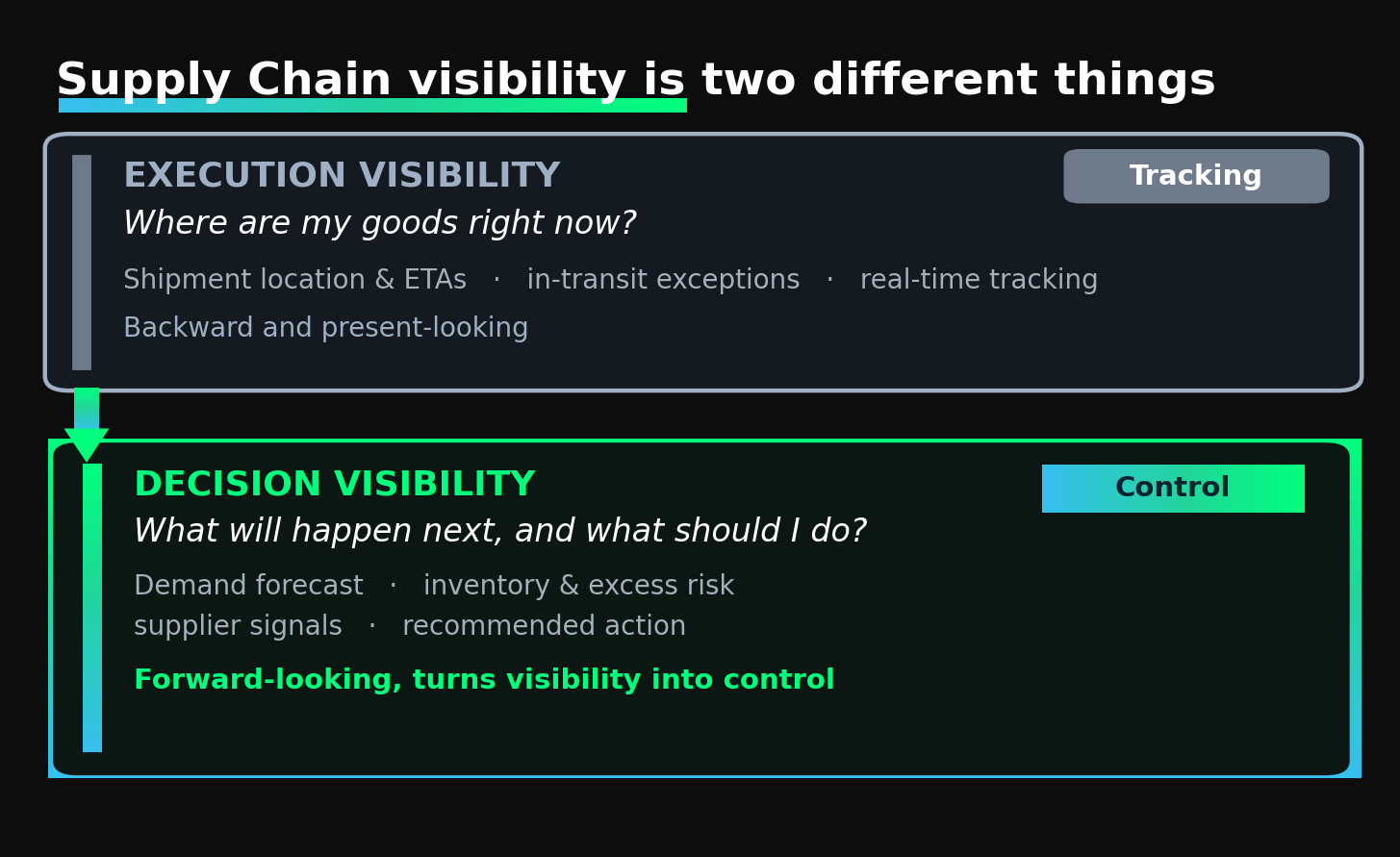
There are two layers of visibility, and they solve different problems.
Execution visibility
Execution visibility tells you where things are: which trucks are moving, which containers are delayed, when a shipment will arrive. It is backward and present looking, built on live tracking and estimated time of arrival (ETA) prediction. It is essential for logistics teams.
Decision visibility
Decision visibility tells you what will happen and what to do about it: where a stockout is forming 3 weeks out, which excess is about to tie up cash, which supplier risk actually threatens a customer order. It is forward looking, built on demand forecasting, inventory logic and supply signals rather than GPS pings.
Why it matters
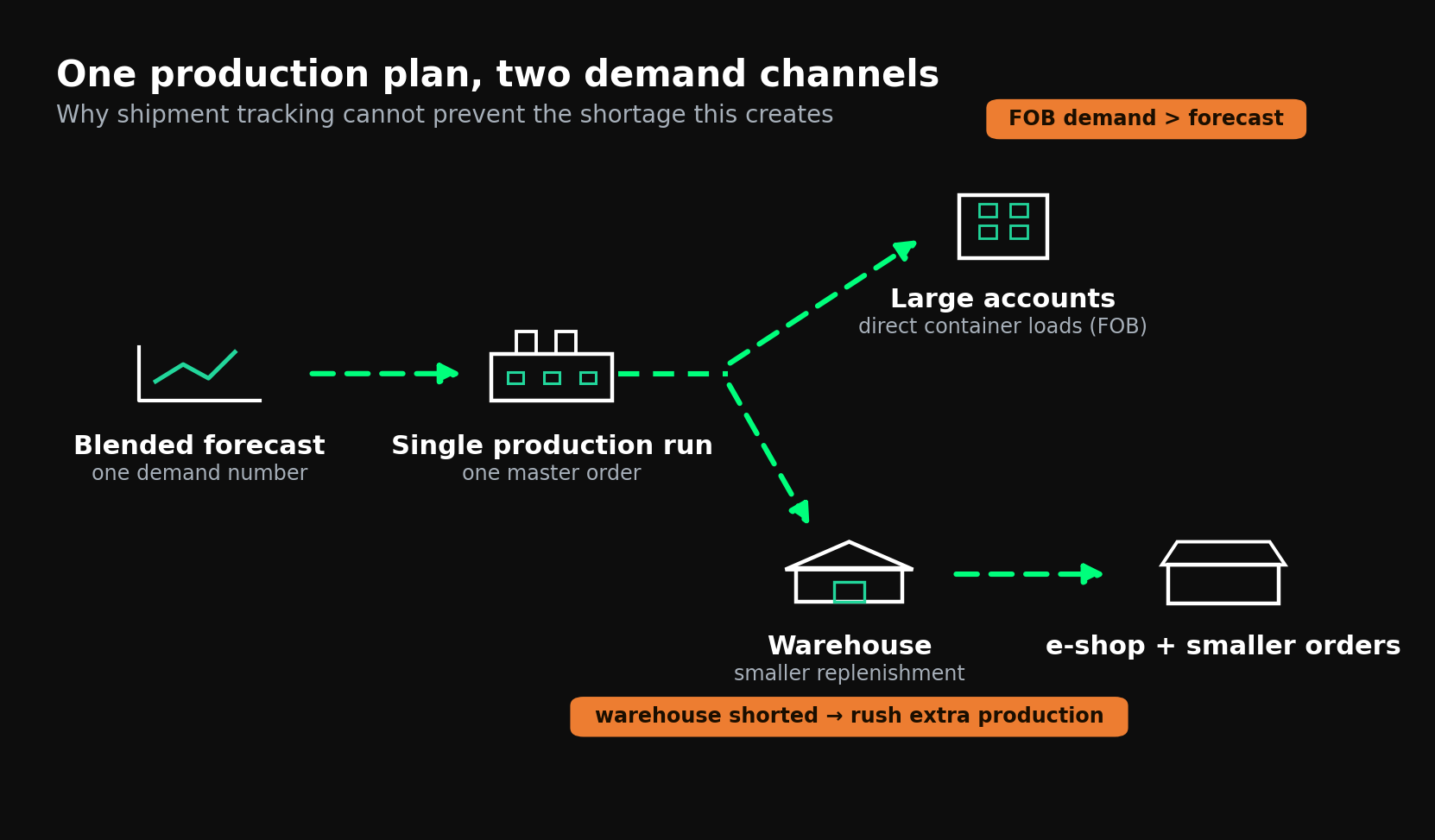
The distinction is not academic. Consider a mid-market manufacturer that sells both in full container loads to large accounts and through its own distribution warehouse. Its single production plan is built on one blended forecast. When direct-to-customer demand runs hotter than expected, there is not enough left to replenish the warehouse, so the team ships too much to the warehouse early, then scrambles to produce extra when the container orders land. No amount of shipment tracking fixes this. Knowing exactly where each container sits does nothing for a problem that is really about anticipating how demand will split and deciding allocation before it happens. That is decision visibility, and it is the layer most tools skip.
The two categories of Supply Chain visibility software
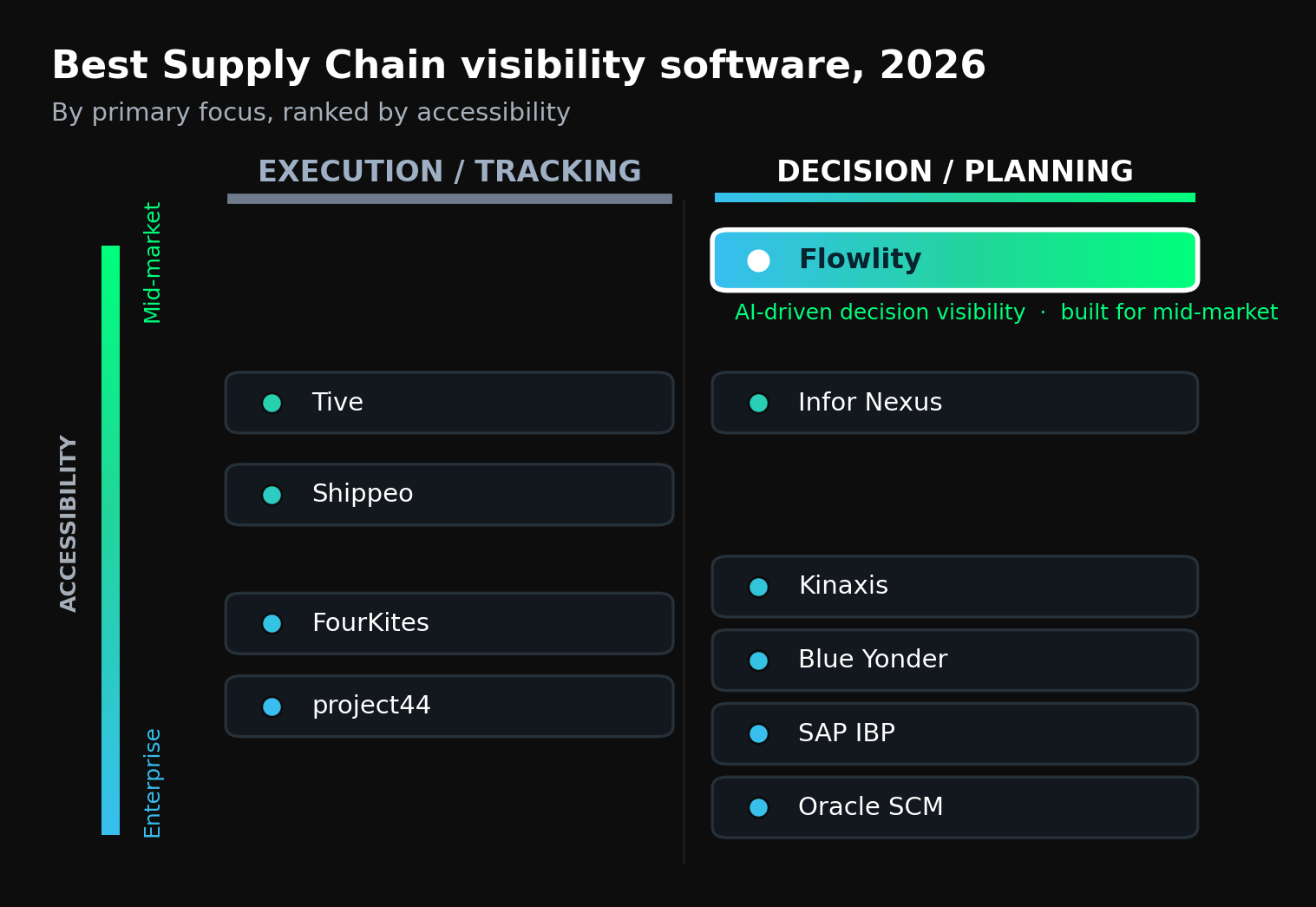
Because these layers are different, the market has split into two families of tool, plus a handful of platforms trying to bridge them.
Execution and transportation visibility tools
These platforms, often called real-time transportation visibility (RTTV) tools, connect to carriers and telematics to track shipments across road, ocean, rail and air. Their strength is in-transit accuracy: better ETAs, fewer “where is my order” calls, faster exception handling in the yard. Their limit is scope. They see goods in motion, not the demand and inventory decisions that determine whether you needed those goods in the first place.
Decision and planning visibility platforms
These platforms build visibility from the planning side: demand, inventory, supply and supplier collaboration. The best of them are increasingly AI Supply Chain visibility platforms, using probabilistic models to show not a single forecast but a range of likely outcomes, then recommending the buffer and the order that best cover that range. This is where visibility becomes control, and where a mid-market team without a large Integrated Business Planning (IBP) function can actually act on what it sees.
How we evaluated the best Supply Chain visibility software
We compared platforms on the criteria that decide whether visibility changes a decision, not just a dashboard:
- Scope of visibility: transportation only, or end to end across demand, inventory and supply.
- Predictive versus descriptive: does it show what happened, or forecast what will happen and recommend an action.
- Inventory and demand integration: can it connect a delay to a specific stockout or excess risk.
- Collaboration and multi-tier reach: can suppliers and partners see and respond to the same signals.
- Integration: fit with enterprise resource planning (ERP), warehouse management system (WMS) and transportation management system (TMS).
- Time to value and mid-market fit: weeks or quarters to go live, and whether a lean team can run it.
Best Supply Chain visibility software in 2026: the 10 platforms compared
The 10 tools below (FourKites, project44, Shippeo, Tive, SAP IBP, Oracle SCM Cloud, Kinaxis, Blue Yonder, Infor Nexus and Flowlity) span both categories. No single tool wins every row, which is exactly the point: the right choice depends on whether your gap is execution or decision.
FourKites: real-time transportation visibility at enterprise scale
FourKites is one of the best-known real-time transportation visibility platforms, plugging into a large network of carriers and telematics feeds to follow shipments across road, ocean, rail and air. Its core strength is in-transit accuracy: live location, predictive ETAs, and early warnings when a load slips. That makes it a strong fit for large shippers whose daily pain is logistics execution and answering “where is my order.” Its focus stays on goods in motion, so it typically sits next to a planning tool rather than replacing one.
- Who it’s for: large shippers whose main gap is logistics execution.
- Pros: strong shipment tracking and ETA accuracy at scale.
- Cons: transportation-centric, so it needs a planning layer to connect delays to inventory decisions.
project44: multimodal carrier network for global shipment tracking
project44 runs one of the largest multimodal carrier networks on the market, with broad connectivity across ocean, road, rail, air and parcel. It is built to track freight at global scale and give logistics teams dependable, real-time status and ETAs on complex international lanes. Like FourKites, its centre of gravity is execution: it tells you where your freight is and when it will land, not what demand is coming or what to reorder. Most teams pair it with a planning layer to turn those transport signals into inventory decisions.
- Who it’s for: companies running complex, cross-border, multimodal freight.
- Pros: wide carrier coverage and reliable tracking at scale.
- Cons: answers where your freight is, not what to order next.
Shippeo: European real-time transport visibility
Shippeo is a real-time transportation visibility specialist with particularly deep coverage in Europe and a strong reputation for ETA accuracy. It gives shippers and logistics teams a live view of shipments in transit and surfaces delays early enough to act on them. Its scope is transport execution rather than demand or inventory planning, so it works best as a visibility layer on top of an existing planning setup. For European operations whose main need is reliable delivery tracking, it is a focused, well-proven choice.
- Who it’s for: European shippers focused on delivery reliability.
- Pros: high ETA accuracy and strong European carrier coverage.
- Cons: a complement to a planning platform, not a replacement for one.
Tive: sensor-based tracking for in-transit and cold-chain goods
Tive takes a hardware-led approach to visibility, using its own internet-of-things (IoT) trackers to follow shipments and monitor their condition, including temperature, humidity and shocks. That makes it especially valuable for cold-chain, pharmaceutical and high-value goods, where a pallet’s condition matters as much as its location. The data is precise and real-time, but it is scoped to goods already on the move. As with the other execution tools, it complements planning software rather than telling you what to produce or order.
- Who it’s for: teams moving cold-chain or high-value goods.
- Pros: precise, real-time location and condition monitoring in transit.
- Cons: hardware-dependent and limited to goods already on the move.
SAP IBP: planning and visibility for SAP-native enterprises
SAP Integrated Business Planning (IBP) brings demand, supply and inventory planning together with visibility for organizations already running the broader SAP landscape. It is deep and wide-ranging, spanning forecasting, Sales and Operations Planning (S&OP) and response planning, and it benefits from tight native integration. That power comes with weight: rollouts are typically long, consultant-heavy and costly. For most mid-market teams it is more platform than they can realistically deploy or keep running.
- Who it’s for: large enterprises already standardized on SAP.
- Pros: broad, powerful planning and visibility in one suite.
- Cons: long, complex implementations that rarely fit mid-market teams.
Oracle SCM Cloud: a full Supply Chain suite with visibility built in
Oracle SCM Cloud is a full Supply Chain suite covering planning, logistics, order management and more, with visibility features built across the modules. For enterprises already committed to Oracle, it delivers broad, integrated functionality under one roof. As with any suite this size, the trade-off is a substantial IT programme and the cost and change management that come with it. It fits organizations ready to invest in a long-term, enterprise-wide platform rather than teams chasing fast time to value.
- Who it’s for: Oracle-native enterprises wanting one integrated suite.
- Pros: broad functional coverage across the Supply Chain.
- Cons: heavy IT transformation to deploy and maintain.
Kinaxis: concurrent planning and scenario analysis at scale
Kinaxis is best known for concurrent planning: a single live model where demand, supply and inventory move together, so planners can run fast what-if scenarios across large, complex networks. That capability is genuinely deep and well suited to global manufacturers managing constant change. The trade-off is cost and complexity, both a serious investment and a meaningful implementation effort. Smaller teams that just want quick wins often find it heavier than their situation calls for.
- Who it’s for: large enterprises with complex, fast-changing networks.
- Pros: deep concurrent planning and rapid scenario simulation.
- Cons: cost and complexity make quick time to value hard for smaller teams.
Blue Yonder: enterprise demand, fulfillment and control tower
Blue Yonder offers a broad enterprise suite spanning demand and fulfillment planning, warehouse and transportation management, and a Supply Chain control tower for end-to-end visibility. It is designed for large retailers and manufacturers running sophisticated, high-volume operations. That breadth is a real asset, but it also makes the platform heavy to deploy, integrate and maintain. Time to value tends to run into quarters, which usually puts it beyond leaner teams.
- Who it’s for: large retailers and manufacturers.
- Pros: comprehensive, end-to-end enterprise capabilities.
- Cons: heavy and slow to deploy and maintain.
Infor Nexus: multi-tier visibility across a supplier network
Infor Nexus takes a network approach to visibility, connecting buyers and their suppliers on a shared platform so everyone works from the same order, shipment and inventory data. That gives it genuine multi-tier visibility and makes it a real bridge between execution and planning for large, supplier-heavy operations. The value grows with the number of trading partners connected, but so does the effort, since onboarding a full supplier network takes time and coordination. It suits large buyers with the resources to drive that adoption.
- Who it’s for: large buyers coordinating many suppliers.
- Pros: genuine multi-tier visibility that bridges execution and planning.
- Cons: onboarding a full supplier network takes real effort.
Flowlity: AI-driven decision visibility for mid-market planning
Flowlity approaches visibility from the decision side. Alongside knowing where goods are, it makes visible what will happen across demand, inventory and supply, and recommends what to do about it. Its AI-driven demand forecasting is probabilistic: instead of one number that is always wrong, it plans across the range of likely outcomes and sizes the buffer to the risk you actually face. On top of that, it works to optimize inventory across the whole network and flags stockout and excess risk weeks ahead, so teams act by exception instead of firefighting.
Where it separates from the enterprise suites is reach and accessibility. Flowlity lets planners share forecasts and constraints with suppliers, so a delay upstream becomes a visible, actionable signal rather than a surprise. Our webinar on visibility across the extended Supply Chain explores the same idea: seeing demand, stock and supplier signals across every tier. Because it is built for mid-market teams, it goes live in weeks rather than quarters, with no large Integrated Business Planning (IBP) department required. That decision-first approach is what earned Flowlity a place on the 2025 Gartner Cool Vendor list in Supply Chain. Flowlity was also named an Accelerator in Nucleus Research’s 2026 SMB SCP Value Matrix, among the most usable planning platforms for SMBs.
This is not just theory. Saint-Gobain Sekurit uses Flowlity to drive visibility across its end-to-end Supply Chain, from its distribution centres to its suppliers’ plants, and the payoff lands in decisions rather than dashboards: across its 30 distribution centres, its service level rose from 95.8% to 97.2% while inventory fell by 9.25%. In the words of Kimberley Darban, Sales and Operations Planning (S&OP) and project manager at Saint-Gobain Sekurit, Flowlity helps “drive the digitalization and integration of our end-to-end supply chain, from our distribution centres to our suppliers’ plants.”
- Who it’s for: mid-market manufacturers, distributors and retailers that want visibility to end in a decision, without a large planning department.
- Pros: AI-native probabilistic forecasting across demand, inventory and supply, multi-tier supplier collaboration, and go-live in weeks rather than quarters.
- Cons: not a shipment-tracking tool, so pair it with an execution layer if live freight tracking is a core need.
How to choose the right Supply Chain visibility software
Start by naming your gap.
- If your team spends its day chasing “where is my order,” an execution tool will pay for itself quickly.
- If it spends its day reacting to stockouts and excess it could have seen coming, no tracking tool will help, and you need decision visibility instead.
Then pressure-test vendors with a few pointed questions:
- Is the visibility descriptive or genuinely predictive?
- Can it connect a supplier delay to a specific customer order at risk?
- Can planners stay in control of the recommendation, or does the system just raise alerts?
- How fast can you go live, and does the integration assume a planning department you do not have?
Many teams pair a strong tracking tool with a planning platform and connect the two, which is a perfectly good outcome as long as the Sales and Operations Planning (S&OP) process sits on top to turn both signals into one decision.
Imagine a mid-market retailer running promotions across 3 regions. Execution visibility tells it a promotional shipment is 2 days late. Decision visibility tells it which stores will stock out before the shipment lands, and whether to reallocate existing stock now. The second view is the one that protects the sale.
From visibility to control: what to prioritize in 2026
The best Supply Chain visibility software in 2026 is not the one with the most data points on screen. It is the one that changes a decision. Real-time tracking will always matter for goods in motion, but the durable advantage now comes from decision visibility: seeing demand, inventory and supply far enough ahead, across every tier, to act before a problem forms. That is the difference between watching a stockout arrive and preventing it.
If your team can see where everything is but still gets caught by shortages and excess, the gap is not tracking, it is decision visibility. See how Flowlity turns forward-looking visibility into daily decisions, and book a demo to map it to your own Supply Chain.
For teams weighing collaboration tools specifically, see our comparison of the best supply chain collaboration software.
Level up your supply chain with AI.
Get a demo
FAQ
Find everything you need to know right here.
How does Supply Chain Management Software improve visibility?

Visibility goes beyond dashboards and analytics.
A good Supply Chain solution integrates with your ERP, WMS, or TMS to provide:
- Real-time stock positions
- Supplier performance insights
- Forecast accuracy metrics (MAE, MAPE)
- Risk alerts on potential shortages
- Scenario simulations
True end-to-end visibility means you can answer critical questions instantly:
- Where are we exposed?
- Which SKUs are at risk?
- What happens if demand increases by 15%?
- How will a supplier delay impact service level?
Better visibility reduces firefighting and increases confidence in decision-making.
What is Supply Chain Visibility Software and how does it enable real-time tracking?
Supply Chain visibility software gives you a shared, real-time view of what is happening across your network, and it comes in two layers. Execution (tracking) visibility focuses on flows and disruptions: where goods are and what is going wrong right now. Decision (planning) visibility looks forward, showing what demand, inventory and supply will do next and what to act on. Most tools do one well; the strongest do both.
At the tracking layer, Supply Chain visibility software lets companies:
- Monitor stock movements in real time
- Track supplier performance
- Detect delays early
- Identify demand anomalies
- Share information with partners
When integrated with enterprise resource planning (ERP) and logistics systems, visibility tools provide a live operational view. But visibility alone is not enough: you also need Supply Chain intelligence. The most advanced platforms combine tracking with artificial intelligence (AI) recommendations, so you don't just see the problem, you know what to do next.
How does supply chain visibility help reduce shortages?
By improving forecasts, supplier collaboration, and early alerts, Supply Chain visibility helps prevent late reactions, panic ordering, and stockouts. The mechanism is straightforward: shortages typically build up well before they become visible at the warehouse, through small signals in supplier performance, demand drift or lead time slippage. Visibility tools consolidate those signals and translate them into actionable alerts at SKU and location level, so planners can rebalance stock, escalate critical orders or adjust commitments before service is impacted. The earlier the signal, the cheaper the response, which is why visibility consistently shows up among the highest-return investments in volatile Supply Chains.
How can companies improve visibility in their supply chain?
By combining demand forecasting, inventory optimization, supplier collaboration, and AI-driven planning tools. The combination matters more than any single component: forecasts without inventory logic produce numbers no one acts on, inventory rules without forecasts age quickly under volatility, and collaboration without shared data turns into meetings rather than decisions. AI ties these layers together by modeling uncertainty consistently across demand, lead times and supplier behavior, so the same picture drives planning, replenishment and exception management. The practical result is that planners spend less time reconciling fragmented views and more time acting on the exceptions that genuinely require their judgment.
Why does visibility into goods in transit matter for replenishment decisions?
Without visibility into stock that has already shipped but not yet arrived, a planning process risks reacting to a branch's on-hand position as if it were the full picture, and ordering again for stock that is already on its way. That double-ordering is a common source of the overstock that shows up a few weeks after a promotion, once everything that was in transit during the event finally lands. Factoring goods in transit into the replenishment calculation avoids that overshoot without requiring anyone to manually track shipments against orders.
What is the difference between transportation visibility and Supply Chain visibility?
Transportation visibility is a subset of Supply Chain visibility. Transportation visibility, often called real-time transportation visibility (RTTV), tracks shipments in motion: where a truck or container is, and when it will arrive. Full Supply Chain visibility is broader, covering demand, inventory, supply and supplier collaboration, not just goods in transit.
The practical difference is what each lets you do. Transportation visibility helps you manage a shipment that is already moving. Full, decision-grade visibility helps you avoid the problem earlier, by showing which orders are at risk and what to reorder or reallocate before a delay becomes a stockout. Many companies need both, but confusing one for the other is why some visibility tools disappoint.
How do you choose the right Supply Chain visibility software?
Start with your dominant pain. If your team mostly chases the status of shipments, prioritize a real-time transportation visibility tool with strong carrier coverage and accurate ETAs. If your team mostly reacts to stockouts and excess, prioritize a planning platform that forecasts demand, models inventory risk and recommends actions.
Then check five things: scope (transport only or end to end), predictive versus descriptive intelligence, inventory and demand integration, collaboration across suppliers, and time to value including whether a lean team can run it. Ask vendors to show a delay turning into a specific, recommended decision, not just an alert. Mid-market teams should weigh implementation effort heavily, since a tool that needs a large planning department rarely delivers.
How does AI improve Supply Chain visibility?
Artificial intelligence (AI) turns visibility from a rear-view mirror into a forward view. Traditional dashboards show what happened and leave interpretation to the planner, while AI-driven platforms forecast what is likely to happen and recommend a response.
Probabilistic forecasting is central: rather than committing to a single demand number that will be wrong, AI models the full range of likely outcomes and sizes inventory buffers to the actual risk. It also flags the exceptions that matter across thousands of items, so teams plan by exception instead of reviewing everything. Gartner expects this shift to make a majority of disruption responses autonomous within a few years, which is only possible when visibility is predictive rather than descriptive.
When does real-time visibility matter, and when does predictive?
They answer different jobs, so neither is universally better. Real-time visibility is about the present: it tells you where a shipment is now and shortens the time to react when something is already going wrong, which matters most for logistics-heavy, service-sensitive flows. Predictive visibility is about the near future: it surfaces stockout and excess risk while there is still time to act, which matters most when the pain is inventory and availability.
In practice the two are complementary: real-time keeps today's promises, predictive prevents tomorrow's problems, and the strongest setups connect them, so a live signal like a delay feeds the forward plan of what to reorder or reallocate.