.svg)
.svg)
Best Supply Chain collaboration software in 2026

Most software sold as "collaboration" does not actually make partners plan together. It digitizes the conversation around a purchase order: a portal here, a document exchange there, while each company keeps forecasting in its own silo. Real collaboration is different. It means partners working from one shared view of demand, inventory and capacity, so a change on one side updates the plan on the other. That distinction is the difference between a supplier portal and a Supply Chain that actually stays in sync, and it is the lens this guide uses to compare the best Supply Chain collaboration software for 2026.
What is Supply Chain collaboration software?
Supply Chain collaboration software is a category of tools that let trading partners (suppliers, manufacturers, distributors and customers) share information and coordinate decisions across company boundaries, instead of exchanging spreadsheets and emails. At a minimum it gives everyone a shared, real-time view of the same data. The more advanced platforms go further and let partners plan together, sharing demand forecasts, inventory positions, orders and capacity constraints so the whole chain reacts as one.
The term overlaps with a few others you will see on vendor sites. Supplier collaboration software usually emphasizes the buyer-to-supplier relationship (purchase order collaboration, onboarding, supplier performance). Collaborative Planning, Forecasting and Replenishment (CPFR) and Vendor-Managed Inventory (VMI) are specific processes these tools support. In practice, what matters is not the label but how deep the collaboration actually goes.
Two kinds of collaboration: transactional vs planning
When you compare tools, the single most useful question is what they actually let partners collaborate on.
Transactional collaboration covers the exchange around a transaction: purchase orders, order confirmations, shipping notices, invoices, documents and messages. Procurement-led platforms like Coupa, Ivalua and SAP Ariba are strong here. This solves a real problem (no more chasing PO confirmations by email), but each partner still plans in isolation, so the chain only syncs after decisions are already made.
Planning collaboration goes upstream of the transaction. Partners share the forecast, the inventory position and the capacity picture, so they agree on what will be needed before orders are placed. This is where a supplier can see a demand shift early and adjust production, and where a buyer can see a capacity constraint before it becomes a stockout. It is harder to deliver, because it requires a shared planning engine and not just a shared inbox, and it is where the gap between vendors is widest.
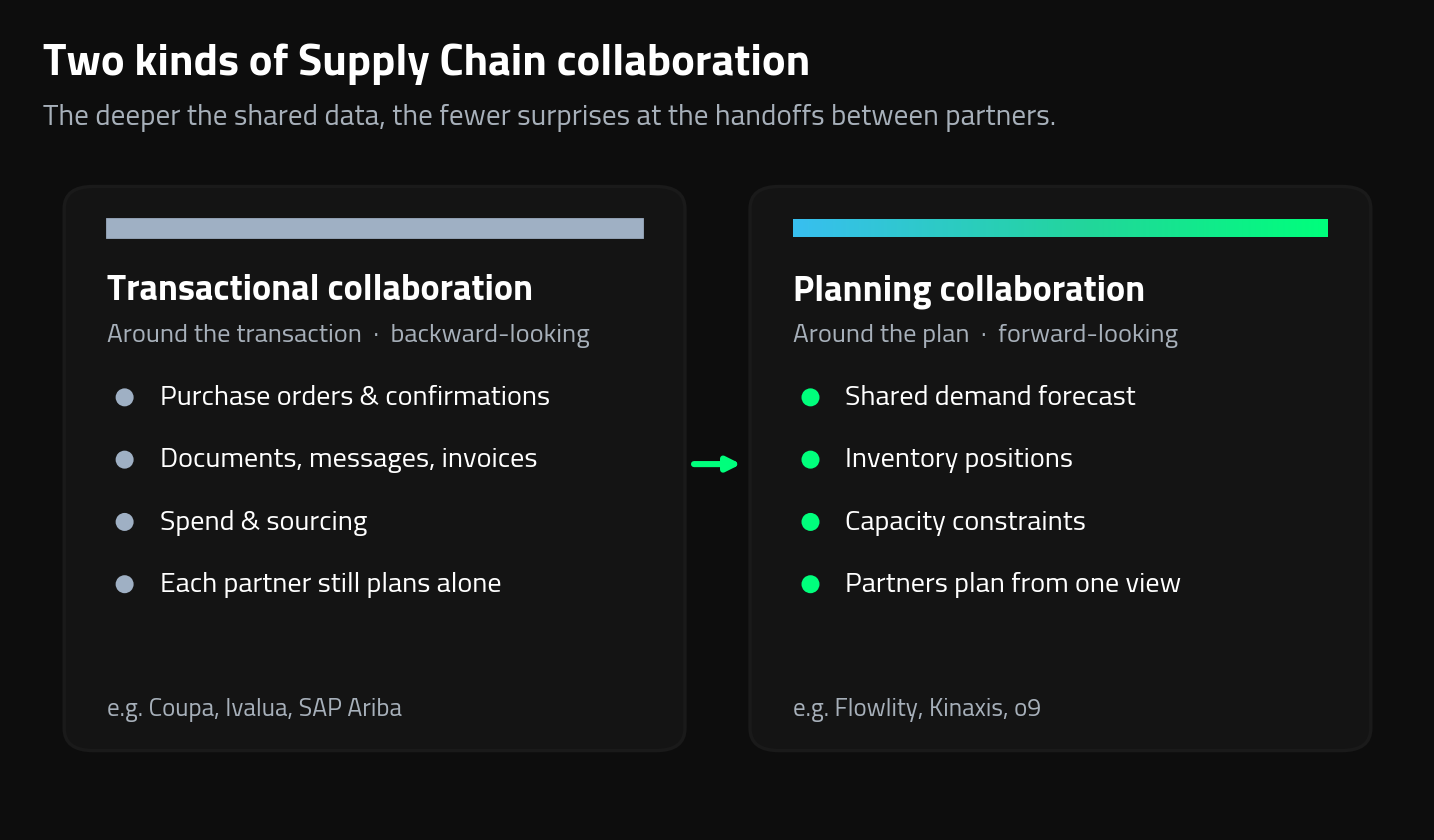
Neither is "better" in the abstract. If your pain is procurement chaos, a transactional tool may be enough. If your pain is excess and shortage at the same time, with partners reacting too late (the classic bullwhip effect, where small demand swings get amplified up the chain), you need planning collaboration.
How to choose Supply Chain collaboration software
- Depth of collaboration (transactional vs planning). Decide which problem you are solving first, then check whether the tool shares documents or shares plans. This is the criterion most buyers skip and most later regret.
- Data connectivity and integration. Collaboration lives or dies on data. Check native connectors to your enterprise resource planning (ERP) system and to your partners' systems, and how much manual data exchange remains.
- Real-time, multi-tier visibility. Can the platform show more than your direct (tier 1) partners, and does a change propagate instantly, or only in an overnight batch?
- Time to value for a mid-market team. Enterprise suites can take many months and a dedicated team to implement. If you do not have a large integrated business planning (IBP) function, weight ease of use and speed heavily.
- Scalability and partner onboarding. How easily can you add a new supplier or customer to the platform? Onboarding friction is the quiet killer of collaboration projects.
- Decision support, not just data. Sharing data is table stakes. The better tools turn shared data into alerts, recommendations and scenarios, so partners know what to do, not just what happened.
The 9 best Supply Chain collaboration software in 2026
The table compares all 9 at a glance, grouped the way you should actually think about them: planning collaboration platforms first, then transactional and procurement tools.
Planning collaboration platforms
These platforms let partners share the forecast, the inventory position and the capacity picture, so they agree on what will be needed before orders are placed. This is where excess and shortage are actually prevented, and where the gap between vendors is widest.
Blue Yonder: an end-to-end, machine-learning planning suite
Blue Yonder Luminate uses machine learning for real-time visibility and disruption prediction across demand, inventory, network design and Production Planning, with scenario and what-if analysis that partners can share. It is one of the broadest and most powerful options here, genuinely end to end for a large organization that wants a single system to run the whole chain. That power comes with weight: implementations are resource-heavy and typically run many months to over a year, and some users report backend issues and slower support. It fits when scope matters more than speed and you have the team to operate it.
Best for: large enterprises that want one end-to-end suite and can staff it.
Kinaxis: concurrent planning and fast scenario collaboration
Kinaxis (Maestro, formerly RapidResponse) is known for concurrent planning: demand, supply and capacity are recalculated together, so a change in one place instantly shows its effect everywhere. Internal teams and partners can run and compare scenarios on one shared model very fast, which is where it shines for "what happens if" decisions during disruptions. That capability is built for scale and priced accordingly, so it is a heavier commitment than most mid-market teams need. Its collaboration strength is cross-functional concurrency more than external, multi-company planning. On G2, users rate it 4.0/5 (13 reviews).
Best for: enterprises that live in fast, frequent scenario planning.
o9 Solutions: an integrated business planning digital brain
o9 positions its platform as a 'digital brain' for integrated business planning, connecting demand, supply and revenue planning on one shared data model, with supplier collaboration and risk modules layered on top. It is modern, capable and broad, well suited to large organizations standardizing planning across regions and functions. The trade-off is the scale of the program: cost and implementation effort assume a dedicated planning organization and a long runway. When that fits, having planning and supplier collaboration on one model is a real advantage. On G2, users rate it 4.2/5 (19 reviews).
Best for: large organizations standardizing planning on one integrated model.
SAP Integrated Business Planning: planning collaboration for SAP-centric landscapes
For SAP-centric companies, SAP Integrated Business Planning (IBP) handles planning collaboration (demand, supply, inventory and S&OP), while SAP Ariba and the SAP Business Network cover the transactional supplier side, all within the SAP ecosystem. The pull is native integration with SAP ERP and a single vendor spanning both camps. The cost is the familiar SAP reality: two products to connect, heavy implementation effort and a time to value usually counted in many months to over a year. It is the natural choice when you are already committed to SAP and want to stay inside that landscape. On G2, SAP IBP holds 4.3/5 (299 reviews).
Best for: enterprises already standardized on SAP.
ToolsGroup: inventory optimization and internal S&OP alignment
ToolsGroup is a Supply Chain planning specialist covering demand planning, inventory optimization, Supply Planning and S&OP, with probabilistic modeling, scenario simulation and control-tower features. Its collaborative S&OP is strong at aligning internal sales, operations and finance around one plan. Where it is thinner is cross-company collaboration: sharing plans with external suppliers and customers can still lean on manual data exchange or integration. It is a solid pick when the priority is optimizing inventory and getting internal functions onto the same page.
Best for: companies focused on inventory optimization and internal S&OP alignment.
Flowlity: AI-native planning collaboration for lean, mid-market teams
Flowlity is an AI-native planning platform that brings demand forecasting, inventory optimization and Supply Planning into one place, then opens that plan up to partners. Its probabilistic forecasts (a range of likely demand with a confidence level, rather than a single number that is wrong by definition) drive inventory recommendations, and its supplier collaboration portal lets suppliers and customers see and act on shared forecasts, orders and capacity in real time.
The differentiator is that partners collaborate on the plan, not just on documents, and that it goes live in weeks to months rather than years: Plum went live in about 3 months across 2 warehouses and 630 SKUs, sharing a rolling 9-month forecast with its suppliers through the portal. Saint-Gobain Sekurit reached 97% product availability across 30 distribution centers (up 2 points) while cutting inventory by 9.25% with Flowlity. On G2, users rate Flowlity 4.9/5 (12 reviews).
Best for: teams that want genuine planning collaboration without an enterprise-scale implementation.
Transactional and procurement collaboration platforms
These platforms make the buyer-supplier transaction smoother: purchase orders, spend, sourcing and documents. The collaboration is real, but it is backward-looking, each partner still plans on its own side.
E2open: multi-enterprise network collaboration at scale
E2open is built around a large multi-enterprise network that connects brands with their suppliers, logistics providers and channel partners on one platform. Collaboration is network-centric: partners exchange orders, capacity signals, forecasts and logistics status across many tiers, which is powerful for global organizations with sprawling partner ecosystems. It does span planning and execution, but its center of gravity is connecting a wide trading network rather than deep, single-company planning. That breadth also makes it a heavy, enterprise-grade platform to deploy and govern. On G2 it shows 5.0/5, though from just 1 review.
Best for: global enterprises that need many partners transacting on one network.
Coupa: supplier and spend collaboration inside a procurement suite
Coupa is a business spend management platform where supplier collaboration happens around procurement: purchase orders, sourcing events, contracts and invoices on a shared cloud interface. For teams whose pain is chasing suppliers by email and losing grip on spend, it removes real friction and gives strong visibility over the transaction. What it does not do is demand forecasting or inventory planning, so collaboration stays at the order level. Companies that need planning usually pair it with a separate planning system.
Best for: procurement-led teams whose priority is spend control and supplier transactions.
Ivalua: source-to-pay collaboration and supplier management
Ivalua is a source-to-pay suite with deep supplier management, letting buyers and suppliers collaborate on orders, quality, documents and direct-spend categories in one place. It is strong when the goal is to standardize procurement and tighten the supplier relationship end to end, from sourcing to payment. Like Coupa, its center of gravity is the transaction, so demand and inventory collaboration sit outside its core and need another tool. Its depth in procurement is a genuine strength for buying-heavy organizations. On G2, users rate it 4.3/5 (102 reviews).
Best for: teams standardizing source-to-pay and supplier management at scale.
Why Flowlity stands out for planning collaboration
Most of the tools above solve one half of the problem well. Procurement platforms (Coupa, Ivalua, SAP Ariba) master the transaction. Enterprise suites (Blue Yonder, Kinaxis, o9) master deep planning, but at a scale and cost that assumes a large IBP team. Flowlity's position is the intersection that mid-market teams actually need: real planning collaboration (shared forecasts, inventory and capacity, not just documents), delivered in a tool that is quick to implement and easy for partners to adopt. When suppliers and customers plan from the same AI-based forecast, the chain stops reacting late, which is where service levels rise and excess inventory falls. Flowlity was also named among Gartner's Cool Vendors in Supply Chain. It was also recognized as an Accelerator in Nucleus Research’s 2026 SMB SCP Value Matrix, among the most usable planning platforms for SMBs.
Turning collaboration from a portal into a shared plan
Effective collaboration is not about adding another portal to log into. It is about partners working from one plan, so demand, inventory and capacity stay aligned as conditions change. Whichever tool you choose, weight how deeply it lets you plan together, not just how well it moves documents.
Level up your supply chain with AI.
Get a demo
FAQ
Find everything you need to know right here.
How does Flowlity facilitate collaboration between suppliers and customers in the Supply Chain?

Flowlity was designed as a collaborative platform connecting the various links in the supply chain, particularly between a client (manufacturer, distributor) and its suppliers.
In concrete terms, the solution can act as a trusted third party where suppliers and customers share information transparently.
For example, suppliers can access (via a portal or dedicated interface) consumption forecasts or supply needs that concern them, and thus better anticipate upcoming orders. Similarly, Flowlity allows suppliers to track performance (on-time performance, reliability) and trigger alerts in the event of potential delays.
This shared visibility helps quickly adjust plans: if a supplier reports a capacity constraint or a longer lead time, Flowlity readjusts recommendations to avoid a disruption downstream.
In addition, the platform offers the possibility of collaborating on supply plans: online validation of order proposals, exchange of comments, jointly approved modifications, etc. This eliminates the need for multiple email and Excel file exchanges and makes supplier-customer relationships more reliable. For both B2B distribution companies and manufacturers, this improved collaboration means fewer unforeseen events and a more agile supply chain.
Because Flowlity is a cloud-based solution, your partners can easily connect—under the control of your administrators—to share this data.
Contact us to learn how to implement supplier collaboration on Flowlity in your context.
What is supply chain collaboration and why is it important?
Supply Chain collaboration refers to the close cooperation between the different actors in a Supply Chain — manufacturers, distributors, suppliers, and retailers — based on shared information and aligned objectives. Rather than each party optimizing its own slice of the flow, collaboration treats the Supply Chain as a single end-to-end system.
It matters because the cost of information silos is measured directly in working capital and missed sales. When partners don't share forecasts or inventory positions, each one inflates safety stock, reacts late to demand shifts, and amplifies variability upstream.
Collaboration reduces those silos, improves joint forecast accuracy, shortens lead times, and — critically — helps every partner respond faster to demand changes or disruptions. In volatile markets, that responsiveness is what protects service levels without inflating inventory across the network.
What features should I look for in the best supply chain collaboration software?
Choosing the right Supply Chain collaboration software is easier when you know which capabilities actually move the needle. The best platforms aren't defined by long feature lists but by a small core of functions that enable genuine end-to-end alignment between partners.
Key capabilities include:
- A supplier portal for shared visibility and communication
- Real-time updates on forecasts, orders, stock and lead times
- Automated alerts for delays, shortages and exceptions
- AI-powered demand forecasting and inventory optimization
- Integration with ERP / WMS / procurement tools
- Scenario analysis and what-if simulation
- User-friendly dashboards to support fast decision-making
The strongest platforms, like Flowlity, combine advanced planning features with multi-party collaboration to improve service levels while reducing operational costs.
Beyond the feature checklist, evaluate how quickly the tool deploys, how easily it integrates with your existing ERP and WMS systems, and whether it scales as your network of suppliers and partners grows over time. Fast deployment and intuitive adoption are what turn a collaboration platform from a procurement project into an operational habit.
How can you improve Supply Chain collaboration?
Start by sharing the right data, not by adding more meetings. Give partners a real-time view of demand, inventory and capacity, ideally in one shared system rather than exchanged files. Agree on a common forecast and a process for updating it (this is what CPFR formalizes). Reduce onboarding friction so partners actually adopt the tool. And move from sharing what happened to sharing what to do, using alerts and recommendations so both sides act on the same signals.
Technology helps, but it works only alongside the trust and habits that make partners willing to plan openly.
How does Flowlity approach Supply Chain collaboration?
Flowlity treats collaboration as a planning problem, not a messaging one. It builds an AI-based, probabilistic plan (demand forecast, inventory targets and supply plan) and then shares the relevant parts of that plan with suppliers and customers through a collaboration portal. Suppliers see upcoming needs early and confirm or flag capacity; buyers see constraints before they cause stockouts.
Because it is designed to go live in a few weeks to months only, it brings this kind of planning collaboration to mid-market teams that do not have a large integrated business planning function.
Which Supply Chain collaboration software is best for mid-market companies?
Mid-market teams face a specific trap. The deepest planning suites (Blue Yonder, Kinaxis, o9, SAP) are built for large enterprises with a dedicated integrated business planning (IBP) function and a long implementation runway, while lightweight procurement portals only cover the transaction.
The best fit for a mid-market company is a tool that still delivers planning-grade collaboration (shared forecasts, inventory and capacity) but deploys quickly and is easy for smaller suppliers to adopt. Flowlity is designed for exactly this profile, and its plug-and-play option, Flowlity Lite, lowers the barrier further for smaller companies. When comparing tools at this size, weight speed to value, ease of supplier onboarding and AI that works without a large planning team more heavily than raw feature breadth.
How much does Supply Chain collaboration software cost?
Pricing is rarely public and varies widely by model. Most vendors charge a software-as-a-service (SaaS) subscription driven by the number of users, SKUs, sites or connected suppliers, and some procurement platforms add a supplier-network fee on top. Enterprise suites such as Blue Yonder, Kinaxis, o9 and SAP typically involve significant licence and implementation costs and multi-month rollouts, so total cost of ownership matters far more than the headline licence price.
Mid-market-focused tools like Flowlity are built for faster, lighter implementation, which lowers the real cost of getting to value. When you compare options, ask each vendor for the total first-year cost including onboarding and integration, not just the annual licence, so you are comparing like for like. For smaller teams that want to avoid opaque enterprise pricing altogether, Flowlity Lite offers transparent, published pricing on a monthly licence with no long-term commitment.
What is the best Supply Chain collaboration software in 2026?
There is no single best tool for everyone, because the right choice depends on which problem you are solving. If your priority is procurement and supplier transactions, Coupa, Ivalua and SAP Ariba lead on purchase order collaboration and spend. If you are a large enterprise that wants deep, end-to-end planning and has the team to run it, Blue Yonder, Kinaxis and o9 Solutions are the heavyweight options. If you are a mid-market team that wants genuine planning collaboration (shared forecasts, inventory and capacity, not just documents) without an enterprise-scale program, Flowlity is the strongest fit, because it combines AI-based probabilistic planning with a supplier portal and goes live in weeks to months only.
The practical rule: match the tool to the problem and to your team's size, not to the length of its feature list.