.svg)
.svg)
CPFR in Supply Chain: the end of an era?

Collaborative Planning, Forecasting and Replenishment (CPFR) was built on a correct premise: Supply Chain partners that share demand signals, promotion plans, and replenishment forecasts make better decisions than those that operate in information silos. The problem was never the concept. It was the implementation model. As markets have grown more complex, volatile, and unpredictable, CPFR's bilateral, process-heavy approach has proved increasingly difficult to maintain. The question for Supply Chain leaders today is not whether collaboration is necessary (it is) but what a collaboration architecture that actually scales looks like.
Every year, trillions of dollars are lost to shortages and overstocks across Supply Chains globally. Supply Chain crises lasting more than a month occur every 3.7 years on average according to McKinsey. Most companies have ERP systems and some degree of internal visibility. The losses are not caused by a lack of technology. They are caused by a coordination failure between Supply Chain partners who each optimize their own slice of the network independently, producing the misalignment that drives simultaneous overstocks and stockouts across the system.
CPFR was designed thirty years ago to address exactly this problem. Understanding where it fell short is the prerequisite for building a collaboration model that works for today's Supply Chains.
What is CPFR and what problem was it designed to solve?
CPFR, Collaborative Planning, Forecasting and Replenishment, is a Supply Chain collaboration strategy first launched in 1995 by Walmart, Benchmarking Partners, SAP, and Manugistics. It was designed primarily for large retailers and their major suppliers, built around a straightforward idea: if retailers and suppliers share demand forecasts, promotion calendars, and replenishment plans with each other, they can jointly build more accurate shared forecasts and aligned supply plans.
The specific problem CPFR targeted was the information asymmetry between retailers and suppliers. Without shared visibility, each party independently estimated what the other was planning, added safety buffers to protect against that uncertainty, and placed orders based on those inflated estimates. The result was the classic bullwhip effect: small demand variations at the consumer level produced amplified order swings upstream, generating excess inventory at some nodes and shortages at others simultaneously. CPFR aimed to eliminate the information asymmetry that fed this amplification.
The approach went well beyond implementing a new internal system. It established the foundations for inter-company information sharing: each business would provide upstream and downstream visibility into its own demand signals, and both parties would use that shared information to produce joint replenishment plans. For products with irregular demand, seasonal items, promotional launches, and new product introductions, this coordination promised to be particularly valuable.
In theory, the logic was sound. In practice, implementation proved far more difficult than anticipated.
How CPFR was deployed in practice
CPFR gained followers throughout the late 1990s and early 2000s, particularly in retail and consumer goods. In the United States, Office Depot followed Walmart's lead. In France, Système U and Lesieur became the first French organizations to launch a CPFR experiment, announced for November 2000.
The operational reality of those early deployments reflects the genuine constraints of the model. According to Thierry Jouenne, project manager at Gencod EAN at the time, shared forecasts were exchanged as Excel files sent between partners by email. This was not an edge case of poor implementation. It was the standard operating model of CPFR at organizations with the resources and motivation to make it work. The collaboration that was supposed to synchronize Supply Chains in real time was running on spreadsheet attachments and inbox management, illustrating precisely why the model struggled to scale beyond pilots.
CPFR required not just a new tool but a structural change within each organization and a fundamental shift toward inter-company collaboration. It demanded greater coordination, information sharing, and the standardization of IT systems and data across independent companies, a level of organizational change that proved difficult to sustain at scale.
Why CPFR struggled to scale
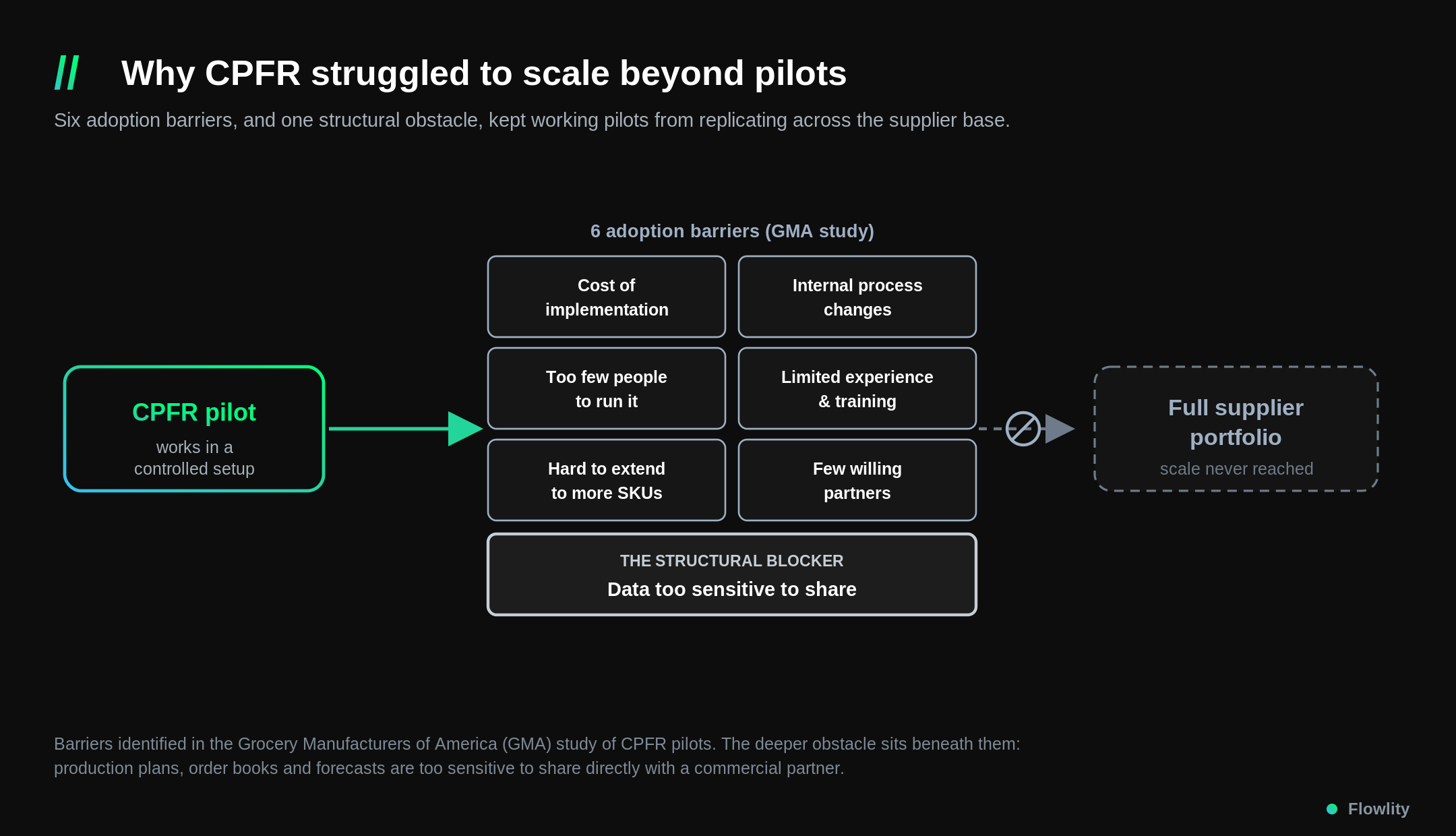
A study by the Grocery Manufacturers of America (GMA) among members who had implemented at least a pilot CPFR system identified six main barriers to adoption:
- Cost of implementation
- Changes to internal processes required
- Lack of human resources to manage the process
- Lack of experience and training
- Difficulty extending the process to a broader range of products or points of sale
- Lack of appropriate commercial partners willing to participate
Beyond the operational friction these barriers describe, the whitepaper highlights a deeper obstacle: the difficulty of data sharing between commercial partners. Certain types of data, such as production plans, order books, and forecasts, are too sensitive to share directly with business partners. The visibility that would benefit each party for forecasting and inventory management is also a source of commercial tension.
This is one of the main reasons why few companies achieved a high degree of Supply Chain collaboration maturity, even among those with the resources and motivation to try. Without a mechanism that allows synchronization without direct sensitive data exposure, CPFR implementations repeatedly stalled at the governance stage, working in carefully controlled pilots and failing to replicate across a full supplier portfolio.
What CPFR got right that still matters
Despite its implementation difficulties, CPFR established principles that remain correct and are now being delivered through different architectures.
Shared demand signals reduce the bullwhip effect
When Supply Chain partners respond to the same demand signal rather than to independently derived estimates of that signal, order amplification decreases and total network inventory falls. CPFR identified the right mechanism. The challenge was the delivery model.
Promotional and launch visibility requires coordination
For irregular demand products, seasonal items, promotions, and new product introductions, the information advantage of coordination is highest. A supplier who knows about a promotion in advance can prepare inventory without emergency production runs. The value CPFR promised in these scenarios is real. The model for delivering it has evolved.
Collaboration creates shared value that unilateral optimization cannot capture
A retailer and supplier each optimizing independently will always hold more total inventory than two parties optimizing against the same signal. CPFR's framing of Supply Chain collaboration as value creation rather than cost allocation was correct. That framing remains the foundation of collaborative planning architectures that are now delivering on it more effectively.
What replaces CPFR: synchronization without sensitive data exposure
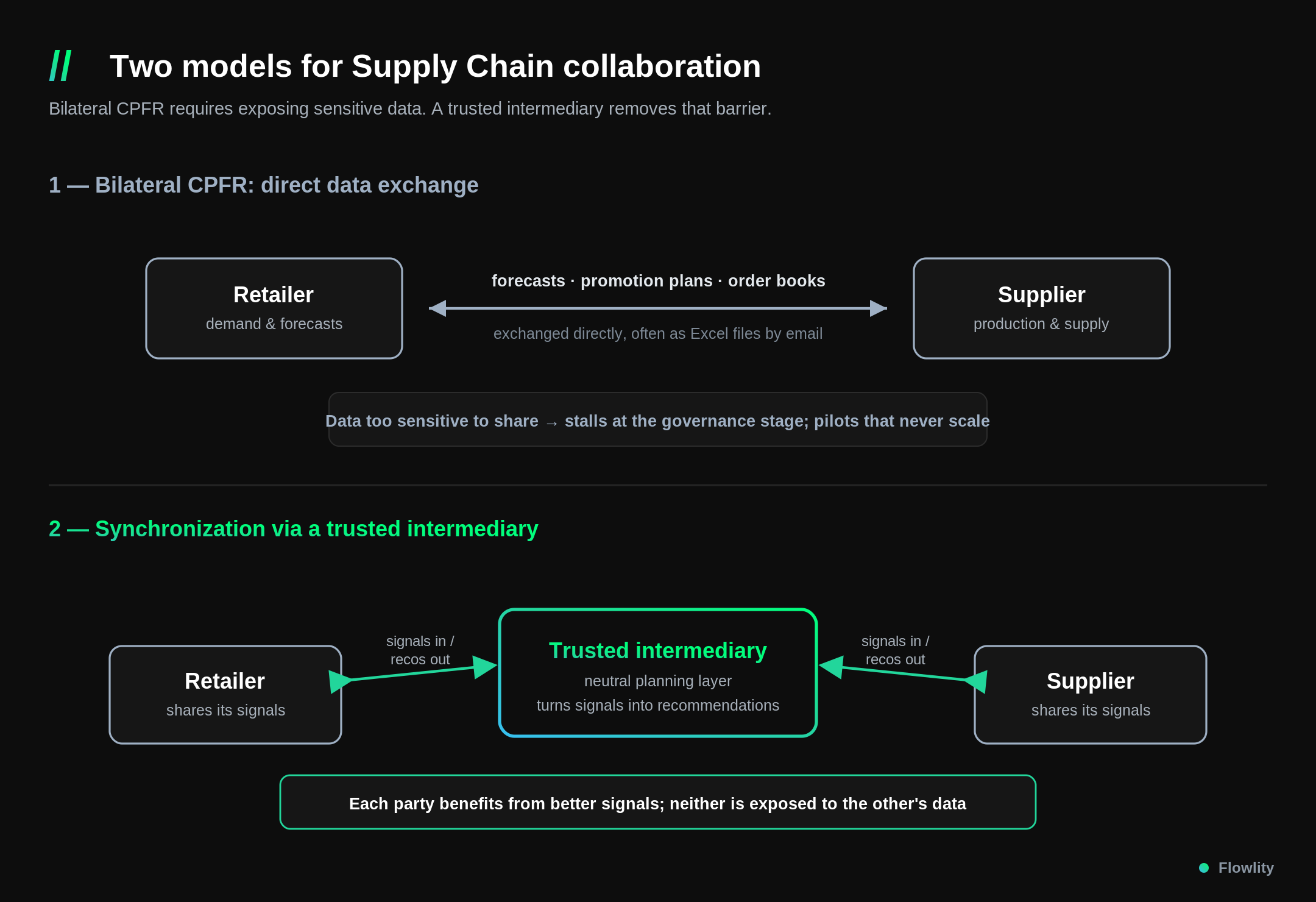
The core limitation CPFR never resolved was the tension between the visibility required for collaboration and the sensitivity of the data that visibility requires. With a trusted third party between customer and supplier, it becomes possible to synchronize the Supply Chain without the disadvantages of sharing sensitive data directly, which is precisely what traditional visibility and collaboration solutions like CPFR and Control Tower approaches could not achieve.
This trusted intermediary model resolves what the bilateral CPFR approach could not. Each party shares signals with the intermediary rather than directly with its commercial partner. The intermediary processes those signals into shared planning recommendations and returns them to each party without exposing the underlying commercial data of either. Each party benefits from better replenishment signals. Neither party is exposed to the other's strategic information. The collaboration that CPFR required direct data exchange to enable becomes possible without it.
Modern AI-driven demand planning and demand sensing capabilities reinforce this model further. Where CPFR relied on deterministic single-point forecasts exchanged periodically, AI-driven platforms update shared replenishment signals continuously as new demand data arrives, with AI Agents handling routine recalculation automatically. The collaboration becomes a continuous operating state rather than a periodic review cycle.
The maturity journey from CPFR to networked Supply Chains
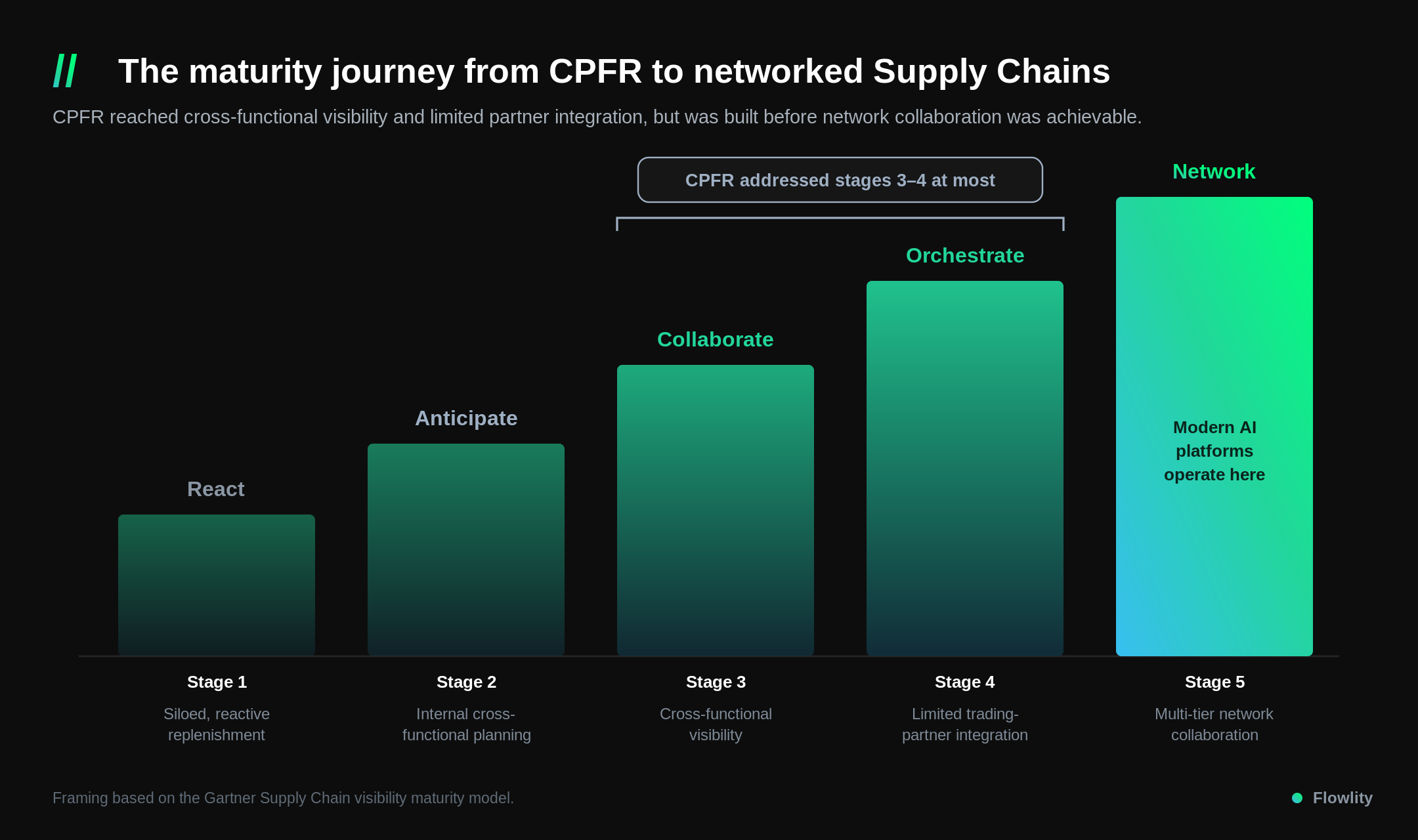
CPFR was designed for a world where bilateral trading partner integration represented the frontier of Supply Chain collaboration. Looking at the Gartner Supply Chain visibility maturity model, CPFR addressed Stages 3 and 4 at most (cross-functional visibility and limited trading partner integration) and was built before Stage 5 network collaboration was technologically achievable.
The detailed breakdown of what each maturity stage requires in terms of technology, data governance, and organizational capability is covered in our article on agile Supply Chain management for retailers and our guide to Supply Chain synchronization. The relevant point for CPFR's legacy is this: the maturity journey CPFR was trying to accelerate is real, and the direction was correct. The implementation model was the wrong vehicle for that journey.
Organizations that made CPFR investments in the 2000s and 2010s built organizational muscle for cross-partner coordination, even where the technology did not deliver. That muscle is not wasted. It is the foundation on which network Supply Chain collaboration can now be built with architectures that solve the problems CPFR could not.
Is CPFR still relevant today?
CPFR as originally defined, bilateral data exchange of forecasts and promotions through standardized templates, is no longer robust enough for the complexity and volatility of modern Supply Chains. The manual coordination model and the direct data exposure requirement have been superseded by better approaches.
The principles CPFR established, shared demand visibility, coordinated replenishment, and supplier-retailer alignment, remain entirely relevant. They are now embedded in Supply Chain collaboration platforms that deliver them without the implementation barriers that prevented CPFR from scaling.
The practical question for Supply Chain leaders is not whether to revisit CPFR. It is whether their current collaboration architecture has resolved the core obstacle that prevented CPFR from delivering: the ability to synchronize Supply Chain partners without requiring direct exposure of commercially sensitive data. If it has not, the outcomes will be familiar: pilots that work and cannot scale, and Supply Chain coordination that exists on paper but breaks down at the governance stage.
Book a demo to discover how Flowlity's collaborative planning platform enables Supply Chain coordination without direct data exposure.
Level up your supply chain with AI.
Get a demo

FAQ
Find everything you need to know right here.
What are the best practices for successful collaborative planning?

Before any process or tool decision, remember that collaborative planning only works when partners genuinely treat the Supply Chain as a shared system rather than a series of handoffs. Once that mindset is in place, a handful of concrete practices separate mature programs from those that drift back into spreadsheets.
Successful collaborative planning relies on a few essential best practices that ensure alignment, transparency, and smooth execution across partners
- Build trust and transparency (data sharing + clear rules);
- Standardize exchange formats (calendar, units, KPIs);
- Use common KPIs to measure collaborative performance;
- Invest in real-time cloud platforms for continuous plan updates;
- Regularly review agreements and adjust processes.
These practices reinforce each other. Trust enables data sharing, standardization makes the data comparable, common KPIs keep everyone focused on the same outcomes, and real-time platforms turn collaboration into an ongoing routine rather than a quarterly meeting. Periodic reviews then close the loop, adjusting thresholds and governance as volumes, partners, or priorities evolve.
What is collaborative supply chain planning?
At its core, collaborative Supply Chain planning is about replacing fragmented local views with a single shared plan that every partner agrees to and acts on. Instead of each actor optimizing its own slice of the flow in isolation, information — and responsibility — flow across organizational boundaries.
Collaborative planning involves sharing forecasts, inventory, and constraints in real time between customers, distributors, and suppliers in order to make joint decisions (quantities, dates, priorities) and reduce the “bullwhip” effect.
The operational payoff is immediate: lower total inventory across the network, fewer stockouts at the end customer, and far less firefighting when demand shifts. It also creates a more resilient Supply Chain, because disruptions are detected and absorbed closer to the source instead of cascading through the network with amplified effects.
What is supply chain collaboration and why is it important?
Supply Chain collaboration refers to the close cooperation between the different actors in a Supply Chain — manufacturers, distributors, suppliers, and retailers — based on shared information and aligned objectives. Rather than each party optimizing its own slice of the flow, collaboration treats the Supply Chain as a single end-to-end system.
It matters because the cost of information silos is measured directly in working capital and missed sales. When partners don't share forecasts or inventory positions, each one inflates safety stock, reacts late to demand shifts, and amplifies variability upstream.
Collaboration reduces those silos, improves joint forecast accuracy, shortens lead times, and — critically — helps every partner respond faster to demand changes or disruptions. In volatile markets, that responsiveness is what protects service levels without inflating inventory across the network.
What does CPFR stand for?
CPFR stands for Collaborative Planning, Forecasting and Replenishment. It is a supply chain collaboration model designed to help business partners jointly plan demand forecasts and replenishment activities by sharing selected planning information.
What is CPFR in supply chain management?
In supply chain management, CPFR refers to a collaborative approach where retailers and suppliers coordinate forecasts, promotions, and replenishment plans. The objective is to better align supply and demand across the supply chain and reduce inefficiencies such as stockouts and overstocks.
How does CPFR work in practice?
CPFR works through structured collaboration between commercial partners. Companies exchange planning data such as demand forecasts, orders, and promotion plans to build shared forecasts and supply plans. Historically, many CPFR initiatives relied on manual processes and limited automation, which impacted scalability.
Why is CPFR difficult to implement?
CPFR is difficult to implement because it requires significant organizational change, standardized data, aligned IT systems, and a high level of trust between partners. Studies have also highlighted high implementation costs, limited resources, and challenges related to data sharing and confidentiality.
What are the main limitations of CPFR?
The main limitations of CPFR include high implementation costs, difficulty scaling beyond pilot projects, reliance on manual coordination, and reluctance to share sensitive data between partners. These constraints have limited its adoption in increasingly complex and volatile supply chain environments.
Is CPFR still relevant today?
CPFR introduced important principles around collaboration and shared visibility. However, today’s supply chains face higher volatility and complexity, raising questions about how well traditional CPFR models can adapt. Flowlity's whitepaper explores how collaboration models are evolving in response to these challenges.
Does CPFR require data sharing between partners?
Yes. CPFR relies on partners exchanging planning data such as forecasts, orders, and promotional information. While this visibility can improve coordination, concerns around data confidentiality and competitive advantage have often slowed or limited adoption.
Which industries have used CPFR?
CPFR has mainly been used in retail and consumer goods industries, particularly for products with irregular demand such as seasonal items, promotions, and new product launches. Large retailers and their major suppliers were among the earliest adopters.