.svg)
.svg)
Managing demand volatility and its Supply Chain impact

Demand volatility does not just make forecasting harder. It exposes a structural flaw in how most manufacturers plan raw material replenishment. When demand fluctuates, MRP-based systems do not absorb the variability. They amplify it upstream, turning small deviations at the finished goods level into large swings at the raw material level. The result is a paradox that most manufacturers recognize immediately: record inventory levels and persistent shortages existing simultaneously. Resolving it requires a different replenishment architecture, not better forecasting of the same broken model.
Two numbers from 2022 define the demand volatility problem precisely. Inventory held by 2,349 listed global manufacturing companies hit a record $1.87 trillion according to Nikkei Asia, the highest level in ten years. In the same period, automakers produced 3.23 million fewer vehicles than planned due to microchip shortages, according to AutoForecast Solutions. More inventory than ever. More shortages than expected. Both at the same time.
This is not a contradiction. It is the predictable outcome of planning systems designed for stable environments operating under volatile ones. The inventory is in the wrong places. The shortages are in the critical ones. And the planning model that produced this allocation is still running nightly in most manufacturing organizations.
What is demand volatility and why has it become structural?
Demand volatility is the degree to which actual customer demand deviates from forecasts over time, not just upward or downward, but in terms of speed, frequency, and unpredictability of those deviations. In stable markets, volatility is occasional. In the current environment, it is the baseline condition.
Several forces have made demand volatility structural rather than cyclical:
- shorter product life cycles that compress the window between launch, peak demand, and obsolescence
- promotional and seasonal demand patterns that create sharp spikes followed by sharp drops
- geopolitical disruptions, climate events, and logistics constraints that shift supply availability independently of demand
- consumer behavior shaped by social media, price comparison tools, and same-day delivery expectations that make purchasing decisions faster and less predictable
- new product introductions that have no demand history and whose ramp-up trajectories are genuinely uncertain
The combination of these forces means that the historical demand patterns on which traditional planning relies are less reliable guides to future demand than they were even a decade ago. This is not a data quality problem. It is an environmental change that requires a planning architecture built for uncertainty rather than one that assumes stability.
How demand volatility propagates through the Supply Chain
The mechanism by which demand volatility damages manufacturing Supply Chains is well established. A small fluctuation of plus or minus 5% in actual customer demand is interpreted by Supply Chain participants as a change in demand of up to plus or minus 40% by the time replenishment decisions reach the raw material level, according to Accelerated Analytics research on the bullwhip effect.
For manufacturers specifically, the impact is asymmetric and severe. Finished goods planners add buffer to account for demand uncertainty. Component planners add buffer to account for production plan variability. Raw material planners add buffer to account for supplier lead time uncertainty. Each layer of buffer amplifies rather than absorbs the variability from the layer below it, because each layer is responding to a demand signal that already includes the overreaction of every downstream node.
The result is that raw material inventories are the most exposed to volatility amplification, and the hardest to correct quickly, because supplier lead times are typically the longest in the network. By the time a raw material overstock or shortage becomes visible, the decisions that created it were made weeks or months earlier.
This is why the manufacturing inventory paradox is not accidental. It is the structural output of planning systems that propagate volatility rather than absorb it.

buffers size the protection to the actual shape of uncertainty for that specific reference.
Why MRP reaches its limits under demand volatility
Material Requirements Planning was designed in an era of relative demand stability. Its logic is deterministic: take downstream demand, propagate it through the bill of materials using fixed lead times and fixed parameters, and generate replenishment orders. When those parameters reflect reality, the system works. When they do not, errors accumulate at every bill of materials level.
Under demand volatility, three specific limitations become critical:
- Longer order lead times, shorter delivery lead times. As market expectations for delivery speed have shortened, the gap between the time needed to order raw materials and the time available to fulfill customer orders has widened. MRP cannot bridge this gap with fixed parameters.
- High volatility in production plans. When finished goods demand shifts, production plans change. MRP translates every production plan change into a cascade of raw material requirement changes. The more volatile the production plan, the more chaotic the raw material replenishment signals become.
- Low forecast accuracy for finished goods. MRP depends entirely on the accuracy of finished goods forecasts. In volatile markets, those forecasts are systematically less reliable. The errors do not stay at the finished goods level. They propagate upstream and amplify.
Distribution Requirements Planning extends MRP logic to the distribution network, pushing inventory through the Supply Chain to meet demand at each node. It inherits all of MRP's limitations under volatility and adds the complexity of managing those limitations across multiple warehouse and store locations simultaneously.
The combined effect is a planning system that was adequate for the environment it was designed for and inadequate for the environment most manufacturers now operate in.
How to measure demand volatility in practice
Managing demand volatility requires first measuring it accurately, and most organizations underestimate how variable their demand actually is because they look at aggregated figures rather than SKU-level distributions.
The coefficient of variation (CV) is the most widely used starting point: it measures demand variability relative to the average demand level. A higher CV indicates a more volatile demand pattern. But CV alone is insufficient because it does not capture trend changes, promotional effects, or the speed at which volatility shifts.
A complete measurement of demand volatility per SKU requires combining:
- historical demand variability expressed as coefficient of variation
- trend direction and rate of change
- seasonality patterns and their stability
- forecast error history and whether errors are systematic or random
- lead time variability from each supplier
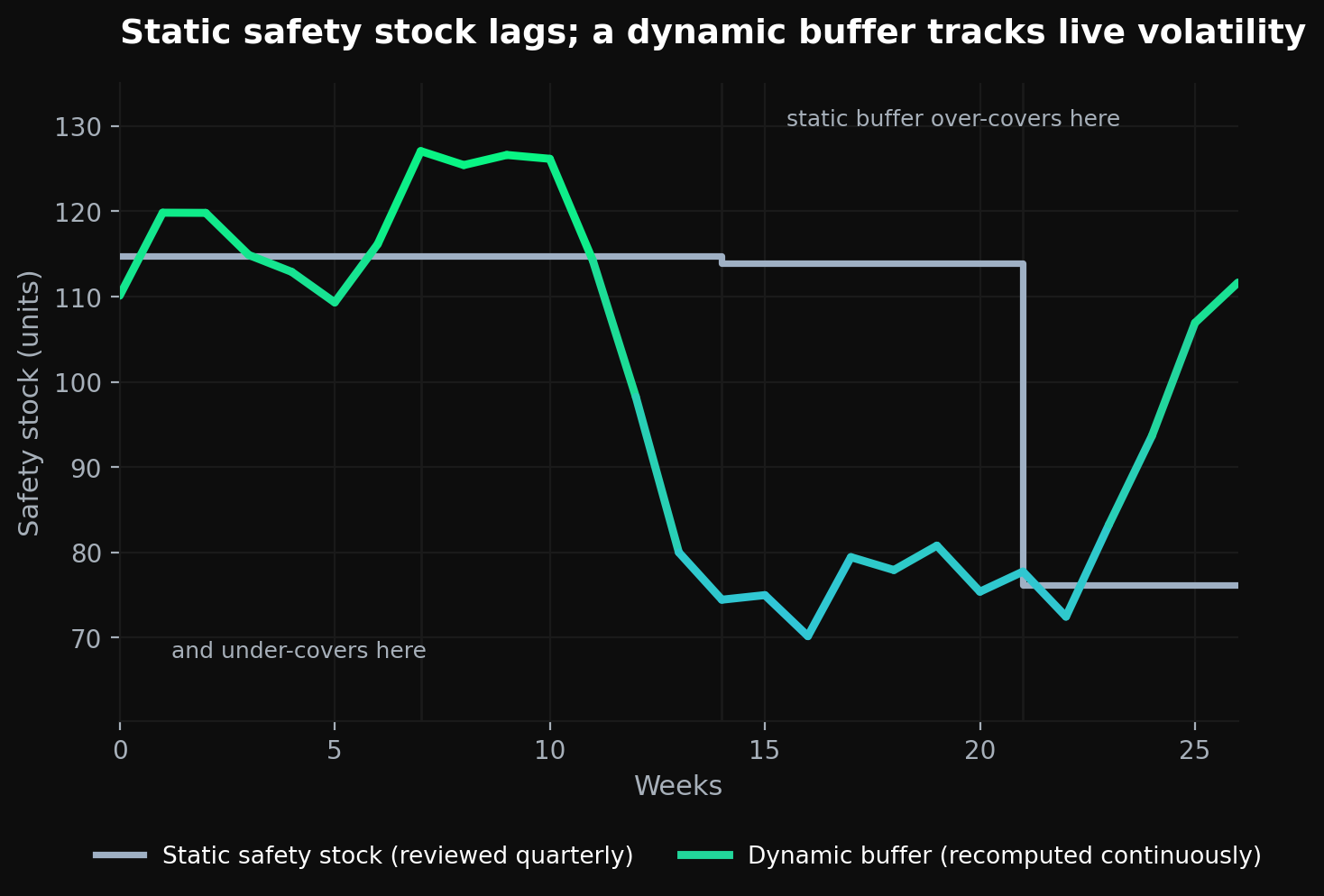
Most traditional planning systems treat volatility as a fixed input rather than a dynamic one. Safety stocks are set once based on a historical volatility calculation and reviewed infrequently. By the time the review happens, the demand profile has already changed. The buffer is sized for a volatility level that no longer exists, either too large for a reference that has stabilized or too small for one that has become more erratic.
Consumption-based replenishment as the structural alternative
The architectural alternative to MRP's dependent demand propagation is consumption-based replenishment: placing buffer stocks at strategic decoupling points in the Supply Chain and sizing them dynamically based on actual consumption forecasts and real-time lead time estimates rather than on cascaded downstream requirements.
The difference is fundamental. MRP asks: "what will be needed based on the production plan?" Consumption-based replenishment asks: "what is actually being consumed, and with what probability distribution, at each point in the Supply Chain?"
By decoupling each Supply Chain stage and forecasting consumption directly at that stage, the system absorbs volatility rather than propagating it. A change in finished goods demand does not automatically cascade into a raw material replenishment change. Instead, the raw material buffer absorbs the variability while the consumption forecast updates to reflect the new signal. When the buffer reaches a threshold, replenishment is triggered based on actual observed consumption rather than on a cascaded forecast that already contains compounded errors from every upstream node.
AI-driven Supply Planning implements this consumption-based logic with four steps:
- place an inventory buffer on the raw material to absorb volatility at source
- use AI to predict how much will actually be consumed, computing multiple scenarios with different parameters and probabilities
- assess risks in both demand and lead times to calculate dynamic buffer levels that reflect current uncertainty rather than historical averages
- replenish to maintain position within the dynamic min-max range, taking into account planned orders
The probabilistic approach is what distinguishes this from simple buffer rules. Rather than setting a fixed safety stock and reviewing it annually, the system continuously recomputes the probability distribution of consumption for each raw material and adjusts the buffer to match the current risk profile. For intermittent or low-volume components, this is particularly valuable: traditional average-based safety stocks either over-protect against sporadic demand or under-protect against genuine lead time risk, while probabilistic buffers size the protection to the actual shape of uncertainty for that specific reference.
The following session covers how to apply probabilistic forecasting and dynamic inventory strategies in volatile markets, with concrete examples from manufacturers: watch how to forecast and optimize your inventories in a volatile market.
What consumption-based replenishment delivers in practice
The business outcomes of consumption-based replenishment are measurable across three dimensions simultaneously. Magotteaux, a manufacturer operating in a high-volatility raw material environment, reduced stockouts by 8% and cut inventory levels by 13% after implementing AI-driven planning. The inventory reduction and the stockout reduction happened in parallel, which is the outcome that deterministic MRP with fixed safety stocks structurally cannot produce: the buffer that prevents stockouts is the same buffer that creates overstock when sized by averages rather than by actual risk.
This simultaneous improvement reflects the core logic of consumption-based replenishment. When each buffer is sized to actual demand uncertainty rather than to a worst-case average, stable references carry less and volatile ones carry more, but only where the probability distribution justifies it. The total inventory falls. The service level holds. The planning team shifts from firefighting to exception management.
Inventory optimization built on this probabilistic foundation also enables the S&OP process to work with more reliable supply signals. When raw material buffers are dynamically sized, the production plan can be more stable, because the raw material planning layer is absorbing rather than amplifying the variability from below. A more stable production plan produces more reliable finished goods forecasts. More reliable finished goods forecasts produce less bullwhip effect upstream. The compounding improvement across the full planning stack is what makes the investment in consumption-based replenishment compound rather than plateau.
Building a demand volatility management capability
Managing demand volatility effectively is not a one-time project. It is an ongoing capability that requires three organizational commitments alongside the technical architecture.
1. Continuous monitoring rather than periodic review
Demand profiles change faster than annual or quarterly review cycles can track. Demand sensing capabilities that detect demand shifts within days rather than weeks allow the replenishment model to update before the deviation materializes as a stockout or overstock rather than after. Dashboard analytics that surface emerging volatility by SKU and by Supply Chain node give planners the forward visibility to act on changing conditions rather than reacting to their consequences.
2. Exception-based governance rather than manual recalculation
As the system handles routine buffer recalculation automatically, planner attention concentrates on the genuine exceptions: the raw material references where volatility is increasing faster than the model predicted, the suppliers whose lead time reliability is degrading, the components whose demand correlation with finished goods is shifting. AI Agents surface these exceptions ranked by financial and service impact, so the highest-risk situations receive attention first rather than being buried in a flat list of replenishment recommendations.
3. Integration across the full planning stack
Demand volatility managed at the raw material level in isolation does not eliminate the bullwhip effect. It requires collaborative planning with suppliers to share consumption forecasts upstream, demand planning accuracy improvements at the finished goods level to reduce the amplitude of the signal that cascades down, and strategic simulations that allow planners to model the impact of demand scenarios on raw material exposure before those scenarios materialize.
Discover how Flowlity's AI-driven manufacturing planning platform helps manufacturers break the inventory paradox and build replenishment infrastructure that absorbs demand volatility rather than amplifying it. Book a demo.
Level up your supply chain with AI.
Get a demo


FAQ
Find everything you need to know right here.
How can technology help in addressing demand fluctuations?

Technology enables real-time data processing, probabilistic forecasting, and dynamic inventory optimization. Advanced Supply Chain analytics help planners anticipate variability, adjust replenishment decisions continuously, and react faster to disruptions. The contribution is most visible on highly variable SKUs, where static rules produce either excess stock or recurring shortages. Probabilistic models quantify the demand uncertainty around each forecast and translate it into buffer sizes that match real risk per SKU period. The result is steadier service level, lower working capital and a clearer view of where attention is needed, since the same engine surfaces the exceptions that genuinely deserve planner time rather than burying them in dashboards.
How can inventory metrics help in managing volatile demand?
Inventory metrics such as stock coverage, service level, forecast error, and coefficient of variation help identify where volatility creates the highest risk. When used dynamically, these metrics guide smarter buffer placement and replenishment priorities. The shift from static to dynamic reading is what unlocks the value. Treated as fixed thresholds, these metrics tend to flag the same SKUs cycle after cycle. Treated as inputs to a probabilistic model, they expose the SKUs whose risk profile is changing now and deserve attention before service or inventory KPIs deteriorate. This is how inventory metrics turn from reporting indicators into operational signals that actually shape replenishment decisions.
Can demand profiles change over time?
Yes. Demand profiles evolve due to seasonality, promotions, product life cycles, and market conditions. This is why static classifications quickly become obsolete in volatile environments. An SKU that behaved as fast-moving last year may have shifted into a more intermittent pattern, and continuing to treat it the same way leads to either excess stock or recurring shortages. Continuous reclassification, driven by recent demand data, keeps planning parameters aligned with reality. Probabilistic models help here by quantifying the demand variability per SKU period directly, so the buffer adapts to the current profile without requiring planners to reclassify thousands of items manually each cycle.
How do demand fluctuations impact inventory optimization?
Demand fluctuations increase the risk of both overstock and stockouts. Without adaptive planning, companies either carry excessive safety stock or fail to meet demand. Dynamic optimization helps balance service and working capital. The trade-off is not symmetric across SKUs, which is why blanket coverage rules tend to misallocate stock. Probabilistic optimization sizes the buffer to the actual demand uncertainty of each SKU period, so working capital concentrates where it genuinely protects service and shrinks where it would only generate waste. The result is steadier service level at lower total inventory, with replenishment decisions that adapt continuously as demand profiles change rather than waiting for the next quarterly review.
How often should businesses reassess their inventory optimization strategies in the face of demand volatility?
In volatile markets, reassessment should be continuous. Inventory and replenishment strategies must adapt as demand patterns, lead times, and risks evolve, rather than relying on annual or quarterly reviews. Fixed review cycles assume the underlying environment changes slowly, which is no longer a safe assumption in most Supply Chains. Modern planning platforms recompute key parameters as new data arrives, so safety stock, reorder points and service level targets stay aligned with current conditions. Planner time then concentrates on the exceptions surfaced by the system, rather than on rerunning the same broad reassessment every few months and discovering that conditions have already shifted again.