.svg)
.svg)
Supply Chain synchronization: build a mature planning model

Supply Chain synchronization is the capability to align demand, supply, production, and finance decisions across internal functions and external partners on a shared, continuously updated planning model. It is the difference between a Supply Chain that optimizes each node in isolation and one that optimizes the network as a whole. Organizations that reach synchronization reduce the bullwhip effect, free up working capital, and absorb disruptions without cascading failures.
Every year, trillions of euros are lost as a result of shortages and overstocks across manufacturers and distributors. Most companies have ERP systems and reasonable visibility of their stock levels. The losses are not caused by a lack of technology. They are caused by a planning architecture that treats the company as an independent entity in a world where Supply Chains are deeply interdependent. Optimizing your own inventory in isolation while your upstream and downstream partners operate with different signals and different assumptions guarantees that variability amplifies across the network rather than cancels out.
Supply Chain synchronization is the structural answer to this problem. It is not a single tool or a one-time project. It is a maturity journey with a clear sequence of steps, and most organizations are earlier in that journey than they realize.
What is Supply Chain synchronization and why does it matter now?
Supply Chain synchronization is the alignment of planning decisions across the full network of suppliers, production sites, distribution centers, and customers on a shared, continuously updated data model. Where traditional Supply Chain management optimizes each function or entity independently, synchronization optimizes the flow of goods, information, and decisions across all of them simultaneously.
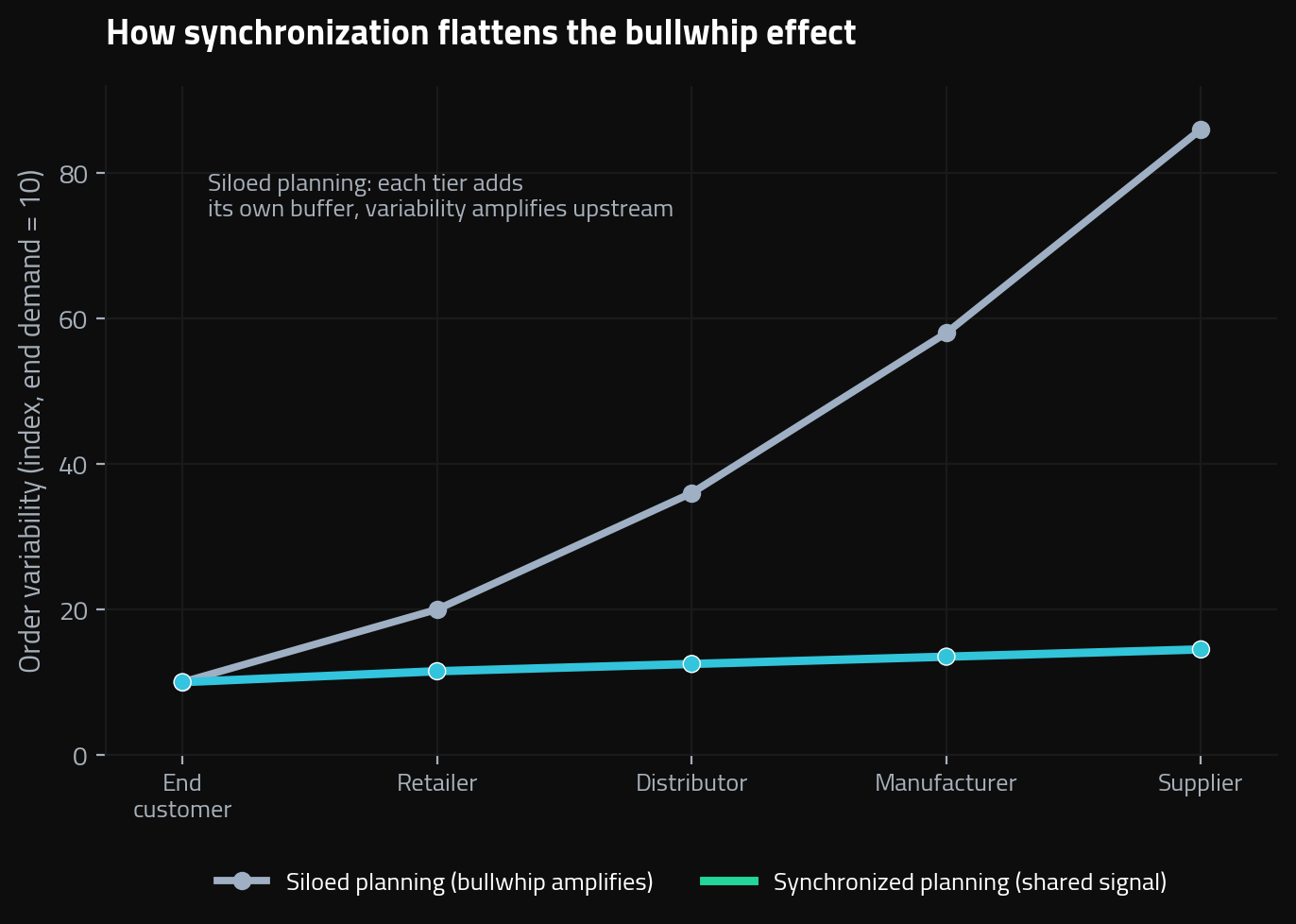
The distinction matters because the primary source of inventory waste and service failure in modern Supply Chains is not poor performance at individual nodes. It is misalignment between nodes. When a manufacturer's production plan does not reflect the retailer's actual demand signal, or when a supplier's replenishment schedule does not account for the customer's real inventory position, variability amplifies with every step removed from the point of consumption. This is the bullwhip effect, and it is a network failure, not a company failure.
Synchronization addresses the bullwhip effect at its source by ensuring that every planning decision in the network is made on the same signal rather than on a lagged, distorted version of it. To see how a small demand swing amplifies upstream across the tiers, try our interactive bullwhip effect simulator.
Where does your Supply Chain sit on the maturity curve?
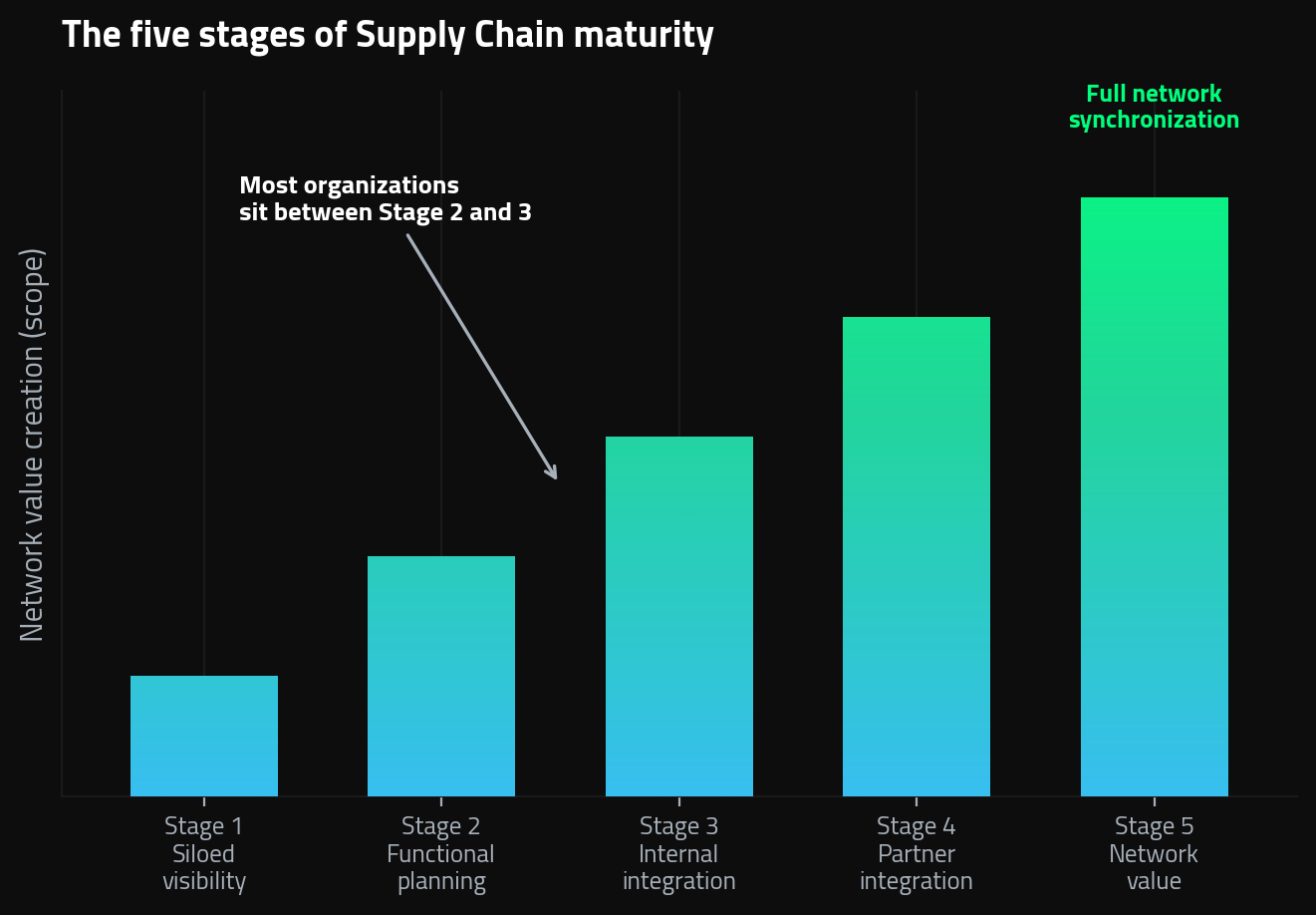
Not all organizations are at the same level of Supply Chain maturity, and the gap between stages is not just operational. It is strategic. A Supply Chain at Stage 1 or 2 is optimizing within its own walls. A Supply Chain at Stage 4 or 5 is creating shared value across a network of partners.
The Gartner Supply Chain visibility maturity model maps this progression across five stages, from siloed after-the-fact performance visibility through to network-wide shared value creation. The full framework and its retail-specific implications are covered in detail in our article on agile Supply Chain management for retailers. The relevant point for synchronization is this: a Gartner report on the Top 25 Supply Chain companies found that only a minority of even the most advanced organizations have reached Stage 5. The challenge for most companies is not to reach Stage 5 immediately but to ensure that today's planning and technology investments are building toward it rather than locking in Stage 2 or 3 permanently.
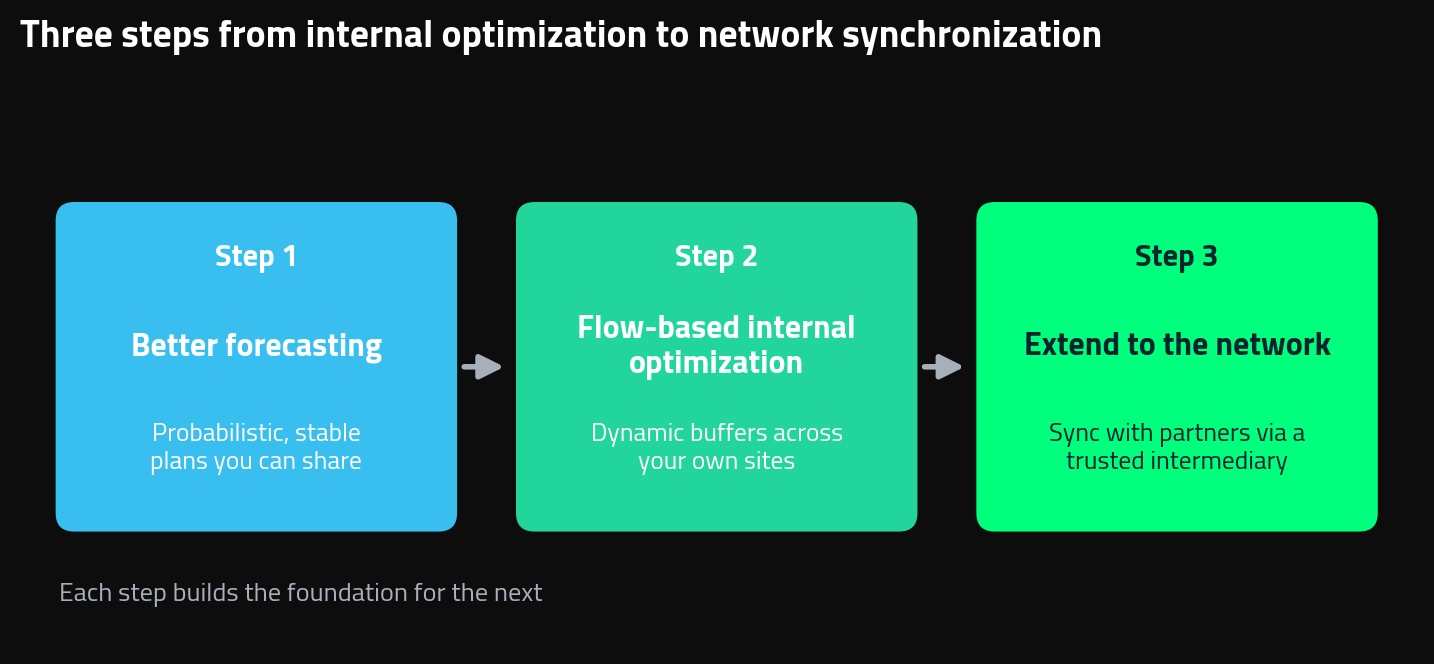
The three steps that follow map the progression from internal optimization to full network synchronization. Each builds on the previous one and each has a clear operational trigger that tells you when you are ready to move forward.
Step 1: better forecasting as the foundation for synchronization
Synchronization cannot happen without a reliable forecast. A plan that changes every time something moves is not a plan that can be shared with partners. The first step toward a synchronized Supply Chain is therefore building the forecasting capability that produces plans stable enough to act on and share.
The core problem with traditional forecasting in this context is not accuracy in isolation. It is that static, deterministic forecasts produce instability. As soon as the plan is finalized, something shifts and the whole process restarts from scratch. This creates an enormous waste of planning time, generates tension between Supply Chain functions, and produces plans that no external partner can rely on because they change before partners can act on them.
AI-driven demand planning addresses this by replacing single-point deterministic forecasts with probabilistic models that account for variability rather than averaging it away. Demand sensing detects real demand shifts within days, reducing the gap between the plan and market reality continuously rather than waiting for the next planning cycle. The result is a forecast that is both more accurate and more stable, which is the combination that makes it safe to share with upstream and downstream partners.
The internal benefit of this step is measurable immediately: Ukal reduced inventory by 16% and achieved its €1M working capital saving target after implementing AI-driven planning. The network benefit compounds once external synchronization becomes possible in steps 2 and 3.
Watch the following webinar for a practical look at how end-to-end Supply Chain visibility works across tiers and how it translates into faster, more reliable planning decisions.
Step 2: flow-based inventory optimization across the internal network
Once forecasting is stable, the next step is to replace deterministic MRP-based replenishment with a flow-based approach that positions dynamic buffers at the right points in the internal Supply Chain and adjusts them continuously as conditions change. The MRP approach to material requirements planning sets in stone parameters that are actually variables, lead time, processing time, scrap rate, and when those variables shift the plan drifts from reality. The flow-based approach treats those variables as inputs to be continuously re-evaluated rather than fixed assumptions.
The flow-based approach resolves this by placing decoupling buffer stocks at strategic points in the chain and dynamically adjusting them by forecasting consumption requirements directly rather than deriving them top-down. Variable parameters like lead time are treated as inputs to be continuously re-evaluated rather than fixed assumptions. The difference between forecast and reality narrows over time rather than drifting.
Starting with the internal network
The transition toward full network synchronization does not have to begin with external partners. For organizations with multiple sites managing different production stages of the same product, the internal network already contains the data needed to dramatically improve upstream and downstream visibility. Connecting those internal nodes first, through multi-echelon inventory optimization and Distribution Requirements Planning, is an excellent first step toward extended synchronization before embarking on external partner integration.
Ravate improved service levels by 6.3 points after implementing AI-driven planning across their network. The improvement came from the same mechanism described above: buffers recalibrated to actual demand variability rather than static coverage rules, with replenishment signals aligned across internal locations rather than managed in isolation.
Supply order management automation closes the loop between replenishment decisions and supplier execution, translating internal plan stability into external reliability. When your internal plan stops changing constantly, your suppliers can plan against it.
Step 3: extending synchronization to the network
The experts are clear: the Supply Chain market is definitively moving toward a new standard, an extended and networked Supply Chain where shared value creation across trading partners is the competitive norm rather than the exception. This transition is already underway among the most advanced organizations. According to a joint study by Roland Berger and France Supply Chain on strategic operational challenges, 39% of respondents aimed to redesign their planning processes and a similar share identified digital transformation, specifically in sales forecasting, demand prediction, and data exploitation, as a key capability to develop.
IT investments are costly in both time and resources, and current Supply Chain projects need to account for this emerging network standard now rather than after it becomes ubiquitous. The choices made today determine how prepared organizations will be for the network Supply Chain of the next decade.
The data-sharing barrier and how to overcome it
The theoretical case for network synchronization has been established for decades. The barrier to implementation has always been data sensitivity. Production plans, order books, and demand forecasts are commercially sensitive. Sharing them directly with trading partners creates competitive exposure that most organizations are unwilling to accept, regardless of the efficiency benefits.
This is the missing link that has prevented most organizations from moving beyond Stage 3 maturity. The difficulty of being transparent about data in collaboration with business partners remains a significant obstacle despite the recognized benefits.
The solution is not to force direct data sharing. It is to use a trusted planning intermediary that allows each party to share the signals necessary for synchronized planning without exposing the underlying sensitive data to the other party. With a trusted third party between customer and supplier, it becomes possible to synchronize the Supply Chain and eliminate the information asymmetries that drive the bullwhip effect, without the competitive risks of direct data exchange that made CPFR and traditional Control Tower approaches unscalable.
Collaborative planning built on this trusted intermediary model allows retailers and suppliers to align on future inventory needs, share replenishment forecasts, and receive automated alerts on stockout risks, all without exposing the commercial data that would compromise their negotiating positions.
What Supply Chain synchronization delivers across the planning stack
When synchronization works, its effects are visible across every layer of the planning stack simultaneously.
At the S&OP level, synchronized demand and supply signals mean executive decisions are made on a shared view of the business rather than on reconciled versions of departmental plans. The misalignment between what sales expects, what operations can deliver, and what finance has planned shrinks. Strategic simulations become genuinely useful because the inputs are aligned rather than siloed.
At the inventory optimization level, network-wide signal alignment means buffer sizing can account for variability at multiple nodes simultaneously rather than each node protecting itself with excess stock against the unpredictability of its neighbors. The total network inventory falls while service levels hold, because each buffer is sized to the actual residual risk after upstream signals are accounted for.
At the operational level, AI Agents can handle routine replenishment recalculation automatically across the full network, surfacing only the exceptions that require human judgment. Planners redirect their time from manual compensation for plan instability to the strategic supplier and customer relationships that determine how well the network performs under disruption.
Dashboard analytics give Supply Chain leaders the visibility to monitor synchronization quality across the network, identify the nodes where misalignment is creating the most variability, and prioritize the integration investments that will deliver the most impact.
Discover how Flowlity's collaborative planning platform helps organizations move from siloed optimization to a fully synchronized network. Book a demo.
Level up your supply chain with AI.
Get a demo

FAQ
Find everything you need to know right here.
What is Supply Chain synchronization?

Supply Chain synchronization is the alignment of planning decisions across the full network of suppliers, production sites, distribution centers, and customers on a shared, continuously updated data model. It moves beyond internal optimization, where each company or function improves its own performance independently, toward network optimization, where all parties plan against the same demand signals and inventory positions simultaneously. Synchronization eliminates the information asymmetries that drive the bullwhip effect and enables each node in the network to hold less buffer stock because it can rely on the planning signals from adjacent nodes rather than protecting itself against their unpredictability.
What are the stages of Supply Chain maturity?
Supply Chain maturity progresses from siloed, after-the-fact visibility at Stage 1 through functional improvement, cross-functional internal optimization, and extended partner integration, to network-wide shared value creation at Stage 5. Most organizations currently operate between Stages 2 and 3, with good internal visibility but limited external synchronization. The key transitions are: from Stage 1 to 2, moving from spreadsheets to functional planning systems; from Stage 2 to 3, connecting cross-functional internal data on a shared planning model; from Stage 3 to 4, extending visibility to trading partners; and from Stage 4 to 5, creating genuine shared value across the full network with aligned data governance.
Why is it difficult for companies to share Supply Chain data with partners?
Production plans, order books, and demand forecasts are commercially sensitive. Sharing them directly with trading partners creates competitive exposure because the same information that enables better supply coordination also reveals strategic priorities, production constraints, and demand expectations that could disadvantage the sharing party in commercial negotiations. This is the fundamental barrier that prevented CPFR and traditional Control Tower approaches from scaling beyond pilot programs. The solution is not to eliminate data sharing but to route it through a trusted intermediary that allows both parties to benefit from synchronized planning without either party gaining direct visibility of the other's sensitive commercial data.
What is the bullwhip effect and how does synchronization reduce it?
The bullwhip effect is the amplification of demand variability as signals travel upstream through the Supply Chain. Small fluctuations in end-customer demand become progressively larger order swings at each upstream node, because each party adds safety stock and ordering buffers to protect against the uncertainty of the signals it receives from its downstream partner. Synchronization reduces the bullwhip effect by aligning planning signals across the network so that each party responds to actual downstream demand rather than a distorted version of it. When a retailer's real demand signal reaches a supplier directly and in real time rather than arriving as an amplified order wave, the supplier can plan production and inventory against reality rather than against uncertainty.
How long does it take to build a synchronized Supply Chain?
The timeline depends on where the organization starts and how it sequences the three steps. Organizations that already have stable AI-driven forecasting in place can move to flow-based internal network optimization within weeks for a focused scope. Extending synchronization to external partners takes longer because it requires integration with partner systems and the governance agreements that define what is shared and how. The recommended approach is to start with internal network synchronization across own sites and divisions, validate the inventory and service level improvements, and then extend progressively to Tier 1 suppliers and key retail customers. Most organizations that follow this sequence achieve measurable network-level improvements within six to twelve months of beginning the external integration phase.