.svg)
Tus decisiones de Supply Chain, en un solo panel
Obtén una visión completa y en tiempo real de tu cadena de suministro. Concéntrate en lo que realmente importa y toma decisiones más rápidas e inteligentes con analítica Supply Chain impulsada por IA.
Agenda una demoObtén una visión clara y completa de tu cadena de suministro
Deja de trabajar con datos fragmentados y vistas parciales.
Visibilidad unificada de la cadena de suministro
.svg)
Fuente única de verdad
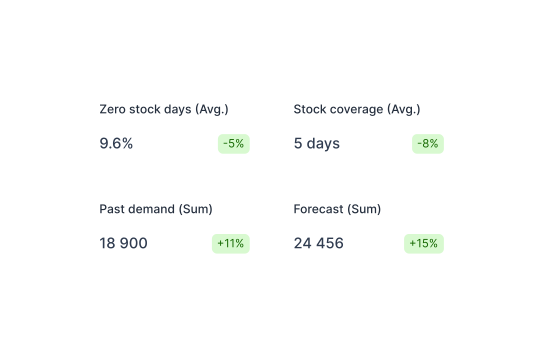
Enfoca la atención en lo que realmente requiere acción
Menos ruido. Más claridad.
.svg)
Indicadores orientados a la acción
Vistas basadas en excepciones
Anticipa problemas y toma mejores decisiones, más rápido
Pasa de un monitoreo reactivo a una toma de decisiones proactiva.
.svg)
Insights predictivos para la cadena de suministro
.svg)
Tableros listos para la toma de decisiones
De paneles de control a herramientas de decisión


How to gain real-time visibility across your operations?
More about Supply Chain dashboards and analytics
Why Supply Chain teams need a unified dashboard

Supply Chain leaders today face a growing challenge: decisions must be taken faster, yet operational data is more fragmented than ever.
Demand signals, inventory levels, supplier performance, logistics constraints, and financial metrics often live in different systems. ERP reports, spreadsheets, and BI dashboards provide partial insights, but rarely deliver the end-to-end visibility needed to manage a modern Supply Chain.
A unified Supply Chain dashboard solves this problem by consolidating operational data into a single decision interface. Instead of spending hours gathering information from multiple tools, planners gain a clear overview of what is happening across the entire network.
More importantly, modern dashboards go beyond simple reporting. When combined with predictive analytics and AI, they help teams anticipate disruptions, identify risks earlier, and prioritize the actions that will have the greatest operational impact.
Platforms like Flowlity bring together key planning processes such as Demand Forecasting, Inventory Management, Supply Planning and more, enabling companies to move from reactive monitoring to proactive decision-making.
Why traditional dashboards are no longer enough for Supply Chain management
Many companies believe they already have dashboards because their ERP or Business Intelligence tools generate reports. In practice, these dashboards often fail to support operational decisions.
The main issue lies in how Supply Chain data is structured and used. Traditional dashboards usually suffer from three major limitations:
Fragmented data sources
Operational data is spread across ERP systems, warehouse platforms, procurement tools, and spreadsheets, making it difficult to obtain a complete view of the Supply Chain.
Static reporting
Most dashboards focus on historical metrics instead of anticipating future risks.
Information overload
When dozens of KPIs appear simultaneously, planners struggle to identify which issues actually require action.
As a result, teams often revert to manual analysis. Planners spend valuable time investigating reports instead of focusing on strategic decisions.
Modern Supply Chain platforms address this problem by introducing exception-based dashboards, where analytics automatically highlight the situations that require attention.
Automation also plays a key role. By combining alerts, predictive analytics, and planning tools, intelligent dashboards drastically reduce manual analysis and improve responsiveness.
Who is Flowlity's Supply Chain dashboard software built for?
Dashboards become operational only when they serve real decisions, not just reporting. Flowlity's Supply Chain KPI dashboard is built for Supply Chain directors and COOs who need a single, reliable view across demand, inventory, supply and service without pulling data from five tools every Monday morning. It fits S&OP managers and operations controllers running cross-functional reviews where every team shows up with a different version of the truth. And it supports demand planners and inventory managers in retail, distribution and manufacturing who need to spot emerging risks (stock coverage deteriorating, demand deviations, supplier delays) before they become service-level issues.
The pain points are familiar: operational data scattered across ERP, WMS, BI tools and spreadsheets with no shared source of truth, historical reporting that tells you what happened last month but not what's about to break next week, dozens of KPIs competing for attention with no clear signal on which ones actually require action, and planners spending hours building ad hoc reports instead of making decisions. A real Supply Chain dashboard inverts that ratio.
How Flowlity provides real-time Supply Chain visibility
Flowlity’s Dashboard and Analytics modules are designed to give Supply Chain teams an immediate and reliable overview of their operations.
Flowlity’s Dashboard tab
When users open Flowlity, the Dashboard acts as the central control panel of the platform. It summarizes the most important operational indicators so planners can quickly assess the health of the Supply Chain before diving into detailed planning decisions.
At the top of the Dashboard, a KPI panel highlights four essential metrics:
- Inventory level, showing the overall stock position across the network
- Zero stock days, identifying periods where products are unavailable
- Stock coverage, indicating how long current inventory will last based on demand
- Past demand, helping planners understand recent demand evolution
Each KPI is displayed with comparisons to previous periods, allowing teams to immediately identify trends and detect anomalies.
Below this KPI panel, time-series charts visualize how key indicators evolve over time. Planners can quickly see whether inventory levels are rising, whether stock coverage is deteriorating, or whether demand trends are shifting.
This high-level visibility makes the Dashboard the natural starting point for daily Supply Chain monitoring.
Flowlity’s Analytics module
When deeper analysis is required, the Analytics module provides a more detailed view of operational data and system performance.
Within Analytics, teams can explore several key areas:
- Data synchronization monitoring, ensuring that demand, orders, and forecasts are up to date
- Data quality reporting, which highlights inconsistencies that could affect planning accuracy
- Global performance overview, aggregating metrics across all sites and warehouses
- Operational alerts, surfacing anomalies and exceptions that require attention
This combination of high-level visibility and advanced analytics allows planners to quickly move from observation to investigation and action.
Because these dashboards are directly connected to Flowlity’s planning modules — including Demand Forecasting, Inventory Management, Supply Planning, and S&OP — insights generated in the dashboard can immediately translate into operational decisions.
Instead of spending time building reports, Supply Chain teams can focus on what really matters: anticipating disruptions and optimizing inventory decisions across the network.
Key Supply Chain KPIs every decision dashboard should track
A well-designed dashboard focuses on the metrics that truly drive Supply Chain performance. While the exact KPIs depend on industry and operational model, several indicators are universally important.
Among the most critical metrics monitored by Supply Chain leaders are:
Service level
Measures the ability to fulfill customer demand without delays or shortages.
Forecast accuracy
Evaluates how closely predicted demand matches actual sales.
Inventory turnover
Indicates how efficiently inventory is replenished and used.
Stockout rate
Tracks how often products are unavailable when customers want them.
Days of inventory on hand
Shows how long existing stock will last based on expected demand.
Cash-to-cash cycle time
Measures how quickly inventory investments convert into revenue.
These indicators help companies balance two critical objectives:
- maintaining high product availability
- minimizing excess inventory and operational costs
The impact of improving these KPIs can be significant when companies gain better visibility and stronger planning capabilities across their Supply Chain.
For example, Saint-Gobain improved its forecast accuracy by 15% at SKU level, while also increasing product availability and service levels across its network. Better forecasts allowed the company to anticipate demand variability more effectively and reduce operational uncertainty.
Other organizations have focused on inventory optimization. Retail organizations show the same pattern. Sport 2000 cut multi-store inventory by 39% while protecting service, by turning forecasting and replenishment into a single, governed dashboard process instead of dozens of local spreadsheets. The working capital freed up by this kind of inventory reduction goes straight back into operations.
These results illustrate how strengthening core planning processes such as Demand Forecasting and Inventory Management can transform Supply Chain performance. By improving visibility on demand variability and stock dynamics, companies are able to balance service levels with inventory efficiency in a far more sustainable way.
From reporting dashboards to Supply Chain control towers
Traditional dashboards help organizations understand what happened. Modern analytics platforms enable companies to understand what will happen next and what actions should be taken.
This evolution is often described as the transition from dashboards to Supply Chain control towers.
A control tower integrates multiple capabilities:
- real-time operational visibility
- predictive analytics
- automated alerts
- decision recommendations
Instead of presenting isolated metrics, it analyzes the relationships between demand signals, supply constraints, and inventory levels.
For instance, predictive analytics may detect that a spike in demand for a particular SKU could lead to a shortage in several weeks. Planners can then adjust replenishment strategies, redistribute inventory, or revise safety stock levels before the disruption occurs.
This proactive approach significantly improves operational resilience and helps organizations manage uncertainty more effectively.
It also integrates closely with planning processes such as Supply Planning, where operational decisions must adapt quickly to changing conditions.
Plum Living shows what this looks like at the operating level. The team reduced inventory value by 38% (from €598k to €367k) within a year, by acting directly on the demand signals and stock coverage views surfaced in the planning dashboard, rather than waiting for monthly reports to reveal the imbalance.
How Artificial Intelligence enhances Supply Chain analytics
Artificial Intelligence is transforming how dashboards support Supply Chain decision-making.
Instead of relying on static reports, AI continuously analyzes operational data to detect patterns, anticipate disruptions, and guide planning decisions.
Some of the most impactful capabilities include:
Probabilistic demand forecasting
AI models generate ranges of possible demand scenarios instead of single forecasts.
Anomaly detection
Algorithms identify unusual patterns such as demand spikes, supplier delays, or unexpected inventory movements.
Scenario simulation
Companies can test the impact of planning decisions before implementing them.
Decision recommendations
AI systems can suggest actions such as adjusting safety stock levels or modifying replenishment strategies.
These capabilities transform dashboards into true decision intelligence platforms.
Saint-Gobain Sekurit AGR illustrates this shift. By moving from static reporting to AI-driven probabilistic forecasting, the team lifted SKU-level forecast accuracy by 15 percentage points and pushed average product availability above 97% across more than 10,000 references, while keeping safety stock under control.
For example, scenario modeling allows planners to test the impact of changes in service levels, supplier lead times, or demand volatility. This approach is particularly valuable when combined with Strategic Simulations, allowing planners to test different scenarios and evaluate the impact of disruptions or policy changes before implementing them in real operations. To cope with increasing volatility and uncertainty, businesses must adopt innovative Supply Chain strategies that rethink traditional planning approaches.
Measurable results achieved with AI-driven Supply Chain dashboards
Companies that implement intelligent planning dashboards often see measurable improvements across multiple dimensions of Supply Chain performance.
One of the most visible impacts is inventory optimization. By combining predictive analytics with operational visibility, companies can align stock levels much more closely with real demand patterns. In practice, this means fewer safety stock buffers, better anticipation of demand variability, and more precise replenishment decisions.
Retail and distribution environments show such results. At La Redoute, Flowlity helped teams rethink packaging inventory management across multiple warehouses. Within months, the company reduced inventory levels by 50%, while also lowering operational costs and freeing up hundreds of pallets of storage space each month.
Beyond inventory optimization, improved visibility also has a direct impact on operational efficiency.
The experience of Camif provides a strong illustration. Before implementing Flowlity, procurement processes were largely manual and forecasting reliability was limited. By introducing data-driven planning and centralized visibility across suppliers and warehouses, the company significantly improved its coordination capabilities. As a result, Camif reduced stockouts by 5 percentage points, generated approximately €40,000 in additional annual revenue by avoiding lost sales, and was able to absorb 44% business growth without increasing logistics headcount.
The operational gains went beyond financial performance. According to the company’s Supply Chain leadership, the platform also generated productivity gains equivalent to one full-time employee, thanks to the automation of previously manual planning tasks and improved decision-making efficiency.
Service performance improvements are another common outcome. When companies gain better visibility across demand, supply constraints, and inventory dynamics, they are able to maintain higher product availability without increasing overall stock levels.
For example, Groupe Lemoine improved its service level by 11%, while Ravate increased product availability by 6.3% through better planning coordination and more accurate demand anticipation.
Taken together, these results highlight a fundamental shift in how Supply Chains are managed. Intelligent dashboards are no longer just reporting tools. When combined with predictive analytics and integrated planning processes, they become operational control systems that help companies anticipate disruptions, prioritize the right decisions, and continuously optimize performance across the entire Supply Chain.
Building an end-to-end Supply Chain dashboard
Creating a powerful Supply Chain dashboard requires more than visualizing KPIs. The real value comes from connecting data across the entire Supply Chain ecosystem.
This means integrating information from:
- suppliers and procurement systems
- production and manufacturing data
- warehouse and logistics operations
- demand signals from sales channels
When these data streams remain isolated, planners struggle to understand how decisions in one area affect the rest of the network.
Modern Supply Chain platforms solve this challenge through seamless integrations with ERP systems, warehouse platforms, and planning tools. This unified data foundation enables dashboards to reflect the true operational situation in real time.
Such visibility is particularly valuable for collaborative processes like Sales & Operations Planning, where demand forecasts, supply constraints, and financial objectives must be aligned.
These challenges often emerge in complex planning environments where demand, supply, and financial objectives must be aligned. Implementing Digital S&OP with AI and automation helps organizations connect these decisions and create a more resilient Supply Chain planning process.
How to choose the right Supply Chain dashboard software
As companies search for better visibility across their operations, many begin evaluating different platforms and technologies. Choosing the best Supply Chain visibility software becomes a key step toward building a more connected and responsive Supply Chain. Selecting the right dashboard solution requires evaluating both technological capabilities and operational impact.
Organizations should consider several key criteria.
First, data integration is essential. The platform must connect easily with existing systems such as ERP, WMS, and procurement tools.
Second, companies should prioritize predictive analytics capabilities. Modern dashboards must go beyond historical reporting and help anticipate disruptions.
Ease of use is another critical factor. If dashboards are too complex, planners will revert to spreadsheets. Intuitive interfaces improve adoption and ensure that insights are used in daily operations.
Scalability is also important. As Supply Chains grow more complex, the dashboard must handle increasing volumes of data and operational scenarios.
Finally, the most powerful solutions integrate analytics with operational planning capabilities such as:
- Demand Forecasting
- Inventory Management
- Supply Planning
This integration allows companies to move seamlessly from insight to action.
FAQ
Find everything you need to know right here.
¿Cómo apoya el dashboard de Flowlity la toma de decisiones en Supply Chain?
El dashboard de Flowlity está diseñado para ofrecer a los equipos de Supply Chain una visibilidad inmediata sobre los indicadores operativos más críticos.
El dashboard resume métricas clave como niveles de inventario, cobertura de stock y tendencias de demanda, permitiendo a los planificadores evaluar rápidamente la salud global de su Supply Chain. Las visualizaciones de series temporales ayudan a los equipos a comprender cómo evolucionan estos indicadores en el tiempo y a detectar riesgos emergentes.
Cuando se requiere un análisis más profundo, el módulo Analytics de Flowlity ofrece capacidades adicionales, incluyendo el monitoreo de calidad de datos, alertas operativas y análisis de rendimiento multi-sitio.
Dado que el dashboard está directamente conectado a los módulos de planificación como Previsión de la Demanda, Gestión de Inventario, Planificación de Aprovisionamiento y S&OP, los insights generados en la interfaz pueden traducirse inmediatamente en decisiones operativas. Esta integración permite a las organizaciones pasar de la visibilidad a la acción y optimizar continuamente el rendimiento de la Supply Chain.
¿Cuál es la diferencia entre un dashboard de Supply Chain y una control tower de Supply Chain?
Un dashboard de Supply Chain se centra en el monitoreo de KPIs operativos, mientras que una control tower de Supply Chain ofrece un entorno de gestión operativa más amplio y avanzado.
Las control towers combinan varias capacidades, incluyendo visibilidad en tiempo real, analytics predictivo, herramientas de colaboración y mecanismos de apoyo a la decisión. Su objetivo no es solo mostrar información, sino también orquestar las operaciones de Supply Chain entre múltiples partes interesadas.
Mientras que los dashboards proporcionan una visión general de las métricas clave, las control towers analizan las relaciones entre los datos de demanda, aprovisionamiento e inventario para anticipar disrupciones y coordinar respuestas.
En las plataformas modernas de Supply Chain, los dashboards suelen servir como punto de entrada a las capacidades de control tower, ofreciendo la visibilidad necesaria para guiar las decisiones operativas.
¿Cómo mejora la Inteligencia Artificial los dashboards de Supply Chain?
La Inteligencia Artificial mejora significativamente las capacidades de los dashboards de Supply Chain al transformarlos de simples herramientas de reporting en sistemas predictivos de apoyo a la decisión.
Los modelos de IA pueden analizar continuamente los datos operativos para detectar patrones y anomalías que serían difíciles de identificar manualmente. Por ejemplo, los algoritmos pueden identificar picos de demanda inusuales, prever posibles roturas de stock o detectar inconsistencias en los flujos de datos.
La IA también puede generar previsiones de demanda probabilísticas, proporcionando a los planificadores un rango de escenarios posibles en lugar de una única predicción. Esto ayuda a las organizaciones a gestionar mejor la incertidumbre y adaptar sus estrategias de inventario en consecuencia.
En las plataformas de planificación avanzadas, la Inteligencia Artificial también puede apoyar simulaciones de escenarios y generar recomendaciones que ayudan a los equipos a priorizar las acciones de mayor impacto.
¿Cómo ayudan los dashboards de Supply Chain a reducir el inventario?
Los dashboards de Supply Chain ayudan a reducir el inventario al mejorar la visibilidad sobre la variabilidad de la demanda, la dinámica de stocks y las decisiones de reaprovisionamiento.
Cuando los planificadores tienen acceso a indicadores precisos y en tiempo real, pueden identificar situaciones donde los niveles de inventario superan las necesidades operativas. Esto facilita el ajuste de los niveles de stock de seguridad, la optimización de las estrategias de reaprovisionamiento y la prevención de la acumulación innecesaria de stock.
Los dashboards también ayudan a los equipos a detectar antes los productos de baja rotación y las fluctuaciones de la demanda, permitiéndoles adaptar los planes de aprovisionamiento y producción en consecuencia.
Combinados con el análisis predictivo y las herramientas de previsión de demanda, los dashboards proporcionan la información necesaria para equilibrar la disponibilidad de productos con una gestión eficiente del inventario.
¿Cómo mejora un dashboard de Supply Chain la visibilidad operativa?
Los dashboards de Supply Chain mejoran la visibilidad al consolidar datos de múltiples sistemas operativos en una única interfaz.
En muchas organizaciones, la información relativa a previsiones de demanda, niveles de inventario, rendimiento de proveedores y operaciones logísticas está dispersa en diferentes plataformas. Esta fragmentación dificulta que los planificadores obtengan una comprensión clara y en tiempo real de la situación.
Un dashboard centralizado conecta estas fuentes de datos y las presenta a través de indicadores visuales, gráficos de tendencias y alertas. Esto permite a los equipos de Supply Chain identificar problemas con anticipación, como caídas en la cobertura de stock, picos de demanda inusuales o retrasos de proveedores.
Una mejor visibilidad ayuda en última instancia a las empresas a pasar de una gestión reactiva a una toma de decisiones proactiva, permitiendo a los planificadores anticipar disrupciones en lugar de simplemente reaccionar ante ellas.
¿Qué KPIs debería incluir un dashboard de Supply Chain?
Los dashboards de Supply Chain más eficaces se centran en un conjunto limitado de KPIs que influyen directamente en el rendimiento operativo.
Entre los indicadores más monitoreados se encuentran el nivel de servicio, que mide la capacidad de satisfacer la demanda del cliente sin roturas, y la precisión de las previsiones, que evalúa en qué medida la demanda prevista se corresponde con las ventas reales.
Las métricas relacionadas con el inventario también son esenciales. Generalmente incluyen la rotación de inventario, la cobertura de stock y los días de inventario disponible. En conjunto, ayudan a las organizaciones a comprender la eficiencia de la gestión de inventario y si los niveles están alineados con los patrones de demanda.
Indicadores operativos como la tasa de ruptura y el ciclo cash-to-cash también se incluyen frecuentemente, ya que proporcionan información sobre la disponibilidad de productos y la eficiencia del capital circulante.
Al monitorear estos KPIs en un solo dashboard, los equipos de Supply Chain pueden identificar rápidamente los desequilibrios entre los objetivos de nivel de servicio y los costes de inventario.
¿Cuál es la diferencia entre un dashboard de Supply Chain y el analytics de Supply Chain?
Un dashboard de Supply Chain se centra principalmente en el monitoreo del rendimiento, mientras que el analytics de Supply Chain ayuda a analizar datos y respaldar decisiones.
Los dashboards suelen mostrar métricas clave como el nivel de servicio, la precisión de las previsiones, la cobertura de stock o la rotación de inventario. Su función es proporcionar una visión rápida del rendimiento operativo y ayudar a los equipos a detectar anomalías.
El analytics de Supply Chain va más allá al permitir una investigación más profunda de las causas de los problemas operativos. Las herramientas de análisis avanzado pueden identificar patrones en la variabilidad de la demanda, resaltar problemas de calidad de datos o simular el impacto de diferentes escenarios de planificación.
Las plataformas modernas de Supply Chain combinan ambas capacidades. Los dashboards ofrecen visibilidad de alto nivel, mientras que los módulos de analytics permiten a los planificadores explorar los datos en detalle e identificar las acciones que mejorarán el rendimiento.
¿Qué es un dashboard de Supply Chain?
Un dashboard de Supply Chain es una interfaz centralizada que agrega datos operativos y presenta indicadores clave de rendimiento de manera clara y accionable. Permite a los equipos de Supply Chain monitorear métricas críticas como niveles de inventario, tendencias de demanda, cobertura de stock y niveles de servicio desde un único entorno.
En lugar de navegar entre múltiples herramientas como informes ERP, hojas de cálculo y plataformas de análisis, los planificadores pueden comprender rápidamente el estado actual de las operaciones y detectar riesgos potenciales. Los dashboards modernos de Supply Chain están diseñados no solo para mostrar KPIs, sino también para ayudar a los equipos a priorizar acciones e identificar disrupciones emergentes.
Cuando se integran con plataformas de planificación, los dashboards se convierten en una herramienta de decisión diaria que favorece una mejor coordinación entre los procesos de previsión, gestión de inventario y planificación de aprovisionamiento.