.svg)
Le tue decisioni sulla Supply Chain, in un'unica dashboard
Ottieni una visione completa e in tempo reale della tua Supply Chain. Concentrati su ciò che conta davvero e prendi decisioni più rapide e intelligenti con l'analisi Supply Chain potenziata dall'IA.
Richiedi una demoOttieni una visione chiara ed end-to-end della tua Supply Chain
Basta con dati frammentati e viste parziali.
Visibilità unificata della Supply Chain
.svg)
Un'unica fonte di verità
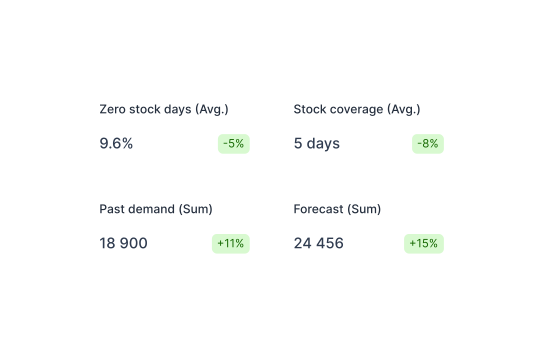
Concentra l'attenzione su ciò che richiede davvero un'azione
Meno rumore. Più chiarezza.
.svg)
Indicatori orientati all'azione
Viste basate sulle eccezioni
Anticipa i problemi e prendi decisioni migliori, più rapidamente
Passa da un monitoraggio reattivo a un processo decisionale proattivo.
.svg)
Insight predittivi per la Supply Chain
.svg)
Dashboard pronte per le decisioni
Da dashboard di reporting a cockpit decisionali


How to gain real-time visibility across your operations?
More about Supply Chain dashboards and analytics
Why Supply Chain teams need a unified dashboard

Supply Chain leaders today face a growing challenge: decisions must be taken faster, yet operational data is more fragmented than ever.
Demand signals, inventory levels, supplier performance, logistics constraints, and financial metrics often live in different systems. ERP reports, spreadsheets, and BI dashboards provide partial insights, but rarely deliver the end-to-end visibility needed to manage a modern Supply Chain.
A unified Supply Chain dashboard solves this problem by consolidating operational data into a single decision interface. Instead of spending hours gathering information from multiple tools, planners gain a clear overview of what is happening across the entire network.
More importantly, modern dashboards go beyond simple reporting. When combined with predictive analytics and AI, they help teams anticipate disruptions, identify risks earlier, and prioritize the actions that will have the greatest operational impact.
Platforms like Flowlity bring together key planning processes such as Demand Forecasting, Inventory Management, Supply Planning and more, enabling companies to move from reactive monitoring to proactive decision-making.
Why traditional dashboards are no longer enough for Supply Chain management
Many companies believe they already have dashboards because their ERP or Business Intelligence tools generate reports. In practice, these dashboards often fail to support operational decisions.
The main issue lies in how Supply Chain data is structured and used. Traditional dashboards usually suffer from three major limitations:
Fragmented data sources
Operational data is spread across ERP systems, warehouse platforms, procurement tools, and spreadsheets, making it difficult to obtain a complete view of the Supply Chain.
Static reporting
Most dashboards focus on historical metrics instead of anticipating future risks.
Information overload
When dozens of KPIs appear simultaneously, planners struggle to identify which issues actually require action.
As a result, teams often revert to manual analysis. Planners spend valuable time investigating reports instead of focusing on strategic decisions.
Modern Supply Chain platforms address this problem by introducing exception-based dashboards, where analytics automatically highlight the situations that require attention.
Automation also plays a key role. By combining alerts, predictive analytics, and planning tools, intelligent dashboards drastically reduce manual analysis and improve responsiveness.
Who is Flowlity's Supply Chain dashboard software built for?
Dashboards become operational only when they serve real decisions, not just reporting. Flowlity's Supply Chain KPI dashboard is built for Supply Chain directors and COOs who need a single, reliable view across demand, inventory, supply and service without pulling data from five tools every Monday morning. It fits S&OP managers and operations controllers running cross-functional reviews where every team shows up with a different version of the truth. And it supports demand planners and inventory managers in retail, distribution and manufacturing who need to spot emerging risks (stock coverage deteriorating, demand deviations, supplier delays) before they become service-level issues.
The pain points are familiar: operational data scattered across ERP, WMS, BI tools and spreadsheets with no shared source of truth, historical reporting that tells you what happened last month but not what's about to break next week, dozens of KPIs competing for attention with no clear signal on which ones actually require action, and planners spending hours building ad hoc reports instead of making decisions. A real Supply Chain dashboard inverts that ratio.
How Flowlity provides real-time Supply Chain visibility
Flowlity’s Dashboard and Analytics modules are designed to give Supply Chain teams an immediate and reliable overview of their operations.
Flowlity’s Dashboard tab
When users open Flowlity, the Dashboard acts as the central control panel of the platform. It summarizes the most important operational indicators so planners can quickly assess the health of the Supply Chain before diving into detailed planning decisions.
At the top of the Dashboard, a KPI panel highlights four essential metrics:
- Inventory level, showing the overall stock position across the network
- Zero stock days, identifying periods where products are unavailable
- Stock coverage, indicating how long current inventory will last based on demand
- Past demand, helping planners understand recent demand evolution
Each KPI is displayed with comparisons to previous periods, allowing teams to immediately identify trends and detect anomalies.
Below this KPI panel, time-series charts visualize how key indicators evolve over time. Planners can quickly see whether inventory levels are rising, whether stock coverage is deteriorating, or whether demand trends are shifting.
This high-level visibility makes the Dashboard the natural starting point for daily Supply Chain monitoring.
Flowlity’s Analytics module
When deeper analysis is required, the Analytics module provides a more detailed view of operational data and system performance.
Within Analytics, teams can explore several key areas:
- Data synchronization monitoring, ensuring that demand, orders, and forecasts are up to date
- Data quality reporting, which highlights inconsistencies that could affect planning accuracy
- Global performance overview, aggregating metrics across all sites and warehouses
- Operational alerts, surfacing anomalies and exceptions that require attention
This combination of high-level visibility and advanced analytics allows planners to quickly move from observation to investigation and action.
Because these dashboards are directly connected to Flowlity’s planning modules — including Demand Forecasting, Inventory Management, Supply Planning, and S&OP — insights generated in the dashboard can immediately translate into operational decisions.
Instead of spending time building reports, Supply Chain teams can focus on what really matters: anticipating disruptions and optimizing inventory decisions across the network.
Key Supply Chain KPIs every decision dashboard should track
A well-designed dashboard focuses on the metrics that truly drive Supply Chain performance. While the exact KPIs depend on industry and operational model, several indicators are universally important.
Among the most critical metrics monitored by Supply Chain leaders are:
Service level
Measures the ability to fulfill customer demand without delays or shortages.
Forecast accuracy
Evaluates how closely predicted demand matches actual sales.
Inventory turnover
Indicates how efficiently inventory is replenished and used.
Stockout rate
Tracks how often products are unavailable when customers want them.
Days of inventory on hand
Shows how long existing stock will last based on expected demand.
Cash-to-cash cycle time
Measures how quickly inventory investments convert into revenue.
These indicators help companies balance two critical objectives:
- maintaining high product availability
- minimizing excess inventory and operational costs
The impact of improving these KPIs can be significant when companies gain better visibility and stronger planning capabilities across their Supply Chain.
For example, Saint-Gobain improved its forecast accuracy by 15% at SKU level, while also increasing product availability and service levels across its network. Better forecasts allowed the company to anticipate demand variability more effectively and reduce operational uncertainty.
Other organizations have focused on inventory optimization. Retail organizations show the same pattern. Sport 2000 cut multi-store inventory by 39% while protecting service, by turning forecasting and replenishment into a single, governed dashboard process instead of dozens of local spreadsheets. The working capital freed up by this kind of inventory reduction goes straight back into operations.
These results illustrate how strengthening core planning processes such as Demand Forecasting and Inventory Management can transform Supply Chain performance. By improving visibility on demand variability and stock dynamics, companies are able to balance service levels with inventory efficiency in a far more sustainable way.
From reporting dashboards to Supply Chain control towers
Traditional dashboards help organizations understand what happened. Modern analytics platforms enable companies to understand what will happen next and what actions should be taken.
This evolution is often described as the transition from dashboards to Supply Chain control towers.
A control tower integrates multiple capabilities:
- real-time operational visibility
- predictive analytics
- automated alerts
- decision recommendations
Instead of presenting isolated metrics, it analyzes the relationships between demand signals, supply constraints, and inventory levels.
For instance, predictive analytics may detect that a spike in demand for a particular SKU could lead to a shortage in several weeks. Planners can then adjust replenishment strategies, redistribute inventory, or revise safety stock levels before the disruption occurs.
This proactive approach significantly improves operational resilience and helps organizations manage uncertainty more effectively.
It also integrates closely with planning processes such as Supply Planning, where operational decisions must adapt quickly to changing conditions.
Plum Living shows what this looks like at the operating level. The team reduced inventory value by 38% (from €598k to €367k) within a year, by acting directly on the demand signals and stock coverage views surfaced in the planning dashboard, rather than waiting for monthly reports to reveal the imbalance.
How Artificial Intelligence enhances Supply Chain analytics
Artificial Intelligence is transforming how dashboards support Supply Chain decision-making.
Instead of relying on static reports, AI continuously analyzes operational data to detect patterns, anticipate disruptions, and guide planning decisions.
Some of the most impactful capabilities include:
Probabilistic demand forecasting
AI models generate ranges of possible demand scenarios instead of single forecasts.
Anomaly detection
Algorithms identify unusual patterns such as demand spikes, supplier delays, or unexpected inventory movements.
Scenario simulation
Companies can test the impact of planning decisions before implementing them.
Decision recommendations
AI systems can suggest actions such as adjusting safety stock levels or modifying replenishment strategies.
These capabilities transform dashboards into true decision intelligence platforms.
Saint-Gobain Sekurit AGR illustrates this shift. By moving from static reporting to AI-driven probabilistic forecasting, the team lifted SKU-level forecast accuracy by 15 percentage points and pushed average product availability above 97% across more than 10,000 references, while keeping safety stock under control.
For example, scenario modeling allows planners to test the impact of changes in service levels, supplier lead times, or demand volatility. This approach is particularly valuable when combined with Strategic Simulations, allowing planners to test different scenarios and evaluate the impact of disruptions or policy changes before implementing them in real operations. To cope with increasing volatility and uncertainty, businesses must adopt innovative Supply Chain strategies that rethink traditional planning approaches.
Measurable results achieved with AI-driven Supply Chain dashboards
Companies that implement intelligent planning dashboards often see measurable improvements across multiple dimensions of Supply Chain performance.
One of the most visible impacts is inventory optimization. By combining predictive analytics with operational visibility, companies can align stock levels much more closely with real demand patterns. In practice, this means fewer safety stock buffers, better anticipation of demand variability, and more precise replenishment decisions.
Retail and distribution environments show such results. At La Redoute, Flowlity helped teams rethink packaging inventory management across multiple warehouses. Within months, the company reduced inventory levels by 50%, while also lowering operational costs and freeing up hundreds of pallets of storage space each month.
Beyond inventory optimization, improved visibility also has a direct impact on operational efficiency.
The experience of Camif provides a strong illustration. Before implementing Flowlity, procurement processes were largely manual and forecasting reliability was limited. By introducing data-driven planning and centralized visibility across suppliers and warehouses, the company significantly improved its coordination capabilities. As a result, Camif reduced stockouts by 5 percentage points, generated approximately €40,000 in additional annual revenue by avoiding lost sales, and was able to absorb 44% business growth without increasing logistics headcount.
The operational gains went beyond financial performance. According to the company’s Supply Chain leadership, the platform also generated productivity gains equivalent to one full-time employee, thanks to the automation of previously manual planning tasks and improved decision-making efficiency.
Service performance improvements are another common outcome. When companies gain better visibility across demand, supply constraints, and inventory dynamics, they are able to maintain higher product availability without increasing overall stock levels.
For example, Groupe Lemoine improved its service level by 11%, while Ravate increased product availability by 6.3% through better planning coordination and more accurate demand anticipation.
Taken together, these results highlight a fundamental shift in how Supply Chains are managed. Intelligent dashboards are no longer just reporting tools. When combined with predictive analytics and integrated planning processes, they become operational control systems that help companies anticipate disruptions, prioritize the right decisions, and continuously optimize performance across the entire Supply Chain.
Building an end-to-end Supply Chain dashboard
Creating a powerful Supply Chain dashboard requires more than visualizing KPIs. The real value comes from connecting data across the entire Supply Chain ecosystem.
This means integrating information from:
- suppliers and procurement systems
- production and manufacturing data
- warehouse and logistics operations
- demand signals from sales channels
When these data streams remain isolated, planners struggle to understand how decisions in one area affect the rest of the network.
Modern Supply Chain platforms solve this challenge through seamless integrations with ERP systems, warehouse platforms, and planning tools. This unified data foundation enables dashboards to reflect the true operational situation in real time.
Such visibility is particularly valuable for collaborative processes like Sales & Operations Planning, where demand forecasts, supply constraints, and financial objectives must be aligned.
These challenges often emerge in complex planning environments where demand, supply, and financial objectives must be aligned. Implementing Digital S&OP with AI and automation helps organizations connect these decisions and create a more resilient Supply Chain planning process.
How to choose the right Supply Chain dashboard software
As companies search for better visibility across their operations, many begin evaluating different platforms and technologies. Choosing the best Supply Chain visibility software becomes a key step toward building a more connected and responsive Supply Chain. Selecting the right dashboard solution requires evaluating both technological capabilities and operational impact.
Organizations should consider several key criteria.
First, data integration is essential. The platform must connect easily with existing systems such as ERP, WMS, and procurement tools.
Second, companies should prioritize predictive analytics capabilities. Modern dashboards must go beyond historical reporting and help anticipate disruptions.
Ease of use is another critical factor. If dashboards are too complex, planners will revert to spreadsheets. Intuitive interfaces improve adoption and ensure that insights are used in daily operations.
Scalability is also important. As Supply Chains grow more complex, the dashboard must handle increasing volumes of data and operational scenarios.
Finally, the most powerful solutions integrate analytics with operational planning capabilities such as:
- Demand Forecasting
- Inventory Management
- Supply Planning
This integration allows companies to move seamlessly from insight to action.
FAQ
Find everything you need to know right here.
Come supporta la dashboard di Flowlity il processo decisionale nella Supply Chain?
La dashboard di Flowlity è progettata per offrire ai team di Supply Chain una visibilità immediata sugli indicatori operativi più critici.
La dashboard sintetizza metriche chiave come livelli di inventario, copertura dello stock e tendenze della domanda, consentendo ai pianificatori di valutare rapidamente lo stato di salute complessivo della loro Supply Chain. Le visualizzazioni di serie temporali aiutano i team a comprendere come questi indicatori evolvono nel tempo e a rilevare i rischi emergenti.
Quando è necessaria un'analisi più approfondita, il modulo Analytics di Flowlity offre capacità aggiuntive, tra cui il monitoraggio della qualità dei dati, gli avvisi operativi e l'analisi delle prestazioni multi-sito.
Poiché la dashboard è direttamente collegata ai moduli di pianificazione come Previsione della Domanda, Gestione dell'Inventario, Pianificazione degli Approvvigionamenti e S&OP, gli insight generati nell'interfaccia possono tradursi immediatamente in decisioni operative. Questa integrazione consente alle organizzazioni di passare dalla visibilità all'azione e ottimizzare continuamente le prestazioni della Supply Chain.
Qual è la differenza tra una dashboard di Supply Chain e una control tower di Supply Chain?
Una dashboard di Supply Chain si concentra sul monitoraggio dei KPI operativi, mentre una control tower di Supply Chain offre un ambiente di gestione operativa più ampio e avanzato.
Le control tower combinano diverse capacità, tra cui visibilità in tempo reale, analytics predittivo, strumenti di collaborazione e meccanismi di supporto decisionale. Il loro obiettivo non è solo visualizzare informazioni, ma anche orchestrare le operazioni di Supply Chain tra molteplici stakeholder.
Mentre le dashboard forniscono una panoramica delle metriche chiave, le control tower analizzano le relazioni tra i dati di domanda, approvvigionamento e inventario per anticipare le perturbazioni e coordinare le risposte.
Nelle piattaforme moderne di Supply Chain, le dashboard spesso fungono da punto di ingresso alle capacità della control tower, offrendo la visibilità necessaria per guidare le decisioni operative.
Come migliora l'Intelligenza Artificiale le dashboard di Supply Chain?
L'Intelligenza Artificiale migliora significativamente le capacità delle dashboard di Supply Chain trasformandole da semplici strumenti di reporting in sistemi predittivi di supporto alle decisioni.
I modelli di IA possono analizzare continuamente i dati operativi per rilevare pattern e anomalie che sarebbero difficili da identificare manualmente. Ad esempio, gli algoritmi possono identificare picchi di domanda insoliti, prevedere potenziali rotture di stock o rilevare incongruenze nei flussi di dati.
L'IA può anche generare previsioni di domanda probabilistiche, fornendo ai pianificatori una gamma di scenari possibili anziché una singola previsione. Ciò aiuta le organizzazioni a gestire meglio l'incertezza e ad adattare le strategie di inventario di conseguenza.
Nelle piattaforme di pianificazione avanzate, l'Intelligenza Artificiale può anche supportare simulazioni di scenari e generare raccomandazioni che aiutano i team a prioritizzare le azioni di maggiore impatto.
Come aiutano le dashboard di Supply Chain a ridurre l'inventario?
Le dashboard di Supply Chain aiutano a ridurre l'inventario migliorando la visibilità sulla variabilità della domanda, le dinamiche dello stock e le decisioni di riapprovvigionamento.
Quando i pianificatori hanno accesso a indicatori precisi e in tempo reale, possono identificare le situazioni in cui i livelli di inventario superano le esigenze operative. Ciò facilita l'adeguamento dei livelli di scorta di sicurezza, l'ottimizzazione delle strategie di riapprovvigionamento e la prevenzione dell'accumulo inutile di stock.
Le dashboard aiutano anche i team a rilevare prima i prodotti a bassa rotazione e le fluttuazioni della domanda, consentendo loro di adattare di conseguenza i piani di approvvigionamento e produzione.
Combinate con l'analisi predittiva e gli strumenti di previsione della domanda, le dashboard forniscono le informazioni necessarie per bilanciare la disponibilità dei prodotti con una gestione efficiente dell'inventario.
Come migliora una dashboard di Supply Chain la visibilità operativa?
Le dashboard di Supply Chain migliorano la visibilità consolidando i dati provenienti da molteplici sistemi operativi in un'unica interfaccia.
In molte organizzazioni, le informazioni relative alle previsioni della domanda, ai livelli di inventario, alle prestazioni dei fornitori e alle operazioni logistiche sono sparse su diverse piattaforme. Questa frammentazione rende difficile per i pianificatori ottenere una comprensione chiara e in tempo reale della situazione.
Una dashboard centralizzata collega queste fonti di dati e le presenta attraverso indicatori visivi, grafici delle tendenze e avvisi. Ciò consente ai team di Supply Chain di identificare i problemi in anticipo, come cali nella copertura dello stock, picchi di domanda insoliti o ritardi dei fornitori.
Una migliore visibilità aiuta in definitiva le aziende a passare da una gestione reattiva a un processo decisionale proattivo, consentendo ai pianificatori di anticipare le perturbazioni anziché semplicemente reagire ad esse.
Quali KPI includere in una dashboard di Supply Chain?
Le dashboard di Supply Chain più efficaci si concentrano su un insieme limitato di KPI che influenzano direttamente le prestazioni operative.
Tra gli indicatori più monitorati troviamo il livello di servizio, che misura la capacità di soddisfare la domanda dei clienti senza rotture, e l'accuratezza delle previsioni, che valuta quanto la domanda prevista corrisponda alle vendite effettive.
Anche le metriche relative all'inventario sono essenziali. Generalmente includono la rotazione dell'inventario, la copertura dello stock e i giorni di inventario disponibile. Insieme, aiutano le organizzazioni a comprendere l'efficienza della gestione dell'inventario e se i livelli sono allineati ai pattern della domanda.
Indicatori operativi come il tasso di rottura e il ciclo cash-to-cash sono anche frequentemente inclusi, poiché forniscono informazioni sulla disponibilità dei prodotti e sull'efficienza del capitale circolante.
Monitorando questi KPI in un'unica dashboard, i team di Supply Chain possono identificare rapidamente gli squilibri tra gli obiettivi di livello di servizio e i costi di inventario.
Qual è la differenza tra una dashboard di Supply Chain e l'analytics di Supply Chain?
Una dashboard di Supply Chain si concentra principalmente sul monitoraggio delle prestazioni, mentre l'analytics di Supply Chain aiuta ad analizzare i dati e supportare le decisioni.
Le dashboard tipicamente mostrano metriche chiave come il livello di servizio, l'accuratezza delle previsioni, la copertura dello stock o la rotazione dell'inventario. Il loro ruolo è fornire una panoramica rapida delle prestazioni operative e aiutare i team a rilevare le anomalie.
L'analytics di Supply Chain va oltre, consentendo un'indagine più approfondita delle cause dei problemi operativi. Gli strumenti di analisi avanzata possono identificare pattern nella variabilità della domanda, evidenziare problemi di qualità dei dati o simulare l'impatto di diversi scenari di pianificazione.
Le piattaforme moderne di Supply Chain combinano entrambe le capacità. Le dashboard offrono visibilità ad alto livello, mentre i moduli di analytics consentono ai pianificatori di esplorare i dati in dettaglio e identificare le azioni che miglioreranno le prestazioni.
Cos'è una dashboard di Supply Chain?
Una dashboard di Supply Chain è un'interfaccia centralizzata che aggrega i dati operativi e presenta gli indicatori chiave di prestazione in modo chiaro e azionabile. Consente ai team di Supply Chain di monitorare metriche critiche come livelli di inventario, tendenze della domanda, copertura dello stock e livelli di servizio da un unico ambiente.
Invece di navigare tra più strumenti come report ERP, fogli di calcolo e piattaforme di analisi, i pianificatori possono comprendere rapidamente lo stato attuale delle operazioni e rilevare i rischi potenziali. Le dashboard moderne di Supply Chain sono progettate non solo per visualizzare i KPI, ma anche per aiutare i team a prioritizzare le azioni e identificare le perturbazioni emergenti.
Quando integrate con le piattaforme di pianificazione, le dashboard diventano uno strumento decisionale quotidiano che favorisce un migliore coordinamento tra i processi di previsione, gestione dell'inventario e pianificazione degli approvvigionamenti.