.svg)
Solución de reabastecimiento de tiendas impulsada por IA
Equilibra disponibilidad e inventario a nivel de tienda. Potencia tu cadena de suministro con decisiones de reabastecimiento impulsadas por IA, basadas en previsiones probabilísticas de la demanda y gestión por excepciones.
Agenda una demoCon Flowlity, ahora estamos en una tasa de disponibilidad promedio del 97 % en nuestros 30 centros de distribución, dos puntos más que el año anterior.

Reduce los desabastos y el exceso de inventarioen tienda
Mejora la disponibilidad sin exceso de inventario.
Reabastecimiento de tienda basado en la demanda
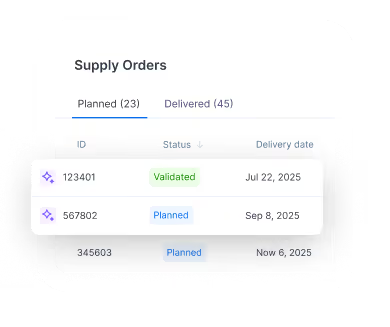
Cantidades de pedido más inteligentes por tienda
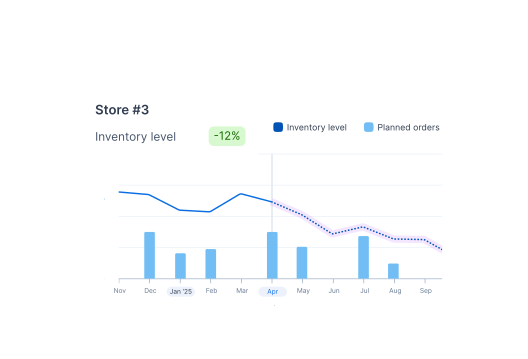
Adapta el reaprovisionamiento a la demanda local y a la volatilidad
Cada tienda se comporta de forma diferente.
.svg)
Inteligencia de demanda a nivel de tienda
Ajustes en temporada
Automatiza el reaprovisionamiento sin perder el control
Enfócate en las excepciones, no en las decisiones rutinarias.
.svg)
Gestión de tiendas por excepciones
.svg)
Store prioritization under constraints
De la reposición manual en tienda a la automatización inteligente


Store replenishment software
From reactive planning to optimized inventory flows
Why store replenishment remains a challenge in modern Supply Chains

In many organizations, store replenishment still relies on a combination of spreadsheets, static rules, and manual adjustments. This approach may work in stable environments, but it quickly reaches its limits as complexity increases.
As soon as you manage multiple locations, large product catalogs, or volatile demand, the same issues start to appear: stockouts on high-demand items, excess inventory in the wrong places, and teams constantly reacting instead of anticipating.
In the Retail industry, product availability directly impacts customer experience. As explored in our whitepaper on customer experience challenges in retail Supply Chains, even small disruptions in availability can translate into lost revenue and decreased loyalty.
The root problem is not operational. It lies in the inability of traditional tools to handle variability at scale.
Who Flowlity's store replenishment software is built for
Store replenishment software matters most where retail complexity meets volatile consumer demand. Flowlity is built for retail Supply Chain directors and category managers operating multi-store networks where static min/max rules can't absorb the variability of each location. It fits store operations managers and demand planners in retail and e-commerce juggling thousands of SKUs across stores, warehouses and marketplaces, where every location has its own demand pattern, seasonality, and customer base. And it supports merchandising and planning leaders in mid-market retail who need scalable replenishment decisions without building a large data science team.
The common pain points are recurring: stockouts on hero products that drive footfall and loyalty, excess inventory sitting in low-demand stores while high-demand ones run dry, promo-driven demand spikes that overwhelm manual replenishment cycles, and teams stuck reviewing every SKU in spreadsheets instead of focusing on strategic exceptions. When these signals stack up, static rules have reached their limit.
Store replenishment software to improve store inventory decisions
The role of store replenishment software is often reduced to automation. In reality, its purpose is much broader: improving decision-making across the Supply Chain.
Every replenishment decision involves a trade-off between service level, inventory cost, and operational constraints. It's all about how to optimize inventory without compromising service levelsS : static rules cannot capture this complexity.
Modern solutions address this by continuously adjusting decisions based on real-time data, including demand signals, stock levels, and supply constraints. When combined with Inventory Optimization, replenishment becomes part of a broader strategy that ensures inventory is positioned where it creates the most value.
This shift transforms replenishment from a repetitive task into a driver of performance.
How AI improves replenishment accuracy and responsiveness
Traditional planning tools rely on a single forecast and fixed parameters such as reorder points or safety stock. These assumptions do not hold in environments where demand fluctuates and uncertainty is constant.
AI-driven approaches introduce a different logic. Instead of predicting one outcome, they model a range of possible scenarios and continuously adjust decisions as new data becomes available.
Probabilistic demand forecasting
Rather than producing a single number, probabilistic forecasting generates a range of possible demand outcomes with associated probabilities. This allows planners to understand uncertainty and make decisions that are robust to variability.
Instead of overreacting or overstocking “just in case”, companies can position inventory more precisely based on risk levels and service targets.
This approach is one of the key drivers behind improved forecast accuracy and more stable replenishment decisions.
Automated replenishment recommendations
AI systems continuously calculate optimal replenishment quantities by combining demand signals, stock levels, and Supply Chain constraints.
These recommendations are not static. They evolve as conditions change, allowing companies to react faster without increasing manual workload.
This ensures that replenishment decisions remain aligned with both operational realities and business objectives.
These capabilities translate into measurable accuracy gains. At Ravate, a multi-category retailer operating under high demand volatility, probabilistic forecasting drove a 6 percentage-point lift in service level, illustrating how better forecasting directly impacts availability.
From SKU-level management to exception-based planning
One of the main limitations of traditional replenishment processes is the need to review large volumes of data manually. Planners often spend most of their time validating decisions rather than focusing on what truly matters.
With AI-driven systems, this approach changes fundamentally.
Exception-based management
Routine decisions are automated, while attention is directed toward situations that truly require human expertise, such as demand anomalies, supply disruptions, or emerging stock risks.
Instead of reviewing everything, planners focus only on what deviates from expected behavior.
This shift allows teams to prioritize high-impact decisions, reduce workload, and improve responsiveness across the Supply Chain.
Aligning store replenishment with the entire Supply Chain
Store replenishment cannot be optimized in isolation. Decisions made at store level have direct consequences on upstream operations, including warehouses, suppliers, and distribution flows.
This is why advanced solutions integrate replenishment within a broader planning framework.
Multi-level inventory optimization
Multi-level (or multi-echelon) optimization ensures that inventory is balanced across all nodes of the Supply Chain, from central warehouses to individual stores.
Instead of optimizing each location independently, the system evaluates the network as a whole and positions inventory where it delivers the highest value.
By combining this approach with MEIO and Distribution Requirement Planning (DRP), companies can align replenishment decisions with end-to-end Supply Chain performance, avoiding local optimizations that create global inefficiencies. Plum Living applied this network-wide logic to rebalance inventory across its locations and cut total inventory value by 38%, from €598k to €367k, without compromising availability.
Business impact: balancing availability, cost, and scalability
Improving store replenishment has a direct impact on business performance.
First, it increases product availability. Better alignment between supply and demand reduces stockouts and improves customer satisfaction. In retail environments, this translates directly into higher sales.
Second, it reduces inventory levels. By positioning stock more accurately, companies can free up working capital without compromising service levels. Sport 2000, a multi-store sport apparel retailer, cut its inventory by nearly 40% through this approach while keeping service levels stable.
Third, it improves scalability. As illustrated in our Camif Supply Chain transformation case study, companies can absorb significant growth without increasing their logistics resources, thanks to more efficient planning processes.
Finally, it stabilizes operations by reducing emergency decisions and improving visibility across the network.
Integrating replenishment into a unified planning environment
Effective replenishment requires more than isolated tools. It depends on the ability to connect forecasting, inventory optimization, and execution within a single environment.
Flowlity integrates these capabilities into a unified platform, combining Demand Planning, replenishment, and Promotion Management to ensure that inventory decisions remain aligned with both operational and commercial objectives.
This integration enables better coordination between teams and ensures that planning decisions are consistent across the entire Supply Chain.
Supporting planners with better visibility and decision tools
Beyond automation, one of the key benefits of modern replenishment software is improved visibility.
Planners need to understand not only what decisions to make, but also why. This requires access to clear and actionable insights.
With integrated dashboard capabilities, teams can monitor key indicators such as service level, stock coverage, and forecast accuracy in real time. This visibility allows them to anticipate risks, evaluate trade-offs, and make more informed decisions.
The result is a planning process that is both more efficient and more transparent.
Key capabilities to look for in store replenishment software
Not all replenishment tools are created equal. Choosing the right solution requires looking beyond basic automation and understanding which capabilities will deliver long-term value.
Demand-driven replenishment
Modern systems must adapt continuously to real demand signals rather than relying on static rules. Demand-driven approaches allow companies to respond quickly to changes while maintaining stable inventory levels.
This logic is closely linked to DRP, which helps coordinate inventory flows across distribution networks and ensures that replenishment decisions remain aligned with actual consumption patterns.
Integration with existing systems
Replenishment software must integrate seamlessly with existing Supply Chain systems, including ERP platforms, warehouse management systems, and e-commerce tools.
Without this integration, decisions are based on incomplete or outdated data. With it, companies benefit from a consistent and reliable planning environment.
Scenario simulation
Advanced platforms allow teams to test different scenarios before making decisions. Whether it is a supplier delay, a promotional campaign, or a demand surge, simulation capabilities help anticipate impacts and choose the best course of action.
This enables a shift from reactive planning to proactive decision-making.
Real-time visibility and dashboards
Visibility is essential for effective planning. Integrated dashboard tools provide real-time insights into key metrics such as service level, stock coverage, and forecast accuracy.
This allows planners to monitor performance continuously and make informed decisions based on up-to-date information.
FAQ
Find everything you need to know right here.
¿Qué es un software de reaprovisionamiento de tiendas?
Los softwares de reaprovisionamiento de tiendas ayudan a las empresas a determinar cuándo y cuánto inventario debe reponerse en toda su red. Utilizan datos como previsiones de demanda, niveles de inventario y restricciones de suministro para generar decisiones de reaprovisionamiento optimizadas.
¿Cuál es la diferencia entre reaprovisionamiento de tiendas y optimización de inventario?
El reaprovisionamiento de tiendas y la optimización de inventario están estrechamente relacionados, pero no operan al mismo nivel.
El reaprovisionamiento de tiendas se centra en las decisiones de ejecución: ¿cuándo debe reabastecerse una tienda y en qué cantidad? Opera a nivel local, asegurando que cada punto de venta disponga de los productos necesarios para satisfacer la demanda.
La optimización de inventario, por otro lado, trabaja a un nivel más amplio. Determina cuánto inventario debe existir en toda la Supply Chain y cómo distribuirlo entre almacenes, centros de distribución y tiendas.
En la práctica, el reaprovisionamiento consiste en mover stock, mientras que la optimización de inventario consiste en posicionarlo correctamente desde el principio.
Ambos están profundamente conectados. Sin una optimización del inventario en toda la Supply Chain, las decisiones de reaprovisionamiento se basan en fundamentos débiles. A la inversa, incluso la mejor estrategia de inventario fracasa si la ejecución del reaprovisionamiento no está alineada.
Por eso las plataformas de planificación modernas combinan ambas capacidades. Al integrar el reaprovisionamiento de tiendas con la optimización de inventario, las empresas se aseguran de que cada decisión de restockeo contribuya al rendimiento global de la Supply Chain, no solo a la eficiencia local.
¿Cómo mejora Flowlity el reaprovisionamiento de tiendas?
Flowlity mejora el reaprovisionamiento combinando la previsión de demanda impulsada por IA con una optimización dinámica del inventario. En lugar de depender de reglas fijas, la plataforma adapta continuamente sus decisiones en función de datos en tiempo real, ayudando a las empresas a reducir las roturas de stock mientras optimizan los niveles de inventario.
¿En cuánto tiempo se pueden obtener resultados?
Gracias a su integración con los sistemas existentes, Flowlity permite a las empresas generar valor rápidamente. Las mejoras en niveles de inventario, tasas de servicio y eficiencia de planificación suelen observarse en las semanas siguientes al despliegue. En Plum, esto se tradujo en una reducción del 21 % del inventario en el lanzamiento, alcanzando una reducción del 38 % del valor del inventario con el tiempo.
¿Flowlity reemplaza los sistemas ERP?
No. Flowlity complementa los sistemas ERP añadiendo una capa decisional sobre los procesos existentes. Mientras el ERP gestiona la ejecución, Flowlity aporta capacidades de planificación avanzadas que mejoran la calidad de las decisiones de reaprovisionamiento.
¿Cómo se compara Flowlity con las herramientas tradicionales de reaprovisionamiento?
La mayoría de las herramientas de reaprovisionamiento tradicionales fueron diseñadas para un mundo más estable. Se basan en reglas fijas, parámetros estáticos e hipótesis simplificadas sobre la demanda.
En ese contexto, suelen funcionar con puntos de pedido fijos, stocks de seguridad estáticos y ciclos de planificación periódicos.
Este enfoque crea un sistema rígido que lucha por adaptarse cuando las condiciones cambian. A medida que la demanda se vuelve más volátil y las Supply Chains más complejas, estas limitaciones generan rápidamente desequilibrios de stock y decisiones ineficientes.
Flowlity adopta un enfoque fundamentalmente diferente. En lugar de aplicar reglas predefinidas, la plataforma adapta continuamente sus decisiones en función de datos en tiempo real y modelos probabilísticos. El reaprovisionamiento ya no está impulsado por umbrales estáticos, sino por una comprensión dinámica de la demanda, los riesgos y las restricciones.
Esto se traduce en varias diferencias clave.
Primero, las decisiones son adaptativas en lugar de fijas. Los niveles de inventario y las cantidades de reaprovisionamiento evolucionan continuamente en vez de recalcularse periódicamente.
Segundo, la planificación se vuelve predictiva en lugar de reactiva. Al anticipar la variabilidad, las empresas pueden actuar antes de que surjan los problemas en lugar de corregirlos después.
Tercero, el alcance se amplía de la optimización local al rendimiento de extremo a extremo de la Supply Chain. Al combinar el reaprovisionamiento con enfoques como la optimización de inventario multi-escalón, Flowlity asegura que las decisiones tomadas a nivel de tienda permanezcan alineadas con toda la red.
Finalmente, la experiencia del usuario cambia. En lugar de revisar manualmente grandes volúmenes de datos, los planificadores trabajan en un entorno basado en excepciones donde la atención se centra en lo que realmente importa.
El resultado no es solo un mejor reaprovisionamiento. Es una Supply Chain más resiliente, más eficiente y más escalable.
¿Puede Flowlity gestionar Supply Chains multi-ubicación?
Sí. La plataforma está diseñada para optimizar el inventario en redes complejas, incluyendo múltiples almacenes, centros de distribución y tiendas. Aprovechando la optimización de inventario multi-escalón, asegura una asignación eficiente del inventario en todas las ubicaciones.
¿Cómo gestiona Flowlity las promociones y la variabilidad de la demanda?
Flowlity integra la variabilidad de la demanda directamente en sus modelos y puede simular el impacto de las promociones en la demanda futura. Esto permite a las empresas ajustar proactivamente sus estrategias de reaprovisionamiento y mantener los niveles de servicio durante períodos de alta incertidumbre.