.svg)
Conjunto de agentes de IA
– Planificación y pronóstico autónomos
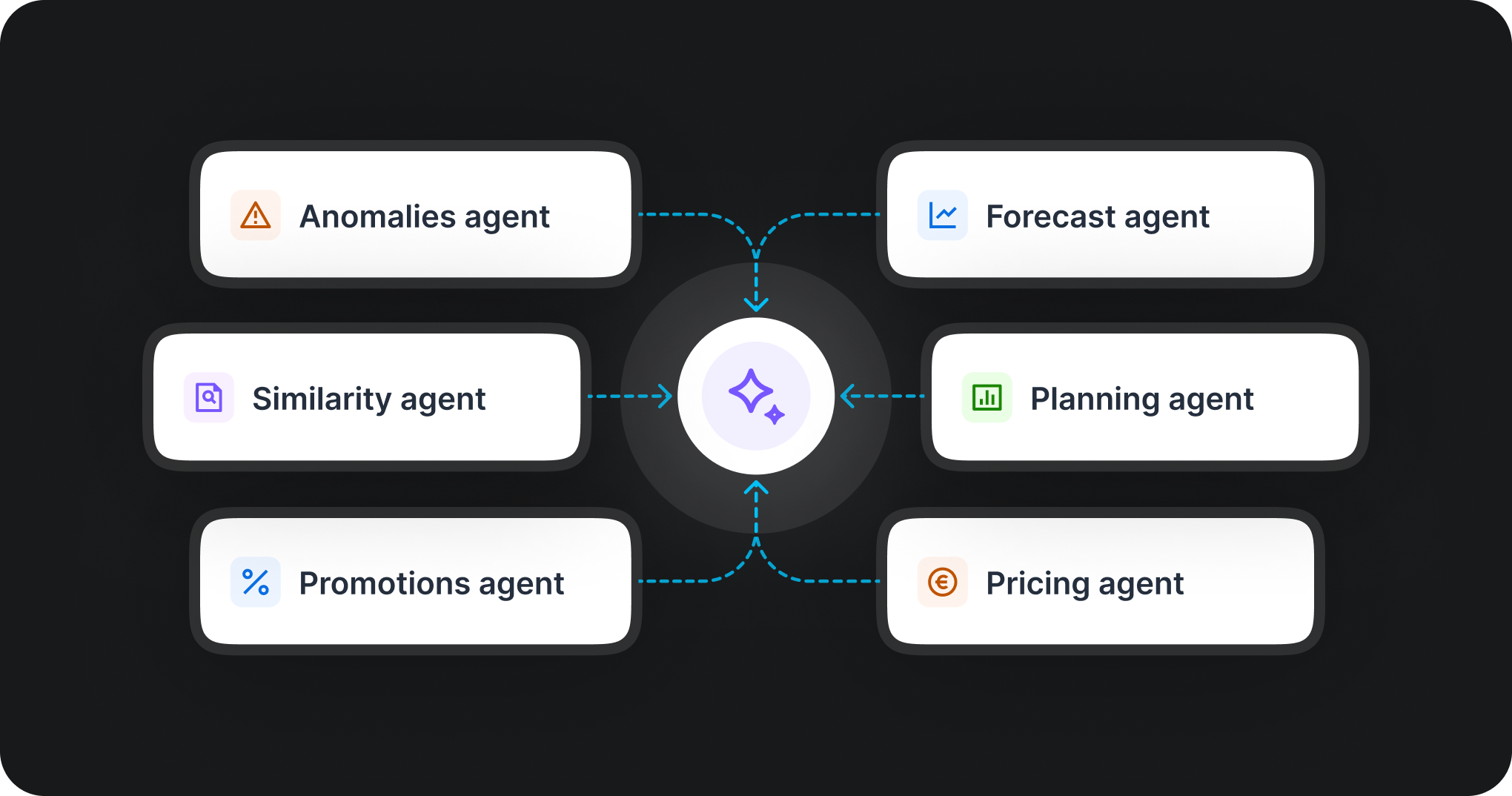
Un único centro de control, varios agentes especializados.
Agenda una demo
¿Por qué agentes de IA?
Las herramientas tradicionales de planificación siguen dependiendo de preparación manual de datos y reglas estáticas, dejando a los planificadores apagando incendios en lugar de diseñar estrategia.
El conjunto de agentes de IA de Flowlity automatiza el ciclo completo —desde la depuración de la demanda hasta la generación de pedidos— para que tu equipo se centre en el crecimiento, no en las hojas de cálculo.

.svg)
“Con los agentes de Flowlity reducimos las mermas un 18 % y dividimos por cinco el tiempo de planificación.”
Presentamos a los Agentes
Agente de Anomalías – Confía en tus datos

Agente de Previsión – La inteligencia al mando
Agente de Similitud – Acelera la introducción de nuevos productos
Agente de Planificación – Ejecución automática del aprovisionamiento
Agente de Simulación – Estrategias de inventario totalmente automatizadas
Las tareas repetitivas que realizas a diario pueden automatizarse directamente desde Flowlity: una gran ventaja.
Hay un agente que vigila las anomalías de demanda. Recibes al instante una alerta sobre un pico inusual y solo tienes que confirmar: ¿es algo puntual o algo que puede repetirse? El análisis ya está hecho por ti.
Koen Ferket
Director de Operaciones, Trixie Baby

What’s New
Designed for modern supply chain teams.


More about Supply Chain automation
What is Supply Chain automation in Supply Chain management?

Supply chain automation isn’t just about robots in warehouses. For planning teams, it’s about automating the workflows that eat up your week: cleaning demand, updating forecasts, balancing inventory levels, generating plans, and keeping everyone aligned—using real-time data instead of spreadsheet guesswork. The goal is simple: optimize decisions, reduce manual tasks, and keep your supply chain management running smoothly—even when disruptions hit.
Definition
Supply chain automation means using automation technologies (like artificial intelligence, machine learning, and sometimes robotic process automation (RPA)) to streamline supply chain processes end-to-end. In practical terms, it’s what turns scattered data into automated systems that can detect issues, recommend actions, and accelerate decision-making across supply chain operations—without adding more meetings.
Automation vs. static rules
Traditional automation tools often rely on rigid, static rules: “if X happens, do Y.” The problem? Real supply chains are full of exceptions, seasonality, and constant change.AI-powered automation goes further: it learns patterns, validates outcomes, and adapts to fresh signals. That means fewer “rule patch” cycles, less human error, and less time spent babysitting spreadsheets.
Benefits of Supply Chain automation
Streamline workflows and remove bottlenecks
Stop losing days to repetitive tasks, manual data entry, and spreadsheet macros. Automation helps streamline workflows, remove bottlenecks, and reduce time-consuming handoffs across teams.
Real-time visibility for faster decision-making
With real-time visibility and real-time tracking, planning becomes proactive. You get a clearer picture of inventory levels, constraints, and risks—so you can make informed decisions faster, with less friction. It also strengthens cross-functional alignment within your S&OP processes.
Fewer inefficiencies and less human intervention (where it matters)
Automation reduces inefficiencies in supply chain processes by handling the repetitive work consistently. Humans stay in control where judgment matters, while automated systems take care of the heavy lifting.
Better customer satisfaction (service level + fewer disruptions)
When supply chain automation improves order fulfillment and reduces supply chain disruptions, the impact is visible: higher service levels, fewer stockouts, and stronger customer satisfaction.
Cost savings (inventory levels + operational costs)
Optimized inventory management means less cash tied up, fewer shortages, and lower operational costs. You improve performance without simply adding headcount.
Key use cases for automation in Supply Chain
Demand forecasting automation
AI-powered demand forecasting uses real-time data, seasonality, lifecycles, and events to keep forecasts fresh. Instead of “forecast once a month and hope,” you continuously optimize accuracy and reduce bias from gut feel.
Inventory management automation
Automation in inventory management helps set the right buffers and safety stocks, align inventory levels to targets, and support end-to-end supply planning—especially when managing multi-echelon networks.
Order processing and procurement automation
From recommended purchase order quantities to constraint-aware plans, automation supports procurement and sourcing by reducing manual processes, improving reliability, and minimizing avoidable errors in order processing.
Handling disruptions with real-time tracking + scenario simulation
Disruptions are inevitable. Automated supply chain workflows help you react faster: detect issues early, simulate options, and choose the best plan based on cost, service, and feasibility.
Why Flowlity’s Supply Chain automation software is different
Agent-based automation (specialists, not one black box)
Flowlity uses a suite of specialized agents to automate supply chain management workflows. Each agent focuses on a specific job—so automation is clearer, more controllable, and easier to trust than a one-size-fits-all engine.
Real-time decision-making, with humans in control
Flowlity is built for faster decision-making—without removing accountability. Recommendations are transparent, explainable, and adjustable, so planners can approve, edit, or reject changes while still benefiting from AI-powered speed. This agent-based design is one of the reasons Flowlity was named a Gartner Cool Vendor in Supply Chain in 2025.
Works with existing systems (ERP)
Great automation software shouldn’t require ripping out what already works. Flowlity connects to existing systems (including ERP) to unify real-time data and orchestrate automated systems across your planning stack.
Supply Chain Automation implemented seemlessly
Getting started shouldn’t feel like a transformation project. Flowlity is designed to plug into your existing systems and secure data flows, so you can automate planning workflows quickly and scale at your pace.
Extend automation beyond the app with the Flowlity MCP
Flowlity's AI agents automate planning workflows inside the platform. The Flowlity MCP takes this a step further: it lets external AI assistants — Claude, ChatGPT, or Microsoft Copilot — interact with your Flowlity data directly. Planners can query stock levels, set up promotions, or trigger data imports from the same chat window they use for everything else — and combine Flowlity with their CRM, ERP, or Excel files in a single conversation.
Preguntas frecuentes
Encuentra aquí todo lo que necesitas saber.
¿En qué se diferencian los agentes de las reglas tradicionales?
Los agentes de IA aprenden de forma autónoma y validan continuamente los resultados con datos actualizados, mientras que las reglas son estáticas y deben modificarse manualmente basándose en intuiciones o suposiciones.
¿Puedo modificar la recomendación de un agente?
Por supuesto. Cada cambio sugerido puede aprobate, editarse o rechazarse libremente.
¿Necesito un equipo de data science para utilizar esto?
No. Flowlity proporciona tanto los modelos como la infraestructura; solo necesitas conectar tus datos.Un experto en el negocio o un key user es el perfil ideal para liderar el uso de nuestro módulo de agentes.
¿Cuál es el mayor beneficio de la automatización en la cadena de suministro?
El mayor beneficio es la velocidad con fiabilidad.La automatización de la cadena de suministro permite a los equipos optimizar la toma de decisiones en toda la cadena, reducir los errores humanos y responder con mayor rapidez a las disrupciones, manteniendo al mismo tiempo altos niveles de servicio y cumpliendo las expectativas de los clientes.
¿Cómo se materializan las herramientas de automatización de la cadena de suministro en la práctica?
En la práctica, las herramientas de automatización conectan datos procedentes del ERP, señales del Internet de las Cosas (IoT) y sistemas de planificación para automatizar procesos clave, como la previsión de la demanda, la gestión de existencias y el tratamiento de pedidos.
Muchos proveedores ilustran estos usos mediante casos de éxito reales en sectores como el retail, el comercio electrónico y los entornos industriales.
¿Cuál es el papel de la IA en una cadena de suministro automatizada?
La inteligencia artificial (IA) utiliza aprendizaje automático para detectar patrones, adaptarse a los cambios y apoyar la toma de decisiones en tiempo real.
Ayuda a los planificadores a anticipar la demanda, gestionar materias primas y ajustar los planes a lo largo de toda la cadena de suministro, incluso a escala global, sin necesidad de una intervención humana constante.
¿Cuáles son los principales desafíos al implementar la automatización de la cadena de suministro?
Entre los desafíos más comunes se encuentran la calidad de los datos, la integración con los sistemas existentes y la gestión del cambio.
La escasez de talento, el uso de herramientas heredadas y la necesidad de capacitar a los equipos humanos también pueden ralentizar la adopción, especialmente cuando la introducción de nuevas tecnologías se realiza de forma demasiado brusca.
¿Cómo impacta la automatización de la cadena de suministro en la eficiencia y el ahorro de costes?
La automatización mejora la eficiencia operativa al reducir el trabajo manual, estabilizar los niveles de existencias y disminuir los costes laborales.
Con el tiempo, una mejor medición del rendimiento, un mayor control de la calidad y un uso más inteligente de los recursos contribuyen también a la escalabilidad y la sostenibilidad de las operaciones, desde el almacenamiento hasta las operaciones de última milla.