.svg)
Intelligenza artificiale
Gli algoritmi intelligenti di Flowlity combinano le più avanzate tecniche di machine learning, ensemble learning e deep learning.
Richiedi una demo.webp)
La previsione puntuale non è più la misura giusta per una supply chain. La previsione probabilistica ci offre una comprensione molto più profonda.
Koen Ferket
Direttore delle Operazioni, Trixie Baby

IA per i pianificatori
La prima soluzione di previsione e pianificazione della supply chain nativo dell’IA .
Previsioni probabilistiche
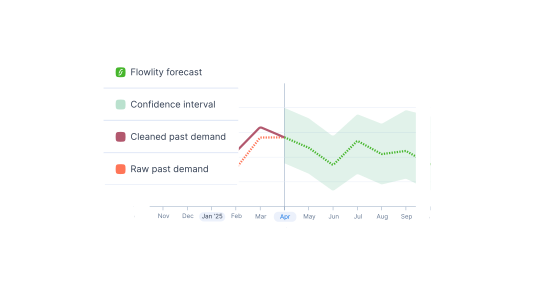
Raccomandazioni basate sull'intelligenza artificiale e sui vincoli
.svg)
Rilevamento di eventi passati
.svg)
Raccomandazione di prodotti simili

Previsione dei ritardi nei tempi di consegna
.svg)

L'IA di Flowlity nell'assistente IA che già usi
Dalla pianificazione della supply chain statica a quella dinamica
Flowlity offre forecasting in tempo reale e una pianificazione continua — addio ai cicli settimanali o mensili lenti.
La tua supply chain rimane sempre allineata ai dati aggiornati, con piani che si adattano automaticamente non appena le condizioni cambiano.
From Legacy Tools to AI-Driven Supply Chain Planning
Previsione
Operazioni di previsione e pulizia dei dati
Stock di sicurezza
Pianificazione
Workflow


Discover more about AI for Supply Chains
How artificial intelligence is transforming Supply Chain management

Artificial intelligence is no longer a futuristic concept for global supply chains. Today, AI supply chain solutions are actively reshaping how companies forecast demand, optimize inventory levels, manage disruptions, and automate decision-making across end-to-end supply chain operations.As volatility increases, traditional tools based on static rules and spreadsheets struggle to keep up. AI in supply chain management introduces a new paradigm: data-driven, adaptive, and increasingly autonomous planning—designed to support planners, not replace them.
This planner-centric approach is what earned Flowlity its place as a Cool Vendor in the 2025 Gartner Cool Vendor list in Supply Chain Management.
What is AI in the Supply Chain?
AI in the supply chain refers to the use of artificial intelligence, machine learning, and advanced algorithms to analyze vast amounts of data and support better, faster decision-making across supply chain management.
Unlike traditional automation, supply chain AI continuously learns from:
- Historical data
- Real-time data
- Market trends
- Supplier performance
AI systems can detect patterns, anticipate disruptions, and recommend actions with a level of speed and accuracy that manual processes simply cannot match. This shift enables companies to move from reactive planning to AI-driven, proactive supply chain orchestration.
How AI-powered Supply Chain software works in practice
Modern AI supply chain software connects data across the entire ecosystem—ERP systems, suppliers, warehouses, and retailers—and transforms it into actionable intelligence through secure, scalable infrastructure. Learn more about our approach to integration and security in AI supply chain systems to see how data flows safely and seamlessly across your organization.
At its core, AI-powered planning relies on:
- Machine learning models trained on historical and real-time data
- Probabilistic forecasting instead of single-point forecasts
- Optimization algorithms that balance cost, service level, and sustainability
These AI-enabled systems continuously recalculate scenarios, allowing planners to adjust inventory, production, and procurement decisions in near real-time. The result: faster workflows, fewer bottlenecks, and more resilient supply chain networks.
Core AI use cases across the Supply Chain
Demand Forecasting & Inventory Optimization
AI has become a game-changer for demand forecasting. By analyzing multiple signals simultaneously, AI improves forecast accuracy while accounting for uncertainty.
Key benefits include:
- Optimized inventory levels
- Fewer shortages and overstocks
- Cost-effective safety stock strategies
- Improved customer satisfaction
AI-powered forecasting adapts dynamically as demand patterns evolve —especially critical in retail, manufacturing, and healthcare supply chains.
Supply Chain Disruption & Risk Management
Disruptions are now the norm, not the exception. AI strengthens risk management by detecting early warning signals across global supply chains.
AI applications help organizations:
- Identify disruptions before they escalate
- Simulate alternative scenarios
- React faster to supply or demand shocks
By leveraging real-time data, AI-driven systems support resilient decision-making—even in highly volatile environments.
Procurement, suppliers & network optimization
In procurement and sourcing, AI improves visibility and performance across supplier ecosystems.
Use cases include:
- Monitoring supplier performance
- Optimizing procurement decisions
- Identifying bottlenecks across supply chain networks
- Improving delivery times and cost control
For supply chain leaders, this means smarter sourcing strategies and better collaboration with providers and retailers alike.
Automation of planning & decision workflows
Beyond automation, AI agents represent the next evolution of supply chain AI.
AI agents are autonomous, goal-oriented AI tools that:
- Monitor supply chain operations continuously
- Trigger alerts when anomalies or risks appear
- Recommend—or execute—specific actions
Instead of manually reviewing dashboards or managing data entry, planners interact with AI agents that streamline workflows, prioritize exceptions, and orchestrate decisions across planning cycles.This human-in-the-loop approach ensures that AI augments expertise while keeping planners in control.
Business impact of AI in Supply Chain management
When deployed effectively, AI delivers measurable business impact across the organization:
- Lower operating costs through better optimization
- Improved service levels and customer satisfaction
- Faster decision-making with less manual effort
- Greater sustainability through reduced waste and smarter inventory policies
- True end-to-end visibility across supply chain operations
AI adoption also enables teams to focus on high-value strategic decisions rather than repetitive planning tasks—unlocking productivity at scale.
The future of AI Supply Chain: from planning to autopilot
The future of AI in supply chain management is not about replacing humans—it’s about collaboration between planners and intelligent systems.
As AI models mature, supply chains are moving toward:
- More autonomous planning cycles
- AI-driven orchestration across functions
- Adaptive, real-time decision-making
- Stronger, data-driven ecosystems connecting suppliers, retailers, and partners
For organizations embracing this transformation, AI becomes a strategic asset—helping supply chain leaders navigate complexity, uncertainty, and growth with confidence.
AI supply chain solutions are no longer optional. They are becoming the foundation of modern, resilient, and sustainable supply chain management.
At Flowlity, we believe the future belongs to AI-powered, planner-centric supply chains—where technology works in the background, and humans stay in control.
Flowlity Co-planner: interact with your Supply Chain data through AI assistants
With the release of the Flowlity MCP serve "Flowlity Co-planner" , planners can now query stock levels, check forecast accuracy, create promotions, and trigger data imports — directly from Claude, ChatGPT, or Microsoft Copilot. No dashboards, no exports: just a conversation with your planning data.Because MCP is an open standard, the same chat window can also pull from your CRM, ERP, or Excel files, enabling cross-tool workflows that no embedded AI sidebar can match.
FAQ
Find everything you need to know right here.
L'IA di Flowlity è trasparente e spiegabile agli utenti?
sì — è persino uno dei principi fondanti di Flowlity: fornire un'IA che possa essere spiegata e compresa dagli umani che la utilizzano.
Sappiamo che nella supply chain, i pianificatori e i manager devono fidarsi delle raccomandazioni di uno strumento e ciò richiede la comprensione del «perché».
Flowlity è stato quindi progettato non per essere una scatola nera, ma piuttosto uno strumento educativo oltre che uno strumento decisionale.
Concretamente, come si manifesta?
Nell'interfaccia Flowlity, ogni previsione e ogni raccomandazione sono accompagnate da elementi esplicativi. Ad esempio, se Flowlity consiglia di ordinare 500 unità dell'articolo X per il mese successivo, l'utente visualizza la suddivisione della domanda prevista: stagionalità, tendenza, effetto promozionale, ecc., a seconda dei casi.
Lo strumento mostra anche un intervallo di confidenza attorno alla previsione (ad esempio: previsione centrale 500, con uno scenario basso a 450 e uno scenario alto a 560), che dà un'idea dell'incertezza. Ciò consente di giustificare le scorte di sicurezza calcolate. Inoltre, Flowlity fornisce avvisi e giustificazioni. Ad esempio: «Rischio di carenza di questo prodotto entro 15 giorni perché la domanda recente supera le previsioni del 20%». Oppure: «Riduzione delle scorte proposta per questo articolo, perché il suo tasso di fatturato è diminuito negli ultimi 3 mesi». Tecnicamente, l'intelligenza artificiale di Flowlity utilizza modelli di machine learning (incluso il deep learning), ma la complessità è nascosta dietro una semplice interfaccia.
Sono inoltre favorite le tecniche di apprendimento d'insieme, che attenuano le previsioni ed evitano le aberrazioni. E soprattutto, Flowlity si considera un assistente: l'utente ha sempre la possibilità di rivedere una decisione. Se non è d'accordo con una raccomandazione, può modificarla (ad esempio, ordinare un po' di più o un po' di meno) e il sistema terrà conto di questo feedback per adattarlo in futuro. È un ciclo di apprendimento virtuoso in cui l'essere umano mantiene il controllo finale. Durante la formazione, insistiamo affinché gli utenti comprendano come funziona lo strumento.
Senza rivelare tutti i dettagli algoritmici, spieghiamo i principi fondamentali (previsione probabilistica, calcolo dinamico del buffer, ecc.). Molto rapidamente, i pianificatori vedono che lo strumento reagisce come farebbe in molti casi, ma meglio perché reagisce più rapidamente e integra più dati. Ad esempio, lo strumento è in grado di rilevare correlazioni tra prodotti che gli esseri umani non avrebbero visto, ma mostrerà «un aumento del 30% della domanda prevista per il prodotto A perché è correlata a quella del prodotto B in promozione». Questo tipo di spiegazione rende tangibile l'IA.
Infine, sulla questione della trasparenza tecnica, Flowlity è aperta a discutere il suo approccio:
Pubblichiamo white paper e articoli sul nostro approccio (ad esempio, uso di previsioni probabilistiche e deterministiche). Il nostro obiettivo non è confondere l'algoritmo, ma rendere collettivamente più intelligente la supply chain. Gli utenti di Flowlity migliorano il loro lavoro perché imparano dal feedback dell'IA. Molti riferiscono che dopo alcuni mesi, hanno una migliore comprensione delle dinamiche della loro supply chain (stagionalità, impatto delle promozioni, comportamento dei fornitori) grazie alla visibilità che lo strumento offre.
In breve, l'IA di Flowlity è trasparente, spiegabile e a misura d'uomo. È un compagno che informa le tue decisioni invece di sostituirle arbitrariamente. Questa filosofia aumenta la fiducia e l'adozione della soluzione all'interno dei team della supply chain. (Se desideri vedere in pratica come Flowlity presenta i suoi consigli e quali spiegazioni vengono fornite, ti invitiamo a una demo in cui puoi giudicare tu stesso la chiarezza dello strumento.)
How is AI being used in supply chains?
AI is used to turn large volumes of historical and real-time data into better decisions—like demand forecasting, inventory optimization, replenishment recommendations, disruption detection, and workflow automation across planning, procurement, and logistics.
Will artificial intelligence ever fully take over supply chains?
Not in a way we’d recommend. At Flowlity, we believe the best results come from human intelligence + AI: automate everything that can be automated (data prep, calculations, alerts, routine decisions), so people stay focused on high-value work like strategy, trade-offs, stakeholder alignment, and exception management.