.svg)
Pianificazione del riapprovvigionamento materiali basata sull'IA
Supera i limiti del MRP tradizionale. Allinea il riapprovvigionamento dei materiali con previsioni della domanda basate sull'IA per garantire la produzione e liberare capitale circolante.
Richiedi una demo
Evita le carenze di materiali che bloccano la produzione
Mantieni la produzione attiva, anche quando la domanda oscilla.
.svg)
Fabbisogni di materiali guidati dalla domanda
Riapprovvigionamento con visibilità sui lead time
Riduci le scorte in eccesso e libera liquidità
Smetti di acquistare in eccesso "per sicurezza".
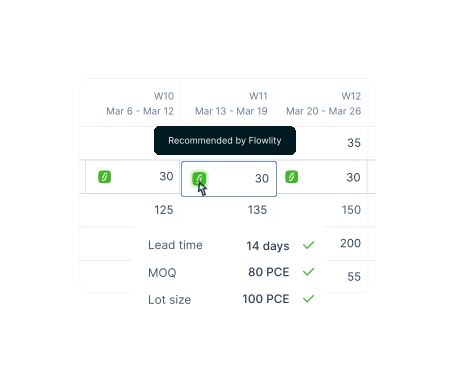
Raccomandazioni intelligenti sulle quantità da ordinare
Visibilità sui rischi di scorta
Sostituisci il MRP su fogli di calcolo con un'automazione affidabile
Meno lavoro manuale. Decisioni più affidabili.
.svg)
Calcoli di riapprovvigionamento automatizzati
.svg)
Un'unica fonte di verità
Adatta la pianificazione dei materiali quando la realtà cambia
Perché domanda e offerta non restano mai ferme.
Ripianificazione continua
Avvisi basati sulle eccezioni
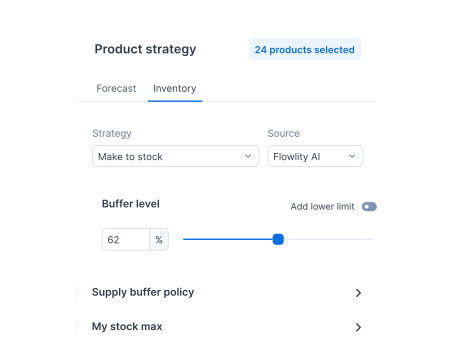
Dal MRP rigido al riapprovvigionamento intelligente


MRP software for manufacturing: smarter material planning in a volatile Supply Chain
Learn more about benefit MRP software and how Flowlity is different
Why modern material planning requires more than traditional MRP

Material Requirements Planning was originally designed to answer a simple operational question: what materials should be ordered, when, and in what quantity? For decades, this logic worked well in relatively stable industrial environments where demand was predictable and supply disruptions were rare.
Today, however, most manufacturers operate in a far more volatile Supply Chain. Demand fluctuations, raw material shortages, longer supplier lead times and increasing SKU complexity make static planning models increasingly fragile.
Traditional MRP tools — often embedded in ERP systems — typically rely on deterministic forecasts and fixed planning rules. When demand deviates from expectations or when suppliers delay deliveries, planners must manually adjust parameters, recalculate replenishment quantities, or compensate by increasing safety stock.
This reactive approach creates a structural trade-off. Companies either maintain large inventories to protect production continuity, or reduce stock levels and expose themselves to shortages.
Modern MRP software aims to remove this dilemma by introducing dynamic planning capabilities. Instead of running rigid calculations once per week or month, intelligent planning systems continuously adapt replenishment decisions based on demand signals, supplier constraints and inventory dynamics.
The objective is not only to calculate material requirements more accurately, but to transform MRP into a proactive planning capability connected to the entire Supply Chain planning process.
How MRP software calculates material requirements
To understand the value of modern MRP software, it helps to look at how the calculation logic actually works.
Material Requirements Planning transforms demand signals into operational decisions. The system analyzes multiple inputs across the Supply Chain to determine what materials should be ordered, when they should be ordered, and in what quantity.
The calculation typically starts with the demand forecast. This forecast represents the expected consumption of finished products over time. From there, the system expands the demand through the Bill of Materials, identifying every component required to manufacture those products.
Inventory data is then incorporated into the calculation. The system evaluates current stock levels, incoming purchase orders and production orders already in progress.
Finally, supplier lead times determine when replenishment must be triggered to ensure materials arrive before production begins.
From these inputs, the system generates several operational outputs:
- purchase order recommendations
- production orders
- projected inventory levels
- replenishment alerts when stock risks appear
Modern planning platforms enhance this traditional logic by combining it with demand forecasting, inventory optimization and Supply Planning processes.
This integration allows companies to move beyond static calculations and adopt a more adaptive planning model.
A chi è destinato il software MRP di Flowlity
Un software MRP trova la sua piena utilità quando i punti di riordino fissi e le previsioni deterministiche generano più rotture di stock e sovrascorte di quante ne risolvano. Il software MRP di Flowlity è pensato per i pianificatori dei materiali e i responsabili acquisti dell'industria manifatturiera (automotive, beni di consumo, elettronica, materiali da costruzione), dove le distinte base si articolano in centinaia di componenti e un singolo pezzo mancante può fermare un'intera linea di produzione. È adatto ai pianificatori di stabilimento e ai supervisori di produzione che operano in ambienti make-to-stock, make-to-order o ibridi, e che hanno bisogno di un riapprovvigionamento allineato alla domanda reale e ai lead time effettivi dei fornitori. Supporta inoltre i direttori Supply Chain delle medie imprese industriali che vogliono smettere di compensare un MRP rigido integrato all'ERP con correzioni manuali su Excel.
I punti critici sono strutturali. I materiali arrivano in ritardo perché i lead time configurati nell'ERP non corrispondono più alla realtà. Lo stock di componenti in eccesso resta immobilizzato perché le scorte di sicurezza sono state impostate un anno fa. I piani di produzione vengono rivisti ogni settimana su fogli di calcolo, al di fuori dello strumento di pianificazione. I pianificatori restano sommersi da attività transazionali invece di gestire per eccezione. Un MRP moderno dovrebbe ridurre questi problemi a eccezioni, non lasciarli come prassi quotidiana.
How to choose the right MRP software
Choosing an MRP solution is not only a technology decision; it is a strategic choice that shapes how planning teams operate every day.
Many software vendors position themselves as MRP providers, yet their capabilities can differ dramatically depending on how they approach forecasting, planning automation and Supply Chain visibility.
One of the first criteria to evaluate is the ability to integrate demand forecasting with material planning. In many legacy systems, forecasting and replenishment are disconnected processes. Forecasts are produced in one tool while planning decisions are calculated elsewhere, forcing planners to manually reconcile both datasets.
Modern planning platforms combine these capabilities so that demand signals immediately influence replenishment decisions. This tight integration becomes particularly important when coordinating material planning with upstream production constraints such as Production and Capacity Planning.
Another critical aspect is how the system handles uncertainty. A solution that simply applies fixed safety stock rules may struggle to support volatile environments. Advanced platforms instead rely on probabilistic forecasts and dynamic inventory policies, allowing planners to anticipate demand variability rather than react to it.
Usability also plays a decisive role. Planning teams must be able to understand recommendations quickly and simulate alternative decisions when conditions change. If the system requires complex configuration or heavy IT support, adoption within operational teams will often remain limited.
Finally, companies should evaluate how well the MRP software connects with broader planning and Inventory Management processes, which ensures that replenishment decisions remain aligned with procurement strategies and supplier constraints.
Key features to look for in modern MRP software
The capabilities of MRP solutions have evolved significantly in recent years. While traditional systems focused primarily on calculating replenishment orders, modern planning platforms provide a much broader decision-support environment for Supply Chain teams.
One of the most valuable features is dynamic inventory optimization. Instead of relying on fixed safety stock parameters, advanced systems continuously adapt inventory buffers based on demand variability and supplier lead times. This allows companies to reduce excess stock while maintaining service levels.
Another important capability is real-time stock projection. Planners should be able to visualize how inventory will evolve over time depending on demand forecasts, confirmed orders and recommended replenishments. These projections help teams anticipate shortages or overstock risks before they impact operations.
Modern systems also enable scenario simulation. Planning teams can test alternative replenishment strategies — for example adjusting order quantities or supplier allocations — and immediately observe the impact on stock trajectories.
Visualization tools play a crucial role here. Clear analytical interfaces such as a Supply Chain dashboard & analytics allow planners to monitor inventory risks, supplier performance and demand trends without relying on manual spreadsheets.
Another differentiating capability is the integration between planning decisions and operational execution. Once replenishment recommendations are validated, they must seamlessly translate into purchase orders or supply orders through Supply Order Management tools.
When these features are combined within a single environment, the MRP system becomes not only a calculation engine but a true planning cockpit for Supply Chain teams.
Market evolution: from static MRP to intelligent planning
From stable planning environments to volatile Supply Chains
The evolution of MRP software reflects broader changes in manufacturing Supply Chains.
Historically, material planning systems were designed primarily to support stable production environments where demand variability was relatively limited. The focus was therefore on ensuring that components were available for production while minimizing shortages.
Today, however, planning must operate in a context where uncertainty is the norm rather than the exception. Raw material shortages, demand volatility and global sourcing disruptions require systems capable of reacting dynamically to changing conditions.
The rise of AI-driven planning
Artificial Intelligence plays a central role in this transformation. AI-driven forecasting models generate probabilistic demand scenarios rather than single forecast values, allowing planners to better understand variability and adjust replenishment strategies accordingly.
This shift also changes how companies think about planning processes. Instead of relying solely on MRP calculations, organizations increasingly integrate material planning with broader Supply Chain coordination mechanisms such as Distribution Requirements Planning (DRP), which helps synchronize product flows across distribution networks.
Manufacturers exploring these new planning approaches often begin by understanding how demand volatility affects replenishment strategies. A useful perspective on this challenge can be found in our whitepaper Managing demand volatility and its Supply Chain impact with Smarter Raw Material Replenishment, which explains how smarter replenishment policies stabilize material flows.
From MRP I to modern intelligent planning
Another important evolution of material planning concerns the historical distinction between MRP I and MRP II.
MRP I originally focused on calculating material requirements based on demand forecasts and Bills of Materials. MRP II expanded this logic by incorporating additional operational dimensions such as production capacity, workforce planning and financial planning.
Modern planning platforms extend these concepts even further by integrating Artificial Intelligence, advanced forecasting and Supply Chain coordination capabilities.
Rather than separating forecasting, inventory optimization and production planning, these systems bring them together into a unified planning environment.
Why Flowlity brings a new approach to MRP planning
Flowlity rethinks MRP by combining forecasting, inventory optimization and replenishment planning within a single AI-driven platform.
Instead of running periodic calculations based on static assumptions, the platform continuously analyzes demand signals and Supply Chain constraints to generate adaptive planning recommendations.
At the core of this approach is the Planning environment where demand forecasts are translated into operational supply decisions. Planners can visualize projected stock trajectories, evaluate recommended orders and immediately understand how inventory will evolve depending on demand conditions.
The system displays a clear inventory corridor defined by dynamic minimum and maximum stock levels. As long as projected stock remains within this corridor, the inventory policy is considered optimal. When stock is predicted to fall outside these boundaries, the platform automatically highlights the issue and suggests corrective actions.
Because the planning interface combines forecasting data with replenishment recommendations, planners gain a complete view of the decision process. They can simulate order adjustments, test alternative supplier strategies and observe the impact on stock levels in real time.
This approach allows planning teams to move beyond reactive spreadsheet adjustments and adopt a more proactive planning methodology supported by Artificial Intelligence. In a cement and mining manufacturing context, Magotteaux applied this kind of AI-driven planning across its raw material and component portfolio. The result was a 13% inventory reduction combined with a 22% drop in coverage and an 8% decrease in stockouts. The shift came from replacing static replenishment rules with continuous, data-driven recalculations rather than from injecting more safety stock into the system.
Companies seeking to understand how such planning innovations help prevent disruptions can explore the webinar "How to prevent Supply Chain disruptions", which explains how modern planning technologies go beyond traditional MRP capabilities.
Real-world impact of intelligent MRP planning
The impact of advanced material planning becomes particularly visible when organizations operate large and complex product portfolios.
In industrial manufacturing environments, small forecasting errors can cascade through Bills of Materials and rapidly generate shortages across multiple components. Improving forecast reliability and replenishment accuracy therefore has a direct impact on both service levels and inventory efficiency.
For example, Saint-Gobain improved forecast accuracy at SKU level while simultaneously reducing inventory by 9.25% after implementing more advanced planning practices. This combination of improved visibility and optimized inventory policies significantly reduced the risk of emergency shipments caused by material shortages.
In another context, the furniture company Plum Living was able to reduce the value of its inventory by -38%. Rather than simply cutting stock levels, the company improved planning precision so that materials arrived closer to the moment they were actually required.
These examples illustrate a broader principle: better planning does not merely reduce inventory; it also stabilizes production operations by ensuring that the right materials are available when needed.
Organizations facing structural raw material shortages often explore broader resilience strategies. The whitepaper Resilience in Supply Chain Facing Raw Material Shortages provides additional insights into how companies strengthen Supply Chain resilience when supply conditions become uncertain.
Strategic adoption: integrating MRP into end-to-end Supply Chain planning
For many manufacturers, the true value of modern MRP software emerges when it becomes part of a broader planning ecosystem.
Material planning must be aligned with upstream production decisions and downstream distribution strategies. When these planning layers operate independently, companies often experience conflicting priorities between inventory reduction and service level objectives.
By integrating MRP calculations with Production Planning, Supply Planning and distribution coordination processes, organizations can build a more synchronized planning model.
This integrated approach is particularly relevant in sectors such as the Manufacturing sector or the Automotive sector, where product complexity and supplier dependencies create strong interdependencies across planning processes.
When planning tools share the same data foundation and analytical models, decision-making becomes faster and more coherent across the entire Supply Chain.
This kind of integration has tangible operational impact. Cotton manufacturer Groupe Lemoine lifted service levels by 5 percentage points to reach 98% availability after replacing fixed safety stocks with dynamic, demand-driven buffers shared across its multi-site network. The gain came from aligning replenishment decisions with a single planning model rather than from coordinating separate site-by-site forecasts.
FAQ
Find everything you need to know right here.
Quanto tempo serve per implementare un software MRP moderno?
I tempi di implementazione di un software MRP dipendono fortemente dalla soluzione scelta e dalla complessità dell’ambiente Supply Chain.
I moduli MRP tradizionali integrati nei sistemi ERP richiedono spesso lunghi cicli di implementazione — a volte da 6 a 18 mesi o più — a causa della personalizzazione, della migrazione dei dati e dei requisiti di integrazione del sistema.
I software MRP moderni e cloud come Flowlity sono progettati per un deployment più rapido. Poiché queste soluzioni funzionano a fianco degli ERP esistenti anziché sostituirli, i tempi di implementazione sono significativamente più brevi — spesso misurati in settimane anziché in mesi.
L’approccio di Flowlity si concentra sull’integrazione rapida dei dati e sul deployment incrementale, consentendo ai team Supply Chain di iniziare a migliorare le performance della pianificazione dei materiali rapidamente, senza attendere una revisione completa del sistema.
Come funziona la pianificazione dei materiali in Flowlity?
In Flowlity, la pianificazione dei materiali si basa su previsioni della domanda basate sull’IA combinate con modelli probabilistici delle scorte.
Invece di affidarsi a scorte di sicurezza fisse e punti di riordino statici, Flowlity ricalcola continuamente i fabbisogni di materiali in base ai segnali di domanda in evoluzione, ai tempi di consegna dei fornitori e alle posizioni di inventario nella rete.
Ciò significa che i suggerimenti di riapprovvigionamento sono sempre allineati alle condizioni Supply Chain più recenti — non basati su ipotesi formulate settimane o mesi prima.
Flowlity offre inoltre ai pianificatori una visibilità chiara su quali materiali sono a rischio di rottura e quali hanno una copertura eccessiva, consentendo decisioni di pianificazione più mirate e sicure.
Il risultato è un processo di pianificazione dei materiali che si adatta dinamicamente, riduce gli interventi manuali e supporta migliori decisioni di acquisto e produzione.
Come migliora un software MRP moderno la pianificazione Supply Chain?
Il software MRP moderno migliora la pianificazione Supply Chain sostituendo una logica rigida basata su regole con approcci intelligenti guidati dai dati.
I sistemi MRP tradizionali si basano su scorte di sicurezza fisse, tempi di consegna statici e aggiustamenti manuali delle previsioni. Le soluzioni moderne utilizzano previsioni della domanda basate sull’IA, modelli probabilistici delle scorte e integrazione di dati in tempo reale per generare piani di approvvigionamento più precisi e adattivi.
Questo consente ai team Supply Chain di rispondere più rapidamente ai cambiamenti della domanda, alle interruzioni dei fornitori e agli squilibri delle scorte — senza rielaborare costantemente i piani manualmente.
Il software MRP moderno offre anche una migliore visibilità su tutta la Supply Chain, aiutando i pianificatori a comprendere non solo quali materiali sono necessari, ma quando, dove e perché — per decisioni di acquisto e produzione più efficaci.
Qual è la differenza tra MRP ed ERP?
L’MRP (Material Requirements Planning) si concentra specificamente sulla pianificazione dei materiali necessari, su quando devono essere ordinati e in quali quantità per supportare la produzione o la distribuzione.
L’ERP (Enterprise Resource Planning) è un sistema più ampio che copre molteplici funzioni aziendali — tra cui finanza, acquisti, produzione, risorse umane e talvolta pianificazione Supply Chain.
La maggior parte dei sistemi ERP include un modulo MRP di base. Tuttavia, questi moduli MRP integrati si basano spesso su una logica semplificata (scorte di sicurezza fisse, tempi di consegna statici) e mancano delle capacità avanzate di previsione e ottimizzazione offerte dai software MRP dedicati.
Le soluzioni MRP moderne, come Flowlity, sono progettate per integrare i sistemi ERP — non per sostituirli. Si collegano agli ERP esistenti per migliorare la pianificazione dei materiali grazie a previsioni basate sull’IA, modelli probabilistici delle scorte e visibilità in tempo reale.
Cos'è un software MRP?
Un software MRP (Material Requirements Planning o pianificazione dei fabbisogni di materiali) è uno strumento di pianificazione Supply Chain utilizzato per determinare quali materiali sono necessari, quando devono essere ordinati e in quali quantità per soddisfare i requisiti di produzione o distribuzione.
I moduli MRP tradizionali sono spesso integrati nei sistemi ERP e utilizzano una logica deterministica — scorte di sicurezza fisse, tempi di consegna statici e previsioni manuali — per generare piani di approvvigionamento.
I software MRP moderni vanno oltre integrando previsioni della domanda basate sull’IA, ottimizzazione probabilistica delle scorte e dati in tempo reale per creare piani di riapprovvigionamento più precisi e adattivi.
Queste capacità avanzate aiutano i team Supply Chain a superare la pianificazione reattiva e a costruire strategie di approvvigionamento che anticipano i cambiamenti della domanda, la variabilità dei fornitori e i rischi legati alle scorte.