.svg)
.svg)
Supply Chain scalability: managing the challenges of growth
Supply Chain scalability is the ability to absorb revenue growth, geographic expansion, and SKU proliferation without losing control of inventory, service levels, or planning reliability. Most Supply Chains are designed for a specific scale and a specific level of complexity. When the business grows beyond that design point, the Supply Chain does not scale gracefully. It fractures: stockouts and overstocks multiply simultaneously, planning teams are overwhelmed, and the cost of growth exceeds its benefit. Building a scalable Supply Chain requires addressing four structural dimensions, not just adding more technology or more headcount.
Growth is a positive signal for any business. For the Supply Chain, it is often the moment when hidden fragility becomes impossible to ignore. Volumes increase. Product portfolios expand. New markets add regulatory, cultural, and logistics complexity. Suppliers multiply. And the planning model that worked well enough at the previous scale begins to produce the wrong answers faster and faster.
The challenge is not that growth is bad. It is that most Supply Chains were never designed to scale. They were designed to operate, and there is a significant difference between the two.
What is Supply Chain scalability?
Supply Chain scalability is the structural capability to support business growth in volume, geographic scope, and complexity without a proportional increase in planning errors, inventory waste, or operational costs. A scalable Supply Chain:
- absorbs demand growth without generating simultaneous stockouts and overstocks
- handles a growing number of SKUs, suppliers, and ordering constraints without requiring linear headcount increases
- expands geographically while maintaining forecast reliability and inventory visibility
- adapts quickly to disruptions and demand volatility rather than amplifying them
- keeps planning teams focused on decisions rather than manual compensation for system limitations
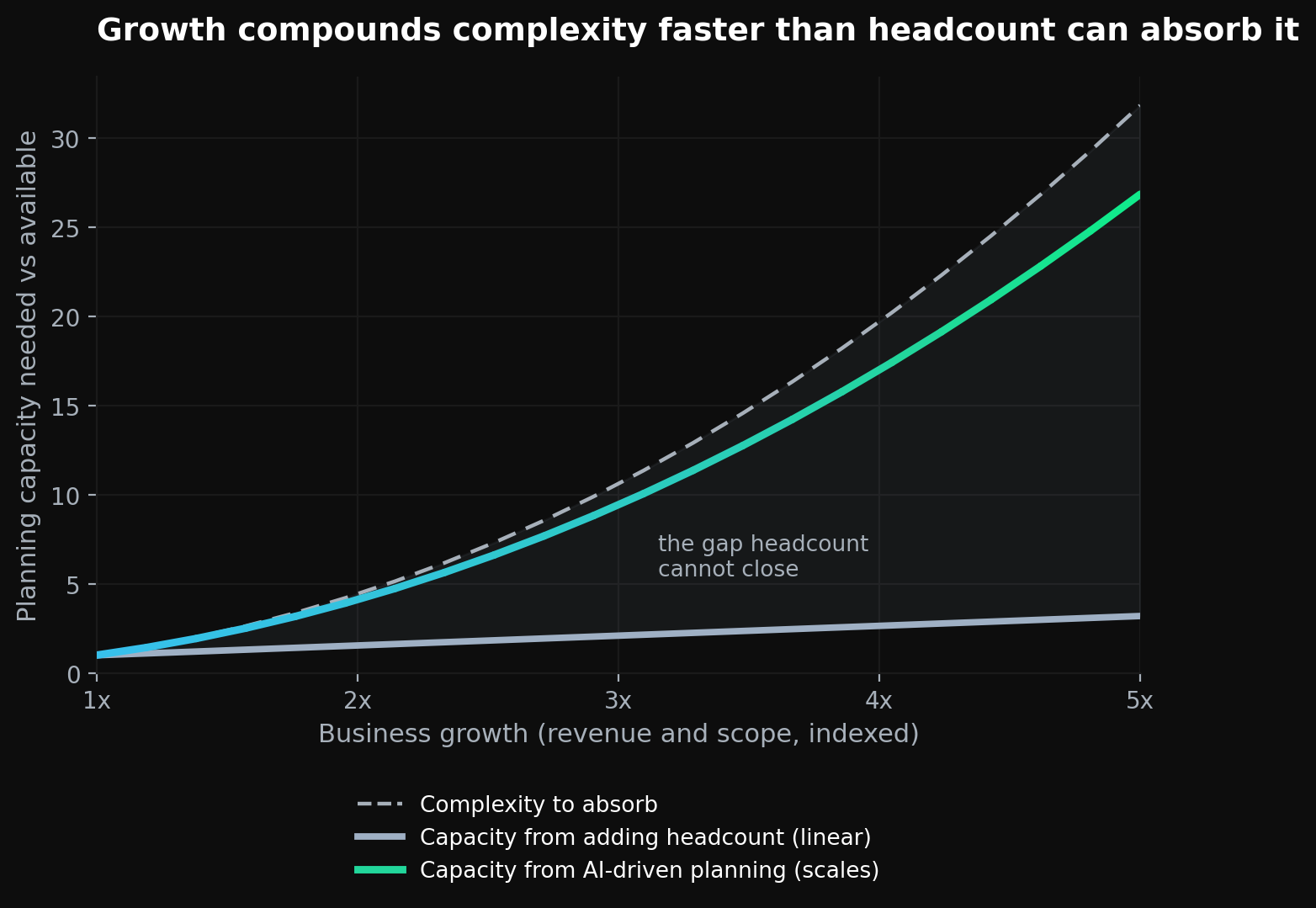
In practice, the test of scalability is simple: does the Supply Chain get harder to manage in proportion to growth, or does the planning capability grow faster than the complexity it needs to handle? Most organizations, when they examine this honestly, find that their planning tools and processes were designed for the scale they were at two or three years ago.
Why growth exposes Supply Chain fragility
The frequency and variety of Supply Chain disruptions that companies now face is structural, not exceptional. In a single year the Suez Canal blockage, semiconductor shortages, raw material price spikes, and container capacity constraints all materialized simultaneously. Supply Chains that were lean and efficient in stable conditions became brittle and expensive under this pressure. The durable answer is not more buffer stock but a resilient Supply Chain that absorbs shocks by design.
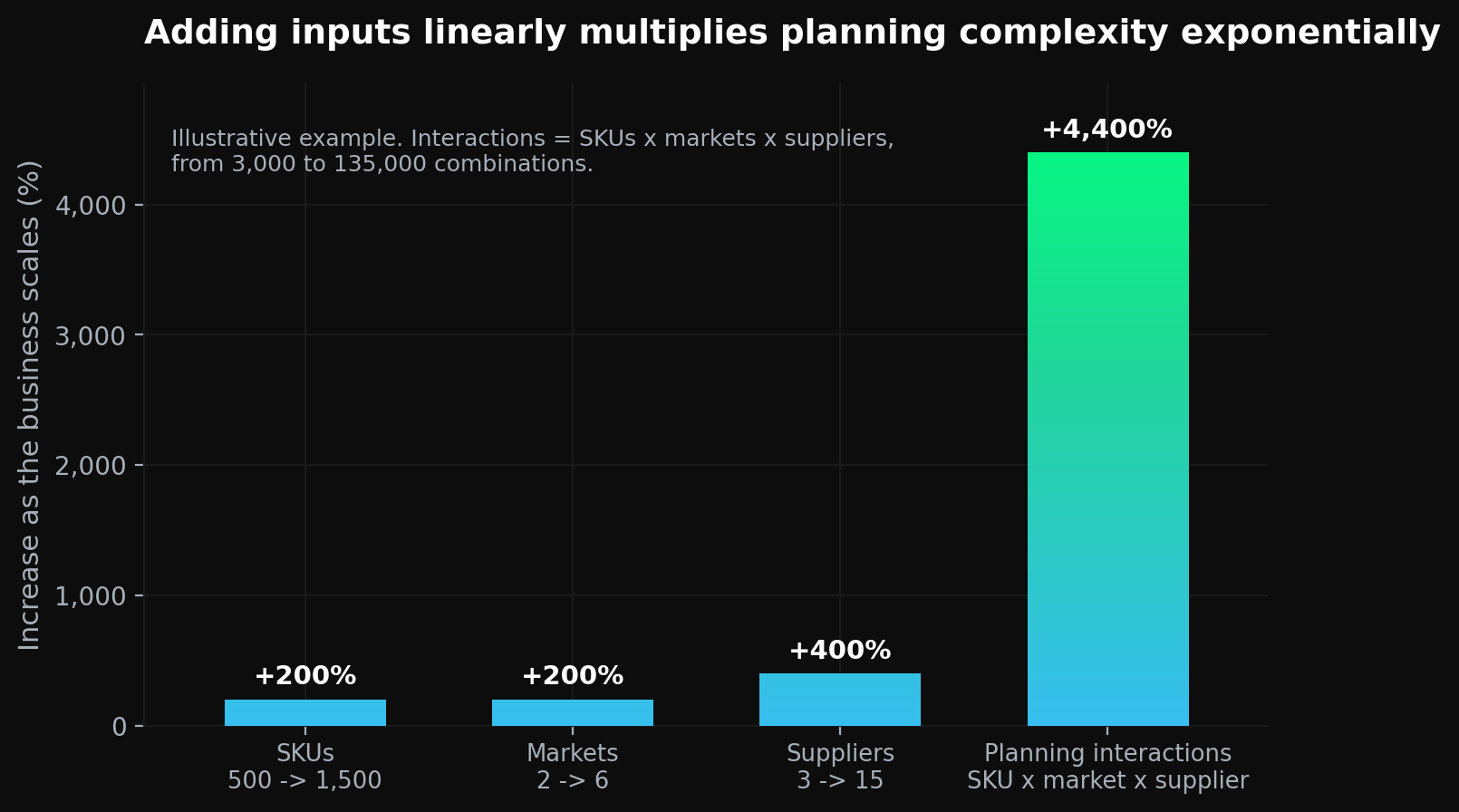
Growth compounds this fragility. A company managing 500 SKUs across two markets with three suppliers has a manageable planning problem. The same company managing 1,500 SKUs across six markets with fifteen suppliers has an exponentially more complex one. If the planning model scales linearly with headcount rather than exponentially with AI-driven automation, the planning team is always behind.
According to MIT research on digital maturity, digitally mature companies are 26% more profitable than their industry peers, generating 9% more revenue from their physical assets and achieving 12% higher market valuations. The Supply Chain is where digital maturity translates most directly into operational performance, because it is the layer where planning decisions determine whether growth produces margin or consumes it.
The consumer side of this equation is equally unforgiving, especially for retailers managing thousands of SKUs. A significant share of consumers, when they encounter a stockout, do not wait for restocking. They move to a competitor. Availability is not just a service metric. It is a revenue retention metric. And availability at scale requires planning infrastructure that scales.
The four main challenges of Supply Chain growth
Geographic expansion
Entering new markets means new regulatory environments, new supplier relationships, new lead time profiles, and new demand patterns that historical data cannot predict. The cultural and linguistic complexity of new geographies adds friction to every planning decision. Companies that expand geographically without updating their planning architecture typically find that inventory accuracy degrades in new markets while excess stock accumulates in established ones.
Expanding into new markets is where an agile Supply Chain that adapts to market volatility proves decisive, positioning the right stock at the right node across an expanding geographic footprint rather than managing each market independently.
Identifying and integrating the right partners
Having the right suppliers, logistics partners, and technology integrations in place when entering new markets can determine whether expansion succeeds or stalls. The challenge is that partner identification and onboarding in new markets is slow, and the planning systems that manage existing supplier relationships are often not built to absorb new ones quickly. Supply order management automation reduces the manual overhead of managing a growing supplier base by standardizing order tracking, forecast sharing, and validation processes regardless of how many new suppliers are added.
Connectivity and data visibility
Growth multiplies data sources: more SKUs, more warehouses, more suppliers, more sales channels. Without a planning infrastructure that integrates these sources into a unified, real-time view, decisions are made on partial information. The result is a Supply Chain that is physically larger but epistemically smaller, with planners having less reliable visibility per unit of complexity than they had before growth began.
Small and growing teams rarely have a dedicated integration project, which is why choosing Supply Chain software built for small business that connects to existing systems and surfaces the right signals is what makes growing data complexity manageable rather than paralyzing.
Speed and operational complexity
Growth accelerates the pace of planning decisions while simultaneously increasing the stakes of each one. More products, more markets, and more suppliers mean more exceptions, more trade-offs, and more scenarios to evaluate. Manual planning processes that worked at smaller scale become bottlenecks. Planners spend increasing proportions of their time on routine recalculation rather than on the strategic decisions that drive performance.
AI Agents handle routine recalculation and exception flagging automatically, allowing planning teams to concentrate on the decisions that require judgment. The speed at which the Supply Chain responds to growth-related complexity increases, while the organizational cost of that response decreases.
The four pillars of a scalable Supply Chain
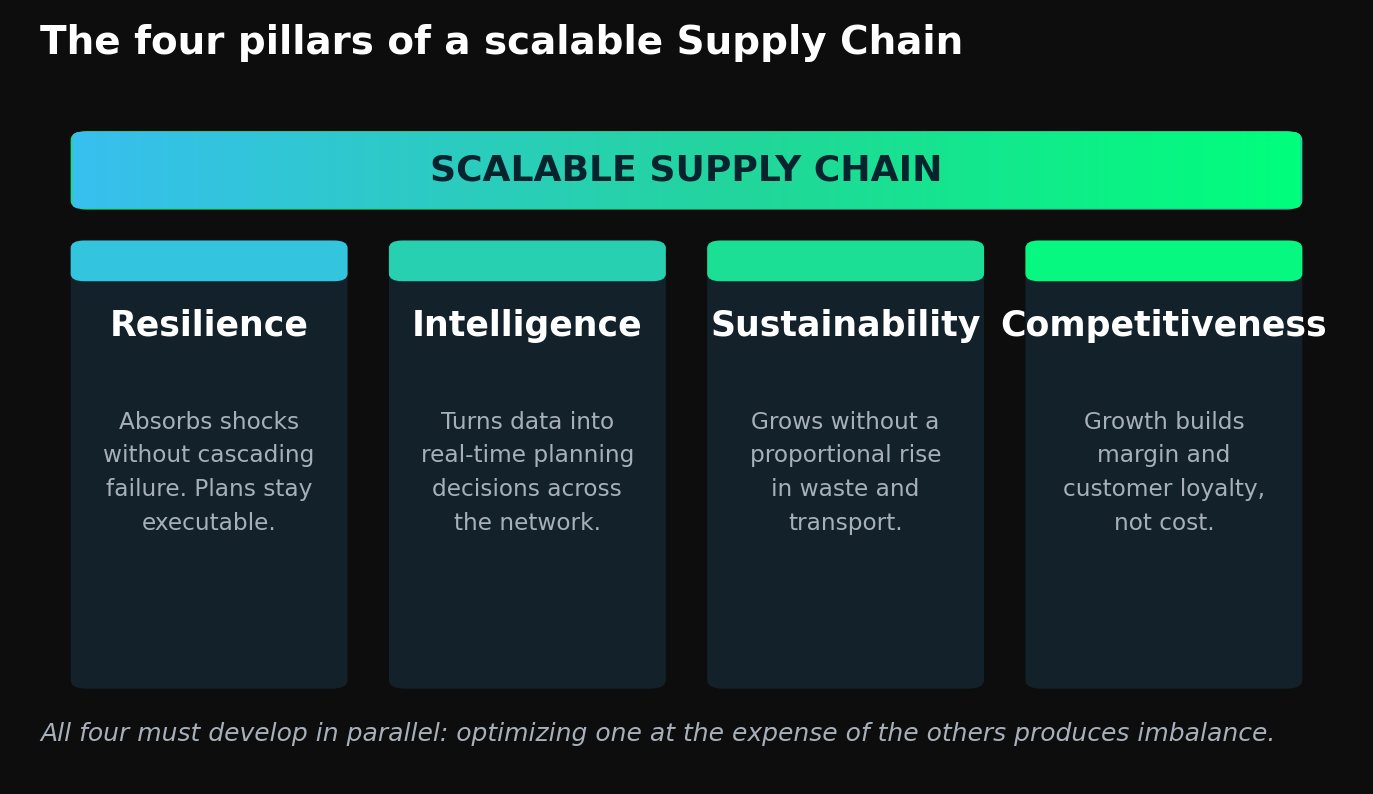
To build a Supply Chain that scales sustainably, four dimensions must develop in parallel. Optimizing one at the expense of the others consistently produces imbalance.
Resilience
Resilience is the ability to absorb disruptions without cascading failure. A resilient Supply Chain produces medium and long-term plans that maintain executability under changing conditions rather than requiring complete replanning every time something shifts. It is what allows a Supply Chain to grow without becoming more fragile with each additional unit of scale. The organizations that have built genuine resilience into their planning architecture consistently outperform those that rely on buffer stock and manual intervention to absorb volatility, an approach that works at small scale and breaks visibly under growth pressure.
Intelligence
Intelligence is the ability to turn data into actionable planning decisions across the full Supply Chain, in real time. It means complete digitalization and synchronization of Supply Chain signals, so that demand shifts, supplier delays, and inventory imbalances are detected and acted upon before they produce service failures. AI-driven demand planning, now also available as AI demand planning built for SMBs, is the core capability that makes intelligence operational at scale.
Sustainability
Sustainability means building a Supply Chain that grows without proportionally increasing waste, unnecessary transport, or environmental impact. As companies scale, they generate more inventory risk, more logistics movement, and more packaging consumption. A Supply Chain that optimizes these flows reduces both financial and environmental costs simultaneously. ESG criteria are increasingly influencing procurement decisions, investor assessments, and regulatory requirements. Supply Chain sustainability is no longer a parallel reporting obligation. It is an operational design requirement.
Competitiveness
Competitiveness means that growth produces better margins and stronger customer relationships rather than consuming them. Contrary to the practices of earlier decades, competitiveness must now be built on top of resilience, intelligence, and sustainability rather than at their expense. A Supply Chain that is efficient but brittle, or that reduces costs by increasing inventory risk, is not genuinely competitive at scale.
How a growing company scales its Supply Chain in practice
Camif is a useful illustration of what scaling Supply Chain capability under growth pressure looks like in practice. The company experienced rapid volume growth that put significant pressure on its logistics and planning operations. As supplier count increased by 20% and product range expanded by 30% within a single year, the ordering constraints and forecast complexity grew at a pace that manual processes could not absorb.
The response was to invest in Supply Chain intelligence: implementing AI-driven forecasting to handle the growing SKU base reliably, and collaborative planning to synchronize supply signals with a rapidly expanding supplier network. The result was team efficiency that held constant despite the growth in complexity, and a reduction in stockout events that protected the service level gains the growth was intended to produce.
The pattern is consistent across growing organizations: the Supply Chain investment that enables scale is not adding more planning headcount or more safety stock. It is building the planning infrastructure that handles growing complexity without growing proportionally in cost or error rate.
What Supply Chain scalability requires from an S&OP perspective
As the business grows, the S&OP process becomes more important and more difficult simultaneously. More markets, more product categories, and more stakeholders create more opportunities for the plan to diverge from reality between cycles. Strategic simulations allow growing organizations to model the financial and operational impact of expansion decisions before committing to them: what does entering a new market do to inventory requirements across the existing network? What does a new product launch do to supplier capacity? What does a promotion in one region do to availability in another?
These questions cannot be answered reliably with static planning models. They require a planning infrastructure that can simulate multiple futures simultaneously and surface the trade-offs for decision-makers rather than hiding them inside averaged assumptions.
When to reassess your Supply Chain scalability
The signals that a Supply Chain has reached the limits of its current design are consistent across industries and company sizes:
- inventory grows faster than revenue, indicating that growth is being absorbed by excess buffer rather than by better planning
- stockouts increase despite higher overall stock levels, the classic symptom of inventory positioned at the wrong nodes
- forecast accuracy declines as product range and market complexity increase
- planning relies heavily on spreadsheets and manual overrides that planners cannot fully explain or audit
- expansion into new markets or channels creates operational stress rather than efficiency
- planning teams spend the majority of their time firefighting rather than anticipating
Each of these signals indicates that the Supply Chain's planning architecture has reached its design limit. The organization has grown past the model that was built to run it. The investment required to restore scalability at this point is always larger than it would have been if scalability had been designed in from the start.
Watch our webinar on how to gain control over your Supply Chain and operations to see how teams move from reactive firefighting to inventory control and data-driven planning decisions.
Discover how Flowlity helps fast-growing companies build Supply Chain planning infrastructure that scales with the business. Discover Flowlity Lite or book a demo.
Level up your supply chain with AI.
Get a demo
FAQ
Find everything you need to know right here.
What is supply chain scalability?

Supply chain scalability is the ability to support business growth without increasing costs, risks or complexity at the same pace. It ensures service levels and efficiency remain stable as the business expands.
Why is supply chain scalability critical during growth?
Growth amplifies weaknesses. Without scalability, companies face stockouts, excess inventory, rising costs and declining customer satisfaction.scal
What are the main challenges of supply chain growth?
The biggest challenges include increased complexity, lack of visibility, inventory imbalance, overloaded teams and limited ability to respond to disruptions.
How does AI support scalable supply chain management?
AI improves forecast accuracy, automates routine decisions, detects anomalies early and enables scenario-based planning, making it easier to scale operations.