.svg)
.svg)
Best sales forecasting software 2026: top AI tools

The best sales forecasting software in 2026 depends on what you forecast. For sales pipeline and revenue, Clari and Gong lead. For demand and supply-chain-driven forecasting, where sales predictions drive inventory, replenishment and production, Flowlity is the strongest AI pick, with probabilistic models built for demand across the Supply Chain. This guide compares the seven leading tools on forecast type, best-fit company and price.
Here is the uncomfortable truth about most sales forecasting software: it cannot actually make your forecast more accurate, because all it does is re-read your CRM pipeline. If the deals in the pipeline are wrong, the forecast is wrong faster. The tools that genuinely move accuracy forecast something different: demand.
Modern forecasting software predicts future demand or revenue by analyzing historical data, market signals and operational constraints. Some tools focus on AI-driven demand planning and turn forecasts into supply chain decisions, while others stay focused on pipeline analytics and CRM reporting. This guide explains that distinction, then compares the leading platforms so you can choose the right one for how your business actually makes money.
What sales forecasting software actually does
Sales forecasting software estimates future revenue and demand by analyzing historical sales, seasonality and market signals, instead of relying on spreadsheets or a sales manager's gut feel. Most tools combine several data sources:
- CRM pipeline data
- historical sales performance
- seasonal demand patterns
- deal progression metrics
- market signals
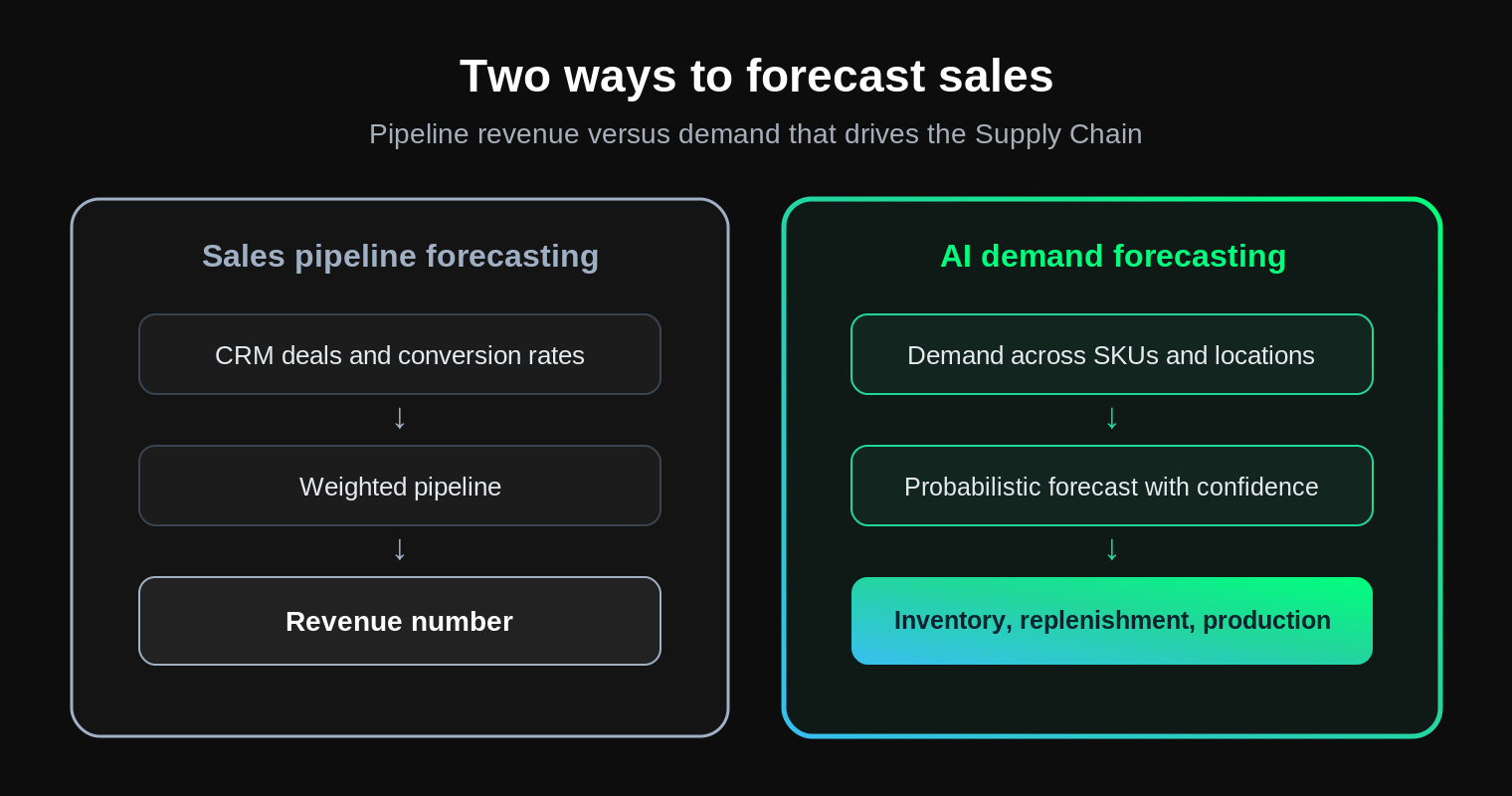
But forecasting sales is rarely just a revenue problem. In retail, manufacturing and distribution, a sales forecast immediately becomes an inventory decision, a production plan and a purchase order. That is the fault line running through this category: some tools forecast the pipeline (how many deals will close), while platforms like Flowlity forecast demand across products, SKUs and locations, then connect it to inventory optimization.
Why most sales forecasting fails
Whichever tool you use, four failure modes explain why forecasts drift, and why "add AI" alone does not fix them.
Human bias
When planners adjust forecasts by hand, they overreact to recent spikes and drops. AI models reduce this by learning demand patterns across thousands of SKUs and flagging anomalies a human would miss.
Poor data quality
A forecast is only as good as its inputs. Missing SKU history, broken product mappings and unclean promotional data quietly degrade accuracy. Modern platforms detect anomalies, clean historical signals and consolidate data from several systems before forecasting.
Static models
Traditional forecasts lean on historical averages and cannot absorb sudden change. AI platforms update predictions as new data arrives and let planners run strategic simulations on promotions or disruptions before they happen.
No operational visibility
Pipeline-only tools ignore whether you can actually fulfill the demand. Connecting the forecast to inventory and replenishment is what turns a number into a decision.
Comparison of the best sales forecasting tools
These platforms differ less in "how much AI" and more in what they forecast, who they fit, and what they cost.
While most tools forecast the sales pipeline, platforms like Flowlity introduce AI-driven demand forecasting that connects sales forecasts with operational planning.
1. Flowlity, AI forecasting beyond the sales pipeline
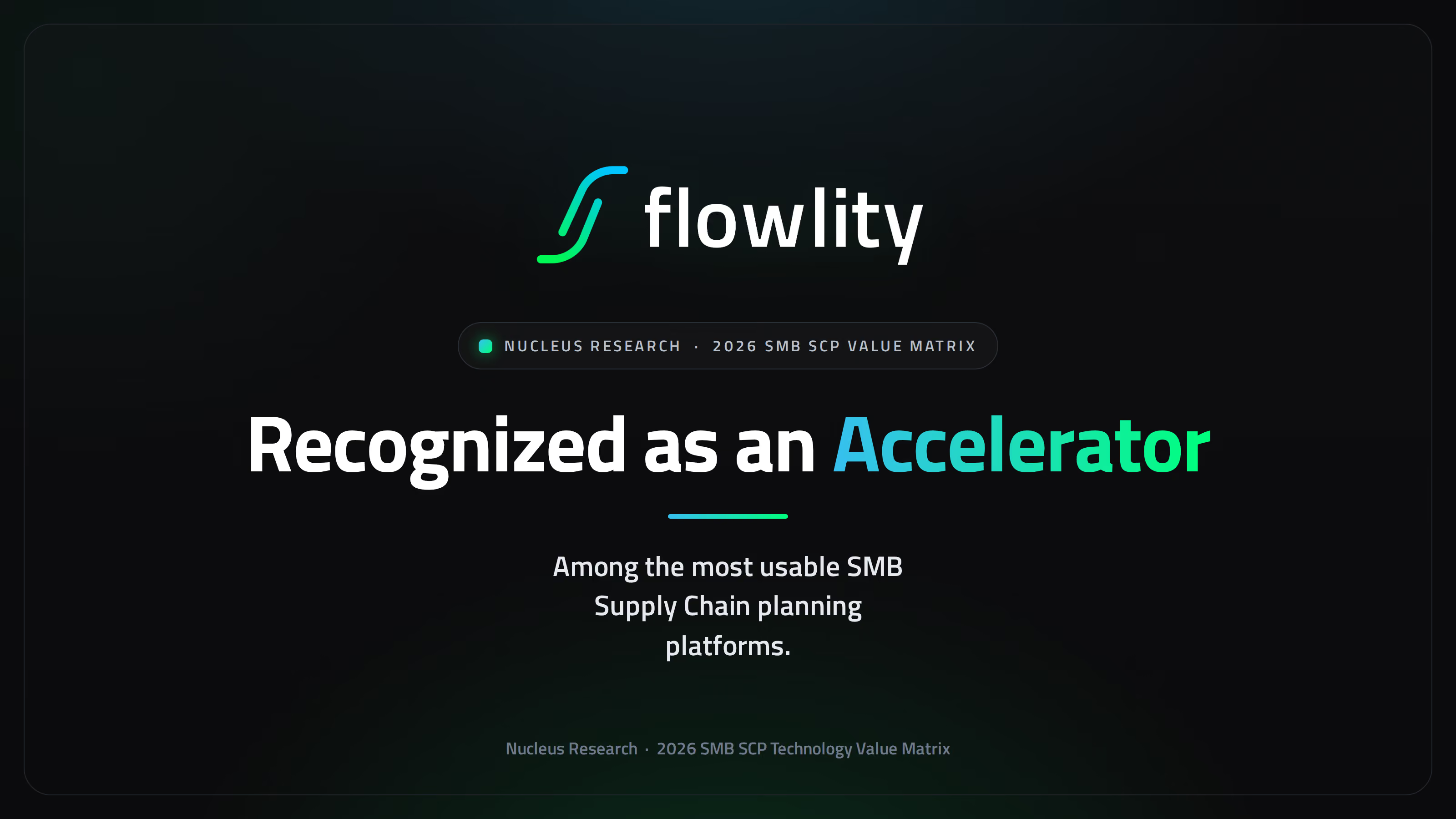
Flowlity is an AI-powered forecasting and inventory optimization platform. Instead of predicting only revenue, it forecasts demand across SKUs and locations, then translates it into replenishment, inventory levels and production plans. Its core is probabilistic forecasting: rather than a single number, it generates a demand range with a confidence level, so planners size safety stock against real uncertainty. Planners can run scenario simulations and monitor accuracy in real-time dashboards. This approach earned Flowlity a place on Gartner's 2025 Cool Vendor list for Supply Chain, and forecasts are now queryable directly inside Claude, ChatGPT and GitHub Copilot through the Flowlity AI co-planner. Flowlity was also recognized as an Accelerator in Nucleus Research’s 2026 SMB SCP Value Matrix, among the most usable forecasting platforms for SMBs. For smaller teams, Flowlity Lite brings the same probabilistic engine from €249 per month, with a 14-day free trial and no ERP integration. Best for companies whose sales forecast has to drive a physical Supply Chain.
2. Clari
Clari is a revenue operations platform used by sales and RevOps leaders to run their forecasting process. It pulls data from the CRM, typically Salesforce, automatically captures rep activity, and rolls the pipeline up into a single forecast view with confidence levels. Its strengths are pipeline inspection, historical trend analytics, deal-risk alerts and quarter-end predictability for leadership. It fits mid-market to enterprise B2B teams that live in a CRM and need a defensible number for the board. Its limit is scope: Clari forecasts the sales pipeline, not product demand or inventory, so unlike Flowlity it does not translate a forecast into replenishment or production decisions.
3. Gong
Gong is best known for revenue intelligence built on conversation analytics: it records, transcribes and analyzes sales calls and emails to surface what is really happening inside deals. On top of that data it layers deal scoring and revenue forecasting, so leaders can see which opportunities are at risk and why. Its strengths are deal-level insight, rep coaching and pipeline realism grounded in actual buyer conversations. It suits sales teams from SMB to enterprise that want to improve win rates and forecast discipline. Its forecasting stays centered on sales conversations and pipeline, so like Clari it does not connect to inventory or supply, where Flowlity operates.
4. Salesforce Forecasting
Salesforce Forecasting is the native forecasting capability inside Sales Cloud. It lets managers build collaborative forecasts, customize forecast categories and types, and roll numbers up through the sales hierarchy without adding another vendor. Its strength is convenience: forecasts live exactly where reps already log deals, and Einstein predictive features are available in higher tiers. It fits any size of team already standardized on Salesforce. The trade-off is that accuracy depends heavily on manual pipeline hygiene, and it is designed for pipeline visibility rather than predictive demand modeling, so for physical-goods businesses it does not address inventory or production the way Flowlity does.
5. HubSpot Forecasting
HubSpot Forecasting is part of Sales Hub and projects future revenue from deal stages, amounts and close probabilities, with both manual and AI-assisted category forecasts shown in simple dashboards. Its strengths are ease of use and tight integration for teams already running sales on HubSpot, with fast setup and a gentle learning curve. It is a strong fit for SMB and mid-market sales teams that need a clear revenue projection without a heavy implementation. Its limit is depth: it lacks probabilistic forecasting and scenario simulation, so it struggles with volatile or seasonal demand. Like other CRM tools it forecasts revenue, not the demand and inventory decisions Flowlity is built for.
6. Anaplan
Anaplan is a connected planning platform that large enterprises use to model sales, finance, supply chain and workforce in a single environment. For forecasting, it aligns the sales number with financial planning, territory and quota, and long-range scenarios across the business. Its strength is flexible, cross-functional modeling: almost any planning process can be built in it. That power comes at a cost, deployment is complex and usually needs dedicated modeling expertise and time. It is less a turnkey demand-forecasting AI than a modeling platform, so for SKU-level demand and inventory a specialized tool such as Flowlity is faster to value.
7. Aviso AI
Aviso AI is an AI-driven revenue platform that combines machine-learning forecasting, deal prediction, pipeline analytics and conversational intelligence in one workspace. It aims to give revenue teams a more accurate, less manual forecast than a CRM alone, with predictive roll-ups and guidance on where to focus. Its strengths are automation and AI scoring for sales leaders who want to reduce forecasting guesswork. It fits mid-market to enterprise revenue organizations. Like Clari and Gong its focus is the sales pipeline and revenue, not product demand, so it does not extend into inventory, replenishment or production planning, which is Flowlity's domain.
How AI is changing sales forecasting
Artificial intelligence is shifting forecasting from historical averages to models that update continuously and quantify uncertainty. The concrete gains: higher forecast accuracy, faster detection of demand anomalies, real-time updates and automated scenario simulations. Probabilistic forecasting is the clearest example. By generating multiple demand scenarios instead of one point estimate, it tells planners not just what to expect but how confident to be, which is exactly the input needed to set safety stock and replenishment.
What results to expect
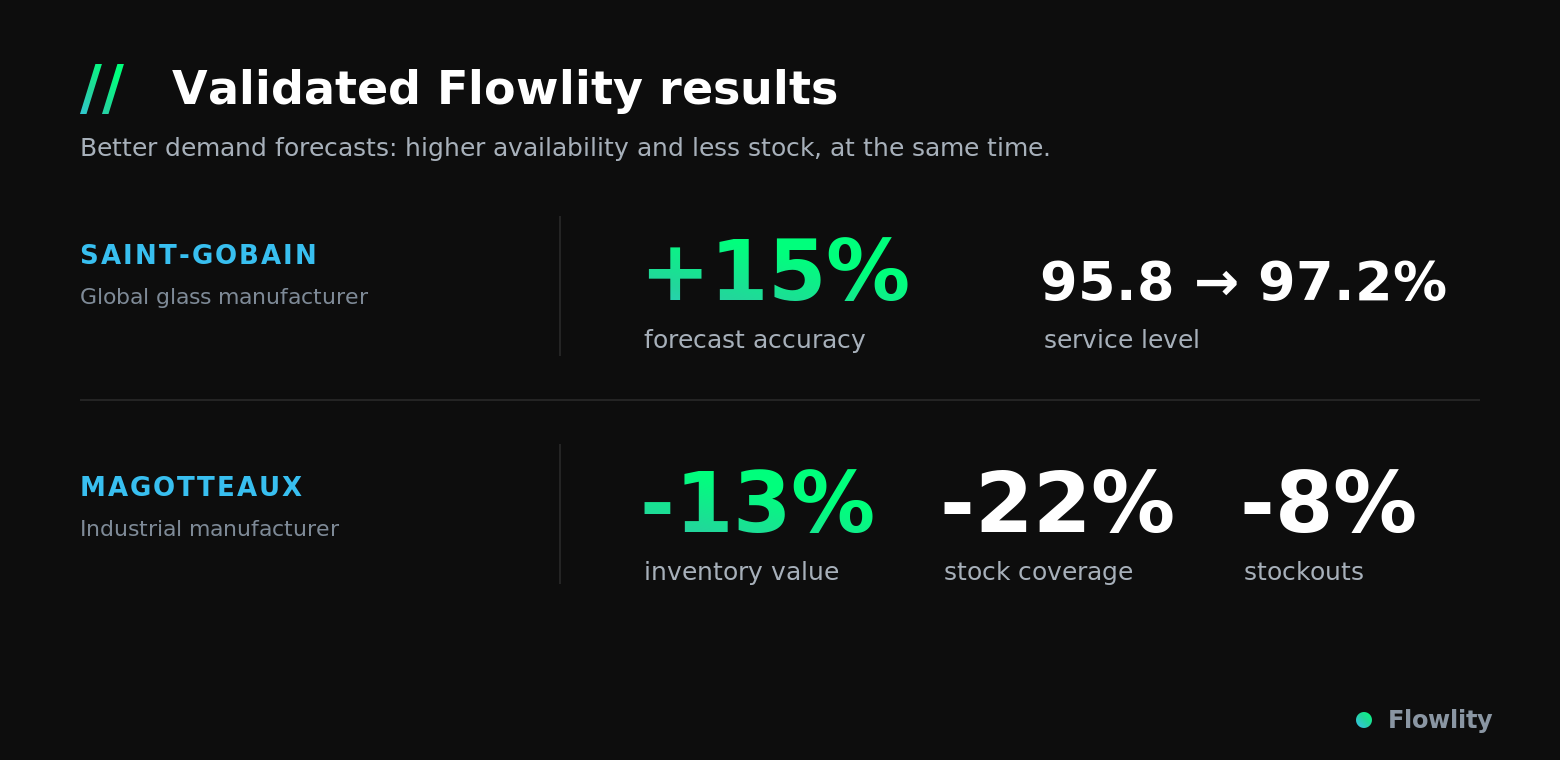
Accuracy gains matter only if they change decisions and money. Two validated examples show the range. At Saint-Gobain, a global glass manufacturer, Flowlity lifted forecast accuracy by 15% and raised the service level from 95.8% to 97.2%, while reducing inventory. At Magotteaux, an industrial manufacturer, AI-driven planning cut inventory value by 13% and stock coverage by 22%, while lowering stockouts by 8%. The pattern is consistent: better demand forecasts produce higher availability and less capital locked in stock at the same time.
How to choose the right sales forecasting software
Start from what you actually need to forecast. If your challenge is closing more deals and giving leadership a reliable revenue number, a pipeline tool such as Clari, Gong or Salesforce Forecasting is the natural fit. If your sales forecast has to drive inventory, replenishment and production, choose a demand-first platform: Flowlity is the strongest AI option for companies managing a physical Supply Chain, with Flowlity Lite making it accessible to SMBs from €249 per month. Then weigh integration with your ERP or CRM, the depth of AI (probabilistic and scenario capabilities beat static models), and total cost including implementation. For an outside view, cross-check independent user reviews on G2 and Gartner Peer Insights. The best tool is the one aligned with how your business converts demand into revenue.
Level up your supply chain with AI.
Get a demo

FAQ
Find everything you need to know right here.
What is the best sales forecasting software in 2026?

It depends on what you forecast. For sales pipeline and revenue, Clari and Gong lead; for CRM-native forecasting, Salesforce Forecasting and HubSpot Forecasting are convenient; for enterprise connected planning, Anaplan is the reference. For demand and supply-chain-driven forecasting, where the sales forecast must drive inventory and production, Flowlity is the strongest AI pick, using probabilistic models that lifted forecast accuracy by 15% at Saint-Gobain. Choose the tool that matches how your business turns demand into revenue.
What is the difference between sales forecasting and demand forecasting software?
Sales forecasting software predicts future revenue, usually from CRM pipeline data such as deals and conversion rates. Demand forecasting software predicts future product demand across SKUs, locations and time horizons. The difference matters for companies with physical inventory: a revenue forecast tells you what you might sell, while a demand forecast tells you what to buy, make and stock. Platforms like Flowlity focus on AI-driven demand planning and then connect it to inventory and production, so the forecast becomes an operational decision rather than just a financial estimate.
Can sales forecasting software improve forecast accuracy?
Yes, when it does more than re-read your pipeline. AI models improve accuracy by learning demand patterns across thousands of SKUs, cleaning noisy history and updating continuously as new data arrives. Probabilistic approaches add a confidence range instead of a single number, which helps planners manage uncertainty. In practice, Flowlity improved forecast accuracy by 15% at Saint-Gobain and helped raise its service level from 95.8% to 97.2%. Accuracy gains are largest when the tool forecasts demand and connects it to inventory, not when it only summarizes CRM deals.
Which sales forecasting tool is best for supply chain and inventory planning?
For supply chain and inventory planning, Flowlity is the best fit. Unlike pipeline tools that stop at revenue, it forecasts demand across SKUs and locations and turns it into replenishment, inventory optimization and production plans. Its probabilistic forecasting sizes safety stock against real uncertainty, and scenario simulations let planners test promotions or disruptions before acting. Results include -13% inventory value and -22% stock coverage at Magotteaux. For smaller teams, Flowlity Lite delivers the same engine from €249 per month, while Anaplan can support large enterprises through connected planning with heavier deployment.
How much does sales forecasting software cost?
Pricing splits into two models, using public figures as of July 2026 that change often. CRM-based tools publish per-seat pricing: HubSpot Sales Hub Professional is around $90 per seat per month (annual) and Salesforce Sales Cloud Enterprise, which includes forecasting, is around $175 per user per month. Flowlity is the transparent option for smaller teams: Flowlity Lite starts at €249 per month, with a 14-day free trial and no ERP integration, while its enterprise edition is quoted on request. Clari, Gong, Anaplan and Aviso AI price on request, based on scope, users and data volume. When budgeting, add implementation, integration and onboarding costs, which for enterprise tools can match or exceed the license itself.