.svg)
.svg)
How Saint-Gobain Sekurit improved forecast accuracy by 15% and cut inventory by 9%
.avif)

AI-based demand forecasting replaces single-point estimates with probabilistic predictions that account for volatility, seasonality, and lead time risk. Saint-Gobain Sekurit, an automotive glass manufacturer, used this approach to lift forecast accuracy by 15% and cut inventory by 9%. This case study explains how AI reshaped its demand planning process.
Saint-Gobain Sekurit, the automotive glass replacement division of the €46.6 billion multinational Saint-Gobain, was facing a challenge familiar to many manufacturing and distribution companies: fragmented ERP systems, manual spreadsheets, and inaccurate demand forecasts that led to excess inventory and service level gaps. By implementing Flowlity's AI-powered demand planning solution across its end-to-end supply chain, Sekurit achieved a 15% improvement in forecast accuracy at SKU level, reduced inventory by 9.25%, and raised product availability from 95.8% to 97.2%.
This demand forecasting case study explores how one of the world's largest automotive glass distributors transformed its supply chain operations using artificial intelligence, and the measurable ROI that followed.
About Saint-Gobain Sekurit: a global leader in automotive glass replacement
Saint-Gobain is the world leader in sustainable construction, with 161,000 employees across 80 countries and over 1,100 production sites worldwide. Founded 360 years ago, the company generated €46.6 billion in revenue in 2024.
Within this global group, Saint-Gobain Sekurit AGR (Automotive Glass Replacement) operates a specialized supply chain for the production and distribution of replacement automotive glass. The division manages a complex network that includes three dedicated manufacturing plants in Europe, one central distribution hub serving Europe and export markets, and 30 local distribution centers. Sekurit's product catalog contains over 10,000 glass references — 4,000 windshields, 1,500 rear windows, and 5,000 side windows — with an annual volume of 2.5 million pieces. More than 95% of products are manufactured in Europe.
The end customers are garages and auto glass fitting centers, served through a multi-tier supply chain that flows from suppliers through plants, a central warehouse, and distribution centers before reaching the final client.
The challenge: why traditional demand planning was failing
The scale of the challenge
Managing demand planning for 10,000+ SKUs across 30 distribution centers, with seasonal fluctuations and varying lead times from European factories, requires more than spreadsheets and basic ERP logic. Sekurit's supply chain team recognized that the company needed a fundamentally different approach to demand forecasting — one powered by AI rather than spreadsheets.
Why demand planning is hard in automotive glass replacement
The automotive glass replacement market is shaped by three structural forces.
First, insurance-driven demand: a large share of windshield replacements in Europe is paid through insurance, which compresses turnaround expectations to one or two days.
Second, strong seasonality, with peaks tied to weather, road conditions, and accident patterns.
Third, a long-tail SKU catalogue where any of thousands of references can determine whether a customer chooses Saint-Gobain or a competitor. Spare-parts Supply Chains in this sector also operate multi-tier, from plants to a central hub, from the hub to regional distribution centers, and from those DCs to thousands of garages and fitting centers. Each additional node multiplies demand and inventory complexity, and any forecast error at the SKU level cascades through the entire network.
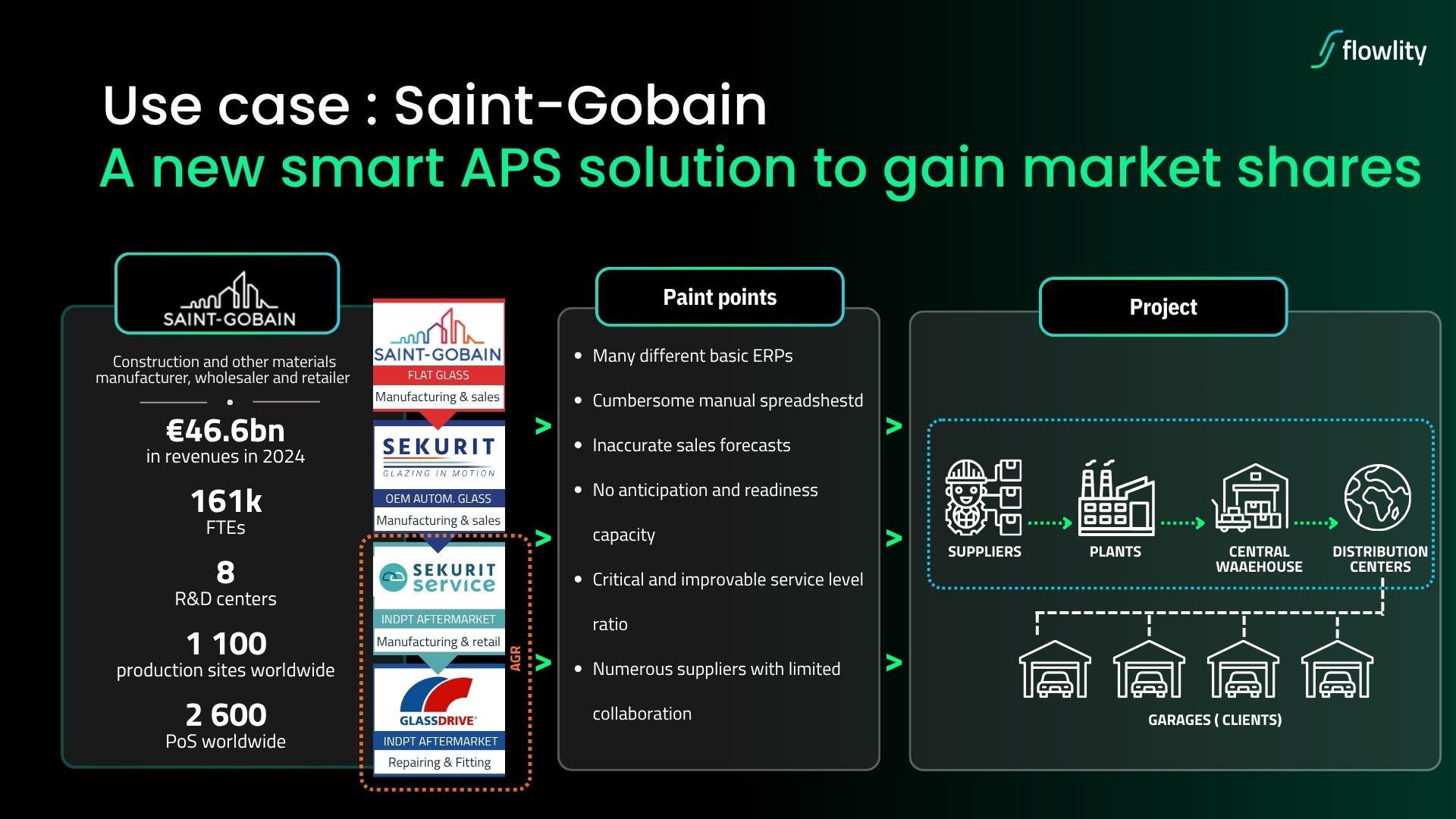
Before implementing Flowlity, Saint-Gobain Sekurit's supply chain planning process was hampered by several critical issues that are common across manufacturing and spare parts organizations.
"Product availability is critical. If you don't have the item in stock at the local warehouse, the customer calls a competitor. With Flowlity, we're now at an average 97% availability rate across our 30 distribution centers, up two points compared to the previous year."
Philippe Boutonnet, Supply Chain Director, Saint-Gobain Sekurit AGR
Fragmented systems with no single source of truth
The division operated with multiple different ERP systems across its network of plants and distribution centers. Each site had its own data logic, making it nearly impossible to consolidate demand signals into a coherent forecast. Supply chain planners spent more time reconciling data between systems than actually analyzing demand patterns.
Over-reliance on manual spreadsheets
Demand planning was done through cumbersome manual spreadsheets — a familiar pain point for supply chain teams worldwide. These spreadsheets were error-prone and impossible to scale across 10,000+ references.
Inaccurate macro-level sales forecasts
The forecasting approach relied on macro-level sales estimates rather than granular, SKU-level predictions. This top-down method failed to capture the nuances of demand at the individual product and location level, leading to systematic forecast errors that cascaded through the entire supply chain.
No anticipation and limited capacity readiness
Without accurate demand signals, the supply chain team had no anticipation capability. They couldn't prepare for seasonal peaks, react to shifts in the product portfolio, or align production capacity with actual market needs.
Critical service level gaps
The combined effect of these issues was a service level that left significant room for improvement. Stockouts were occurring more frequently than acceptable, and the seasonality of the automotive glass market amplified forecasting errors.
The solution: how Flowlity transformed demand forecasting at Sekurit
Saint-Gobain Sekurit was looking for a single digital tool to replace the patchwork of ERPs and spreadsheets. The objectives were clear: digitalize the supply chain, improve forecast reliability, optimize stock health, increase product availability, and ultimately improve the client experience. The company chose Flowlity's AI-powered platform to address all five goals within a single, integrated solution covering the end-to-end supply chain — from plants and the central warehouse to distribution centers.
End-to-end supply chain integration
Flowlity was deployed progressively across Sekurit's entire supply chain, not just at one node. The implementation covered three layers.
At the distribution center level, the solution handles sales forecasting, inventory management, and purchase forecasting for each of the 30 local centers. At the central warehouse level, it adds collaborative planning capabilities on top of the core forecasting and inventory optimization modules. At the plant level, the solution incorporates production forecasting, production forecasting, and stock management.
Each layer feeds into the next — better demand forecasts at distribution centers improve replenishment orders to the central hub, which in turn enables more accurate production planning at the factories. This cascading approach means that every step in the implementation adds value to the next.
Tactical simulation capabilities
One of the most powerful features for Sekurit's planning team is the tactical simulation module. Planners can adjust buffer levels by distribution center and product tag, then simulate the impact on stock levels and stockout days before committing to changes. For example, when preparing for the high season or adjusting for a client portfolio change, the team can model scenarios like reducing buffer from 95% to 70% and instantly see the projected impact on inventory quantities, coverage days, and rupture risk.
This simulation capability replaced the old approach of making inventory policy changes blindly and hoping for the best.
Smart alerting and supply chain automation
Flowlity's cockpit provides automated alerts for outliers and shortages, allowing planners to focus their attention where it matters most. Instead of reviewing thousands of SKUs manually, the team can quickly identify products with abnormal demand patterns, incoming stockout risks, or new product launches that need attention. A dedicated new product module helps manage the critical introduction phase when no historical data exists — powered by Flowlity's AI agents.
"Flowlity enables us to drive the digitalization and integration of our end-to-end Supply Chain, from our distribution centres to our suppliers' plants. They offer a user-friendly, dynamic solution that supports us in facing our challenges, and their dedicated team provides excellent accompaniment."
Kimberley Darban, S&OP & Project Manager, Saint-Gobain Sekurit AGR
Results: a proven ROI that keeps improving over time
The results of this AI demand forecasting case study at Saint-Gobain Sekurit have been measured rigorously — and they continue to improve as the system learns from more data.
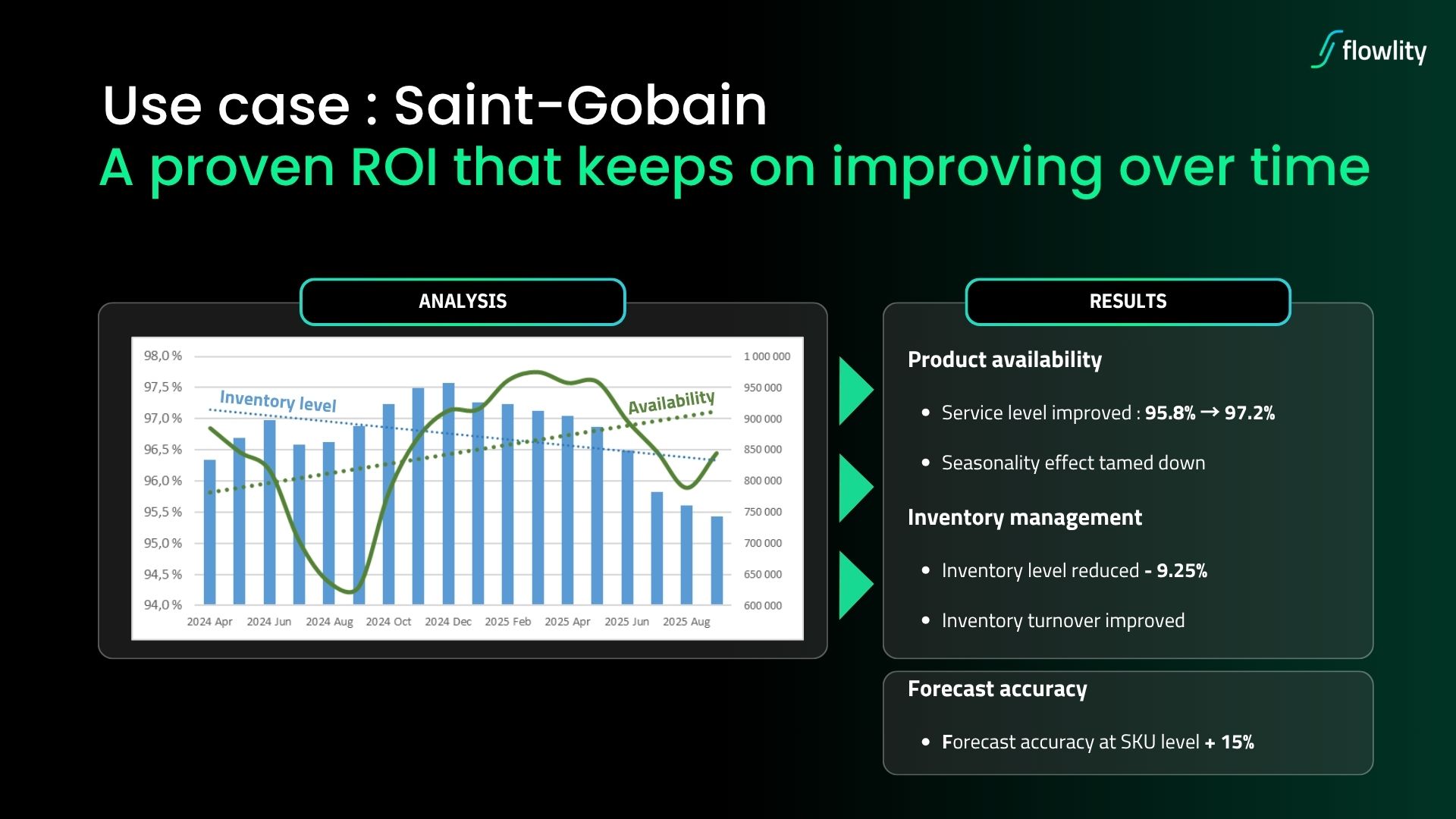
Forecast accuracy: +15% improvement at SKU level
The most fundamental improvement was in forecast accuracy at the SKU level, which increased by 15%. This is a significant achievement given the complexity of forecasting demand for 10,000+ glass references across 30 distribution points. More accurate forecasts cascade into better decisions across the entire supply chain — from purchasing and production to inventory allocation.
Product availability: service level from 95.8% to 97.2%
Product availability improved from 95.8% to 97.2%, a 1.4 percentage point increase that represents a substantial reduction in stockout events across thousands of SKUs. Critically, the seasonality effect was tamed — the availability curve became much more stable throughout the year, eliminating the deep seasonal dips that previously disrupted service to garages and fitting centers.
Inventory optimization: stock reduced by 9.25%
While service levels were rising, inventory levels were simultaneously declining by 9.25%. This is the hallmark of effective demand planning — not simply building more stock to improve availability, but intelligently positioning the right inventory in the right place at the right time. Inventory turnover improved accordingly, freeing up working capital and warehouse space.
Operational KPI development
Beyond the headline metrics, Sekurit developed a comprehensive set of operational KPIs powered by Flowlity data. Upstream indicators include OTIF (on-time in-full), planning adherence, lead time tracking, and frozen zone compliance. Downstream indicators cover availability and forecast quality. Stock health indicators track coverage, obsolescence, and overall inventory condition. The team is also working on end-to-end supply chain cost measurement — a natural next step once demand planning accuracy and inventory efficiency are under control.
Watch the full story: Saint-Gobain Sekurit & Flowlity webinar
For a deeper dive into this AI demand forecasting case study, watch the full webinar replay where the Saint-Gobain Sekurit supply chain team shares their experience implementing Flowlity and the lessons learned along the way.
Key takeaways for Supply Chain leaders
This demand planning case study from Saint-Gobain Sekurit offers several lessons for supply chain leaders evaluating AI-driven forecasting solutions.
Start with the data foundation
Before any AI model can add value, you need clean, consolidated data. Sekurit's first challenge was unifying data from multiple ERPs into a single reliable pipeline.
Think end-to-end, implement progressively
Flowlity was deployed across distribution centers, the central warehouse, and manufacturing plants — but not all at once. The progressive rollout meant that each phase delivered value while building the foundation for the next. This approach reduces implementation risk while maintaining momentum.
Demand planning is not just about the forecast
The real value of AI demand forecasting comes from what you do with it. Sekurit's gains in inventory reduction and service level improvement came not just from better forecasts, but from the tactical simulation tools, automated alerting, and collaborative planning processes that Flowlity enabled around those forecasts.
Measure what matters, continuously
The development of comprehensive operational KPIs — from OTIF and planning adherence to stock healthiness and obsolescence tracking — shows that AI demand planning is not a one-time project but an ongoing capability that improves with measurement and refinement. A structured S&OP process helps ensure these metrics translate into strategic decisions.
About Flowlity
Flowlity is an AI-powered Supply Chain planning platform that helps manufacturers and distributors optimize demand forecasting, inventory management, and supplier collaboration. Using probabilistic forecasting and machine learning, Flowlity enables companies to reduce inventory while improving service levels. The platform is deployed across industries including automotive, chemicals, FMCG, and industrial distribution.
Level up your supply chain with AI.
Get a demo
.avif)
FAQ
Find everything you need to know right here.
What business outcomes did Saint-Gobain Sekurit achieve with Flowlity?

The Saint-Gobain Sekurit project produced a dual outcome that traditional planning systems struggle to deliver simultaneously: product availability rose from 95.8% to 97.2% (1.4 points), while inventory levels fell by 9.25%. The 97% average availability rate across the 30 distribution centers translates directly into protected revenue: spare-parts customers who find the right glass at the local warehouse do not call a competitor. The seasonality effect was also tamed, with the availability curve becoming much more stable through the year and eliminating the deep seasonal dips that previously disrupted service to garages and fitting centers. The +15% forecast accuracy gain at SKU level cascaded into better replenishment decisions, smoother production planning at the 3 European plants, and freed inventory turnover capacity across the network. Inventory turnover improved, freeing working capital and warehouse space. For an automotive aftermarket business where insurance-driven turnaround expectations are tight and competitors are one phone call away, these gains translate directly into market share defense.
How does Saint-Gobain Sekurit use Flowlity's Strategic Simulations in daily planning?
Strategic Simulations let Sekurit's planners test the impact of a policy or demand change before committing to it. The team can adjust buffer levels by DC or product tag and instantly see the projected impact on inventory, coverage, and stockout risk, which replaces the old approach of changing rules and hoping for the best. Concretely, planners can model scenarios like reducing buffer from 95% to 70% for a given category in DC 12 ahead of low season, and see within seconds what that does to inventory quantities, coverage days, and rupture risk. This capability is particularly valuable for navigating seasonal transitions, client portfolio changes, and disruption scenarios where the cost of getting the policy wrong is high. The simulation engine runs on the same probabilistic forecasts and dynamic buffer logic as the production system, so what the planner tests is what the platform would actually do, not an approximation. For a network as complex as Sekurit's, this shifts inventory policy from gut feeling to evidence-based decision-making and builds the team's confidence to commit to changes that would otherwise feel too risky.
How does Flowlity cover Saint-Gobain Sekurit's 10,000+ SKUs across 30 distribution centers?
Flowlity consolidates data from each of Sekurit's 30 distribution centers, the central warehouse, and 3 European plants into a single planning layer, then generates SKU-by-DC recommendations powered by AI. Smart alerting surfaces only the items that need planner attention, so the team can manage tens of thousands of SKU-location pairs without reviewing them one by one. Without this exception-based approach, managing 300,000 SKU-DC combinations would require an unrealistic planning headcount. The platform operates at multiple network layers simultaneously: sales forecasting and inventory management at each of the 30 local DCs, collaborative planning layered at the central warehouse on top, and production forecasting and stock management at the plant level. Each layer feeds into the next, so better demand forecasts at distribution centers improve replenishment orders to the central hub, which in turn enables more accurate production planning at the factories. This cascading end-to-end Supply Chain integration delivers more value than node-by-node optimization, a pattern visible in other industrial rollouts like multi-site planning at Groupe Lemoine.
How did Saint-Gobain Sekurit improve forecast accuracy with Flowlity?
Sekurit moved from macro-level sales estimates to SKU-level probabilistic forecasts powered by Flowlity, which is the structural shift behind the 15% improvement in forecast accuracy at SKU level across 10,000+ glass references. Before Flowlity, the team produced top-down forecasts based on aggregate market trends and budget assumptions, then disaggregated them to SKU level using historical splits. This worked for aggregate planning but generated systematic errors at SKU level, where each reference has its own demand profile, seasonality, and lead time. The new approach builds forecasts bottom-up at the SKU level using probabilistic AI that captures variability rather than averaging it away. The 15% accuracy gain translated directly into better replenishment decisions at distribution centers, smoother production planning at the three European plants, and a much more stable availability curve through the year, with the deep seasonal dips that previously disrupted service to garages and fitting centers largely eliminated. The team also developed comprehensive operational KPIs on top of the new platform, which connects directly to multi-echelon inventory optimization across the network.
What demand planning challenges was Saint-Gobain Sekurit facing?
Saint-Gobain Sekurit AGR, the Automotive Glass Replacement division of the €46.6 billion Saint-Gobain group, manages a specialized Supply Chain for replacement automotive glass: 3 manufacturing plants in Europe, one central distribution hub, 30 local distribution centers, and 10,000+ glass references (4,000 windshields, 1,500 rear windows, 5,000 side windows) for an annual volume of 2.5 million pieces. Before Flowlity, the division operated with multiple ERP systems across its network, which made it nearly impossible to consolidate demand signals into a coherent forecast. Planning relied on cumbersome manual spreadsheets that were error-prone and impossible to scale across 10,000+ references. The forecasting approach used macro-level sales estimates rather than granular SKU-level predictions, which generated systematic errors that cascaded through the entire Supply Chain. Without accurate demand signals, the team had no anticipation capability for seasonal peaks or portfolio shifts. The combined effect was a service level that left significant room for improvement, with stockouts occurring more frequently than acceptable and the seasonality of the automotive glass market amplifying forecasting errors.