.svg)
.svg)
Customer satisfaction in Supply Chain management

The relationship between Supply Chain performance and customer satisfaction used to be invisible to most consumers. Customers experienced its outcomes, a stockout, a delayed delivery, a wrong item in the wrong box, but they attributed those failures to the store or the brand rather than to the planning decisions that produced them. That invisibility no longer holds. E-commerce has made the Supply Chain explicit. Every delivery window, every out-of-stock notification, every packaging failure is now a direct touchpoint between the Supply Chain and the customer. The Supply Chain has become the customer experience.
How e-commerce transformed the relationship between Supply Chain and customer satisfaction
E-commerce compressed decades of retail transformation into a few years. According to McKinsey, the pandemic squeezed ten years of digital sales penetration into just three months. The French e-commerce market alone reached €112 billion in 2020, an increase of 8.5% in a single year, driven primarily by product sales. E-commerce represented 9.8% of retail trade in France in 2019. By 2020 it represented 13.4%, accounting for 1.8 billion transactions, according to Fevad's E-Commerce Report 2020.
This growth did not just shift volume online. It restructured the entire customer relationship with retail. The consumer no longer goes to the product. It is now the company's responsibility to anticipate consumer behavior and position inventory at the right place to meet demand. The simpler and faster it becomes to purchase, the more complex and demanding the customer experience that the Supply Chain must support. Personalized customer journeys, fast delivery windows, flexible return options, and environmentally consistent packaging have all become baseline expectations rather than differentiators.
The Supply Chain is no longer the operational backstage of the customer experience. It is the customer experience.
Why Supply Chain visibility is the missing link in customer satisfaction
Despite the recognition that visibility drives performance, most retail Supply Chain organizations still operate with significant blind spots. A Zetes study of 451 retailers across the UK, France, Germany, and Spain found that a large majority considered their Supply Chain visibility to be insufficient. Of those respondents, 94% believed that this visibility gap was directly affecting the performance of their Supply Chain.
The same study found that 87% of respondents agreed that an end-to-end visible Supply Chain with real-time updates would provide a genuine competitive advantage. That figure is striking not because it is surprising but because it reveals how widely understood the solution is while the gap persists. Visibility is not a conceptual aspiration for retail Supply Chain leaders. It is a clearly identified operational lever that most organizations have not yet fully activated.
The consequences of that gap are concrete. When inventory position is unclear, replenishment decisions are reactive rather than anticipatory. When supplier commitments are not tracked in real time, lead time variability accumulates without early warning. When store and warehouse stock levels are not synchronized across the internal network, allocation decisions are based on incomplete information. The result is a Supply Chain that perpetually catches up with demand rather than anticipating it.
According to an INSEE survey on the impact of the health crisis on French companies, 58% of French companies cited supply problems as a factor directly affecting their activity during the first lockdown. Others had excess inventory they could not sell. Both outcomes reflect the same underlying failure: insufficient visibility to position the right inventory in the right place before demand shifted.
The five consequences that 71% of companies in the Zetes study confirmed were having a negative impact on their business reflect the full cost of this visibility gap:
- excessive inventory levels tying up working capital
- increased waste from misallocated or unsold stock
- lost sales due to product unavailability
- lack of real-time alerts to mitigate the effects of disruptions
- inability to identify returned products in good condition as available inventory
How customer experience extends beyond product availability
Product availability is the most visible Supply Chain driver of customer satisfaction. But the customer experience in modern retail extends well beyond whether the right SKU is in stock. It encompasses how the product is packaged, how quickly it is delivered, how reliably the delivery window is communicated, and what happens when it needs to be returned.
The packaging dimension illustrates how deeply Supply Chain complexity reaches into the customer experience. A parcelLab study of the 100 largest e-retailers in France found that a significant share struggled to provide packaging adapted to the size of the product, affecting their environmental footprint, their customer experience, and their transportation costs simultaneously. In a market where sustainability has become a purchasing criterion and oversized packaging is perceived as waste, this is not a minor operational detail. It is a brand signal.
The challenge compounds as the Supply Chain grows more complex. Managing the right product in the right quantity is already difficult. Managing the right product in the right quantity with the right packaging, delivered within the right window, with the right return process, while maintaining profitability, is a different order of complexity entirely. It is the complexity that modern retail Supply Chain planning must support.
What planning capabilities drive customer satisfaction in retail Supply Chains
Closing the gap between customer expectations and Supply Chain delivery requires a planning model built around three capabilities that traditional ERP and spreadsheet-based approaches cannot provide at scale.
Demand anticipation rather than reactive replenishment
The consumer no longer has a predictable path to purchase. Demand shifts faster than periodic planning cycles can track. AI-driven demand planning moves beyond historical averages to probabilistic forecasting that captures the shape of demand uncertainty per SKU per period. Demand sensing detects demand shifts within days rather than weeks, allowing replenishment to respond before shelves empty rather than after. Camif reduced stockouts by 6 points and generated €40,000 in additional turnover from avoided stockouts after implementing AI-driven demand planning. The 1,760 planner hours saved annually were redirected toward the customer-facing inventory decisions that required judgment rather than routine recalculation.
Inventory optimization across the full network
Inventory is not a single number. It is a distribution of stock across warehouses, distribution centers, and stores that must be continuously rebalanced as demand evolves. Inventory optimization sized to actual demand risk per node, rather than blanket coverage rules applied uniformly, reduces excess inventory where demand is stable while protecting availability where it is volatile. Plum Living reduced inventory by 21% at go-live and by 38% over time while maintaining service levels, by applying dynamic buffer sizing to actual demand patterns rather than static safety stock rules. Store replenishment and Distribution Requirements Planning ensure that the right allocation decisions flow through to each node in the network, closing the gap between central planning and shelf availability.
Supplier collaboration without data exposure
The Supply Chain that the customer experiences does not begin at the warehouse. It begins at the supplier. When suppliers see the same demand signals the planning team sees, their ability to prepare accurate and timely deliveries improves. Collaborative planning allows retailers to share forecasts and replenishment signals with suppliers automatically as plans update, reducing the lead time variability that is one of the primary causes of stockouts and excess safety stock. The mechanism mirrors what CPFR promised but could not deliver at scale: shared visibility without direct exposure of sensitive commercial data, through a neutral planning layer that both parties trust.
Five best practices to align Supply Chain performance with customer satisfaction
Five practical steps consistently close the gap between Supply Chain performance and customer experience in retail organizations:
- Improve forecast reliability. The forecasting tool that worked in a stable environment is unlikely to be the right tool for a volatile one. A flexible AI-driven forecasting solution that adapts to market volatility and produces reliable forecasts regardless of disruption conditions is more valuable than a highly customizable tool that requires manual reconfiguration with every market shift.
- Gain visibility of your extended Supply Chain. Know where inventory is, in what quantities, and at which location, across stores, warehouses, and distribution centers. Dashboards and analytics that give a real-time, synchronized view of the full internal network are the prerequisite for every other optimization. You cannot optimize what you cannot see.
- Optimize your supply plan against real business constraints. A supply plan that does not account for actual business constraints, service level targets, storage capacity limits, supplier minimums, and promotional calendars, produces recommendations that planners override. Supply Planning built around the specific constraints of the business automates the routine decisions and surfaces the exceptions that require judgment.
- Digitalize your supplier relationships. Once the internal network is optimized, extend visibility upstream. Track orders, share forecasts, and follow validation processes in real time to eliminate the information gaps that produce late deliveries and unexpected shortages. Supply order management automation closes the loop between replenishment decisions and supplier execution.
- Communicate your Supply Chain performance to customers. Customers who understand that a retailer is actively managing inventory, limiting waste, and optimizing for availability are more likely to trust the brand during disruptions. Transparency about Supply Chain effort is itself a customer experience signal.
Why Supply Chain performance is now a brand differentiator in retail
The race between retailers is no longer won on product range or price alone. When two retailers offer comparable products at comparable prices, the one that consistently delivers the right item, on time, in appropriate packaging, is the one that builds lasting loyalty. That consistency is a Supply Chain output, not a marketing output.
Retailers that invest in AI-driven Supply Chain planning are not just improving operational metrics. They are building the capability to deliver on the promise that every marketing campaign makes but only the Supply Chain can keep: the right product, in the right place, at the right time. Sport 2000 reduced order placement time from one to two hours down to ten to twenty minutes after centralizing orders and forecasts, freeing the planning team to focus on the supplier relationships and availability decisions that directly affect what customers find on shelves.
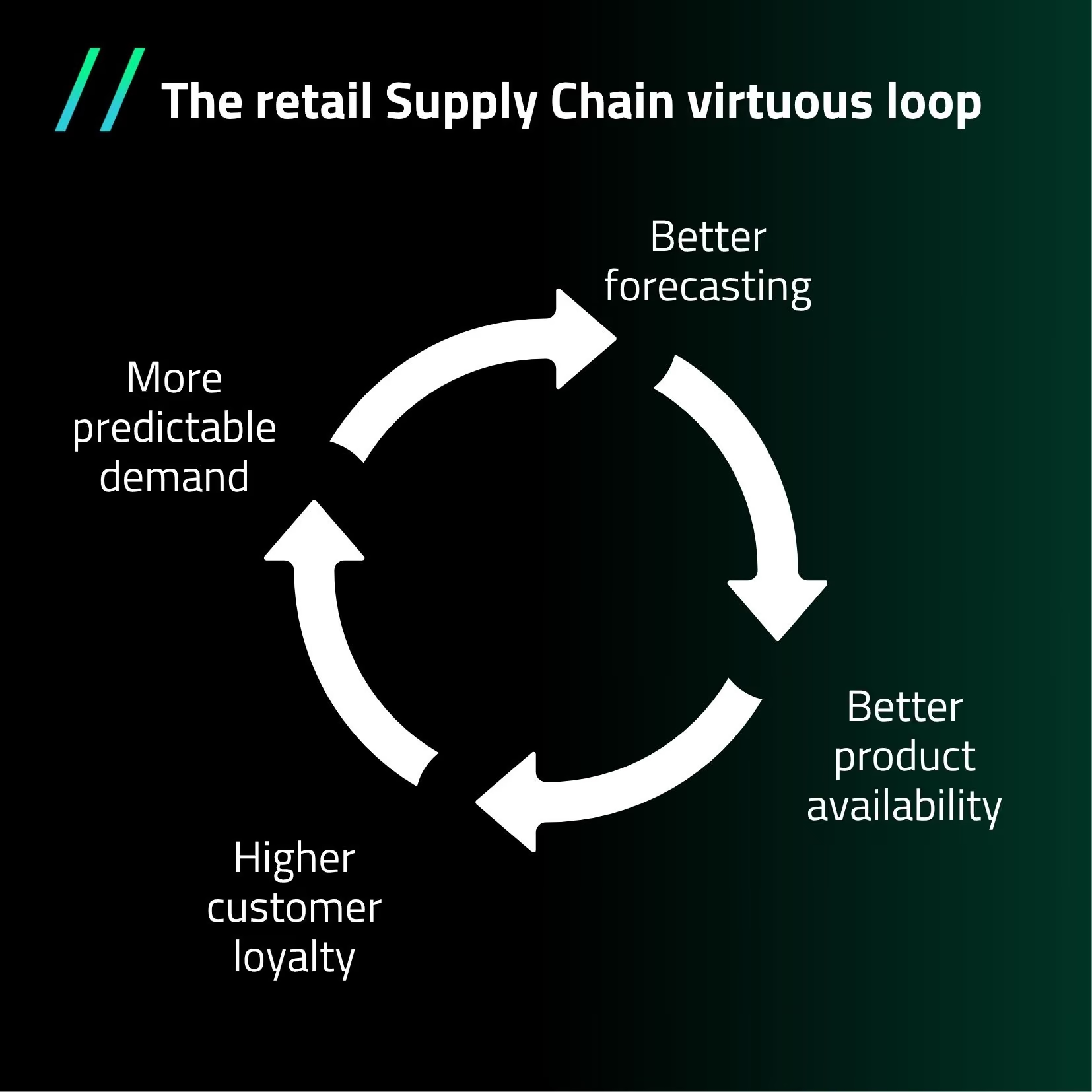
The organizations that close the gap between Supply Chain performance and customer satisfaction fastest will compound the advantage. Better forecasting produces better availability, which produces higher customer loyalty, which produces more predictable demand, which produces even better forecasting. The feedback loop runs in both directions. Getting ahead of it is the strategic imperative for retail Supply Chain leaders.
Discover how Flowlity helps retail and e-commerce Supply Chains close the gap between planning performance and customer experience with AI-driven forecasting, dynamic inventory optimization, and automated supplier collaboration.
Level up your supply chain with AI.
Get a demo
FAQ
Find everything you need to know right here.
What is customer satisfaction in Supply Chain management?

Customer satisfaction in Supply Chain management refers to the degree to which Supply Chain decisions, on product availability, delivery reliability, order accuracy, and fulfillment speed, meet or exceed customer expectations. In retail, it is determined primarily by three Supply Chain outputs: whether the product the customer wants is available when and where they want it, whether the delivery commitment made at purchase is honored, and whether the post-purchase experience, packaging quality, return process, communication, reflects the brand promise. Each of these is the result of planning decisions made days or weeks before the customer interaction occurs.
How does Supply Chain management affect customer satisfaction?
Supply Chain management affects customer satisfaction at every stage of the customer journey. Product availability at the point of purchase depends on demand forecasting and inventory positioning decisions made weeks or months earlier. Delivery reliability depends on supplier performance, lead time accuracy, and replenishment timing. Order accuracy and packaging quality depend on warehouse operations and the Supply Chain processes that support them. When any of these planning decisions fail, the customer experiences the failure directly, as a stockout, a late delivery, or a damaged package, regardless of how strong the brand's marketing or customer service effort is.
How can AI improve customer satisfaction through Supply Chain management?
AI improves customer satisfaction through Supply Chain management by replacing reactive, average-based planning with anticipatory, probabilistic planning that continuously updates as demand and supply conditions change. On the demand side, AI-driven forecasting detects shifts within days rather than weeks, allowing replenishment to respond before availability is affected. On the inventory side, AI sizes buffers to actual demand risk per SKU per location rather than applying blanket safety stock rules, releasing working capital where risk is low while protecting availability where it is high. On the supplier side, AI-enabled collaborative planning shares updated forecasts automatically as plans evolve, reducing the lead time variability that is one of the primary drivers of stockouts.