.svg)
.svg)
Lemoine
.avif)
.svg)
AI inventory optimization sizes buffers continuously by probability of risk and business impact, instead of by static coverage rules. Groupe Lemoine, a European manufacturer of cotton-based hygiene products, applied this approach across its catalogue. This case study shows how the team lifted service level by 11% while keeping working capital under control.
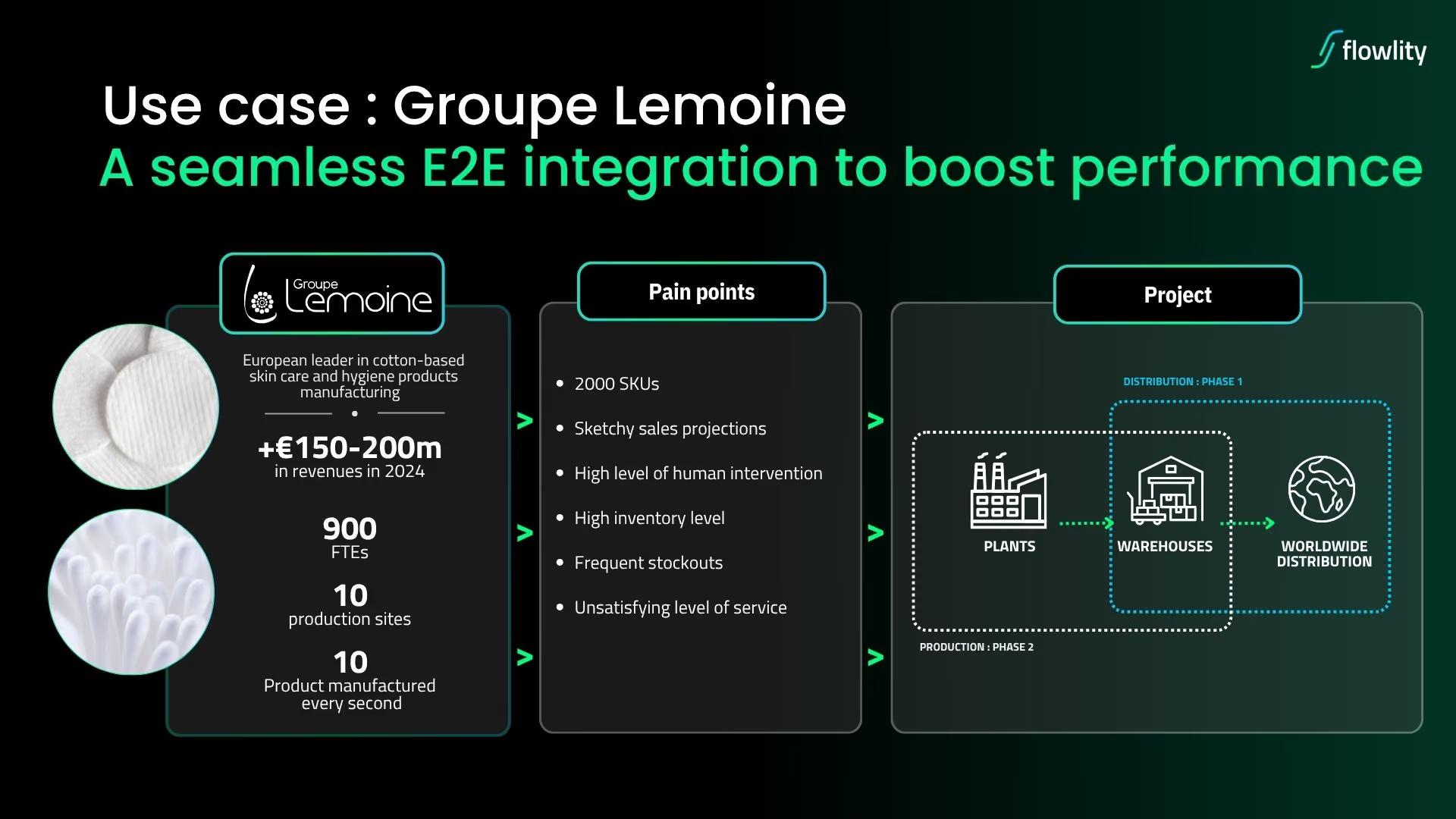
When you manage 2,000 SKUs across 10 production sites globally and a European planning network spanning 5 countries, every planning decision ripples through the entire Supply Chain. For Groupe Lemoine, the European leader in cotton-based skin care and hygiene products, that complexity was increasingly difficult to manage with legacy tools — relying on spreadsheets, manual reviews, and team expertise. Until they decided to change the game.
This inventory optimization case study explores how Groupe Lemoine moved from reactive, manual planning to AI-driven Supply Chain control with Flowlity — and the measurable results that followed.
The cotton hygiene industry context
Multi-country cotton hygiene manufacturers run complex Supply Chain networks that combine European production with international distribution. For Groupe Lemoine, the planning challenge spans 10 production sites globally and a European network across France, Holland, Spain, Germany, and Estonia. Before Flowlity, only three of those European factories shared the same IT system (Voxlog, Sept. 2023), which forced planners into weekly manual reconciliation across disconnected stacks. A single missed forecast signal at one site could cascade into stockouts at distribution and excess inventory at another plant.
Managing 2,000 SKUs with spreadsheets: Groupe Lemoine's starting point
Groupe Lemoine is no small operation. With over €150 million in annual revenue, 900 employees, and a product manufactured every second, the company supplies cotton-based hygiene products to retailers and distributors across Europe and beyond. Their production network spans 10 sites across France, Holland, Spain, Germany, and Estonia — a scale that requires optimizing inventory across multiple echelons and locations to keep operations running smoothly.
But behind this industrial scale, the Supply Chain team was working with a planning process that hadn't kept pace with the company's growth.
As Stéphanie Aury, Supply Chain Project Manager at Groupe Lemoine, explains: "The decision-making process was entirely manual. Every week, every month, her team had to review data line by line — a time-consuming effort that left little room for reactivity or strategic thinking".
The consequences were tangible: sales forecasts that lacked precision, high inventory levels, frequent stockouts, and a service level below the company's potential. A missed demand signal at one site would cascade into a shortage at distribution and excess stock at another plant: the structural cost of operating a multi-echelon network without a unified planning layer. Different production sites were running on different information systems, making it nearly impossible to get a unified view of what was happening across the network. On top of that, teams were spending significant time on Excel-based data reconciliation, rather than on actions that actually move the business forward.
Groupe Lemoine needed more than incremental improvement. They needed a fundamentally different approach to inventory management optimization — one that could unify their multi-site operations and free their teams to focus on what matters.
Why Groupe Lemoine chose Flowlity for inventory optimization
When evaluating solutions, Lemoine had a clear set of requirements. The tool had to connect production sites that weren't on the same ERP, provide a single source of truth for planning decisions, and be user-friendly enough for daily adoption across teams.
Flowlity stood out because it addressed all three. The platform connected Lemoine's existing production systems, with 2,000 SKUs integrated from the start. But unlike traditional planning tools, Flowlity didn't just centralize data — it transformed how that data was used. Instead of reviewing every SKU manually, planners now only focus on items flagged by Flowlity's alert system, effectively automating and streamlining supply orders across the network.
The project followed a phased approach: distribution first, then production. This allowed teams to build confidence in the tool progressively, starting with replenishment flows across distribution networks before extending to the more complex production environment with its capacity constraints.
A key factor in the project's success was the dedicated support model. From day one, Lemoine worked with a dedicated customer success manager at Flowlity, supporting IT, project management, and Supply Chain teams across the rollout. This streamlined communication, accelerated onboarding, and ensured alignment throughout the rollout.
How AI-driven planning transformed daily operations
Replacing manual reviews with intelligent alerts
The most immediate change was operational. Before Flowlity, planners spent hours every week going through data line by line. Now, the system automatically identifies which SKUs need attention and which are running smoothly. This shift from exhaustive manual review to exception-based management freed up significant time — time that Lemoine's team now invests in running parallel strategic projects.
Unifying a multi-site, multi-country Supply Chain
One of Lemoine's biggest challenges was the fragmentation of their information systems across sites. Flowlity acts as a unifying layer, giving planners visibility across their European network within a single platform. This visibility is critical for making informed decisions about where to allocate inventory, how to balance production loads, and how to respond to shifts in demand across markets.
The tool also serves as an internal communication support, replacing scattered Excel files with a shared, real-time view of the Supply Chain. Teams across sites now work from the same data, which has streamlined and standardized production processes across the network.
Running simulations in seconds, not days
One of the capabilities that made the biggest difference for Lemoine is Flowlity's simulation engine. Before, evaluating the impact of a change in demand or a shift in production capacity was a slow, manual exercise. Now, simulations run in seconds, allowing planners to test scenarios and make decisions almost instantly.
This capability proved especially valuable for navigating Supply Chain disruptions and capacity constraints — situations where speed of decision directly impacts service levels and costs. For companies facing similar challenges, exploring strategies for forecasting and optimizing inventories in volatile markets can provide additional insights into how simulation-driven planning strengthens resilience.
Smarter demand analysis with AI
Beyond planning automation, Flowlity's AI layer gave Lemoine a deeper understanding of customer behavior patterns. The system analyzes demand signals to produce higher-quality forecasts, which in turn feed into more stable production requirements and better inventory positioning. The result: better organization, better anticipation, and more confident decision-making across the business.
Results: a proven ROI that keeps improving
Across 2,000 SKUs and six European production sites, the outcomes were measurable, sustained, and covered every dimension of operational performance:
- Fewer stockouts and a higher service level across the full European network
- Inventory levels right-sized to actual demand, with working capital freed
- Multi-site Supply Chain unified under a single planning layer
- Production processes streamlined and standardized across all sites
- Decision-making shifted from reactive and manual to data-driven and proactive
- Planner time redirected from weekly data reconciliation to strategic work
The headline figures tell the most precise part of the story.
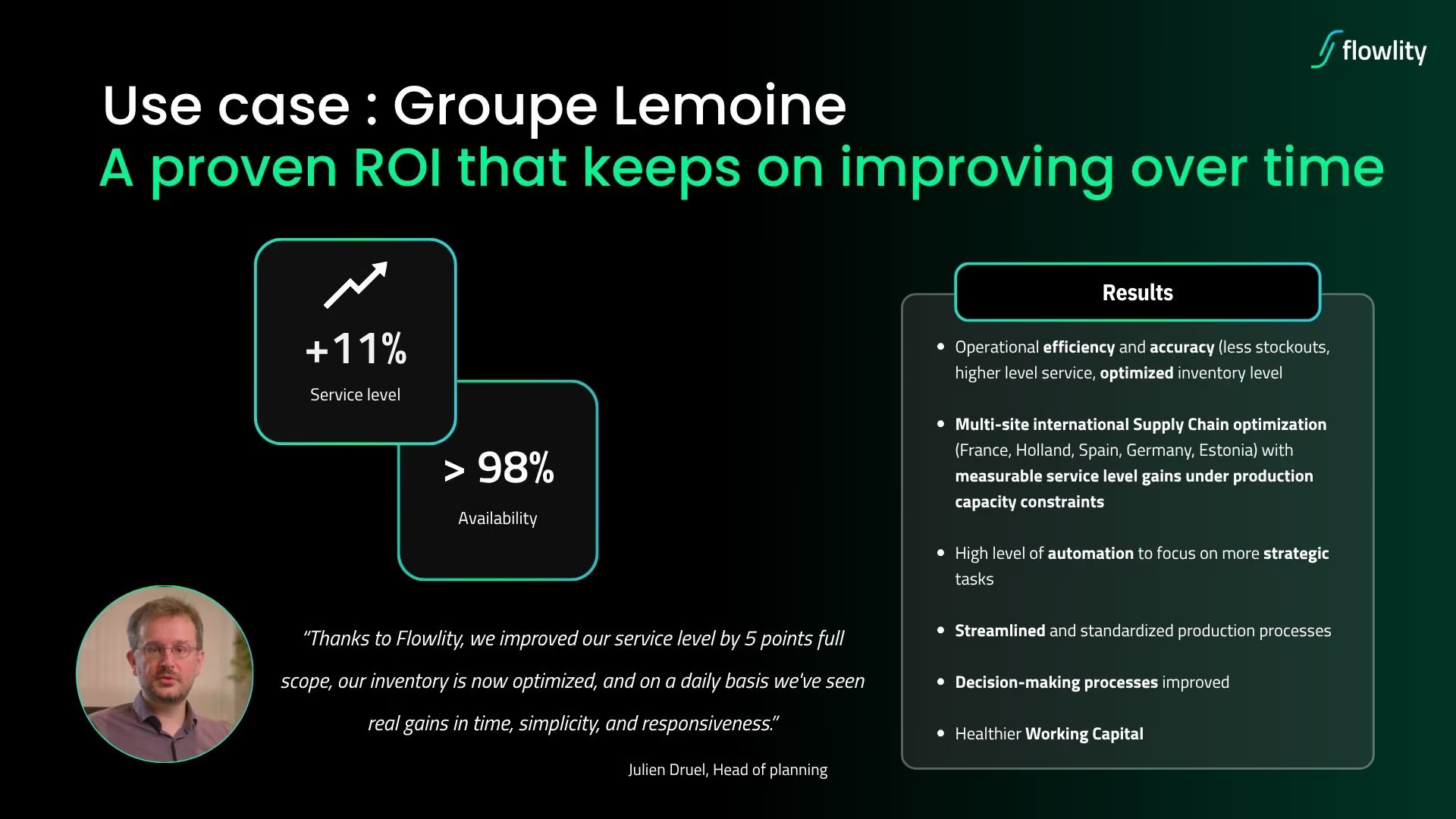
+11% service level improvement
Lemoine improved their service level by 5 points across the full scope of operations, with peaks of +11 points on specific product segments such as cotton pads.The lift came from real-time AI processing of demand data across the unified European network, with forecasts now refined client by client and country by country.
>98% product availability
A significant reduction in stockouts, directly tied to better demand forecasting and optimized inventory positioning across sites. Above 98% availability means that fewer than two order lines out of every hundred fall short. Lemoine reached this level after Flowlity consolidated data and harmonized planning processes across its six European factories, enabling more complete simulations that anticipate stockouts before they cascade through the network (Voxlog, Sept. 2023).
Healthier working capital
By right-sizing inventory levels, Lemoine freed up cash by aligning inventory levels more closely with actual demand. Service level went up and inventory came down at the same time. Traditional planning treats the two as a trade-off: more buffer for better service, less buffer for less cash locked up. Probabilistic, AI-driven inventory optimization breaks that compromise by sizing each buffer to its actual risk profile rather than to a blanket coverage target. SKUs with stable demand and short lead times carry less. Volatile or critical SKUs carry more, but only where the data justifies it. The cash that used to sit idle in over-stocked references is freed back into the working capital baseline.
Beyond the KPIs, the transformation reshaped how the Supply Chain team works. Decision-making processes are faster and more data-driven. Production workflows are streamlined and standardized across all sites. And perhaps most importantly, planners now spend their time on strategic work rather than manual data crunching.
As Julien Druel, Head of Planning at Groupe Lemoine, puts it:
"Thanks to Flowlity, we improved our service level by 5 points full scope, our inventory is now optimized, and on a daily basis we've seen real gains in time, simplicity, and responsiveness."
Watch: Groupe Lemoine's Supply Chain transformation
Hear directly from Stéphanie Aury, Supply Chain Project Manager at Groupe Lemoine, as she shares how Flowlity helped unify their multi-site operations and deliver measurable results.
Key takeaways from this inventory optimization case study
Groupe Lemoine's experience highlights several lessons that are relevant for any manufacturer looking to optimize inventory management across complex, multi-site operations.
The right tool must unify, not just optimize
Lemoine's core challenge wasn't just high inventory — it was fragmented visibility across sites and systems. A solution that only optimized stock levels without connecting the dots across locations wouldn't have solved the underlying problem. Before Flowlity, only 3 of Lemoine's six European factories shared the same IT system. Aggregating those 6 plants on the same SaaS platform was the prerequisite Flowlity addressed first, which consolidated data and harmonized processes across the European network. That is the order of operations Flowlity enforced from day one: data unification before any inventory optimization gain.
Automation should target the right tasks
The shift from reviewing every SKU to focusing only on alerts was transformational. It didn't just save time — it changed the nature of the planner's role from data processing to strategic decision-making. Plum Living's transformation tells a similar story of how AI reshaped daily planning in a different industry context (retail DTC).
Implementation matters as much as technology
The phased rollout (distribution first, then production) and the dedicated customer success model were instrumental in driving adoption and delivering results quickly.
Phasing matters because it lets planners build confidence on a simpler scope (replenishment flows between warehouses) before tackling the harder problem of production with its capacity constraints, changeover times, and raw material lead times. A dedicated customer success manager covering IT, project management, and Supply Chain matters because escalations stop bouncing between tickets and queues: one person carries the full context of the deployment, which is often the difference between a six-month rollout and a stalled one. For mid-market manufacturers evaluating the benefits of using software for inventory optimization, both of these implementation choices are usually as decisive as the technology itself.
For industrial companies managing complex Supply Chains, Lemoine's story is a clear proof point: AI-powered inventory optimization isn't just a promise — it's a measurable, operational reality. Explore more Supply Chain case studies to see how other companies achieved similar transformations.
Level up your supply chain with AI.
Get a demo


FAQ
Find everything you need to know right here.
What ROI did Groupe Lemoine measure on its Flowlity project?

Lemoine measured ROI across three axes: service level (+5 points on the full scope, peaks of +11 points on specific segments like cotton pads), product availability (above 98% across the network), and working capital (right-sized inventory, cash freed at equal or better service).
Beyond those headline KPIs, the project also delivered a healthier working capital baseline by aligning inventory levels with actual demand, and a significant gain in planner productivity that lets the team focus on strategic work.
Julien Druel, Head of Planning at Groupe Lemoine, summarizes the outcome around three concrete daily gains for the team: time saved, simplicity in the planning routine, and responsiveness to demand changes (full quote in the Results section above).
What changed in Groupe Lemoine planners' daily work with AI inventory optimization?
Before Flowlity, Lemoine's planners spent hours every week going through data line by line across the European network, reconciling Excel files and recalculating buffers SKU by SKU. After Flowlity, the system automatically identifies which SKUs need attention and which are running smoothly, which shifts the work from exhaustive manual review to exception-based management.
The freed time gets reinvested in strategic work that adds real business value. Simulation has been particularly valuable: scenarios that used to take days now run in seconds, so planners can test the impact of a demand change or a capacity constraint and make decisions almost instantly.
The shift, made possible by AI-powered Supply Chain planning, changes the nature of the planner role from data processing to strategic decision-making, which protects against turnover in a function where experienced talent is hard to replace. Decision-making across the business is faster and more data-driven.
How does Flowlity unify Groupe Lemoine's multi-country Supply Chain?
Flowlity connects to each of Lemoine's site ERPs, normalizes the data, and gives planners a single interface to see demand, stock, and production across the entire network. Decisions and policy changes propagate downstream automatically, so a forecast adjustment in centralized AI demand planning triggers a coherent production response at the relevant plant without manual relays between teams.
Cross-site visibility means planners can rebalance inventory dynamically, avoiding the classic pattern where one site stocks out while another carries excess of the same SKU. The system also acts as an internal communication layer: scattered Excel files are replaced with a shared, real-time view that everyone reads from, which standardizes processes across the European network.
For Lemoine specifically, this unification was the prerequisite for everything else: before AI could optimize buffers, the data had to be reconciled across plants in France, the Netherlands, Spain, Germany, and Estonia, and that consolidation is what made the subsequent service-level and inventory gains possible.
How many SKUs and production sites does Flowlity cover at Groupe Lemoine?
Flowlity covers Groupe Lemoine's full operational scope: 2,000 SKUs across the company's European production network in France, the Netherlands, Spain, Germany, and Estonia, with one product manufactured every second on the industrial footprint. The platform ingests demand signals from distribution and pushes coherent production plans back to each plant.
This scale would be impossible to sustain manually: 2,000 SKUs reviewed weekly across the European network means tens of thousands of decisions per cycle. Flowlity's exception-based logic surfaces only the SKU-site combinations that genuinely need planner attention, which is what makes the planning function scale without growing the team.
How did Groupe Lemoine improve its service level with Flowlity?
By unifying planning data across Lemoine's European network in France, the Netherlands, Spain, Germany, and Estonia, Flowlity replaced manual SKU-by-SKU reviews with exception-based alerts that surface only the items needing attention. The team raised service level by 5 points on the full scope, with peaks of 11 points on specific segments such as cotton pads where demand variability was hardest to forecast manually.
Product availability reached above 98% across the network, supported by AI-sized buffers that account for both demand uncertainty and supplier lead time risk. Critically, this happened while inventory pressure on working capital actually decreased, because the AI right-sized buffers SKU by SKU rather than applying the broad safety margins that planners used to add by default.
The unified view also standardized planning decisions, so the same product gets the same logic regardless of which factory makes it. A similar service-level transformation has been documented in industrial spare-parts contexts, notably the AI demand forecasting case study at Saint-Gobain Sekurit across 30 distribution centers.
What Supply Chain challenges was Groupe Lemoine facing before Flowlity?
Groupe Lemoine operates a cotton-based skin care and hygiene products business with around €150 to 200 million in annual revenue, 900 employees, and 10 production sites globally. Its European network covers France, the Netherlands, Spain, Germany, and Estonia. With 2,000 SKUs and one product manufactured every second, the planning workload was significant: each site ran its own ERP and its own data formats, which forced planners into weekly line-by-line spreadsheet reviews to reconcile signals across the network.
The consequences were tangible: imprecise sales forecasts, high inventory levels, frequent stockouts, and a service level below the company's potential. Different production sites operated on different information systems, which made it nearly impossible to get a unified view of what was happening across the European network. The team spent significant time on Excel-based data reconciliation rather than on actions that actually moved the business forward, and growth was making the workload exceed what the planning team could sustain manually.
Lemoine needed a fundamentally different approach: one that could unify multi-site operations and free planners from manual reconciliation.