.svg)
.svg)
Best food and beverage inventory software (2026)

The number every F&B planner already knows by heart
The FAO (Food and Agriculture Organization of the United Nations) estimates that 13% of the food produced worldwide is lost between harvest and the store shelf, before a household or a restaurant wastes a single unit. That is the paradox at the heart of food and beverage supply chains: the sector has never had more demand data, and yet a real share of what it produces never reaches a customer.
The problem is rarely a lack of data. It is a planning problem, and it shows up with the same two symptoms in almost every F&B business: empty shelves on the fast movers, and warehouses full of stock that will expire before anyone can sell it.
The sector lives under constant pressure from demand variability, seasonality, tight regulatory requirements and the specific challenge of managing perishable stock. To hold service levels high without piling up excess or generating waste, companies increasingly lean on food and beverage inventory software that supports forecasting, replenishment and operational planning. This comparison is written for F&B manufacturers, brands and distributors, not for restaurant-only tools.
What F&B teams are actually up against, every day
Talk to manufacturers, distributors and retailers in food and beverage and the same patterns surface, whatever the product category. Four typical situations:
- A fresh-food e-grocer has to plan some SKUs in daily buckets for the first few weeks, where shelf life leaves no room for error, then switch to monthly buckets further out, while lead times shift depending on which day of the week the order is placed.
- A confectionery and snack chain with hundreds of stores needs a tool for reordering from the central warehouse to its suppliers, not just for pushing stock from warehouse to shelf: a link still handled by hand.
- A large wholesale distributor carrying food, beverage and household goods, with thousands of SKUs across several distribution centers, still plans in spreadsheets on top of a legacy ERP, with real overstock and waste but no objective visibility into where it actually comes from.
- A specialty food distributor runs manual, fragmented purchasing, made harder by promotion-driven demand spikes, strong seasonality and new SKUs with no history to forecast against.
None of these is an edge case. This is what everyday F&B planning looks like, and it is why a tool built for a restaurant checkout rarely satisfies a manufacturer or a distributor, and why a generic ERP module rarely covers a team that drowns in exceptions every week.
ERP, MRP, APS: understand the categories before you choose
Much of the confusion comes from lumping together tools that solve different problems. Before comparing them, it helps to separate them:
- ERP and business systems (SAP, NetSuite, Odoo): the system of record. They run transactions, book inventory, handle invoicing and lot/HACCP traceability. They know what happened, not what will happen.
- MRP and production software (Katana, Fishbowl): they orchestrate bills of materials, production orders and raw materials for companies that transform a product.
- Restaurant and POS software (Toast, MarketMan): food cost, menus and the restaurant checkout. Out of scope for a manufacturer or a distributor.
- APS (advanced planning and scheduling) and demand planning (Relex, Slimstock, o9, Flowlity): forecasting, safety stock and replenishment. This is the layer that decides how much to order and when.
This comparison focuses on that last category applied to food and beverage, because that is where the fight between waste and stockouts is won or lost. Each tool below, though, answers a different need.
The F&B inventory software compared
Katana: MRP for makers
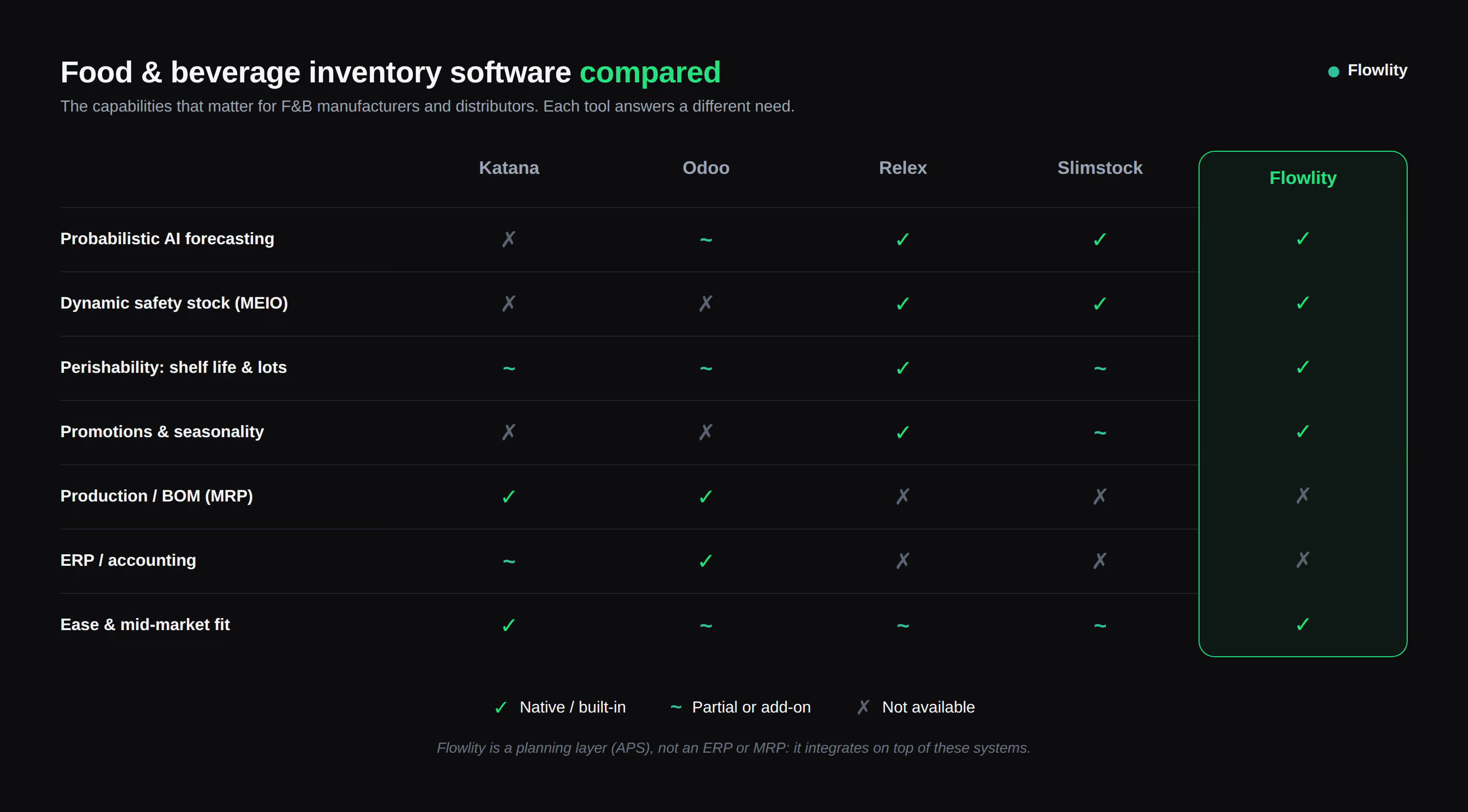
Katana is a cloud MRP built for companies that actually make things: breweries, bakeries, roasteries, small food processors. It ties together bills of materials, production orders, raw materials and finished goods in real time, with support for variants and multiple sites. It is the natural pick when the core problem is coordinating the shop floor rather than forecasting demand. But it was born as a production-execution tool: advanced forecasting and dynamic safety stock are not in its DNA, and many teams end up bolting on a spreadsheet or a dedicated planning tool to handle food and beverage volatility.
Strengths
- Supports product variants and multi-site operations
- Fits simple production environments: breweries, bakeries, small artisanal producers
Limits
- Its built-in forecasting (the Planning and Forecasting module) is based on historical trends and simple rules, not probabilistic models: good for stabilizing orders, less so for modeling real demand uncertainty
- For highly perishable or fast-moving stock with marked variability, many teams still add a spreadsheet or a dedicated planning tool
Relex: enterprise APS for grocery retail
Relex is an enterprise planning platform built for grocery retail and FMCG. It uses machine learning for store-level forecasting, automated replenishment and shelf-life management, with end-to-end visibility across procurement, production and sales. For a large chain or a structured food distributor, it is one of the most complete solutions on the market. The flip side is scale: it is designed for large organizations, its center of gravity is retail rather than production, and for a mid-market manufacturer with recipes and batch constraints it can feel oversized and harder to bend. If you are weighing the two, our Flowlity vs Relex comparison breaks down where each one fits.
Strengths
- Automated replenishment, shelf-life management and store-level forecasting
- A strong fit for large distributors and grocery chains
Limits
- Primary focus on grocery retail rather than production
- Manufacturers with complex recipes, batch dependencies or production constraints should check carefully: a retail-first approach can limit flexibility in production planning and batch-level inventory control
Slimstock (Slim4): mid-market inventory optimization
Slimstock, with its Slim4 suite, is one of the long-standing names in inventory optimization in Europe (founded in 1993, more than 1,500 customers). It is very solid on replenishment, stock classification and parameter management, with an added S&OP module, and it is often the choice of mid-market companies moving off spreadsheets. It is a good reference when the goal is to normalize replenishment across a broad catalog. Against a natively probabilistic approach, though, it stays anchored to more traditional stock models: the fine handling of perishability and the mixed daily/monthly horizons of fresh categories is not its strong suit, and projects tend to be multi-year contracts. For a side-by-side, see our Flowlity vs Slim4 (Slimstock) comparison.
Strengths
- Mature, reliable replenishment across broad, multi-warehouse catalogs
- S&OP module and a strong installed base in the European mid-market
Limits
- More traditional than natively probabilistic stock models, a weaker fit for the extreme volatility of fresh
- Perishability and mixed daily/monthly horizons are not the primary focus
Odoo: the modular ERP
Odoo is a modular open-source ERP: with its Manufacturing, Inventory and Warehouse modules it covers real-time tracking, bills of materials and basic forecasting in a single system. For an F&B company looking for one low-cost system of record, it is a flexible and widely adopted option. That flexibility has a price, though: customization takes technical skills, and Odoo does not natively include advanced food and beverage demand-forecasting algorithms or perishability-constraint handling. It stays better suited as a generalist ERP than as a specialized planning platform.
Strengths
- Very flexible; coordinates production and stock in a single ERP
Limits
- Customization often requires specific technical skills
- No native advanced algorithms for F&B demand forecasting or perishability constraints, which makes it better as a generalist ERP than as a specialized planning platform
Flowlity: the AI-native planning layer
Flowlity is an AI-based planning layer that sits on top of your existing ERP or business system. Its probabilistic models generate SKU-level forecasts and dynamically compute the optimal stock, factoring in lead times (including lead times that vary by day of the week), supplier reliability and demand volatility, along with the mixed daily/monthly horizons typical of fresh categories. It is built for mid-market F&B manufacturers and distributors that have outgrown spreadsheets but do not run a dedicated IBP function: implementations are measured in weeks, not months.
Strengths
- Safety stock computed from lead time, supplier reliability and demand variability, to balance service level against waste reduction, including day-of-week-dependent lead times and the mixed daily-to-monthly horizons of fresh categories
- Collaborative features to share forecasts with suppliers and customers, cutting stockouts and preventing overproduction
- AI-based demand planning that turns promotions and seasonality into modeled inputs rather than after-the-fact surprises; dedicated promotion management extends the approach to teams whose biggest planning risk is the promo calendar
- Advanced AI paired with genuine ease of use: implementations typically in a few weeks, with no need for a dedicated integrated business planning (IBP) function
The market landscape: where a planning layer fits
Search for food and beverage software and you mostly land on three families of tools, all different from a true planning layer:
- ERP and accounting systems (NetSuite, SAP, QuickBooks, Odoo): they cover accounting, inventory, invoicing and lot/HACCP traceability. Excellent as a system of record, but demand forecasting and safety stock stay static rules or a spreadsheet on the side.
- Restaurant and POS software (Toast, MarketMan): built for the checkout, menus and food cost of a restaurant, not for a manufacturer’s or a distributor’s reordering.
- Warehouse and manufacturing execution (Fishbowl, Unleashed, BatchMaster): they govern locations, movements and shop-floor execution, but they do not forecast demand or dynamically size perishable stock.
Flowlity does not replace these systems. It is the AI planning layer that integrates on top of the ERP or business system and turns demand forecasting and inventory planning into a probabilistic process, built for the perishability of food and beverage categories.
How to choose the right food and beverage inventory software
Each solution answers a different need inside F&B. In short:
- Katana and Odoo: execution (production and ERP), but advanced forecasting is still something you add on top.
- Relex: enterprise planning for large grocery retailers; powerful, but often oversized for the mid-market manufacturer.
- Slimstock (Slim4): solid, mature replenishment; less specialized on perishability and the mixed horizons of fresh.
- Flowlity: an AI-native planning layer for the F&B mid-market (probabilistic forecasting, perishable stock, dynamic optimization), to integrate on top of the ERP instead of replacing it.
For F&B companies that want to optimize working capital, cut waste, lift service levels and simplify planning without the burden of a full ERP rollout, an AI-driven solution like Flowlity offers the best balance of performance, agility and ease of use.
Cutting waste starts with the right planning layer, not a bigger spreadsheet
Every tool in this comparison can track a SKU. The difference between them shows up in the week a promotion launches, a supplier’s lead time stretches, or demand on a fast mover jumps with no warning: that is exactly the moment a static spreadsheet rule or a restaurant checkout tool runs out of answers.
For manufacturers, brands and distributors handling real perishability and real demand swings, an AI-native, probabilistic planning layer is what turns that weekly fire drill into a manageable queue of exceptions.
Want to see how it works on your own catalog? Request a Flowlity demo and bring your hardest SKU, the one that costs you the most today in stockouts or waste, to see how the platform handles it.
Level up your supply chain with AI.
Get a demo

FAQ
Find everything you need to know right here.
What is food and beverage inventory software?

Food and beverage inventory software helps manufacturers, brands and distributors track stock levels, manage perishable goods, forecast demand and reduce waste. Unlike generic inventory tools, it is designed to handle shelf life, variability and regulatory constraints specific to the food industry. Typical capabilities include batch and lot traceability, expiry-aware replenishment logic, and demand forecasting that accounts for promotions, seasonality and shelf life jointly. The result is an inventory view that reflects not only how much stock is on hand, but how much of it remains sellable, which is the only number that matters for service level, waste and margin in food and beverage operations.
Which inventory management software works best for perishable goods?
The best inventory management software for perishable goods combines accurate demand forecasting, dynamic safety stock calculation and expiry-aware inventory management. AI-driven solutions are especially effective for managing volatility and minimizing food waste. Static reorder rules tend to either over-cover, generating expired stock, or under-cover, generating shortages, because they cannot adapt fast enough to changing demand profiles. A probabilistic approach sizes buffers continuously based on actual demand variability and remaining shelf life per SKU, which is the only way to protect service level while reducing waste in a category where excess stock and lost sales both translate quickly into hard cost.
How can food and beverage companies reduce food waste in the supply chain?
Reducing food waste in the Supply Chain requires better demand forecasting, tighter inventory control and closer collaboration with suppliers. Using specialized food and beverage inventory software helps align production capacity, replenishment and real demand, preventing overproduction and obsolescence. Shelf life and demand variability make this category particularly unforgiving: a small forecast error can translate directly into expired stock or stockouts, with no margin to absorb the difference. Probabilistic planning helps by sizing buffers to actual demand uncertainty per SKU, so coverage is concentrated where it protects service and reduced where it would only generate waste before the next replenishment cycle.
What is the difference between ERP inventory modules and specialized F&B inventory software?
ERP inventory modules provide basic stock tracking but often lack advanced forecasting and perishable goods optimization. Specialized food and beverage inventory management software focuses on demand variability, shelf life and inventory optimization, delivering faster ROI with less complexity. The methodological difference matters in volatile categories: a generic stock module treats every SKU the same, while a specialized tool sizes buffers per SKU period using probabilistic models that account for demand uncertainty and expiry constraints. In practice, this is what allows food and beverage companies to reduce waste without degrading service level, which is rarely achievable with ERP inventory modules alone.
Can food and beverage inventory software integrate with ERP systems?
Yes. Most modern food and beverage inventory software integrates with existing ERP systems to avoid data duplication. This allows companies to enhance planning and inventory optimization without replacing their core transactional systems. The integration typically synchronizes master data, sales history, inventory positions and supplier lead times, so the planning tool always works on a consistent picture of the operation. Decisions computed in the planning layer, replenishment proposals, dynamic safety stock and exception alerts, can then be written back to the ERP for execution. The result is a clean separation: the ERP remains the system of record, while the planning solution provides the analytical layer on top.
What is the best inventory management system for food manufacturers?
The best inventory management system for food manufacturers depends on production complexity, volume and perishability. Solutions designed specifically for the food industry provide better forecasting accuracy, inventory control and waste reduction than generic tools. Food manufacturers also need planning logic that accounts for batch sizes, line capacity and shelf life jointly, since a decision that looks optimal on a single dimension often creates waste or shortages on another. Probabilistic, AI-driven planning tools handle this complexity natively, balancing service level, inventory and waste at the SKU level rather than relying on static safety stock rules that age quickly in volatile food and beverage markets.
Is food and beverage inventory software suitable for mid-sized companies?
Yes. Many mid-sized food and beverage companies benefit from specialized inventory software because it is faster to implement, easier to use and more cost-effective than large enterprise suites, while still delivering measurable performance gains. Mid-sized operations rarely have the slack to absorb either expired stock or shortages, so the impact of better planning shows up quickly in service level, waste reduction and working capital. Modern AI-driven platforms are now packaged for that reality: shorter onboarding, lighter data requirements and pricing aligned with smaller perimeters, which removes the historical barrier that advanced inventory optimization used to be reserved for the largest food manufacturers.