.svg)
.svg)
Flowlity vs Sunstice (FuturMaster): how they compare
Both Flowlity and Sunstice (formerly FuturMaster) are advanced planning systems (APS). The split shows up one layer below: how each handles uncertainty, who operates it day-to-day, and time-to-value, from kickoff to first KPI moved. This article compares the two solutions on those three lenses.
Open any Supply Chain software homepage in 2026 and "AI" surfaces in the first scroll. Sunstice and Flowlity are no exceptions. The slogans look similar. The platforms underneath are not. Both qualify as APS, but they were built around different bets. The cost of that difference shows up where it matters: implementation timelines, planner workflows, and what the algorithm does the day demand surprises everyone.
In brief: Flowlity and Sunstice on a single page
Flowlity launched in 2018 in Paris on a single thesis: a forecast should ship with an explicit uncertainty interval, not a single number. In short, the platform forecasts demand using probabilistic AI, then auto-tunes inventory targets and supplier orders around that interval. Customers span retail and DTC (Plum Living, Sport 2000, Ravate), distribution (Camif, EDF), and industrial (Saint-Gobain Sekurit, Groupe Lemoine). Gartner named Flowlity a Cool Vendor in Supply Chain planning in 2025, and the platform holds 4.9 out of 5 on G2 across 9 reviews.
Sunstice has a longer story. Founded in 1994 as FuturMaster, the company rebranded to Sunstice in January 2026, fifteen months after Sagard NewGen acquired it and folded in PlaniSense for production scheduling. Sunstice supports more than 650 organizations across roughly 90 countries, with 70% of its base in partnerships longer than ten years. Reference clients include Heineken, L’Oréal, Forvia, LVMH, Bel, Bonduelle, and TotalEnergies. The platform holds 4.8 out of 5 on Gartner Peer Insights across 98 reviews and a spot in the 2026 Gartner Magic Quadrant.
Same APS family, different planning philosophy
Flowlity and Sunstice both fit the advanced planning system label. The interesting argument is over the assumption sitting inside the engine.
Sunstice runs a classical APS architecture: demand planning, supply planning, S&OP, revenue growth management, stitched into one loop. The engine takes a forecast and computes plans around it. That works for stable categories at companies with deep history. The day a category turns volatile, the recomputation cycle has to catch up, and the planner waits for the next cycle before the plan reflects what just happened.
Flowlity sits in the same family but starts from the opposite end. The forecast is probabilistic by construction. Every demand point ships with a calibrated upper and lower bound, anchored on history and external signals. Inventory targets, safety stocks, and supplier orders are sized for the uncertainty interval, not the central estimate. The practical effect: when a stock keeping unit (SKU) shifts from 100 to 30 units in a week, the classical APS notices and recomputes. The probabilistic version already had a buffer in place. That is the bet behind AI-driven planning at Flowlity: plan around the uncertainty, not against it.
How each platform applies AI
Many Supply Chain software vendors describe their platforms as AI-powered. Flowlity and Sunstice both fit that label. However, the two products take different paths to back it up.
Sunstice describes its AI through six technology pillars: data model, applied AI layer, dynamic digital twin, adaptive elastic engine, intelligent optimization, data integration. The 2026 Gartner Magic Quadrant slot reflects the maturity and enterprise scale of that stack. Public documentation describes the framework at a high level, with AI positioned as one layer inside a broader optimization platform that combines digital twin modeling, data integration, and decision engineering.
Flowlity goes the other way. The probabilistic forecast is the engine, and Gartner recognized the approach with its 2025 Cool Vendor award in Supply Chain planning. Plum Living, a direct-to-consumer furniture retailer, illustrates this in practice: the team went live on Flowlity Core in 3 months, and the probabilistic buffers calibrated during the rollout cut inventory 21% at go-live without compromising service. Fast implementation and early ROI flow from the same architectural choice: planning against a distribution from day one.
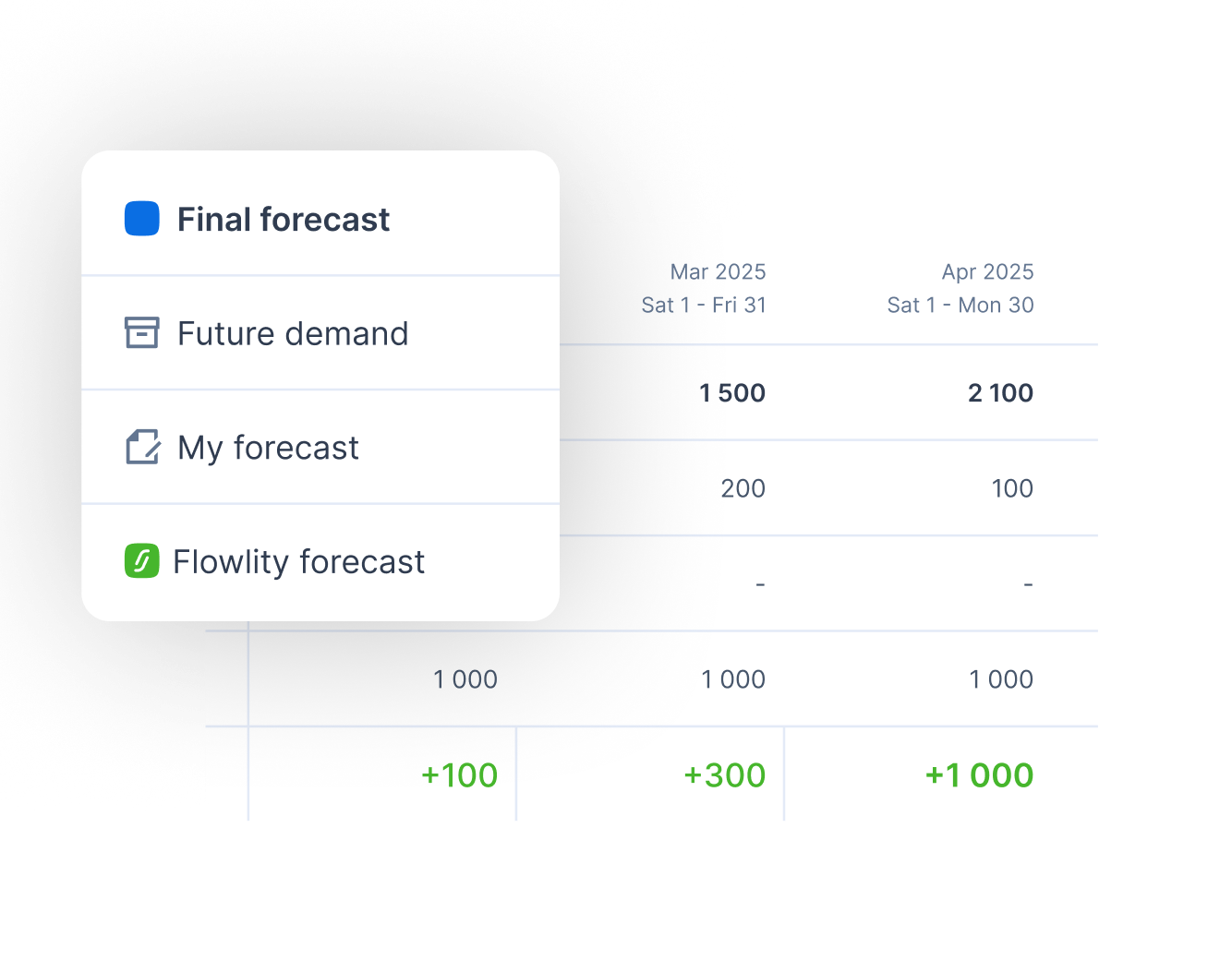
This is the substance behind demand planning built on probabilistic forecasting, a position Flowlity has held since 2018.
Software you use, or a program you run?
Two questions to put on the table before signing anything: who logs in tomorrow morning, and when does the first KPI move?
Sunstice does not publicly disclose deployment timelines. Enterprise IBP programs of comparable shape usually run discovery, configuration, change management, and integrator workstreams in parallel for six to nine months. Heineken, L’Oréal, and Bonduelle have the appetite and the planning center of excellence for that investment. A four-person Supply Chain team at a mid-market retailer does not.
Flowlity is built for the reality of mid-market Supply Chain teams: no dedicated data science function, demand that moves fast, no appetite for a multi-year program. The deployment model reflects that design. Flowlity Lite, the plug-and-play solution for smaller teams, is even faster to implement. Supply Caddy was fully operational two weeks later. Camif, a retail furniture company, freed a full-time planner (1,760 hours a year) while absorbing 44% growth, without hiring extra planners. Each Flowlity customer also gets a dedicated customer success manager (CSM) sitting next to the team during onboarding and beyond.
The official framings make the contrast plain. Sunstice’s positioning emphasizes co-design, predictable delivery, and secure integration with enterprise customers, a model that fits multi-quarter transformation programs. Flowlity’s positioning is the inverse: day-one usability for in-house planning teams, with a dedicated customer success manager accompanying the deployment from week one.
The planner’s Tuesday morning
The biggest difference between the two platforms isn’t the architecture slide. It is the planner’s Tuesday morning.
Sunstice’s Integrated Business Planning module follows the standard IBP cadence: monthly demand and supply reviews, financial reconciliation, executive sign-off. The strength is governance. Every plan crosses several stakeholders before it lands. The trade-off is cycle length: a monthly IBP loop responds at monthly frequency by design, with corrective actions landing in the warehouse on that cadence.
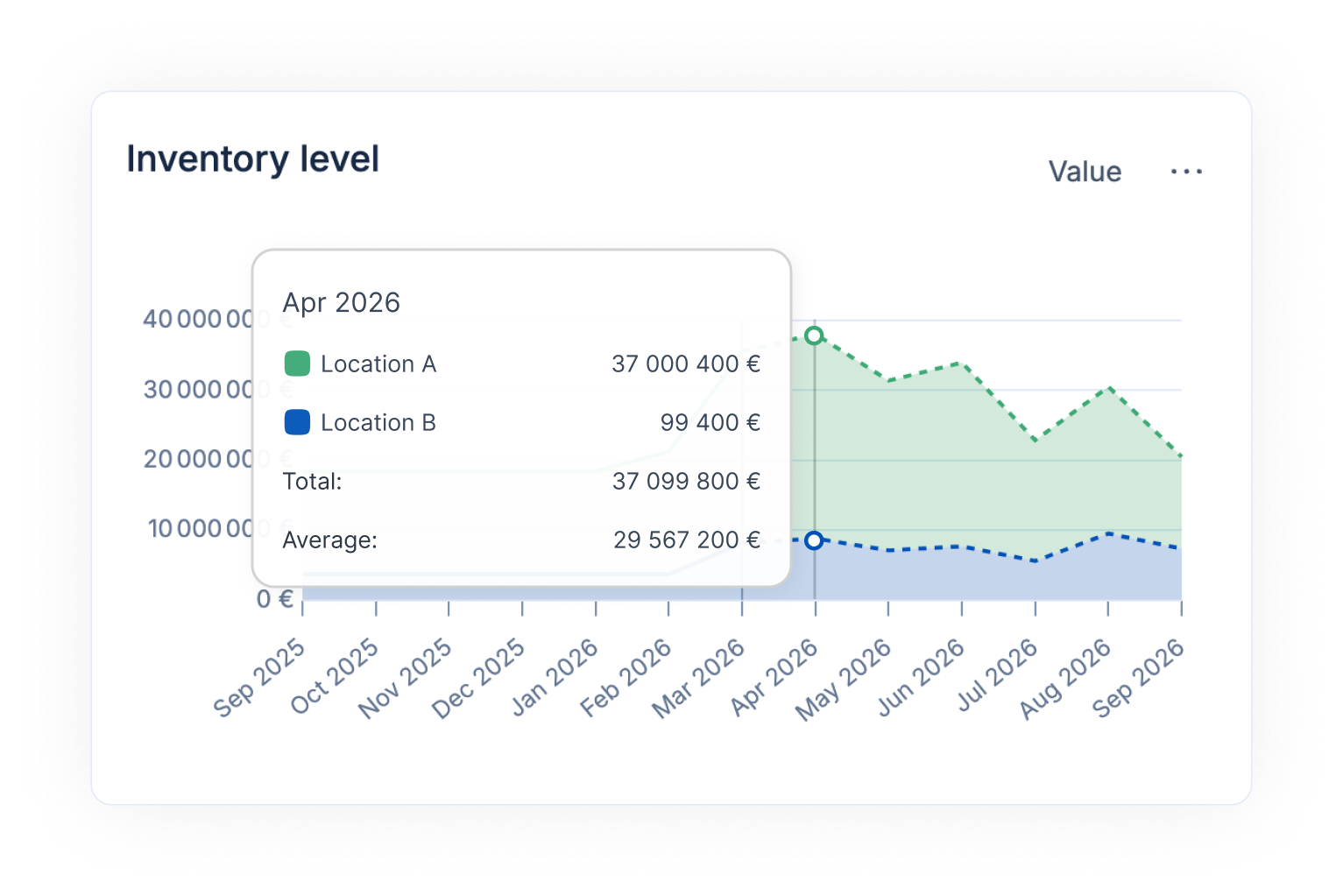
Flowlity inverts the flow. Inventory targets and supplier order propositions are computed automatically. The system raises a notification only when something falls outside the calibrated buffer. Planners spend the day on the 10% of SKUs that need a human, not on rebuilding plans across the other 90%. Saint-Gobain Sekurit lifted service level from 95.8% to 97.2% while compressing inventory by 9.25%. That band only closes when the loop between forecast, decision, and execution is short.
Flowlity vs Sunstice comparison table
Who each platform fits
Sunstice fits global organizations running a mature Sales and Operations Planning (S&OP) or Integrated Business Planning (IBP) practice. Internal planning teams, a transformation budget, and a multi-quarter horizon are the prerequisites. Consumer packaged goods, beauty, and pharma companies operating across dozens of countries are the natural buyers, especially once production scheduling enters the scope through PlaniSense. The 70% ten-year retention rate confirms that once the program lands, the platform performs.
Flowlity fits mid-market Supply Chain teams in retail, distribution, and industrial sectors that need probabilistic forecasting and inventory control without a transformation program around it. Plum Living, Camif, and Sport 2000 sit in this band. Flowlity Lite is the plug-and-play route for smaller or single-site operations. Companies aiming at global IBP harmonization will find Sunstice. Teams aiming at fast probabilistic control with one CSM on speed dial will find Flowlity.
Level up your supply chain with AI.
Get a demo

FAQ
Find everything you need to know right here.
How does Flowlity compare to traditional APS systems like FuturMaster or AZAP?

Flowlity differs in multiple ways:
AI at the Core
Built from the ground up with AI and automation, unlike traditional APS solutions based on manual tuning and linear models.
Modern UX
Simplified, intuitive interface that supports high user adoption vs complex legacy screens.
Agile Deployment
SaaS-based, modular rollouts deliver value in weeks—not the long waterfall projects required by older APS tools.
Continuous Innovation
Flowlity updates frequently with new features, while legacy tools evolve more slowly and require manual upgrades.
In short, Flowlity is ideal for organizations looking for faster ROI, ease of use, and advanced automation in a modern planning environment.
What is Sunstice (formerly FuturMaster)?
Sunstice is a Paris-based Supply Chain planning vendor founded in 1994. The company rebranded from FuturMaster to Sunstice in January 2026, after Sagard NewGen acquired it in late 2024. Sunstice serves more than 650 customers across roughly 90 countries, including Heineken, L'Oréal, Forvia, and Bonduelle. The platform covers IBP, demand planning, supply planning, revenue growth management, and production scheduling.
Is Flowlity an APS or something different?
Flowlity is an advanced planning system, like Sunstice. The distinction sits in the planning philosophy. Sunstice runs a classical APS that takes the forecast as a single number to plan against. Flowlity is an AI-native APS that treats demand as a distribution and sizes decisions for the uncertainty interval. Same software family, different bet on what the engine assumes.
How long does a Flowlity implementation take compared with a Sunstice deployment?
Flowlity implementations span from a few weeks to a few months. Flowlity Core typically goes live in under two months, as it did at Plum Living. Flowlity Lite, designed for smaller scopes, has gone live in under two weeks at Supply Caddy. Sunstice does not publicly disclose deployment timelines; enterprise IBP programs of comparable scope commonly run several months to more than a year before reaching full production.
What does probabilistic forecasting change in practice?
A traditional engine takes a single forecast number and computes plans on the assumption it is accurate. Probabilistic forecasting treats demand as a distribution and sizes decisions for the uncertainty interval. When demand is volatile, the gap shows up in stockouts avoided and inventory not parked in a warehouse waiting for a sale.
Who should pick Sunstice over Flowlity?
Sunstice fits companies that run a formal IBP cycle, have an internal planning center of excellence, and can fund a multi-quarter transformation involving system integrators and change management workstreams. The implementation weight that comes with that depth is the price of the platform's enterprise breadth: consumer goods, beauty, pharma, and large industrial groups with the team and budget to absorb it are the canonical profile. Flowlity fits smaller teams where time-to-value matters and the planner needs a daily AI decision support tool, not a program around it.