.svg)
.svg)
How Plum Living cut inventory by 38% with machine learning in Supply Chain


Machine learning in Supply Chain turns demand and supplier signals into continuously updated buffers, sized by probability of risk. Plum Living, a fast-growing DTC interior design brand, used this approach to redefine inventory management. This case study explains how the team cut stock by 38% while protecting service in a volatile catalogue.
Machine Learning is increasingly used in Supply Chain planning, but many discussions remain theoretical. Companies hear about AI forecasting, automated replenishment, or inventory optimization, yet it can be difficult to understand what these technologies actually change in day-to-day operations.
The experience of Plum Living provides a concrete example. As the company grew, its Supply Chain became more complex: more products, more suppliers, and increasing demand variability. Planning processes that once worked in Excel were no longer sufficient to manage inventory efficiently.
This case study explores how Plum Living introduced Machine Learning into its planning process, moving from manual inventory management to data-driven forecasting and replenishment decisions. The transformation improved visibility across the supply chain and significantly reduced inventory levels while supporting the company’s growth.
The DTC interior design context
Direct-to-consumer interior design brands sell highly customizable products, kitchens, wardrobes, bathrooms, where each configuration multiplies SKU complexity. Manufacturing lead times stretch over weeks while consumer expectations are now set by next-day e-commerce. The post-2020 boom in online home design also lifted demand variance: many fast-growing DTC home brands have seen inventory grow faster than revenue, locking up cash that should fund expansion. In this environment, accurate forecasts and a longer replenishment horizon are not nice-to-haves, they are what makes the growth model sustainable.
Plum Living: a fast-growing digital-first furniture brand
Founded in Paris in 2020, Plum Living specializes in customizable kitchens, wardrobes, and bathrooms sold through an online model focused on design and personalization. The company quickly built a strong brand presence across Europe and attracted a large online audience.
At the time of the project, the company operated with:
- around 45 employees
- approximately 1,000 SKUs, combining make-to-stock and make-to-order products
- around 10 suppliers supporting production and sourcing
- two warehouses managing inventory flows
Like many fast-growing digital brands, Plum Living faced a common operational challenge: scaling its supply chain while maintaining efficiency and service levels.
As demand increased and the product catalog expanded, the limitations of manual planning became more visible.

When growth exposes the limits of manual Supply Chain Planning
Before implementing an AI-driven planning system, Plum Living relied heavily on spreadsheets to manage inventory and replenishment.
While Excel provided flexibility in the early stages of the company, it gradually became difficult to maintain accurate and reliable planning as the business expanded.
Several operational problems appeared:
High inventory levels
Inventory was unevenly distributed across product categories, tying up working capital and increasing storage costs. With no statistical model behind buffer sizing, planners applied uniform coverage rules across very different references, which produced overstock on some lines and made cash harder to release without taking shortage risk elsewhere.
Limited visibility on future demand
The planning team lacked reliable forecasts, making it difficult to anticipate replenishment needs. Excel-based forecasts, typically built on past sales averages and manual adjustments, struggle to capture the demand variability of a fast-growing online catalogue where volumes shift quickly between SKUs. Decisions ended up being reactive rather than anticipative.
Manual replenishment processes
Inventory planning relied on manual calculations and spreadsheet updates, which made decision-making slow and error-prone. Each replenishment cycle required planners to refresh formulas and recalculate thresholds SKU by SKU, with logic that lived inside individual spreadsheets and was difficult to audit or hand over. The volume of maintenance work left little bandwidth for exception analysis.
Weak supplier visibility
Suppliers had little visibility into future demand, which complicated coordination and production planning. They received purchase orders as Plum Living’s needs surfaced, often at short notice, which forced them to react on raw materials, capacity, and shipments without the room to plan ahead. The relationship stayed transactional rather than collaborative.
Stockouts not systematically measured
Shortages were not always tracked or analyzed, preventing planners from identifying recurring issues. Without a structured stockout log, the team had no learning loop to feed back into safety stock policies or supplier discussions, so the same shortages tended to repeat across cycles.
These challenges are typical of organizations that grow faster than their planning processes. The supply chain becomes reactive, with planners spending most of their time correcting problems rather than anticipating them.
Introducing Machine Learning (ML) into Supply Chain planning
To address these issues, Plum Living decided to modernize its planning process using an AI and Machine Learning-driven Supply Chain planning platform – Flowlity.
The goal was not simply to improve forecasting accuracy, but to support better planning decisions across inventory management and replenishment.
The system analyzes historical demand patterns, lead times, and operational data to generate planning recommendations and improve visibility across the Supply Chain.
Once implemented, the platform provided several capabilities:
- demand forecasting based on historical patterns and variability
- automated replenishment recommendations
- inventory optimization based on service level targets
- improved coordination with suppliers through shared planning horizons
This approach allowed planners to move away from manual spreadsheet management and focus on monitoring exceptions and adjusting planning strategies.
These capabilities are part of a broader shift toward Supply Chain automation, where companies progressively replace manual planning with scalable tools designed to support growth. For a deeper look at this evolution, explore our guide on the most scalable Supply Chain automation tools to support growth and retail expansion.
A fast deployment focused on operational impact
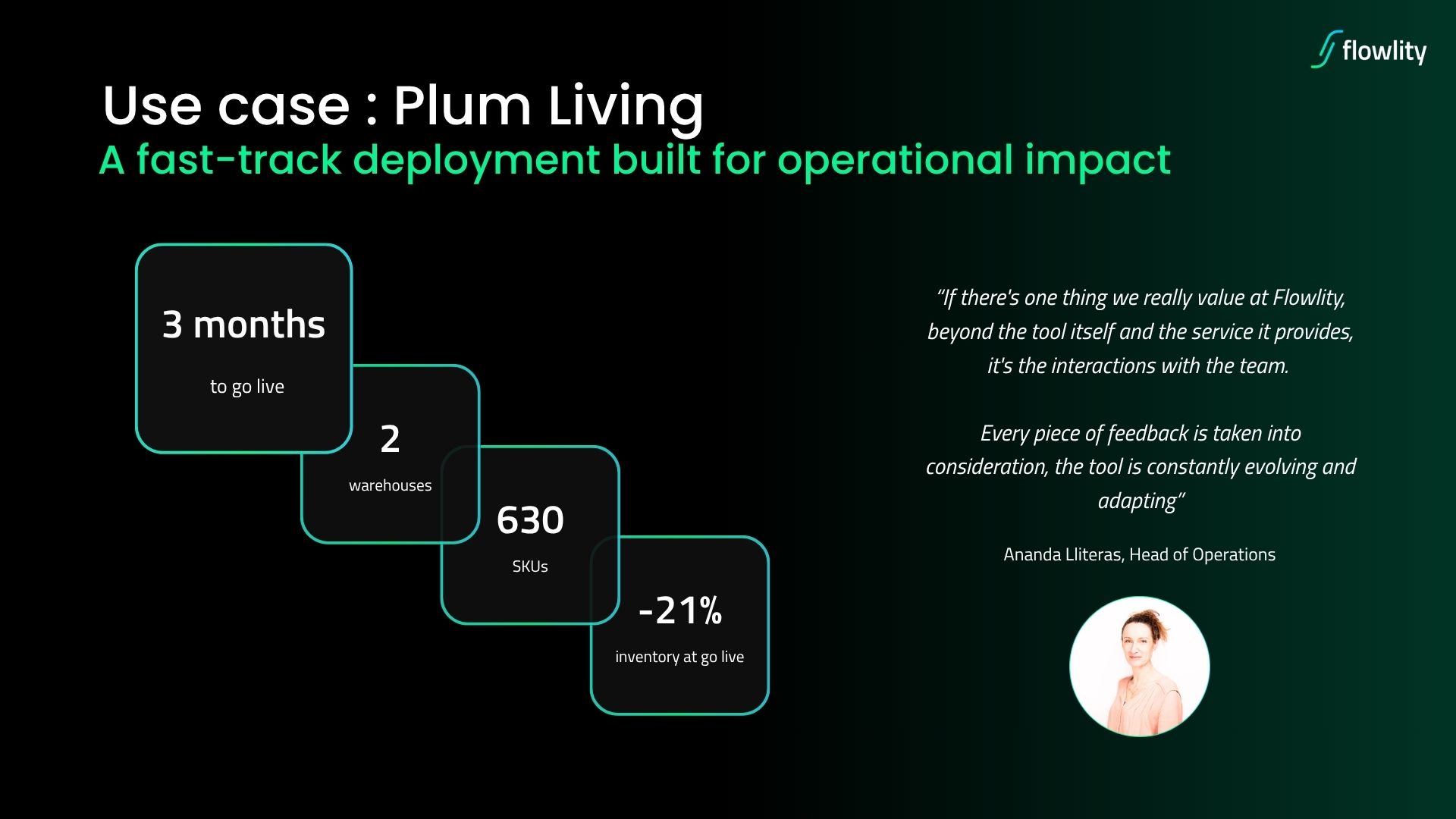
The implementation was designed to deliver value quickly. The project followed several phases:
Supply Chain analysis
The first step involved mapping Plum Living’s operational processes and identifying the main planning challenges. The exercise covered how demand flowed through the catalogue, where inventory decisions were taken, and which data sources fed those decisions, which set the scope of what Flowlity would automate and what would stay under planner control.
Data synchronization
Operational data from Plum Living’s systems was integrated into the planning platform, allowing the models to analyze historical patterns. Sales history, supplier lead times, and current inventory positions were pulled into Flowlity, then cleaned and aligned so the AI could be trained on consistent series.
Model calibration and training
Machine Learning models were trained using the company’s historical data to improve forecasting accuracy. The training phase tuned the models to Plum Living’s specific patterns: a catalogue combining make-to-stock and make-to-order references, relatively short product histories on newer SKUs, and the demand volatility of a digital-first business. Plum’s planners reviewed outputs during this phase to validate that the recommendations matched what they knew about the business.
Operational testing and deployment
Planning recommendations were tested with real use cases before being deployed in daily operations. Planners ran Flowlity’s recommendations alongside their Excel process during the transition, comparing outputs and adjusting configurations where needed. This allowed the team to build confidence in the model before relying on it for live decisions, which kept the switchover smooth.
The full deployment took approximately three months, covering two warehouses and around 630 SKUs.
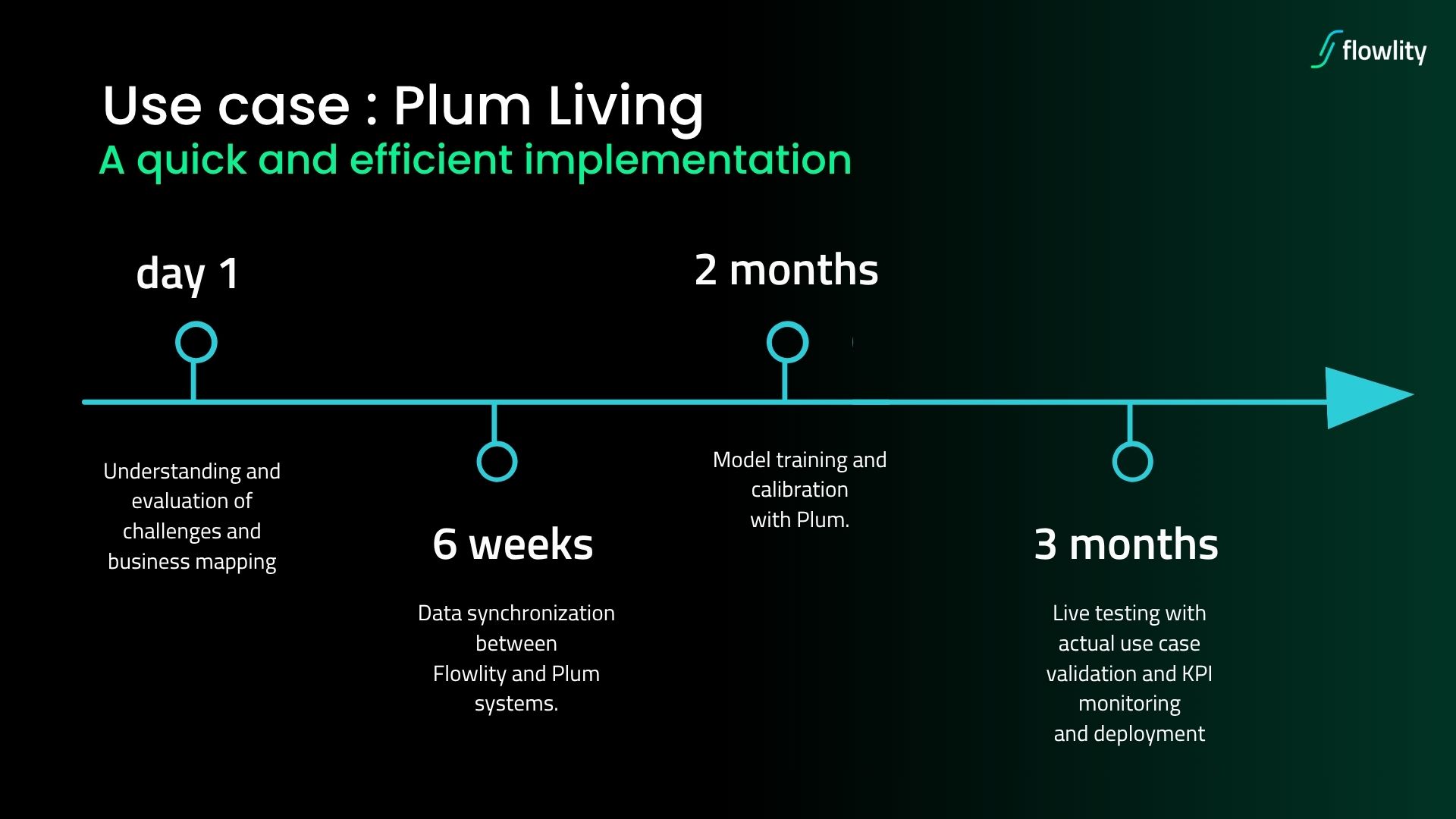
This relatively short implementation timeline allowed the company to quickly move from manual planning to a more automated, data-driven approach.
"At the beginning of the project, we were looking for a user-friendly, easy-to-implement tool to support us in our daily activities. Flowlity checks all the boxes; moreover, we are accompanied by a professional and available team. The tool is very easy to use, and we have effective control over our inventory management."
Ananda Lliteras, Head of Operations & Procurement, Plum Living
From forecasting improvements to better inventory decisions
One of the key changes introduced by the new planning system was the ability to generate a longer-term view of demand and replenishment needs.
The platform produced a nine-month replenishment horizon, which could be shared with suppliers to improve coordination.
This longer planning horizon helped teams anticipate supply constraints earlier and reduce uncertainty across the upstream supply chain.
At the same time, automated replenishment recommendations simplified the daily work of planners. Instead of manually recalculating inventory needs, planners could review suggested actions and focus on exceptions.
The system also helped improve visibility across product categories, making it easier to rebalance inventory levels and adjust stock policies. This places Flowlity as one of the best Supply Chain visibility tools for the retail industry.
Results: lower inventory and smoother planning processes
The impact of the transformation became visible quickly.
After deployment, Plum Living achieved a 21% reduction in inventory levels, freeing up working capital while maintaining service levels — lifting inventory turnover by roughly 60% at unchanged demand."
Additional improvements included:
- automated and streamlined replenishment processes
- improved supplier visibility through shared forecasts
- smoother integration of planning into daily operations
- significant time savings for planning teams
- better support for new product launches thanks to improved forecasting
Long term results also show an overall inventory value reduction of around 38% as planning strategies continued to improve.
For operational teams, the transformation had a direct impact on daily work:
“When Flowlity arrived, it truly changed my day-to-day life”
Axel Moulhiac, Logistics Manager

What this case study shows about Machine Learning in Supply Chain
The Plum Living experience highlights several important lessons for companies considering ML in Supply Chain Planning.
First, Machine Learning creates the most value when it is connected directly to operational decisions. Improving forecasting alone is not enough; the real benefits appear when forecasts drive better inventory and replenishment strategies.
Second, implementation speed matters. Many companies hesitate to adopt new planning technologies because they expect long and complex deployments. In this case, the transition from manual planning to AI-supported planning was achieved in only a few months.
Finally, technology adoption must support planners rather than replace them. Machine Learning helps process large volumes of data and detect patterns, but human expertise remains essential to interpret results and adjust planning strategies.
Similar transformations can be observed in other organizations undergoing Supply Chain modernization. For instance, in this case study on Camif’s digital transformation, you can see how another retail player leveraged digital tools to improve planning and operational performance.
Level up your supply chain with AI.
Get a demo.avif)


FAQ
Find everything you need to know right here.
How is Plum Living continuing to improve inventory performance over time?

Plum Living's inventory journey did not stop at the initial 21% reduction. As more demand and lead time data flowed through Flowlity, planners progressively refined buffer policies and supplier replenishment cadences, which pushed the long-term reduction to 38% (€598k → €367k target). Inventory turnover lifted by roughly 60% at unchanged demand, freeing working capital that the company can redeploy into growth. The supplier portal extended the 9-month replenishment horizon to Plum's ~10 suppliers, which turned ordering into collaborative planning and reduced lead time variability on both sides.
How does the 9-month replenishment horizon work for Plum Living's suppliers?
Once Flowlity went live at Plum Living, the system produced a rolling 9-month replenishment plan that gets shared continuously with the brand's ~10 suppliers, refreshed as new orders and forecasts come in. The 9-month horizon gives suppliers time to plan raw materials, capacity, and shipments rather than reacting to last-minute purchase orders, which reduces lead time variability and stockout risk on both sides of the relationship.
For a DTC furniture brand where manufacturing lead times stretch over weeks and customer expectations are set by next-day e-commerce, this kind of visibility is what unblocks growth without piling up inventory. The horizon also changes the conversation with suppliers from transactional ordering to collaborative planning: suppliers can flag capacity constraints early, propose batching that reduces unit cost, and align their own raw material procurement to Plum Living's catalogue evolution. The 9-month window is long enough to cover most supplier upstream cycles in the furniture industry, which is what makes it operationally meaningful rather than just a forecasting exercise.
How did Plum Living reduce inventory by 21% at go-live?
Flowlity replaced Plum's manual replenishment with AI-sized buffers that account for demand variability and supplier lead times rather than relying on flat coverage rules. Excess safety stock that had built up during the Excel era as a defensive reflex was released as the system right-sized policies SKU by SKU, which translated directly into a 21% inventory drop at go-live.
Over time, the long-term reduction reached 38% (from a €598k baseline to a €367k target) as planning strategies continued to mature. At unchanged demand, this lifted inventory turnover by roughly 60%, which freed working capital that Plum Living redeployed into growth investments rather than warehouse storage. Service levels held steady throughout the transition because the AI buffers, while smaller in aggregate, were positioned more intelligently across the catalogue: small movers no longer carried defensive overstock while fast movers gained the protection they actually needed. The 38% long-term gain compounded as more data flowed in and as planners refined the AI parameters with their domain knowledge.
How quickly did Plum Living deploy Flowlity?
Plum Living went live in 3 months across two warehouses and 630 SKUs, then progressively extended the scope. The implementation phases were typical of a Flowlity DTC rollout:
- a few days for scope definition and business mapping
- around six weeks for data synchronization between Plum and Flowlity systems
- two months for model training and calibration using Plum's historical data
- a three-month phase of live testing and KPI monitoring before full deployment.
A single customer success manager on the Flowlity side and a small core team on the Plum side were enough to drive the rollout, which kept coordination overhead low. Speed of value matters more for DTC brands than feature breadth, and Plum Living's case demonstrates that AI planning is now a realistic option even for fast-growing digital businesses without large IT teams. Similar phased rollouts have been documented in industrial contexts, notably Groupe Lemoine's multi-site project, where the same logic applies: start narrow, prove value, then scale.
Why did Plum Living move away from Excel for inventory planning?
Excel had been flexible at the early stage of Plum Living but stopped scaling once SKU count, supplier complexity, and demand variability all rose together. Planners spent more time updating formulas and reconciling sheets across the team than analyzing exceptions. Supplier visibility flatlined because nobody had bandwidth to share rolling forecasts, and stock decisions became reactive: orders went out when shortages appeared rather than ahead of demand. The cost was paid in overstock on slow movers and stockouts on fast movers simultaneously, which is the worst possible inventory position for a DTC brand built on customer experience. Working capital climbed faster than revenue because safety stock kept being added defensively across the board, and inventory turnover deteriorated silently until cash became a real constraint on growth. Plum Living recognized the limit when the planning team's workload was scaling linearly with SKU count, which is the opposite of what an asset-light digital brand model is supposed to enable. The shift to AI-powered Supply Chain platforms was what restored operating leverage.
What planning challenges did Plum Living face as it grew?
Founded in Paris in 2020, Plum Living specializes in customizable kitchens, wardrobes, and bathrooms sold through a digital-first model focused on design and personalization. As the company grew across Europe, its Supply Chain became more complex: more products, more suppliers, more demand variability. At the time of the Flowlity project, Plum Living operated with around 45 employees, approximately 1,000 SKUs combining make-to-stock and make-to-order products, around 10 suppliers, and two warehouses managing inventory flows. The planning team relied heavily on spreadsheets, which worked at small scale but gradually broke down as the catalogue and supplier panel expanded. Several operational issues appeared simultaneously: high inventory tying up working capital, poor stock balance between product categories with overstock on some lines and shortages on others, limited visibility on future demand, manual replenishment that made decision-making slow and error-prone, weak supplier visibility, and stockouts not systematically tracked. These are typical signs of a fast-growing brand whose planning processes have not scaled with the business: the Supply Chain becomes reactive, with planners spending most of their time correcting problems rather than anticipating them. Plum Living needed a planning approach built for variability and growth, not a bigger spreadsheet.