.svg)
.svg)
Raw materials shortage: how to build Supply Chain resilience

Raw material shortages are not a temporary anomaly. They are a stress test that reveals the structural fragility of Supply Chains built for efficiency rather than resilience. When the pandemic exposed the limits of Just-in-Time manufacturing, shortages cascaded from steel and copper into plastics, construction materials, microchips, and aerospace components simultaneously, affecting every sector of industry at once. The organizations that absorbed this pressure better than others shared three capabilities: reliable demand forecasts that did not collapse under volatility, dynamic inventory buffers on critical components, and supplier relationships with enough shared visibility to anticipate rather than react. This guide explains what the multi-sector shortage crisis revealed and what Supply Chain leaders can do structurally to prevent a recurrence.
The pandemic did not create Supply Chain fragility. It exposed it. The collapse in demand followed by the rapid rebound created a synchronized shock that cascaded from raw material producers through processors through manufacturers to their customers faster than any planning system designed for stable conditions could absorb. By the time the full extent of shortages became visible in production planning systems, the decisions that could have mitigated them had already passed.
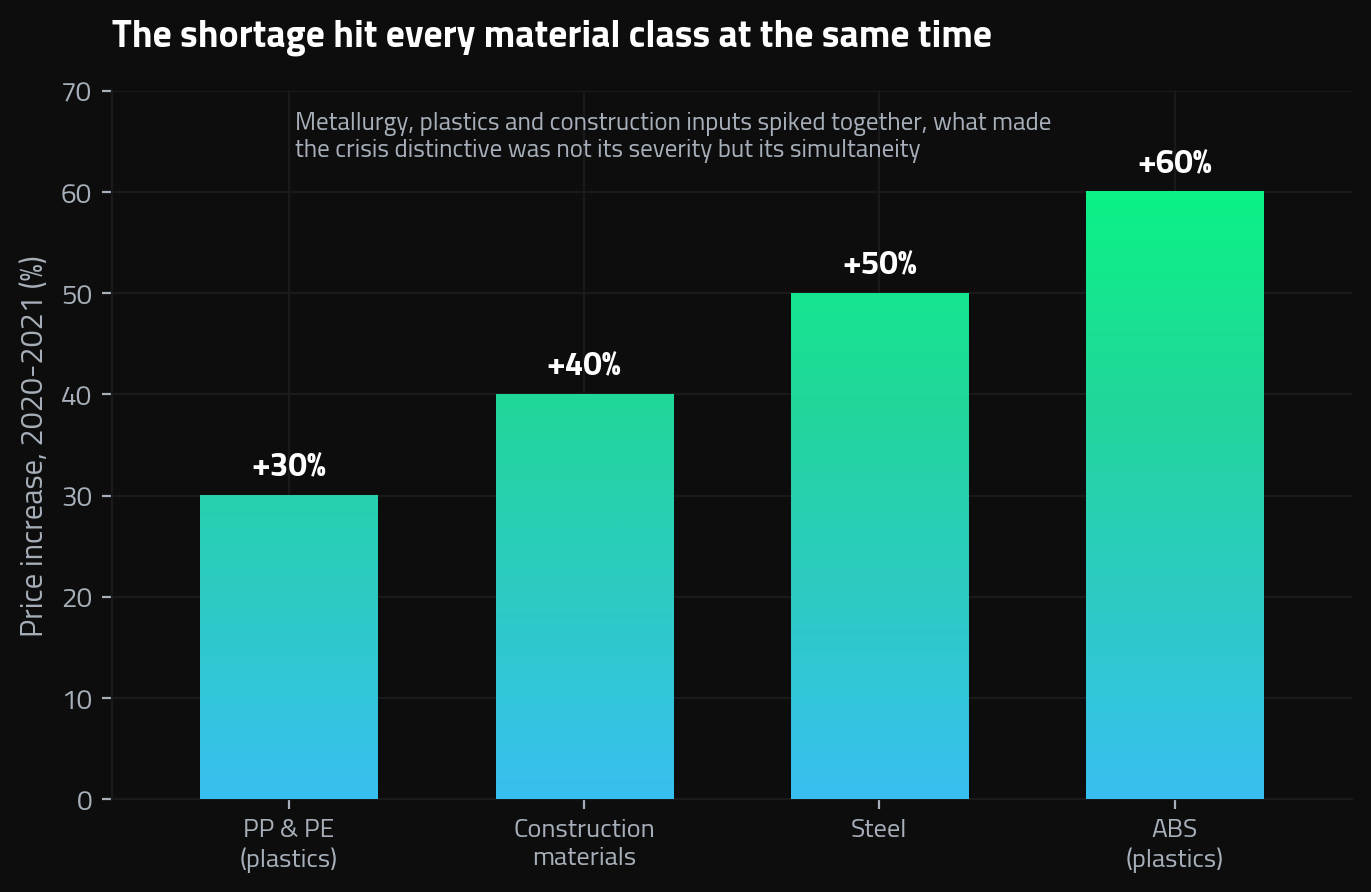
What made this crisis distinctive was not its severity in any single sector. It was its simultaneity across all of them.
How the raw material shortage crisis unfolded across industries
Metallurgy: the opening shock
The first shortage signals appeared in metallurgy as demand recovered faster than supply capacity could respond. Steel and stainless steel delivery times grew by ten to seventeen weeks beyond normal lead times according to a manufacturer cited by the Fédération des Industries Mécaniques. Steel prices, which had begun rising in November 2020, accelerated sharply through winter and spring, increasing by 50% from their pre-crisis levels.
From mining to processing, businesses in the metallurgical sector lacked the visibility to see demand recovery signals early enough to adjust production capacity. By the time the rebound was confirmed, order books were already saturated and downstream industries were competing for allocation.
Plastics: compounding factors
Plastics shortages arrived through a combination of structural and circumstantial factors. Resin producers who had deferred maintenance during the downturn encountered machine failures when they attempted to restart at full capacity. Extreme cold weather in Texas and Louisiana halted production at US resin plants; when they restarted, they prioritized their domestic markets first. Flooding of the Rhône in Europe disrupted barge transport of chemicals.
According to Elipso and Polyvia figures reported by Premium Beauty News, PP and PE prices rose by 30% between May 2020 and February 2021, and ABS prices increased by more than 60% in a single year. “In practice, all plastic materials are affected,” said Florent Tronquit, Supply Chain Vice President at Albéa, noting that his organization was maintaining constant dialogue with suppliers and customers in a context where forecasts had become particularly uncertain.
Construction: fixed-price contracts under pressure
The construction sector faced the convergence of multiple material shortages simultaneously: galvanized steel products, PVC, plasterboard, and glass all became constrained. Hot rolled sheet metal, concrete reinforcing bars, aluminium, copper wire, and brass ingots all saw significant price rises in the final months of 2020, with some materials increasing by 40% or more.
For construction companies operating under fixed-price contracts with delivery penalties, the combination of price inflation and unpredictable delivery lead times threatened project viability. The cost risk had already been transferred to the contractor at signature. The supply risk materialized after the fact.
Automotive: the semiconductor cascade
The automotive sector’s raw material shortage took a form specific to its supply chain architecture. When demand collapsed at the start of the pandemic, automakers scaled back semiconductor orders. TSMC and other semiconductor manufacturers redirected capacity toward consumer electronics (phones, consoles, and computers) where demand had surged. When automotive demand recovered, semiconductor production capacity was committed elsewhere and could not be redirected quickly due to the long qualification and switching times that automotive-grade chip supply requires.
According to a FIEV survey of French automotive equipment manufacturers, 84% of respondents were directly or indirectly affected by supply problems for components or alloys: 43% directly, and 41% indirectly through production stoppages at their own customers or delivery failures from their suppliers. AlixPartners updated its forecast in September 2021 to estimate that the semiconductor shortage would cost the global automotive industry $210 billion in lost revenue that year, with 7.7 million vehicles of production lost globally.
Aerospace: structural fragility made visible
The aerospace sector entered the crisis already weakened. Airlines had seen traffic reduced to less than 50% of normal levels because of travel restrictions. Guillaume Faury, CEO of Airbus, announced in mid-2020 that production and deliveries would be 40% lower than initially planned for a period extending across 2020 and 2021. Éric Trappier, CEO of Dassault Aviation and president of GIFAS at the time, publicly emphasized the critical need to protect the aerospace supply chain ecosystem, which relies on hundreds of equipment manufacturers and SMEs across France that were particularly exposed to a prolonged crisis.
What the multi-sector crisis revealed about Supply Chain architecture
The simultaneous spread of shortages across metallurgy, plastics, construction, automotive, and aerospace was not coincidence. It reflected three structural characteristics of the Supply Chain models that most manufacturers had built.
Just-in-Time amplified rather than absorbed the shock
Supply Chains optimized for minimum inventory held the least buffer against disruption. When upstream supply compressed, the absence of buffer stock meant that production lines stopped faster and stayed stopped longer. The efficiency gains of Just-in-Time accumulated over years were consumed in months.
Lack of upstream visibility prevented early response
From mining to processing to manufacturing, each tier lacked reliable visibility of what was happening one or two tiers upstream. Industry leaders and trade associations called repeatedly during the crisis for greater transparency across the Supply Chain, noting that the more visibility companies had of future orders, the more manageable the situation would be. Without such visibility, the bullwhip effect could not be contained at source.
Supplier concentration created single points of failure
Many manufacturers had concentrated their sourcing in a small number of suppliers for critical materials to optimize unit costs. When those suppliers were disrupted, there were no alternative sources qualified and ready to supply at scale.
The bullwhip effect that propagated these shocks upstream was not a new phenomenon. But its scale and speed were unprecedented, because Just-in-Time had removed the buffers that previously absorbed the first waves of amplification before they reached production lines.
Watch the following webinar to understand why traditional MRP amplifies Supply Chain vulnerability and what smarter raw material replenishment looks like in practice.
How raw material shortages cascade to SMEs and VSEs
One dimension of the crisis that received less attention than the headline figures was its disproportionate impact on smaller organizations in the Supply Chain. Large manufacturers had financial reserves, procurement teams, and supplier relationships that gave them leverage in allocation negotiations. SMEs and VSEs, which form the majority of supply chain participants in sectors like aerospace and automotive, had none of these advantages.
When raw materials were in short supply, allocation priority went to the largest buyers. Smaller organizations found themselves unable to secure volumes that their production plans depended on, with no negotiating leverage and no alternative source. Their fixed-price contracts with larger customers continued to require on-time delivery while their own supply was constrained.
This asymmetry is a systemic risk that raw material shortage events reliably expose. A Supply Chain is only as resilient as its most fragile tier, and in most industrial networks that tier is composed of SMEs with planning tools, inventory buffers, and supplier relationships that were never designed for sustained volatility.
What raw material shortage risk requires from Supply Chain planning
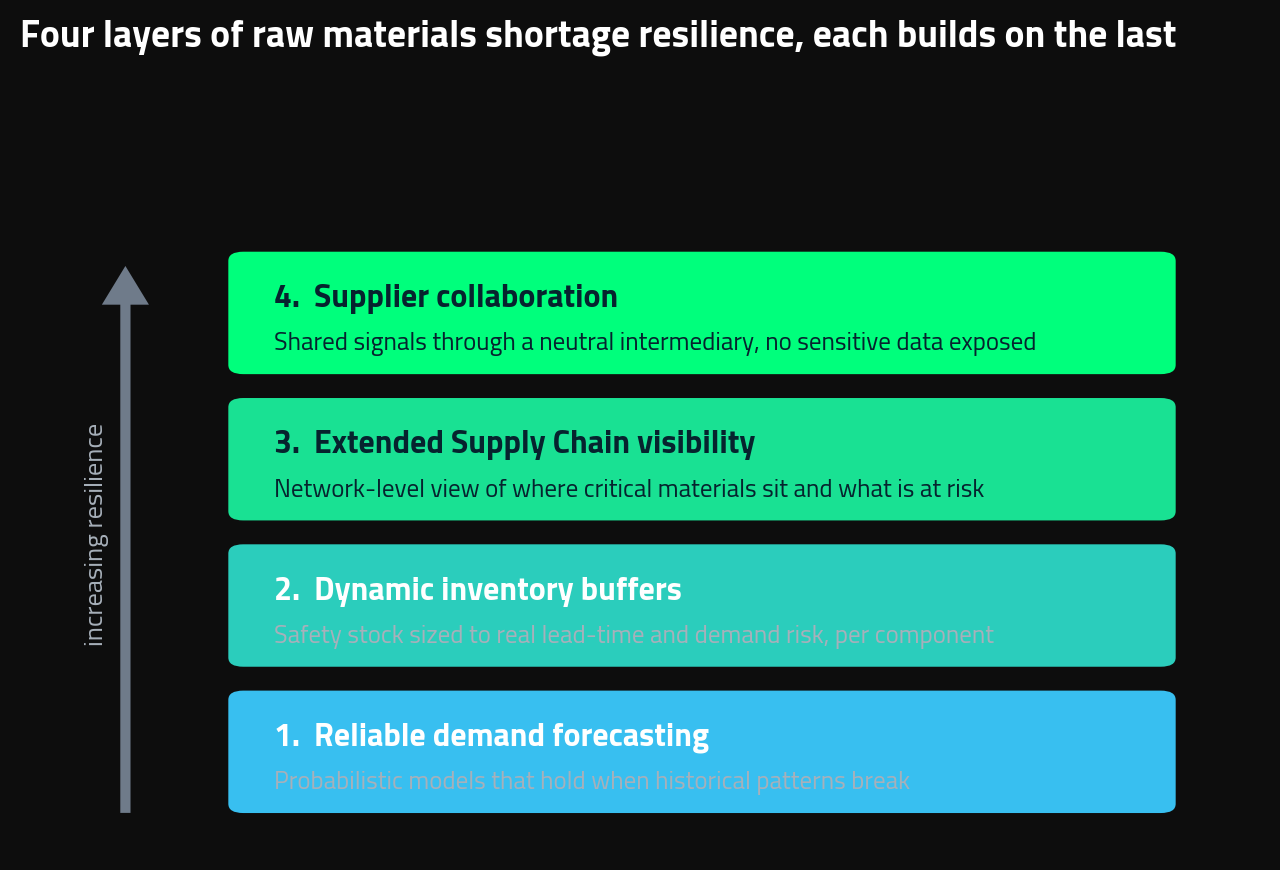
The structural response to raw material shortage risk operates across four layers. Each builds on the previous one, and the sequence matters.
Reliable demand forecasting that holds under volatility
The first requirement is a forecasting capability that does not collapse when historical patterns become unreliable. AI-driven demand planning uses probabilistic models that quantify uncertainty rather than averaging it away. When demand patterns shift rapidly, the system adjusts its probability distributions rather than producing a single-point forecast that becomes outdated within days. Demand sensing capabilities detect demand shifts within days rather than weeks, giving planners earlier signals to act on.
Dynamic inventory buffers on critical materials
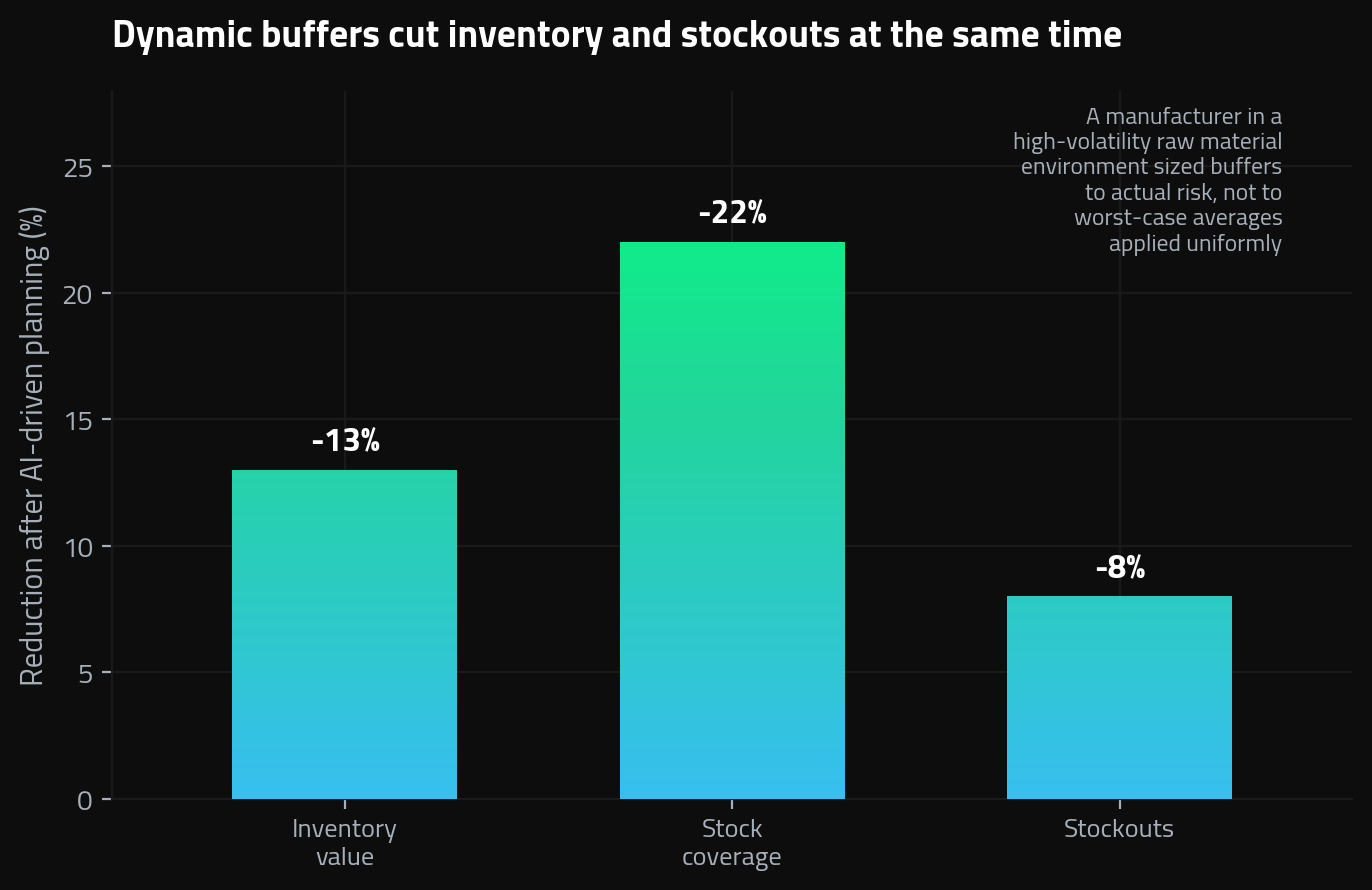
Static safety stocks set annually cannot adapt to the volatility that characterizes raw material supply in crisis conditions. AI-driven Supply Planning sizes buffers dynamically based on actual lead time variability and demand uncertainty per component per period. When a supplier’s delivery reliability deteriorates, the buffer for that supplier’s materials increases automatically rather than waiting for the next parameter review. Magotteaux reduced stockouts by 8% and cut inventory levels by 13% after implementing AI-driven planning on their raw material replenishment, the simultaneous improvement in both metrics reflects buffers sized to actual risk rather than to worst-case averages applied uniformly.
Extended Supply Chain visibility
Raw material shortage risk is not managed at the company level. It is managed across the full network from raw material producer to finished goods. Multi-echelon inventory optimization gives planners a network-level view of where critical materials sit, which buffers are at risk, and which production lines are most exposed. This visibility is what allows early triage decisions: prioritizing deliveries, reviewing recipes, and negotiating with customers before production stops rather than after.
Supplier collaboration without sensitive data exposure
The information that would allow each Supply Chain tier to plan better is also commercially sensitive. A trusted intermediary that allows suppliers and customers to share inventory signals and replenishment forecasts without exposing their commercial positions resolves this tension. Collaborative planning built on this neutral intermediary model gives each party better visibility of what is coming without the competitive exposure that prevents direct data sharing from scaling.
Building resilience beyond the next shortage
The raw material shortage crisis of 2021 will not be the last. Climate events, geopolitical disruptions, energy constraints, and the ongoing concentration of critical material supply in narrow geographies mean that Supply Chains designed for stable supply conditions will continue to be tested by events that assume instability.
The organizations that emerged from the 2021 crisis with the least damage shared a common characteristic: they had invested in Supply Chain visibility, planning flexibility, and supplier relationships before the crisis, not in response to it. The buffer stocks they held were sized to actual volatility rather than to efficiency targets. The supplier relationships they maintained gave them early warning signals rather than last-minute notifications. The planning tools they used updated continuously rather than freezing parameters at the last annual review.
Building these capabilities is not reactive crisis management. It is the structural investment that determines how well the next crisis is absorbed. The planning infrastructure described above, from AI-driven forecasting to dynamic buffers to collaborative supplier visibility, is not specific to pandemic conditions. It is the baseline capability for operating a manufacturing Supply Chain in an environment where raw material supply can no longer be assumed to be stable, predictable, or adequately diversified.
For a deeper look at how resilient planning architecture works at the network level, see our guides on Supply Chain synchronization and building a resilient Supply Chain.
Discover how Flowlity helps manufacturers build the planning infrastructure to absorb raw material shortage risk without locking working capital into excess inventory. Book a demo.
Level up your supply chain with AI.
Get a demo


FAQ
Find everything you need to know right here.
What causes raw material shortages in manufacturing Supply Chains?

Raw material shortages result from multiple disruptions occurring at the same time. Demand swings, climate events, energy constraints, geopolitical tensions, and supplier concentration all reduce supply or increase demand. Just-in-Time practices further amplify these disruptions by removing the inventory buffers that once absorbed short-term shocks.
How do raw material shortages affect production planning?
Raw material shortages make material availability and lead times unpredictable. Traditional MRP systems struggle with this uncertainty, causing frequent plan changes and cascading scheduling errors. As a result, planners spend more time reacting to instability than optimizing production.
What is the best strategy for managing raw material shortage risk?
Managing shortage risk requires four capabilities: accurate demand forecasting, dynamic inventory buffers, end-to-end Supply Chain visibility, and supplier collaboration. Together, these help manufacturers anticipate disruptions earlier, protect production, and respond more effectively to changing conditions.
How can manufacturers reduce vulnerability to raw material shortages?
Manufacturers can reduce vulnerability by diversifying suppliers, improving demand forecasting, using dynamic inventory buffers, and strengthening supplier collaboration. While these measures cannot eliminate shortages, they significantly reduce the likelihood and impact of production disruptions.