.svg)
.svg)
The bullwhip effect: causes, impact and how to eliminate it

Bullwhip isn't a demand problem. Each tier interprets the signal it receives, then amplifies it. A 5% wobble at the cash register becomes a 20% swing at the distributor, a 40% spike at the manufacturer, and a raw-materials supplier who alternates between idle plants and panic capex. The shape of the curve is famous, the diagnosis is usually wrong. Most teams chase a better forecast when the real defect is in how orders are passed from one tier to the next.
What the bullwhip effect is
The bullwhip effect is the progressive amplification of demand variability as orders move from the consumer end of a Supply Chain to the raw-materials end. The label comes from the shape of the order curve: a small flick at the handle (consumer demand) produces a wide arc at the tip (upstream supply orders).
The phenomenon was formalised in 1997 by Hau L. Lee, V. Padmanabhan and Seungjin Whang in MIT Sloan Management Review, drawing on observed patterns at Procter & Gamble and Hewlett-Packard. P&G noticed that Pampers consumption at retail was almost flat week to week, yet orders from distributors to the factory swung sharply, and orders from the factory to material suppliers swung even more.
Two practical signatures show the effect is at work in your own network:
The bullwhip effect in Supply Chain economics is the reason finished-goods inventory and raw-materials inventory rarely move in sync, and why "more stock" almost never fixes the service problem it was bought to fix.

See it: interactive bullwhip effect simulator
Move the sliders below to watch a small swing in consumer demand balloon into ever-larger order swings upstream, and how much extra safety stock each tier must hold for the same service level.
➡️ Open the full-screen bullwhip effect simulator
The seven classic causes of bullwhip
Hau Lee identified four root causes, and three more have been added to the canon since. They overlap, and most networks suffer from at least four of them at once.
The first three are operational, the next two are structural, the last two are informational and behavioural. Effective countermeasures need to address at least one cause in each band, not just the easiest one.
Why bullwhip is a translation problem, not a demand problem
Most articles on bullwhip frame it as a demand-forecasting issue. Improve the forecast, the argument goes, and the variability calms down. That diagnosis is wrong often enough to be dangerous.
End-consumer demand for established categories is usually less volatile than the order curves upstream. Toilet paper consumption per household didn't triple during the pandemic, even though factory orders did. What changed wasn't the demand. It was the chain of translations between consumption and production.
Each tier in a Supply Chain receives an order, runs it through its own forecasting and inventory logic, and emits a new order to the tier above. Every translation discards information: the original demand distribution is replaced by a point estimate, the point estimate is shifted by a safety multiplier, the safety multiplier is rounded to a batch size, the batch size is delayed by a review cycle. By the time the signal reaches the raw-materials supplier, it has almost nothing in common with what consumers actually bought.
In information-theory terms, the bullwhip is what happens when a low-entropy signal (consumer demand, fairly stable) is repeatedly encoded by lossy intermediaries into a high-entropy signal (factory orders, very volatile). The cure isn't to encode it more cleverly at each tier. It's to stop re-encoding it.
That reframe matters because it changes the lever. If bullwhip is a forecast problem, you invest in forecasting software at every tier. If bullwhip is a translation problem, you stop translating: you share the original signal end-to-end and let one probabilistic model interpret it once. This is what AI-native planning platforms like Flowlity do by design, and it is why their inventory and service-level results don't reproduce when grafted onto a deterministic MRP backbone.
Why deterministic planning systems make bullwhip worse
A classical material requirements planning (MRP) system is built on a deterministic chain of explosions. A finished-good forecast is exploded through a bill of materials, lead-time-offset by component, then released as planned orders. Every step assumes the inputs are facts, not distributions.
This logic was a reasonable compromise in 1975, when computing power was scarce. In a network with stable demand and predictable lead times, deterministic propagation works. In a network with variable demand or variable lead times, which is to say every real network in 2026, it actively amplifies bullwhip.
Here is what happens in practice. A planner enters a forecast of 100 units per week for a finished good. MRP explodes that forecast into 200 units of component A, lead-time-offset by four weeks, plus a safety stock of 80 units. Demand wobbles to 110 two weeks later. The forecast is revised, the bill of materials is exploded again, planned orders move, safety stock recalibrates. Multiply that by a thousand SKUs and three tiers and the supplier sees noise, not signal.
Deterministic propagation has two specific failure modes that aggravate bullwhip:
AI in Supply Chain planning doesn't fix MRP by replacing it with a better forecast. It fixes it by changing what gets propagated.
From shared forecasts to shared raw signals: the visibility cure
Most "collaborative" Supply Chain programs (CPFR in the 1990s, S&OE forums in the 2010s, control towers today) try to align tiers around a shared forecast. The intent is right, the implementation usually isn't.
Orders are opinions. So are forecasts. A shared forecast is just a shared opinion: it embeds whichever assumptions the loudest stakeholder argued for in the consensus meeting. Sharing an opinion across tiers reduces friction, but it doesn't reduce bullwhip, because the underlying signal still gets re-encoded at every node.
What does reduce bullwhip is sharing the raw signal. The raw signal is the data closest to actual consumption: point-of-sale data for retail-served networks, end-customer call-offs for industrial networks, sensor or telemetry data for installed-base networks. When upstream tiers gain visibility across every tier of the network and read the raw signal directly, they don't have to reconstruct it from downstream orders. The translation chain shortens to one step instead of four.
Three operational practices make the shared-raw-signal model work:
Teams that get this right usually start with one strategic SKU family and one tier above retail. They prove the upstream factory schedule stabilises when it stops reading distributor orders and starts reading consumer demand, then expand from that proof point.
How AI eliminates amplification across tiers
Probabilistic demand planning, dynamic safety buffers and multi-tier optimisation together address the three pieces of the bullwhip puzzle that deterministic systems make worse: distribution loss, brittleness and translation chains. This is where AI-native Supply Chain planning, and the wider category of modern supply chain visibility software, has moved from research to production over the last five years.
Flowlity is an AI-native Supply Chain planning platform built on the thesis that more than 95% of a planner's work can and should be automated. The algorithm produces a probabilistic demand forecast per SKU, sizes dynamic safety buffers against the uncertainty range rather than against a fixed coverage rule, automates supplier orders, and surfaces only the exceptions that need human judgement inside an intuitive UI used directly by Supply Chain teams without specific training. Each customer is supported by a dedicated Customer Success Manager. More recently, Flowlity Co-planner MCP connects the platform to the AI assistants planners already use (Claude, ChatGPT, Copilot) and reduces manual workload on routine decisions further.
In practical terms, three mechanisms cut amplification at the source:
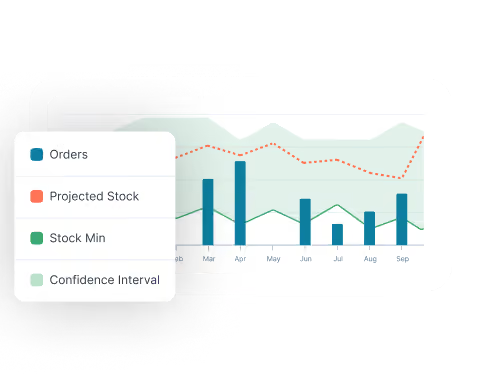
- Probabilistic forecasts replace point estimates. Instead of one number, the algorithm produces a range with explicit probabilities for each outcome. That range is the input to inventory sizing, not a safety multiplier bolted on after the fact.
- Dynamic safety buffers adjust to the uncertainty range. When the forecast distribution narrows (mature SKU, stable demand), the buffer shrinks. When the distribution widens (launch, seasonality, disruption), the buffer expands without the planner having to intervene. This is the opposite of static safety stock, which is the single largest driver of stock inflation in MRP-based networks.
- Multi-echelon inventory optimization replaces single-tier balancing.** Instead of sizing stock at each node independently and propagating orders through MRP, the model sizes stock across all tiers at once. The information loss between tiers disappears because there is no longer a chain of translations to lose information through.
Flowlity customers operating in industrial automotive contexts typically improve service levels by several points while cutting inventory by 10 to 30%. For example, at Saint-Gobain Sekurit AGR, service level moved from 95.8% to 97.2% (+1.4 points) while inventory fell 9.25%, on a network spanning 10,000+ references, 30 distribution centres and three plants. The mechanism is the same one described above: a probabilistic demand model feeding dynamic buffers across all DCs at once, not a stack of MRP runs propagating forecasts tier by tier.
Real-world examples: COVID, automotive 2021
Two recent episodes show the bullwhip effect at industry scale and what it costs to ignore it.
The COVID-19 toilet paper shortage of 2020 is the textbook case. Household consumption rose modestly, driven by the shift from out-of-home to at-home use. Retail orders to distributors rose far more, distributor orders to manufacturers more still, and manufacturer orders to pulp suppliers most of all. By the time pulp suppliers had expanded capacity, retail consumption had normalised, and the same pulp suppliers carried excess inventory for months afterwards.
The automotive semiconductor shortage of 2021 followed a different mechanism but the same structure. Carmakers cut chip orders during the early 2020 demand collapse. Chipmakers reallocated capacity to consumer electronics, which was booming. When auto demand recovered faster than expected, carmakers raced to reorder against suppliers who had already committed wafer capacity elsewhere. Production lines stopped on both sides of the Atlantic for the better part of a year, and several brands accelerated long-overdue programs to build more intelligent, multi-tier Supply Chains beyond their traditional planning systems.
Two episodes, two industries, the same diagnostic: tiers were reading each other's orders instead of the underlying consumption, and the order curves amplified on the way up.
How to measure the bullwhip effect
The standard measure is the Bullwhip Ratio, defined as the variance of orders divided by the variance of demand, both measured over the same period.
Bullwhip Ratio = Variance(orders placed by tier N) ÷ Variance(demand received by tier N)
A ratio of 1.0 means orders are as volatile as demand: the tier is passing the signal through cleanly. A ratio above 1.0 means the tier is amplifying. In practice, healthy multi-tier networks run between 1.2 and 1.8 from retail to first-tier distributor; networks with chronic bullwhip can run 3 to 5 or higher between manufacturer and raw-materials supplier.
Three secondary indicators are useful in the same audit:
Measure the ratio at every tier you can see. The tier where it jumps from below 2 to above 3 is the translation point worth fixing first.
Reading bullwhip the way a Supply Chain leader should
Bullwhip is the diagnostic that separates teams who run their network from teams whose network runs them. The number to watch isn't your forecast accuracy or your service level on its own. It's the ratio between the volatility your customers actually generate and the volatility your suppliers experience. Anything materially above one means you are paying, in inventory or in service, for a translation chain you no longer need.
The shift from deterministic, tier-by-tier planning to probabilistic, multi-tier optimisation is what eliminates that translation chain. It also reframes what a planner spends time on: less recalculating safety stock against a noisy forecast, more managing the exceptions that genuinely need human judgement.
Book a demo to see how Flowlity replaces tier-by-tier forecasting with probabilistic, multi-tier planning software that cuts amplification at the source.
Level up your supply chain with AI.
Get a demo


FAQ
Find everything you need to know right here.
What is the “bullwhip effect” in the supply chain?

The bullwhip effect refers to the phenomenon where small variations in customer demand become increasingly amplified as they move upstream in the Supply Chain. For example, a slight increase in demand at the retail level can lead distributors (and then manufacturers) to place much larger orders, causing excessive stock fluctuations.
This effect is often driven by poor communication and poorly synchronized forecasts between partners. Understanding and controlling it (through better collaboration and real-time data sharing) helps prevent inconsistent inventory levels and operational inefficiencies.
What are the main effects of the bullwhip effect on a Supply Chain?
The main effects are inventory inflation (30 to 60% above what stable demand would require), service-level degradation (because the inflated stock sits in the wrong tier), capacity whiplash at suppliers (idle plants alternating with overtime), expediting costs, and forecast accuracy collapse upstream. Working capital is the financial symptom: cash parked in raw-materials and component inventory while finished goods stock out. The same network often experiences excess and shortage at the same time, in different tiers, for the same product family.
How can suppliers and customers reduce the bullwhip effect together?
Three practices, in order of payback: share point-of-sale or end-customer call-off data with the next tier up, replace tier-by-tier forecasting with one probabilistic model run on the shared signal, and adopt collaborative replenishment instead of order batching. Industrial distributors using AI-driven planning and collaboration platforms like Flowlity typically reduce inventory by 10 to 30% within a year. For example, agricultural distributor Ukal cut inventory by 16% and freed €1M of working capital after rolling out shared-buffer logic across its purchasing operations, anchored on Rodolphe Kautzmann's purchasing team.
Does better forecasting eliminate the bullwhip effect?
No, and this is the most common mistake. A better forecast at each tier marginally reduces local variance but doesn't address the translation problem between tiers. Bullwhip lives in the encoding chain, not in any single forecast. The teams that have actually reduced bullwhip share the raw demand signal and run one model on it, instead of running a better model at every node. Forecast accuracy improves as a side effect; it isn't the lever.
How long does it take to reduce bullwhip in an industrial network?
Most teams see a measurable drop in inventory and a service-level recovery within six to twelve months of moving to probabilistic, multi-tier planning. The first quarter goes to data sharing setup (point-of-sale exchange, call-off integration), the second to model calibration on one product family, the rest to scaling across the network. Flowlity deployments typically run a few weeks to a few months end-to-end depending on scope, and customers commonly report the bullwhip-driven inventory share dropping first, before forecast accuracy gains show up in the reporting.
Is the bullwhip effect worse for industrial or retail Supply Chains?
It is worse where lead times are long, batch sizes are large, and tiers are many: that means industrial and capital-goods networks more than direct-to-consumer retail. In retail, two or three tiers separate the consumer from the factory and lead times are weeks. In industrial networks like automotive aftermarket or building materials, five or six tiers can separate the end user from the raw-materials supplier, with lead times running to months. The amplification compounds at each tier, so deep networks see ratios above 5 routinely.