.svg)
.svg)
Raw material optimization to reduce Supply Chain risk

Most manufacturers treat supply chain risk as something that happens at the finished goods level. The real damage starts upstream, inside the bill of materials, weeks before a production line goes idle. Raw material optimization is not a procurement tactic. It is the primary lever for proactive Supply Chain risk management.
Why does raw material planning create more risk than it solves?
Traditional Supply Chain planning was built around finished goods. Material requirements planning (MRP) and distribution requirements planning (DRP) propagate demand signals upstream through the bill of materials, but each calculation step introduces error. Demand forecast errors compound with production planning errors, scrap rates, and supplier variability. According to a study by Accelerated Analytics, fluctuations as small as +/-5% at the finished goods level can translate into swings of +/-40% at the raw material tier. That amplification is the bullwhip effect operating internally, and legacy software has no mechanism to absorb it.
The complexity of raw materials compounds the problem in ways that finished goods management does not face. Raw materials are sourced from networks of suppliers, each with different lead times, reliability profiles, and minimum order quantities. Demand volatility for any given component is influenced by production mix, scrap rates, seasonal patterns, and changes to the bill of materials. None of these variables respond well to static safety stock rules or infrequent supplier scorecards. The result is predictable: imbalanced inventories, emergency purchases, and production stoppages that erode service levels and compress margins simultaneously.
Meanwhile, the macro environment is tightening the margin for error. The OECD projects demand for critical raw materials, including lithium, rare earths, and agricultural inputs, to increase by a factor of 4 to 6. Supply concentration risk, geopolitical instability, and extended lead times from distant sourcing regions mean that a planning methodology designed for stability is now operating in structural volatility.
What does raw material optimization actually mean?
Raw material optimization is the practice of sizing component buffers dynamically, based on the actual probability distribution of supply and demand uncertainty at each node in the bill of materials, rather than applying flat coverage rules across all stock keeping units (SKUs). The goal is not to maximize buffer levels for safety, nor to minimize them for cost. It is to hold exactly enough stock at each decoupling point to absorb the specific volatility that component faces, given its lead time, supplier reliability, and downstream consumption pattern. This is also the core idea behind DDMRP, with one difference: an AI engine sizes each decoupling buffer per SKU rather than from category-level heuristics.
The concept of a decoupling point is central here. In any multi-tier supply chain, certain components sit at positions where upstream supply uncertainty and downstream demand uncertainty intersect most acutely. Placing inventory buffers at these points absorbs volatility and prevents it from propagating further. Optimizing those buffers requires knowing the probability distribution of both consumption and lead time, not just their averages.
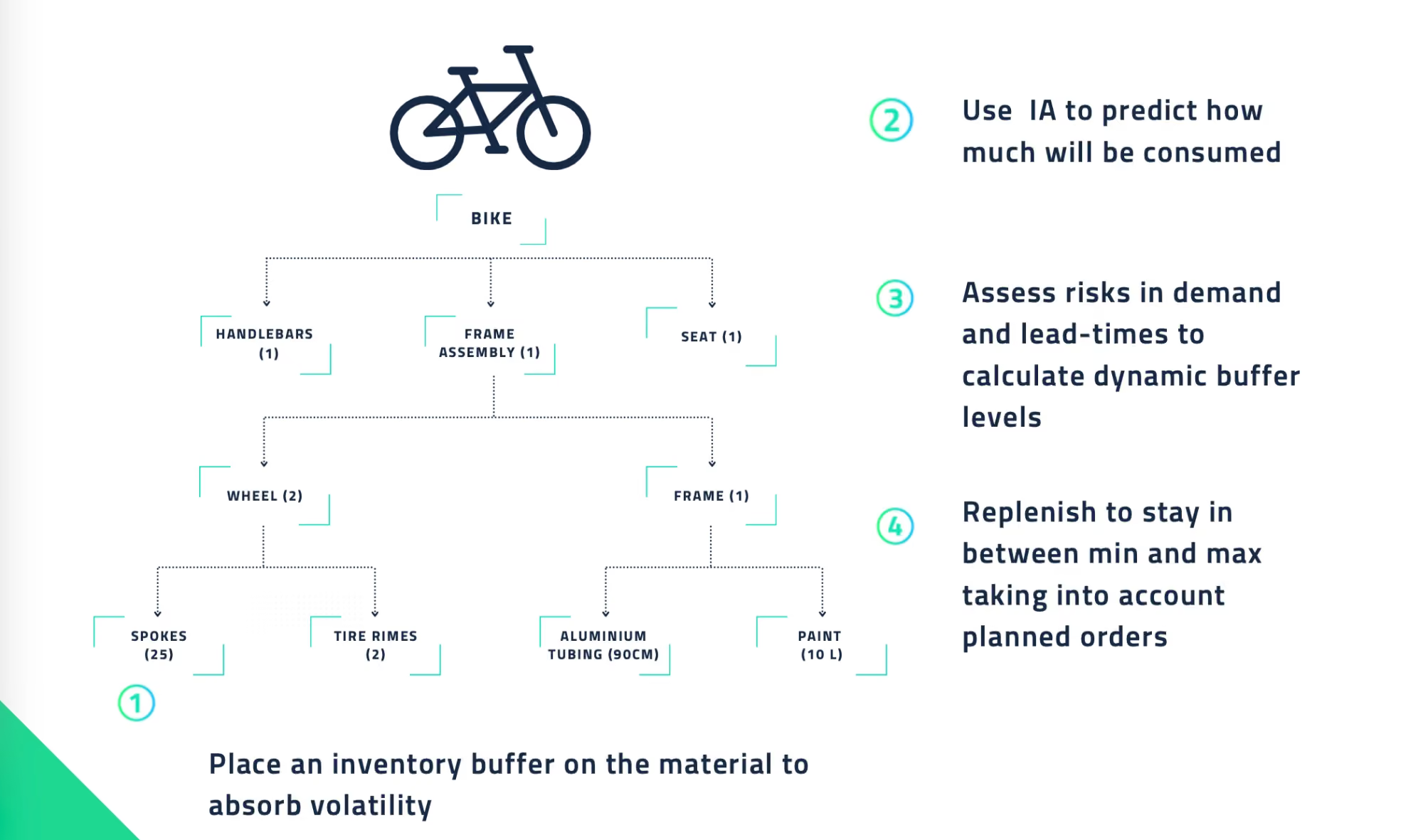
This is where artificial intelligence (AI) changes the calculus. Where traditional MRP collects dependent requirements and runs a deterministic netting logic, an AI-driven approach forecasts consumption directly at each decoupling point, generates multiple scenarios with different parameters, assigns a probability to each scenario, and selects the highest-probability outcome as the planning baseline while maintaining a confidence interval that captures residual uncertainty. Replenishment decisions then target staying within a dynamic min/max range that updates as uncertainty changes, rather than respecting a fixed reorder point calibrated once and left unchanged.
How does AI-driven planning reduce Supply Chain risk in practice?
The operational mechanics of AI-driven raw material optimization address each of the failure modes that traditional planning leaves exposed.
On the forecasting side, the system generates consumption forecasts at the raw material level rather than deriving requirements by exploding finished goods forecasts through the bill of materials. This eliminates one of the main amplification mechanisms of the bullwhip effect. The forecast incorporates MRP data to capture planned order trends not visible in consumption history, then applies probabilistic forecasting to produce a range of scenarios rather than a single-point estimate.
On the replenishment side, the system calculates dynamic buffer levels by assessing risk simultaneously in two dimensions: demand uncertainty (how variable is actual consumption relative to forecast?) and lead time uncertainty (how reliable is each supplier relative to their committed lead time?). When either dimension worsens, the buffer expands automatically. When conditions stabilize, the buffer contracts to release working capital. This means a manufacturer is never holding six weeks of cover on a component that realistically needs three, simply because the safety stock was set during a disruption period and never revisited.
On the alerting side, intelligent recommendations surface potential shortages before they materialize, ranked by financial and service impact. Planners act on the highest-priority risks first rather than firefighting across a flat list of MRP exceptions. The supplier collaboration dimension closes the loop: sharing forecasted consumption and open order status with suppliers enables them to plan their own production more accurately, which in turn reduces lead time variability and feeds back into tighter buffer calculations.
Concretely, this translates into four functional capabilities:
- Planning and forecasting: the system anticipates and fulfills demand by recommending the right inventory level at each node, using AI consumption forecasts enhanced with MRP data to capture trends invisible in historical records alone.
- Procurement operations: intelligent alerts prioritize daily actions, spot potential shortages before they reach production, and support planners in managing emergencies without losing sight of the broader replenishment strategy.
- Supply Chain strategy: simulations on inventory and purchasing scenarios give Supply Chain leaders visibility into material availability across past and future horizons, enabling decisions grounded in probability rather than assumption.
- Supplier collaboration: forecasted sales and open orders are shared directly with suppliers, improving order validation, reducing lead time variability, and building the reliability improvements that feed back into tighter buffer calculations over time.
The results are measurable. Magotteaux, an industrial manufacturer of grinding media and mill liners, reduced inventory by 22% after implementing AI-driven planning, with dynamic safety stock adjustments driven by real demand signals rather than static assumptions. At the component inventory optimization level, Flowlity customers see up to 40% reduction in inventory levels.
How does raw material optimization compare to traditional safety stock methods?
The practical differences between AI-driven raw material optimization and conventional safety stock methods are substantial enough to affect financial outcomes.
The fundamental shift is from a planning posture that assumes the future will resemble the past, to one that quantifies how much the future might deviate and sizes buffers accordingly. For components with long or variable lead times, this distinction is consequential. A component sourced from Asia with a 12-week lead time and high supplier variability needs a very different buffer than a locally sourced equivalent with a 2-week lead time and high reliability. Traditional flat coverage rules cannot make that distinction. Probabilistic optimization can.
Watch the following webinar to see how advanced mathematical optimization combined with AI forecasting translates into concrete raw material planning decisions across constraints, costs, and service levels.
What industries benefit most from raw material optimization?
Any manufacturer whose production depends on components with meaningful lead time or demand variability stands to benefit. The gains are largest where raw material cost represents a significant portion of total cost of goods and where supply disruptions have a direct and measurable impact on production output or customer service levels.
Process industries, including chemicals, pharmaceuticals, food and beverage, and building materials, face chronic raw material risk because their input materials are commodity-linked, seasonally volatile, or geopolitically sensitive. Discrete manufacturers in automotive, electronics, and industrial equipment face multi-level bill of materials complexity that amplifies planning errors at every tier. Demand planning discipline is equally critical in distribution businesses that procure finished goods from external supplier networks, where the procurement tier mirrors the raw material challenge in manufacturing.
The common denominator is not industry: it is the combination of supply uncertainty, demand variability, and financial exposure at the raw material level. Where those three factors converge, the case for moving beyond static MRP-based planning is strongest.
Why proactive raw material management is now a competitive requirement
Supply chain risk has moved upstream. The exposures that matter most, long lead times, concentrated suppliers, volatile commodity prices, and multi-tier visibility gaps, are raw material problems before they become finished goods problems. Organizations that continue to manage those exposures with static safety stock and reactive MRP will face recurrent disruptions and the working capital costs that accompany them. Those that adopt probabilistic, AI-driven raw material optimization gain the ability to size buffers to actual risk, release capital where risk permits, and surface shortages before they reach production. That combination of resilience and efficiency is not a theoretical benefit. It compounds as supplier reliability improves through better collaboration, and it is measured in inventory reduction, shortage reduction, and service level stability, across industries from process manufacturing to discrete assembly.
See how Flowlity's Supply Planning integrates with your existing MRP to start reducing raw material risk today.
Level up your supply chain with AI.
Get a demo


FAQ
Find everything you need to know right here.
What are the main sources of supply chain risk?

Supplier reliability, demand volatility, geopolitical issues, and long lead times. These rarely act alone. A long lead time becomes a real problem when demand variability is high or supplier reliability slips, and geopolitical pressure tends to amplify both. Treating each source in isolation produces point fixes that do not last, while modeling demand uncertainty and lead time variability together exposes the SKUs where exposure is concentrated. That view supports better decisions on dual sourcing, inventory placement and contractual flexibility, and it allows planners to prioritize the few items where mitigation actually pays back rather than spreading effort across the full portfolio with little measurable effect.
How does raw material optimization reduce risk?
By aligning inventory policies with uncertainty and anticipating shortages earlier. Raw material optimization works on two levers at the same time. First, it sizes buffers per item to the actual demand and lead time variability rather than to a blanket coverage rule, so working capital concentrates where it genuinely protects production. Second, it surfaces early signals of coverage risk, allowing planners to escalate or reallocate while options still exist. Both levers compress the gap between disruption and response, which is where most of the risk cost lives. The result is steadier line feeding at lower total inventory, even when supplier reliability and demand patterns shift.
Is supply chain risk management only about suppliers?
No. Demand variability and internal planning processes are equally critical. Supplier collaboration is key but is it not enough on its own. The most damaging risks usually emerge from the interaction of several factors: variable demand combined with rigid safety stock rules, or unreliable lead times combined with point-estimate forecasts. Treating risk management as a supplier-only discipline leaves the internal half of the problem unaddressed, which is where many shortages and excess stock situations actually originate. A complete approach models demand uncertainty, lead time variability and supplier behavior together, so the planning system protects service level against the full range of disruptions rather than only the supplier-driven ones.
Can AI really predict supply chain disruptions?
AI does not predict events but models uncertainty to prepare for multiple scenarios. The distinction matters because expecting AI to forecast specific disruptions sets unrealistic standards and obscures the real value. A probabilistic model quantifies the range of outcomes around each forecast and translates that uncertainty into buffer sizes, replenishment proposals and exception alerts. When a disruption occurs, the operation is already positioned to absorb a wider range of outcomes than a single point estimate would allow. Scenario simulation extends this further by showing how the plan would behave under specific stresses, which is what lets teams compare responses before committing to one.
What is raw material optimization in Supply Chain management?
How is AI-driven raw material planning different from MRP?
AI-driven raw material planning forecasts consumption directly at the component level and calculates dynamic buffers based on probabilistic scenarios, while MRP derives requirements top-down from finished goods forecasts using deterministic logic. Each MRP calculation step inherits the errors of the previous one, amplifying variability upstream, the bullwhip effect. Where MRP tells planners what to order based on a single-point demand assumption, AI-driven planning tells them how much buffer they need given the realistic range of outcomes that could occur.