.svg)
.svg)
Supply Chain maturity: pathway to a data-driven organization

Supply Chain maturity is the organizational capability to collect, clean, and exploit data well enough to make better decisions continuously. It is not a technology project. It is a business capability that determines whether AI and machine learning deliver value or fail at the pilot stage. Organizations that reach the highest levels of data maturity are measurably more profitable, more resilient, and faster to respond to disruption than those that do not. The path there is incremental and the starting point is always the same: understanding the quality of the data you already have.
Supply Chain organizations generate vast amounts of data every day. Demand signals, inventory levels, supplier lead times, production constraints, promotional calendars, and historical sales are all tracked, stored, and analyzed in some form. Yet despite this abundance, most Supply Chain teams still struggle with the same questions: why are forecasts still unreliable? Why do we keep oscillating between overstock and stockouts? Why does decision-making feel slow, reactive, and fragile?
The problem is not a lack of data. The problem is data maturity.
What is data maturity and why does it matter for Supply Chain organizations?
Data maturity is the degree to which an organization understands where its data comes from, how reliable it is, and how effectively it uses that data to make decisions. In a Supply Chain context, it determines whether planning inputs are trustworthy enough to support AI-driven forecasting, dynamic inventory optimization, and automated replenishment, or whether they undermine these capabilities before they can deliver value.
A data-mature Supply Chain organization:
- trusts its data and understands its limitations
- uses shared definitions and metrics across planning, procurement, and commercial teams
- relies on structured data rather than spreadsheets and manual workarounds
- integrates data from multiple sources including ERP, sales channels, suppliers, and logistics partners
- uses data proactively to anticipate risks rather than react to them after the fact
Data maturity does not mean perfect data. It means data that is consistently good enough to support decisions, continuously improved through feedback loops as new information arrives.
What is the cost of immature data in Supply Chain planning?
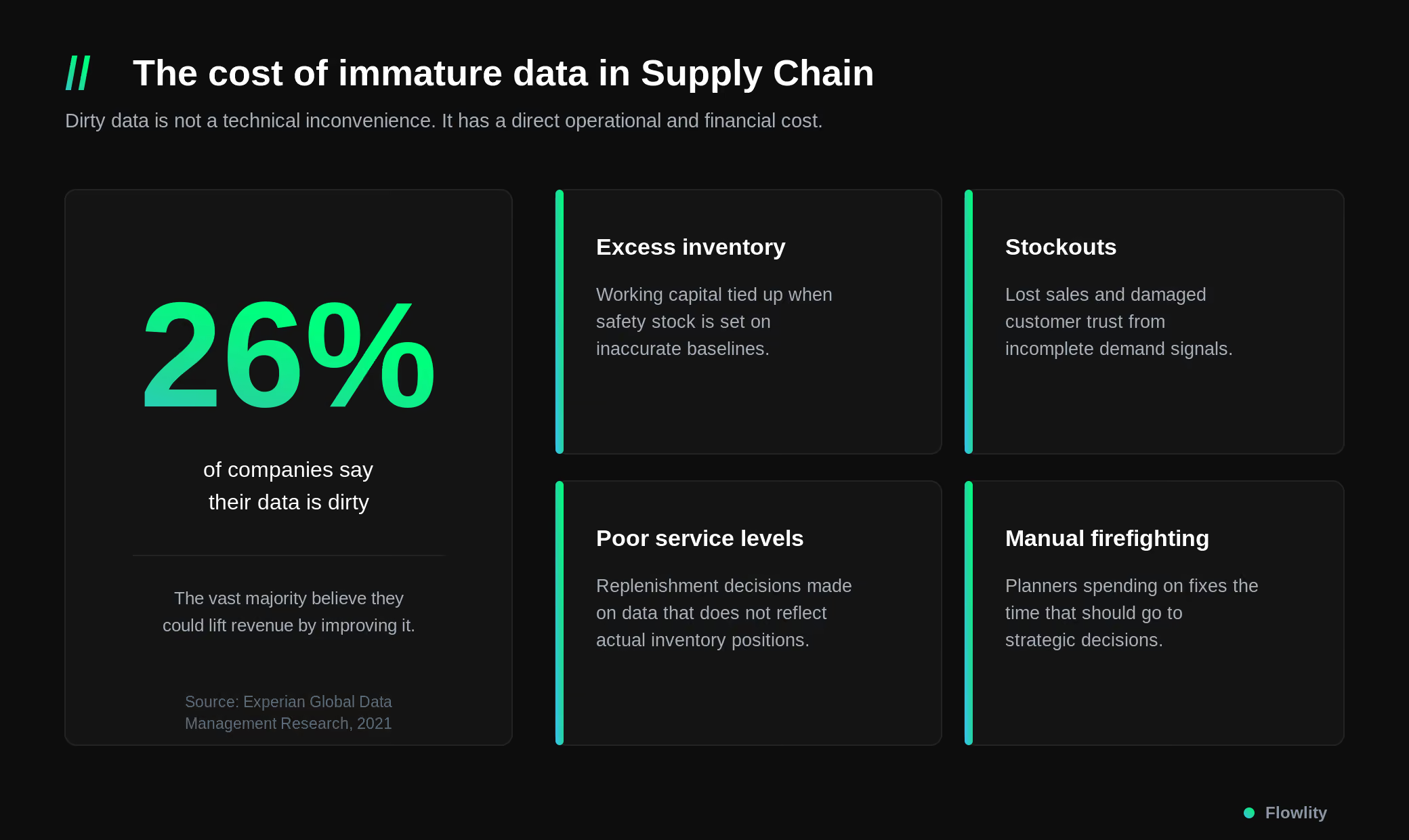
Poor data quality is not a technical inconvenience. It has a direct financial cost. According to Experian's 2021 Global Data Management Research, on average 26% of companies globally consider their data to be dirty, and businesses lose a significant share of their revenue as a result. The consequences compound in Supply Chain contexts, where dirty data translates into four specific operational failures:
- excess inventory tying up working capital because safety stock parameters are set on inaccurate baselines
- stockouts causing lost sales and damaged customer relationships because demand signals are incomplete or inconsistent
- poor service levels because replenishment decisions are made on data that does not reflect actual inventory positions
- endless manual adjustment by planners compensating for unreliable system outputs, which absorbs the time that should be spent on strategic decisions
The vast majority of companies believe they could improve revenue by improving data quality. The gap between that belief and the organizational investment required to act on it is where most data maturity journeys stall.
What are the three stages of Supply Chain data maturity?
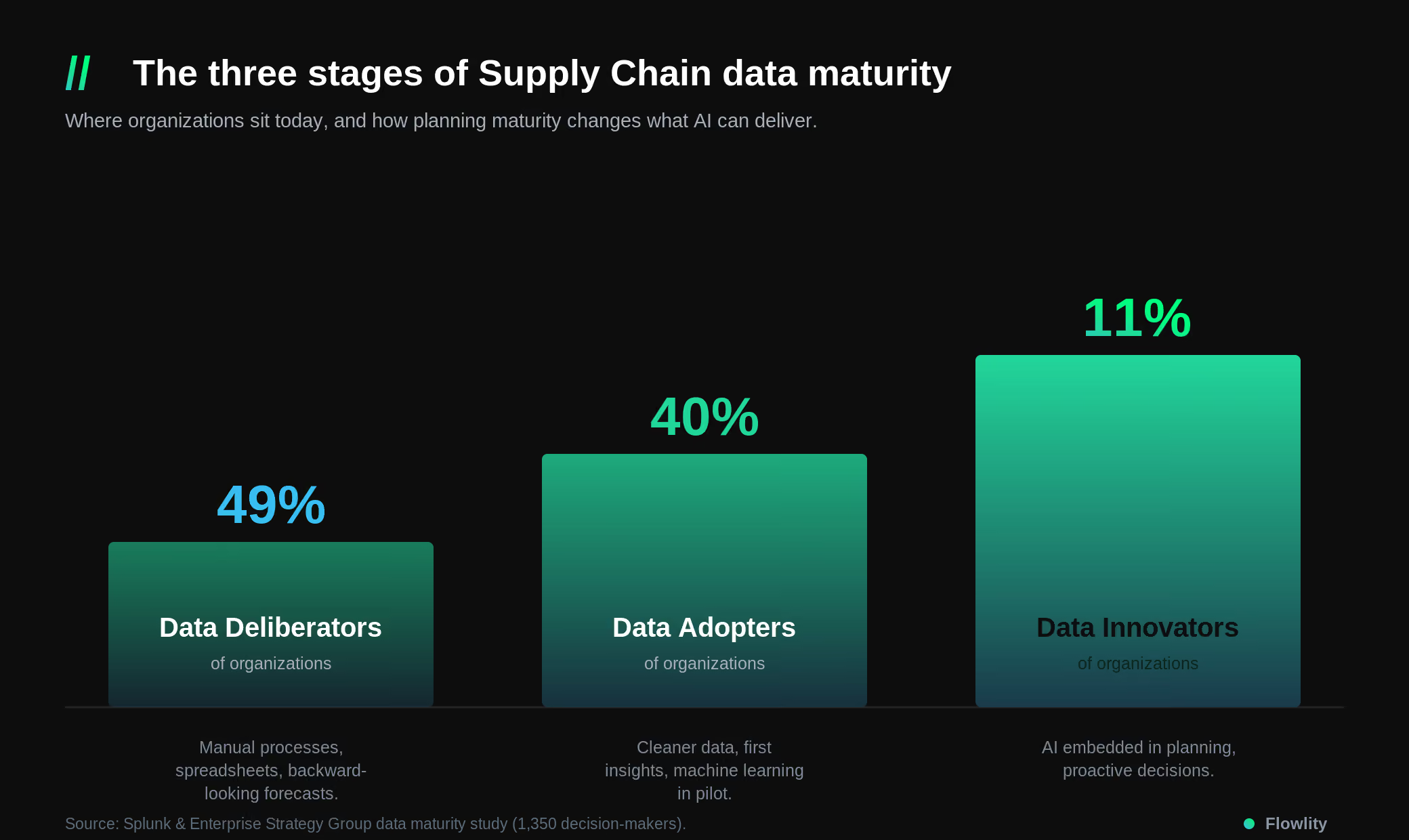
A joint study by Splunk and Enterprise Strategy Group surveying 1,350 senior business and IT decision-makers across eight industries identified three distinct stages of data maturity, finding that data mature companies boosted profitability by an average of 12.5% of their total gross profit compared to less mature peers. Data Innovators added 83% more revenue and 66% more profit than Data Deliberators in the same period. The distribution across stages reveals how early most organizations still are in this journey.
Stage 1: Data Deliberators (49% of organizations)
Organizations in the early stage of data implementation. Planning relies on manual processes, disconnected documents, and Excel spreadsheets. Data is collected but rarely cleaned, governed, or used consistently across teams. Forecasting is largely deterministic and backward-looking. The majority of organizations surveyed fell into this category, which reflects the genuine immaturity of data practices across industries today.
Stage 2: Data Adopters (40% of organizations)
Organizations that have developed cleaner data and started extracting meaningful insights but have not yet reached their full potential. Data strategies are actively being developed. Some functions have improved data quality while others still operate in silos. Machine learning may be in pilot or limited deployment. The gap between what is possible and what is actually happening is largest at this stage.
Stage 3: Data Innovators (11% of organizations)
Organizations using data to its maximum potential and building data-centric strategies across the business. AI and machine learning are embedded into planning processes rather than running as separate experiments. Decision-making is proactive rather than reactive. Only 11% of organizations surveyed reached this level, which illustrates both the scale of the opportunity and the genuine difficulty of the journey.
The distribution matters. The fact that nearly half of all organizations are still at Stage 1 means that the competitive advantage available to organizations that progress through Stages 2 and 3 is substantial and, for now, not widely captured.
How do data-mature companies use AI differently?
The difference between a data-mature organization and a data-immature one is not which AI tools they use. It is what those tools can actually do with the data they are given.
Starbucks: from economic crisis to data-driven growth
Starbucks began its data transformation in 2008 following store closures during the economic recession. By systematically building data-driven capabilities, the company created personalized promotions, optimized machine maintenance schedules, improved real estate planning, and developed insight-driven product strategies. Annual revenue grew from $10.7 billion in 2010 to $26.5 billion by 2019. Active membership in the Starbucks Rewards program increased 15% year-over-year in fiscal 2019, reaching 17.6 million members in the US.
American Express: fraud prevention and customer acquisition at scale
American Express used big data analytics to gain real-time visibility across all transactions from both customer and merchant sides, enabling it to build machine learning algorithms that deliver customized offers based on actual spending behavior. According to a Harvard Business School case study on American Express's data strategy, the company identified $2 billion in potential annual incremental fraud incidents before a single cent was lost, and achieved a 40% rise in new customer acquisition via online interactions following machine learning implementation.
Both cases reflect the same principle: the technology was not new when these organizations deployed it. What was different was the data foundation that made it reliable.
How does data maturity apply specifically to Supply Chain inventory optimization?
Inventory optimization is where the gap between data-mature and data-immature organizations becomes most operationally visible.
Most organizations still rely on static safety stocks, defined once and reviewed infrequently. These buffers are built on simplified assumptions that ignore demand variability, actual supplier reliability, and cross-product correlations. When volatility increases, static safety stocks simultaneously produce excess inventory in stable references and stockouts in volatile ones.
AI-driven inventory optimization changes this logic. By combining historical data with probabilistic models, it enables dynamic buffer strategies that size inventory to actual risk per SKU per period rather than applying blanket coverage rules. The system continuously learns from new data, adjusting recommendations as demand patterns shift, supplier performance evolves, and market conditions change. At Saint-Gobain, a global glass manufacturer, this shift raised forecast accuracy by 15% and lifted service levels from 95.8% to 97.2%, while reducing inventory by 9.25%: higher availability and less stock at the same time.
This approach connects directly to demand planning and demand sensing: the higher the quality of demand data entering the model, the more precisely the system can distinguish between SKUs that need more buffer and those where working capital is being unnecessarily tied up. For a deeper look at how probabilistic forecasting mechanics work in practice, see predictive analytics in Supply Chain planning.
How do you assess your organization's data maturity level?
Data maturity assessment acts as a roadmap that helps organizations understand the effectiveness of their data across functions and identify where investment will deliver the most impact. Several established assessment frameworks exist, most following the Capability Maturity Model method. The most widely used models include:
- IBM's Data Governance Maturity Model
- Gartner's Data Governance Maturity Model
- Stanford's Data Governance Maturity Model
- DataFlux's Data Governance Maturity Model
- Oracle's Data Governance Maturity Model
- TDWI's Data Governance Maturity Model
There is no single model that fits all organizations. The right framework depends on the company's existing data infrastructure, the planning tools in use, and the specific decisions the organization needs data to support. What matters is not which model is chosen but that the assessment is done honestly, covering data sources, data governance, data management practices, and the technology currently in use across each stage of the Supply Chain planning cycle.
Reaching each stage of data maturity requires increasing investment in technology, people, and process change. The return on that investment is real but the timeline is not linear. Organizations that manage expectations realistically, building incrementally rather than attempting a full transformation at once, consistently achieve better outcomes than those that treat data maturity as a one-time technology project.
Why do so many AI initiatives in Supply Chain fail to scale?
The reason most AI and machine learning initiatives in Supply Chain fail is rarely the algorithm. It is the data and the operating model around it.
The most common failure causes are:
- poor data quality that degrades model outputs before they reach planners
- fragmented systems and unclear data ownership across functions
- misalignment between business and data teams on what decisions the model is supposed to support
- unrealistic expectations about automation that lead organizations to deploy AI before the data foundation is ready
- isolated proof-of-concepts that cannot be extended beyond a single use case or region
AI and machine learning is not a magic button. It is a capability that must be embedded into planning processes, decision rights, and governance structures before it can compound. Data-mature organizations understand this. They invest in data foundations first, then progressively layer machine learning on top, ensuring that adoption, trust in outputs, and measurable impact develop together rather than in sequence.
The AI Agent layer that handles routine recalculation and exception flagging in a mature Supply Chain platform only delivers value if the data feeding it is clean, consistent, and integrated across the ERP and planning systems. Integration and security infrastructure is therefore not a technical afterthought. It is the foundation on which every AI-driven planning capability is built.
What does a data-mature Supply Chain organization achieve?
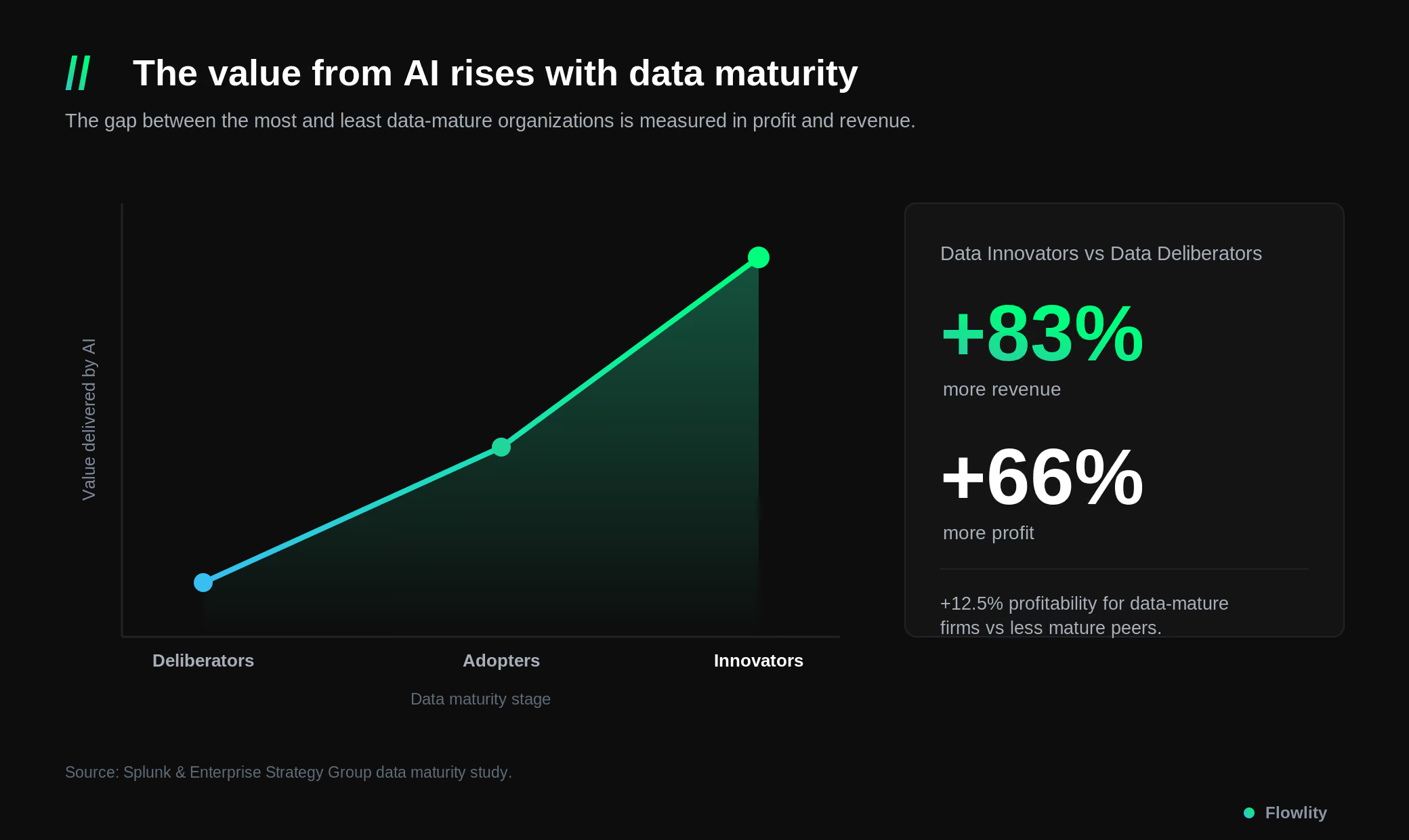
The Splunk and ESG study identified three primary outcomes that data-mature organizations consistently reported, each with direct Supply Chain implications.
Competitive advantage through real-time responsiveness
Data-mature organizations use analytics platforms to make strategic decisions faster than competitors. In Supply Chain terms, this means responding to demand shifts, supplier disruptions, and market changes before they materialize as service failures. Strategic simulations and dashboard analytics give Supply Chain leaders the forward visibility that reactive, spreadsheet-based planning cannot provide.
Better decisions under uncertainty
Data-mature Supply Chain organizations are prepared for disruption because their planning models continuously incorporate new signals rather than freezing assumptions at the last review cycle. Several data-mature companies maintained reliable lead times during supply crises precisely because their planning data was current and their models had learned to distinguish structural volatility from temporary deviation.
Better utilization of AI
Organizations that reach Stage 3 data maturity invest in AI-equipped planning platforms that improve over time rather than requiring manual reconfiguration with every disruption. The algorithms get better as more data flows through them. The planners using them develop greater trust in the outputs and redirect their time toward the decisions that require judgment rather than routine recalculation. This is the compounding return that makes data maturity a strategic investment rather than a cost.
Ready to move from data-immature planning toward decision-grade forecasting and dynamic inventory optimization? Discover Flowlity's AI-powered Supply Chain platform or book a demo.
Level up your supply chain with AI.
Get a demo
FAQ
Find everything you need to know right here.
How is the Supply Chain implementing AI and machine learning today?

Most Supply Chain organizations start by applying machine learning to demand forecasting and inventory optimization. These areas generate fast, measurable value and rely on historical data that is already available. More advanced use cases include supplier risk management, scenario simulation, and automated exception detection. The pattern is to start where the data is cleanest and the KPI movement is easiest to attribute, then extend to use cases that depend on the same probabilistic model and shared data foundation. That progression keeps each step measurable, which is what sustains internal momentum and avoids the trap of large AI programs that produce little in the way of operational impact.
Why is data quality so important for Machine Learning in Supply Chain?
Machine learning models learn from historical data. If the data is inaccurate, inconsistent, or biased, the model will reproduce those issues at scale. Clean, well-structured data is essential to build trust in forecasts and recommendations. In Supply Chain specifically, the data that matters most, sales history, master data, lead times and stock movements, often sits across several systems and accumulates inconsistencies over time. Investing in data quality upstream tends to deliver more KPI movement than tuning the model itself, because a well-prepared dataset lets even standard probabilistic methods produce reliable forecasts and buffer recommendations. Trust in the output is what drives adoption, and adoption is what turns models into operational value.
Can mid-size companies benefit from machine learning in Supply Chain?
Absolutely. Modern machine learning Supply Chain platforms are designed to be faster to deploy and easier to use than legacy planning tools. Mid-size organizations often benefit even more, as they can move away from spreadsheets without the complexity of large IT projects. Many are now actively evaluating AI-powered planning software built specifically for SMBs, comparing solutions based on scalability, ease of integration, and real business impact rather than theoretical features. The reason mid-size teams gain disproportionately is that they have less slack to absorb volatility and fewer planners to handle exceptions, so each improvement in forecast quality and buffer sizing shows up quickly in service level and inventory KPIs.
What is the first step toward a data-mature Supply Chain?
The first step is to assess your current data maturity: data sources, quality, governance, and usage. From there, organizations can define a realistic roadmap to improve data foundations and progressively introduce machine learning where it delivers the most value. The diagnostic stage is more important than it looks. It exposes which data is actually trustworthy, which decisions still depend on spreadsheets and tribal knowledge, and where the highest-return improvements sit. A clear-eyed view at the start prevents teams from layering advanced analytics on top of unreliable inputs, which is the most common reason data and AI programs fail to translate into measurable Supply Chain KPI improvements.