.svg)
.svg)
Best Ecommerce Inventory Management Software 2026
Keeping products available without tying up cash is the core tension in ecommerce, and it gets harder with every extra channel, SKU and supplier you add. Very few tools will tell you what to buy next, and that gap is the whole decision. It is also expensive: IHL Group estimates that stockouts and overstocks cost retailers about $1.77 trillion a year.
Our verdict: if your problem is knowing where inventory sits, execution tools like Cin7, Linnworks or Shopify's built-in features are enough. If your problem is deciding how much to hold, when to reorder and how much cash to lock in inventory, you need a planning layer on top. That is where Flowlity fits best, with AI-native probabilistic forecasting and dynamic safety stock, now accessible to mid-market and smaller brands through Flowlity Lite.
This guide compares 12 of the most-used tools across three families:
- execution and channel-sync tools (Shopify, Linnworks, ShipHero, ShipBob),
- all-in-one inventory ERPs (Cin7, Oracle NetSuite, Katana, inFlow, Zoho Inventory, Extensiv Order Manager, Brightpearl),
- and AI planning layers (Flowlity).
For each, you get what it is genuinely best for, how it handles forecasting and multichannel sync, its pricing model and its public G2 or Capterra rating.
What is ecommerce inventory management software?
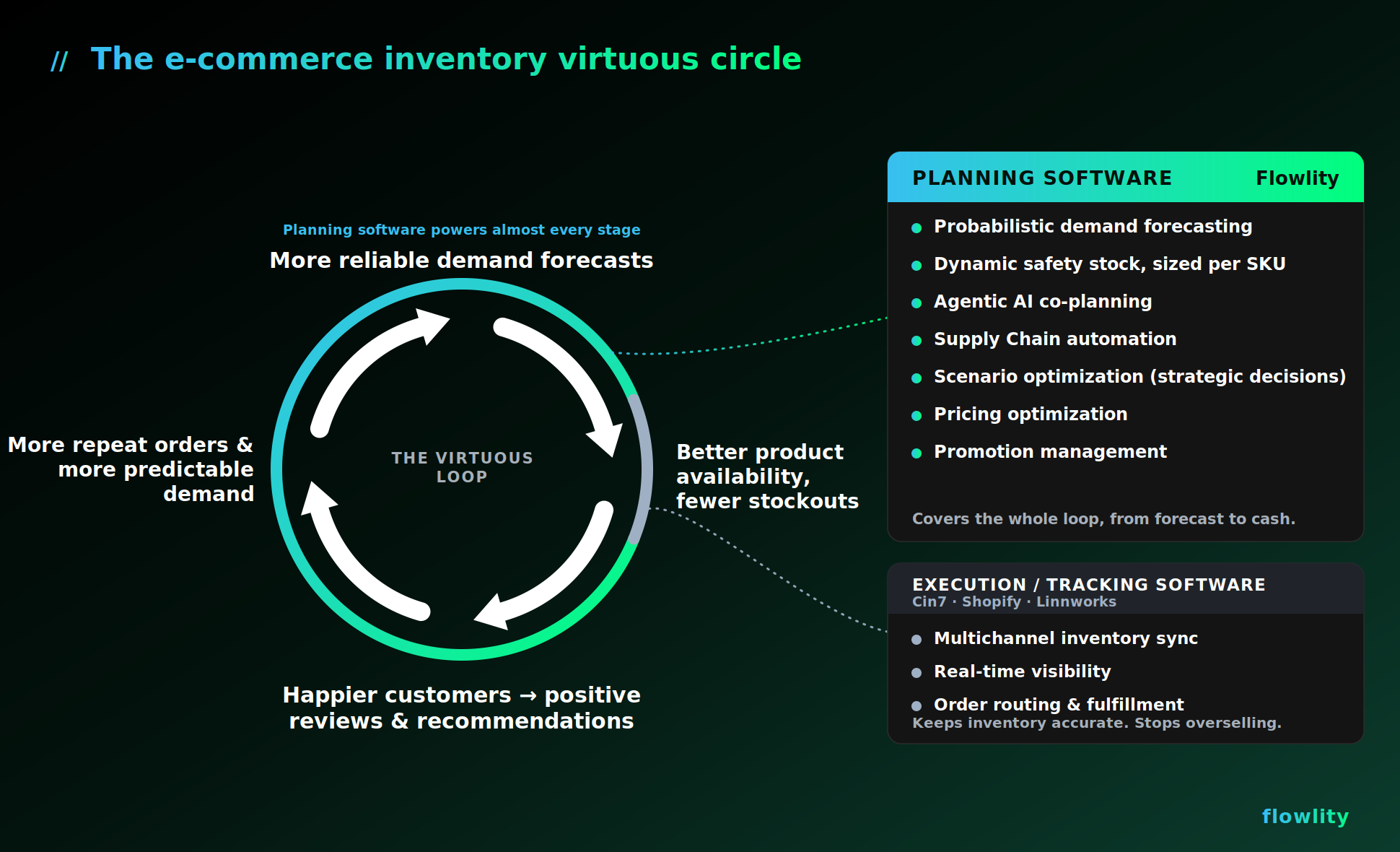
Ecommerce inventory management software tracks, controls and coordinates inventory across every place a brand sells and stores products: online stores, marketplaces, warehouses and physical locations. It centralizes inventory data so teams see accurate, real-time availability, prevent overselling and make faster replenishment decisions. The strongest platforms also connect to sales and order systems to keep inventory synchronized automatically, and a smaller set add demand forecasting to decide what to reorder before a stockout or overstock happens.
Tracking versus planning: the distinction that decides your shortlist
Most tools in this category are execution systems. They record inventory movements, sync quantities between channels and route orders to fulfillment. That is essential plumbing, but it is reactive: it tells you what you hold right now.
Planning software answers a different question, which is what you will need and when. It forecasts demand at the stock keeping unit (SKU) level, sizes safety stock to each product's real volatility, and surfaces future stockouts and overstock early enough to act. For brands with seasonal or promotion-driven demand, long supplier lead times, or hundreds of SKUs, that is where the money is: service protected, and cash freed from excess inventory.
The pattern shows up constantly in conversations with operators. One fast-growing direct-to-consumer (DTC) brand that designs in Europe and manufactures in Asia described spending two weeks every month in spreadsheets, averaging past sales and eyeballing comparable products, just to work out what to reorder before the next container shipped. The inventory was visible the whole time. What was missing was a reliable view of future demand and the right buffer per product, the exact gap Camif, a mid-market retailer, closed by adding an AI planning layer.
As you scan the tools below, keep one lens in mind: is this a tracking tool, a planning tool, or both? Most brands end up needing both layers.
Common ecommerce inventory challenges
Overselling across channels
When marketplace, webstore and retail counts drift even slightly out of sync, you sell units you no longer have. The result is cancelled orders, refunds and, on marketplaces like Amazon, account-health penalties or suppressed listings that are slow to recover. The more channels you add, the more often it happens, because every channel is quietly making promises against the same physical inventory. Preventing it takes a single source of truth that decrements availability everywhere the moment a sale lands, not an overnight batch.
Demand volatility
Promotions, seasonality and short product life cycles make demand jump around, so the static reorder points that worked last year quietly turn wrong. Set buffers too high and cash sits idle in the warehouse; set them too low and you stock out at the worst possible moment. It compounds when a single spike (a viral product, a marketing push) distorts the historical average your reorder rules depend on. Handling it well means sizing each buffer to a product's real variability and refreshing forecasts continuously, the kind of discipline behind a more agile, digital Supply Chain built for volatile retail demand.
Long, variable lead times
When resupply takes weeks or ships by ocean container, the reorder you place today locks in your inventory position months out. Get the timing or the quantity wrong and there is no quick fix: you either wait out a stockout or sit on excess until it slowly sells through. Supplier lead times are rarely constant either, so even a one-week slip can cascade into a shortage. This is exactly where forward-looking planning beats reactive tracking: you have to act before the data on the shelf says there is a problem.
SKU proliferation
Sizes, colours, bundles and channel-specific variants multiply the number of items a planner has to forecast and reorder every single week. What was a manageable spreadsheet at 100 SKUs becomes unworkable at 1,000, and the long tail of slow movers is where cash quietly gets trapped. Manual planning simply does not scale to that many decisions with any accuracy. A fast-growing assortment is one of the clearest signals a brand has outgrown tracking-only tools, one of the Supply Chain challenges that come with growth.
Cash versus service
Every inventory decision trades off two costs pulling in opposite directions: too little inventory loses sales and hurts search rank and customer trust; too much ties up cash and warehouse space you could use elsewhere. Spreadsheets hold this balance together surprisingly well, until volume, SKU count and channel complexity outgrow what a person can track, which is exactly when the cost of getting it wrong is highest. The brands that win treat service level and working capital as one optimisation, not two separate fights, because customer experience now rests on the retail Supply Chain.
Returns and reverse logistics
In ecommerce a large share of what you ship comes back (especially in apparel) and those returns re-enter available inventory on an unpredictable delay. Ignore them in your planning and you either double-order product that is about to reappear on the shelf, or promise inventory that has not yet been inspected and restocked. Forecasting the volume and timing of returns turns reverse logistics from noise into usable supply. See how returns forecasting feeds cleaner replenishment decisions.
What to look for in ecommerce inventory management software
Multichannel synchronization
Good synchronization keeps your inventory consistent across every marketplace, storefront and location in near real time, so no channel can sell a unit another has already committed. Look for native connectors to the channels you actually use, and check how fast they refresh, since an overnight sync is not enough at volume. The best systems also let you ring-fence inventory for a given channel when you need to. This is the single feature that prevents overselling, so treat it as non-negotiable for multichannel sellers.
Real-time visibility
Real-time visibility gives you one live view of inventory as sales, returns and replenishments happen, ideally down to location and bin. That view is what lets a team react in hours instead of discovering a problem at month-end. It should include in-transit and on-order inventory too, not just what is physically on the shelf, so you are never blind to what is already on the way. Every decision downstream is only as good as this underlying data.
Demand forecasting and replenishment
Demand forecasting turns sales history into SKU-level forecasts, sizes adaptive safety stock to each product's real volatility, and produces clear "what to order, how much, and when" outputs instead of fixed min and max rules. This is the capability most execution tools lack, and it should surface future stockouts and overstock early enough to act on, not just report them after the fact. It is also where AI-driven inventory optimization and demand sensing change the economics.
Multi-location and warehouse management
Multi-location management coordinates inventory across warehouses, third-party logistics (3PL) providers and stores, balancing inventory between locations and routing each order to the right one. Done well, it cuts split shipments and puts product closer to the customer; done badly, you end up with the right total inventory in all the wrong places. Look for accurate per-site visibility, not just a global number. This becomes essential the moment you hold inventory in more than one place.
Reporting and KPIs
Good reporting tracks the metrics that actually drive decisions: stock coverage, service level, inventory turnover, and stockout or overstock exposure. The goal is not dashboards for their own sake but a fast read on where risk and trapped cash are building up. Favour reporting you can act on (alerts and rankings) over purely historical charts. Over time these KPIs are how you prove the system is paying for itself.
Integrations
How cleanly a tool integrates with your ecommerce platform, marketplaces, ERP (your finance and operations system of record) and third-party logistics (3PL) providers (the outside firms that store and ship orders on your behalf) decides both how fast you see value and how clean your data stays. Weak integrations mean manual exports, drift between systems and a planning layer working from stale numbers. Favour native, well-documented connectors to the tools you already run; a quick integration is often worth more in practice than a slightly richer feature set that takes 6 months to wire up.
The 12 best ecommerce inventory management tools in 2026
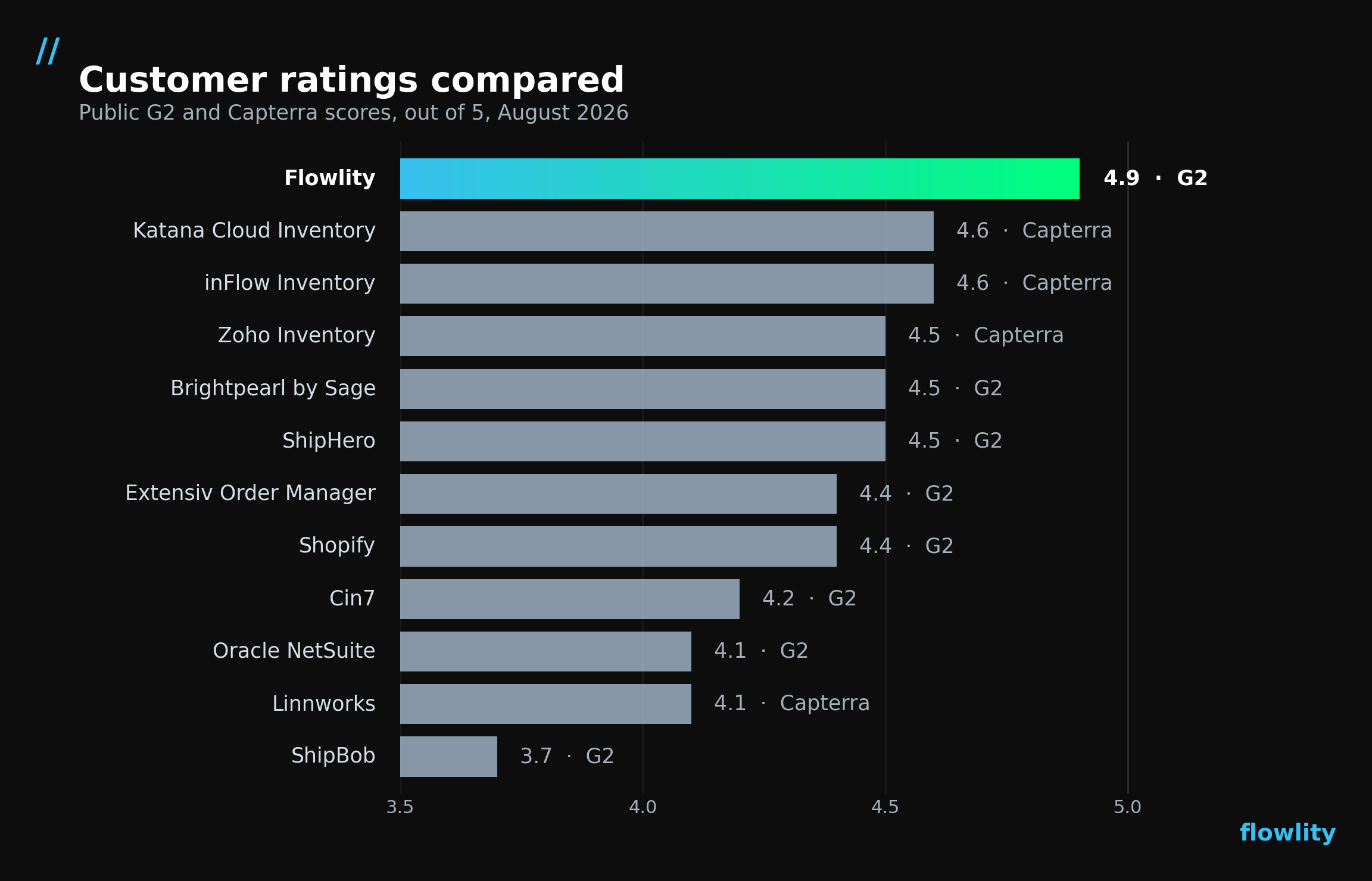
Flowlity: best for AI forecasting and inventory optimization
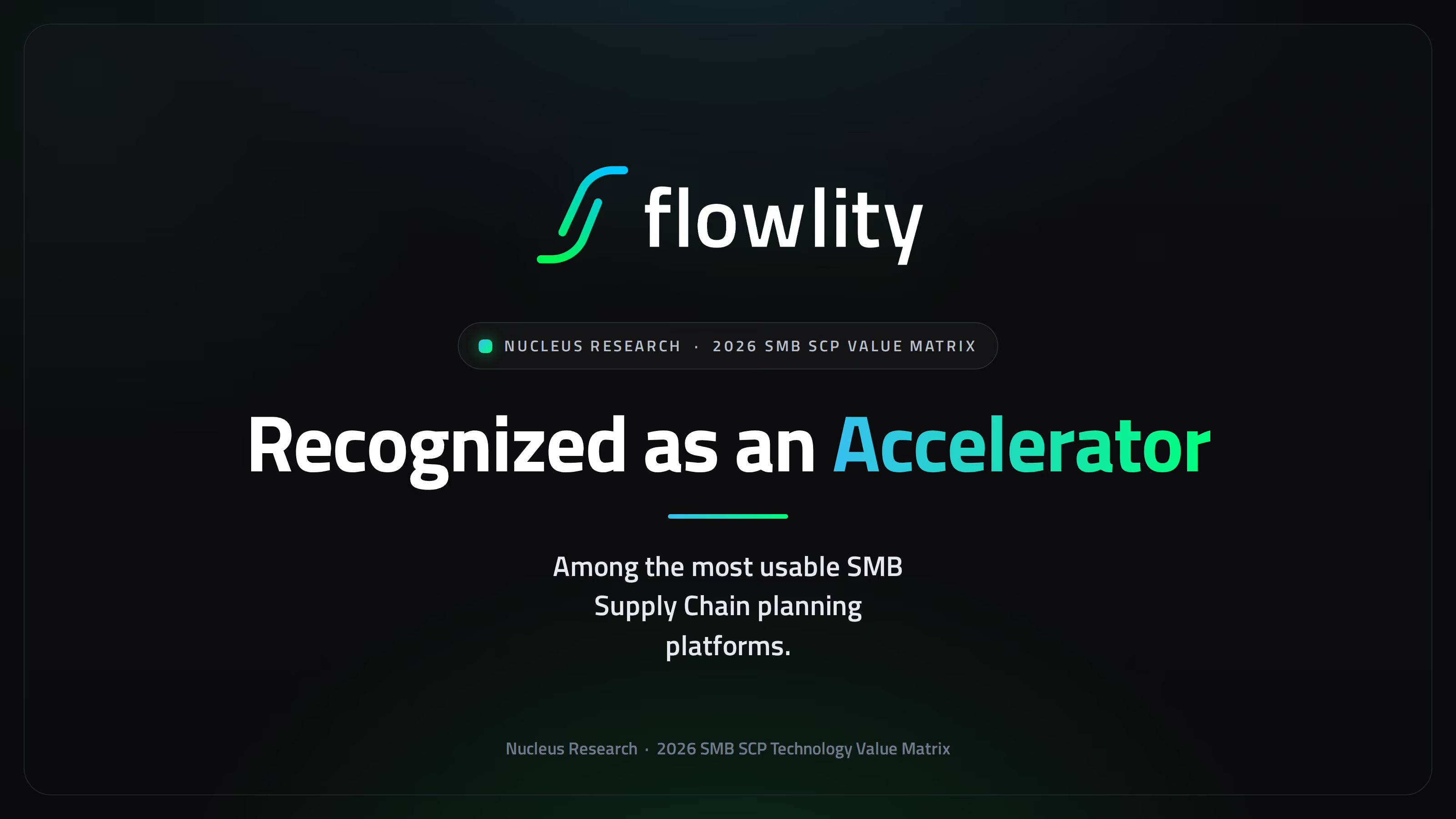
Flowlity is the planning layer of the stack. Its probabilistic models forecast demand per SKU and size safety stock to each product's real variability, so teams act on future stockouts and overstock before they happen rather than reacting after the fact. Beyond forecasting it adds agentic-AI co-planning, Supply Chain automation, scenario optimization for strategic decisions, and pricing and promotion planning. It reads from your ERP or execution tool and keeps a human in control of every decision, and Flowlity Lite brings the core approach to smaller teams without a dedicated planning function. Flowlity was also recognized as an Accelerator in Nucleus Research’s 2026 SMB SCP Value Matrix, among the most usable and innovative planning platforms for smaller teams.
Watch-out: it is a planning layer, not a system of record, so it sits on top of your execution tool rather than replacing it.
Cin7: best all-in-one inventory ERP
Cin7 covers purchasing, inventory control and multichannel order management across two products, Core for smaller sellers and Omni for larger omnichannel operations. It centralizes inventory across sales channels and warehouses, adds landed-cost tracking, a built-in B2B portal and EDI/3PL connections, and syncs inventory natively to stop overselling. For a product business that wants inventory and light accounting in one system of record, it removes a lot of manual reconciliation. Its forecasting, though, is reorder-point logic rather than true demand planning, so brands with volatile demand often pair it with a planning layer.
Watch-out: broad functionality means a heavier setup, and forecasting is basic next to a dedicated planner.
Zoho Inventory: best for the Zoho ecosystem
Zoho Inventory handles order and inventory management with marketplace connections (Amazon, eBay, Shopify), serial and batch tracking and shipping-rate integrations, plus a free entry tier. It fits small brands already using Zoho's wider suite, where it ties neatly into Zoho Books for accounting. The problem it solves is affordable order-to-fulfillment tracking for a modest catalogue, not sophisticated planning. Forecasting is limited to reorder points and it is built for smaller SKU counts, so it tends to be outgrown as complexity rises.
Watch-out: forecasting is reorder-point only, and it is built for smaller catalogs.
Oracle NetSuite: best for larger, complex operations
Oracle NetSuite puts inventory and order management inside a much wider cloud finance and operations suite, with real-time multi-location inventory, order management and a demand-planning add-on module. Its strength is unifying finance, inventory and operations on one system of record for larger, multi-entity businesses, with deep customization via SuiteScript. That breadth is also the catch: it is a major implementation in both cost and time, and overkill for a small brand that just needs inventory control. Forecasting lives in the separate Demand Planning module rather than being native and probabilistic.
Watch-out: a major implementation in cost and time, and overkill for small brands.
Katana Cloud Inventory: best for makers and manufacturers
Katana Cloud Inventory pairs inventory with light manufacturing (bills of materials, raw-material tracking and visual production scheduling) and integrates tightly with Shopify, QuickBooks and Xero. It is built for makers and small manufacturers who need to tie what they can produce to what they can sell, in real time. For a maker selling DTC, that link between production and available inventory is the core problem it solves. Pure resellers get less from it, and its forecasting is limited to reorder points rather than demand modelling.
Watch-out: forecasting is limited to reorder points, and it is strongest for makers rather than pure resellers.
Brightpearl by Sage: best for retail and wholesale operations
Brightpearl, now part of Sage, automates orders, inventory, purchasing and accounting for retailers and wholesalers, with a strong retail-focused automation engine and built-in POS. It is aimed at retail and wholesale brands with high order volume, where the problem is taking manual work out of the back office. Demand planning is not native: it is typically added through the Inventory Planner integration, so forecasting is a bolt-on rather than a core strength. Its retail and wholesale focus makes it heavier than very small brands need.
Watch-out: its retail and wholesale focus makes it heavy for very small brands.
inFlow Inventory: best for simple SMB inventory control
inFlow Inventory gives small businesses clean inventory tracking, purchasing and basic B2B ordering with very little setup, including barcode scanning, purchase and sales order management and a B2B showroom. Its appeal is simplicity and price for a team that just needs to know what it has and when to reorder. It solves basic inventory control for small operations rather than planning at scale. Automation and forecasting are light: reorder-point alerts rather than adaptive buffers, so it is comfortably outgrown as volume and SKU count climb.
Watch-out: light on automation and forecasting; scope is small-business inventory control.
Linnworks: best for multichannel order and inventory sync
Linnworks connects and automates selling across many marketplaces and channels, keeping listings, orders and inventory in sync and routing fulfillment with rule-based automation. For a high-volume seller juggling Amazon, eBay, Shopify and more, its core value is stopping overselling and cutting the manual work of order management across all of them. It is execution- and channel-focused, so its planning stays rules-based rather than forecast-driven. Onboarding can take time given how much it connects to.
Watch-out: execution and channel focused, so planning is rules-based and onboarding can take time.
Extensiv Order Manager: best for high-volume DTC and 3PL
Formerly Skubana, Extensiv Order Manager unifies orders, inventory and fulfillment across channels and warehouses for high-volume operations, with automated PO generation, inventory analytics and 'Orderbot' automation rules. It is aimed at DTC brands and sellers scaling across multiple channels and 3PLs, where the problem is orchestrating orders and purchasing without a person touching each one. It is strong on operations and automation, but planning is basic and pricing leans enterprise. Brands that need real demand forecasting typically add a dedicated layer on top.
Watch-out: strong on operations, but planning is basic and pricing leans enterprise.
Shopify: best entry-level option for small DTC brands
Shopify's built-in inventory and order management is often enough for small brands selling mainly on Shopify: per-location inventory tracking, low-stock views, basic transfers and a tie-in to Shopify POS, all extensible through its app ecosystem. The problem it solves is keeping storefront inventory counts accurate at the point of sale with zero extra tooling. The limits show up with growth: no native demand forecasting, limited multi-location planning and no multi-echelon optimization, so scaling brands lean on apps or a dedicated planning tool. Most keep Shopify for execution and add planning alongside it.
Watch-out: no native forecasting or multi-echelon planning, so scaling brands outgrow it.
ShipHero: best for warehouse and fulfillment execution
ShipHero is a warehouse management system for ecommerce fulfillment: order management, picking, packing, shipping, returns and mobile scanning, with multi-warehouse routing. Its job is running an efficient warehouse (your own or a 3PL's) and cutting mis-ships, not deciding how much inventory to buy. For brands operating their own warehouses it is a strong execution engine. It has no demand forecasting, so it has to be paired with a planning tool to answer the reorder question.
Watch-out: a warehouse system only, with no demand forecasting, so pair it with a planning tool.
ShipBob: best for outsourced fulfillment with inventory tools
ShipBob is a tech-enabled 3PL: brands store inventory in its fulfillment network and get distributed pick-pack-ship plus a dashboard with inventory visibility and reorder-point alerts. It solves the problem of in-house warehousing and slow delivery by spreading inventory across fulfillment centres closer to customers. Outsourcing fulfillment to its network is the point, but it also means planning stays light and you depend on their operations. Reorder alerts help, but they are not a substitute for demand forecasting.
Watch-out: you outsource fulfillment to its network, and planning stays light.
How to choose the right tool for your business
By size and stage
Smaller brands may only need accurate tracking and channel sync, and a Shopify or a Zoho Inventory can carry them a long way. But manual planning gets expensive fast as volume grows: both the hours spent in spreadsheets and the cost of a wrong call climb together. The moment reordering starts eating a meaningful slice of someone's week, the stage has changed even if the tool has not. That is usually the trigger to add a planning layer.
By SKU complexity and volatility
More SKUs and choppier demand are what break static min and max rules. With a few stable products, reorder points are fine; with hundreds of variants and promotion-driven spikes, they are wrong more often than right. This is the profile where forecasting with adaptive safety stock stops being a nice-to-have and starts paying for itself in recovered sales and freed cash. If your assortment and your demand are both growing, weight this factor heavily.
By channel model
Multichannel sellers need centralized synchronization as a hard requirement: without it, overselling is a matter of when, not if. Single-channel brands can start much simpler and add complexity only as they expand. Map where you actually sell today and where you will sell in 12 months, and make sure the tool covers both. Migrating channels later usually costs more than paying for a little headroom now.
By how much forecast accuracy you need
If stockouts, excess stock and planning hours are real, measurable costs in your business, a planning layer stops being optional. The test is simple: can you already see your inventory everywhere but still routinely order too much or too little? If so, your gap is forecasting, not tracking, and more visibility will not close it. That is the point at which an AI planning layer earns its place in the stack.
By budget and integrations
Weigh licensing against setup effort and, above all, how cleanly a tool connects to your platform, ERP and 3PL. A cheaper tool that takes six months and a consultant to integrate can easily cost more than a pricier one that connects in a week. The fastest payback usually comes from tools that fit the stack you already run. Factor in the internal time to operate the system, not just the sticker price.
Build a stack that plans, not just tracks
The tools here are good at different jobs. Execution platforms like Shopify, Linnworks, ShipHero and ShipBob keep inventory synced and orders moving; all-in-one systems like Cin7, NetSuite and Brightpearl add breadth across operations. What most of them do not do is forecast demand and optimize how much to hold, which is where brands lose the most, in stockouts and dead inventory alike.
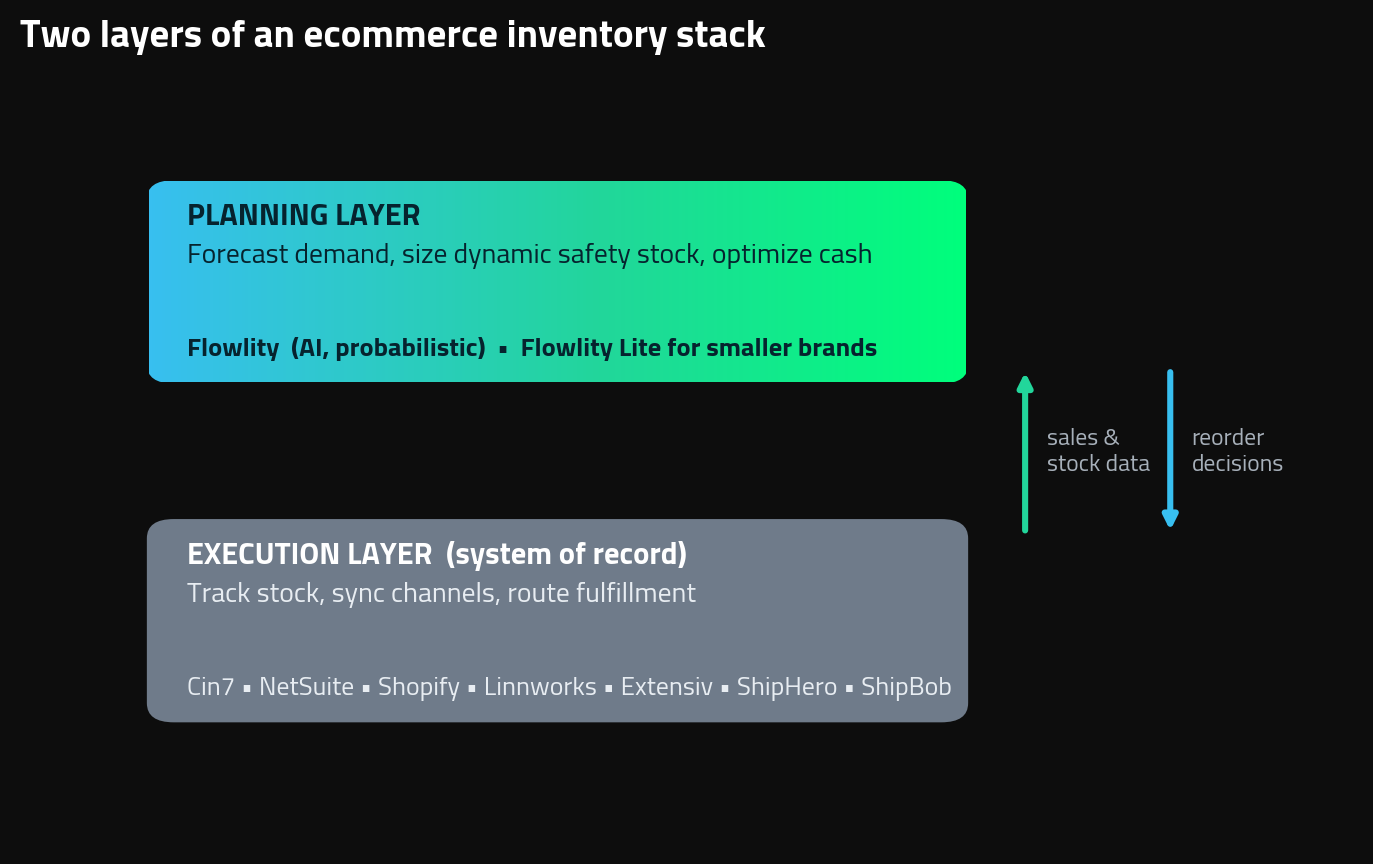
The pragmatic 2026 setup is two layers: a reliable execution tool as your system of record, and a planning layer on top. That planning layer is what Flowlity adds: AI-native probabilistic forecasting, dynamic safety stock and scenario planning on top of the tools you already run.
Ready to move from tracking to planning? Start with Flowlity Lite and its 2-week free trial and see the forecasts on your own data.
Level up your supply chain with AI.
Get a demo

FAQ
Find everything you need to know right here.
What is an Ecommerce Inventory Management Software?

An ecommerce inventory management software is a system that helps businesses track, control, and manage inventory across online stores, marketplaces, warehouses, and physical locations. It centralizes stock data to improve visibility and support replenishment decisions.
Advanced solutions such as Flowlity extend beyond visibility by combining demand forecasting and inventory optimization to improve service levels while reducing excess stock.
Is Shopify enough for inventory management?
Shopify's built-in inventory features are sufficient for small ecommerce businesses with simple needs — basic stock tracking, low-stock alerts, and manual reorder points. As complexity increases — multi-location fulfillment, seasonal demand, longer lead times, or a growing SKU catalog — businesses often require additional tools for demand forecasting and inventory planning.
A dedicated inventory optimization software layer connects to Shopify and adds probabilistic forecasting, dynamic safety stocks, and automated replenishment recommendations. This prevents stockouts during demand peaks while freeing working capital during slower periods, without forcing teams to abandon their existing ecommerce stack.
Do ecommerce brands need demand planning software?
Ecommerce brands with demand volatility, multiple sales channels, or large SKU assortments benefit significantly from demand planning software. Accurate forecasting and inventory optimization help reduce stockouts, excess inventory, and manual planning effort across the entire product catalog.
For ecommerce specifically, demand planning software addresses challenges like flash sales, seasonal peaks, marketplace channel variability, and rapid product turnover that make manual forecasting unreliable. AI-driven tools can process signals from multiple sales channels simultaneously, helping brands maintain optimal stock levels without over-investing in safety stock — especially important for businesses scaling their catalog beyond what a small planning team can manage manually.
What is the best ecommerce inventory management software?
There is no single winner, because the right tool depends on your channels, SKU count, and how much you rely on accurate forecasting. Brands whose main need is accurate multichannel inventory tend to choose execution-first tools like Cin7, Linnworks, or Shopify's native features. Brands whose main pain is stockouts and overstock add a Supply Chain planning software such as Flowlity on top of that system of record. A practical way to decide: if you can already see your inventory everywhere but still order too much or too little, your gap is planning, not tracking.
Ecommerce inventory management versus demand planning software: what is the difference?
Inventory management software tracks current inventory and its movements across channels and locations. Demand planning software forecasts future demand and turns it into replenishment decisions: how much to hold, when to reorder, and what buffer protects a given service level. The first tells you what you have, the second tells you what you will need. Many tools do the first well and the second barely, which is why brands often run a system of record for execution and a dedicated planning layer for forecasting and cash control.
How do I keep stock in sync across multiple sales channels?
Use a system that centralizes inventory and updates every channel in near real time, so a sale on one marketplace immediately reduces availability everywhere else. Multichannel tools such as Cin7, Linnworks, and Extensiv Order Manager are built for this, usually through native connectors to your store and marketplaces. Syncing solves overselling, but it does not decide quantities. To avoid both stockouts and excess inventory, pair synchronization with demand forecasting that sizes inventory to each product's real variability.
How does Flowlity use AI to optimize ecommerce inventory?
Flowlity uses probabilistic forecasting: instead of a single-point number that is known in advance to be wrong, it models a range of demand scenarios and the probability of each. From that it sizes dynamic safety stock to the service level you choose and flags future stockouts and overstock early. It reads from your sales, order, and ERP systems, keeps a human in control of decisions, and, through Flowlity Lite, brings the approach to smaller brands without a large planning team.