.svg)
Still running your stock from Excel?
There's a smarter way. Built for SMBs.
Flowlity’s Intelligent algorithms combine the latest machine learning, ensemble learning, and deep learning algorithms.
Try it for free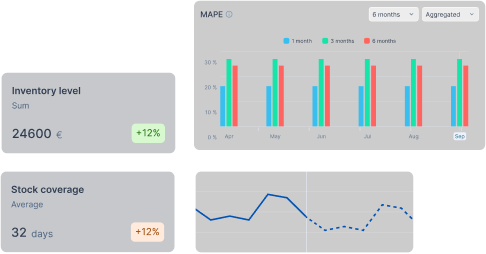

Give your small business the power of a big one.
AI Supply Chain for all, finally accessible.
Before Flowlity Lite
.svg)
With Flowlity Lite
"With Flowlity, I get to see what I can expect three months from now, six months from now, in a year."
Bradley Saveth
President & COO, Supply Caddy

Up and running in less than a day.
Really. No IT needed.

Upload your data

Get your AI forecast

Act on clear recommendations
Everything an SMB needs. Nothing it doesn't.
Three modules à la carte, for a tool fully tailored to your business.


.svg)
Demand Planning
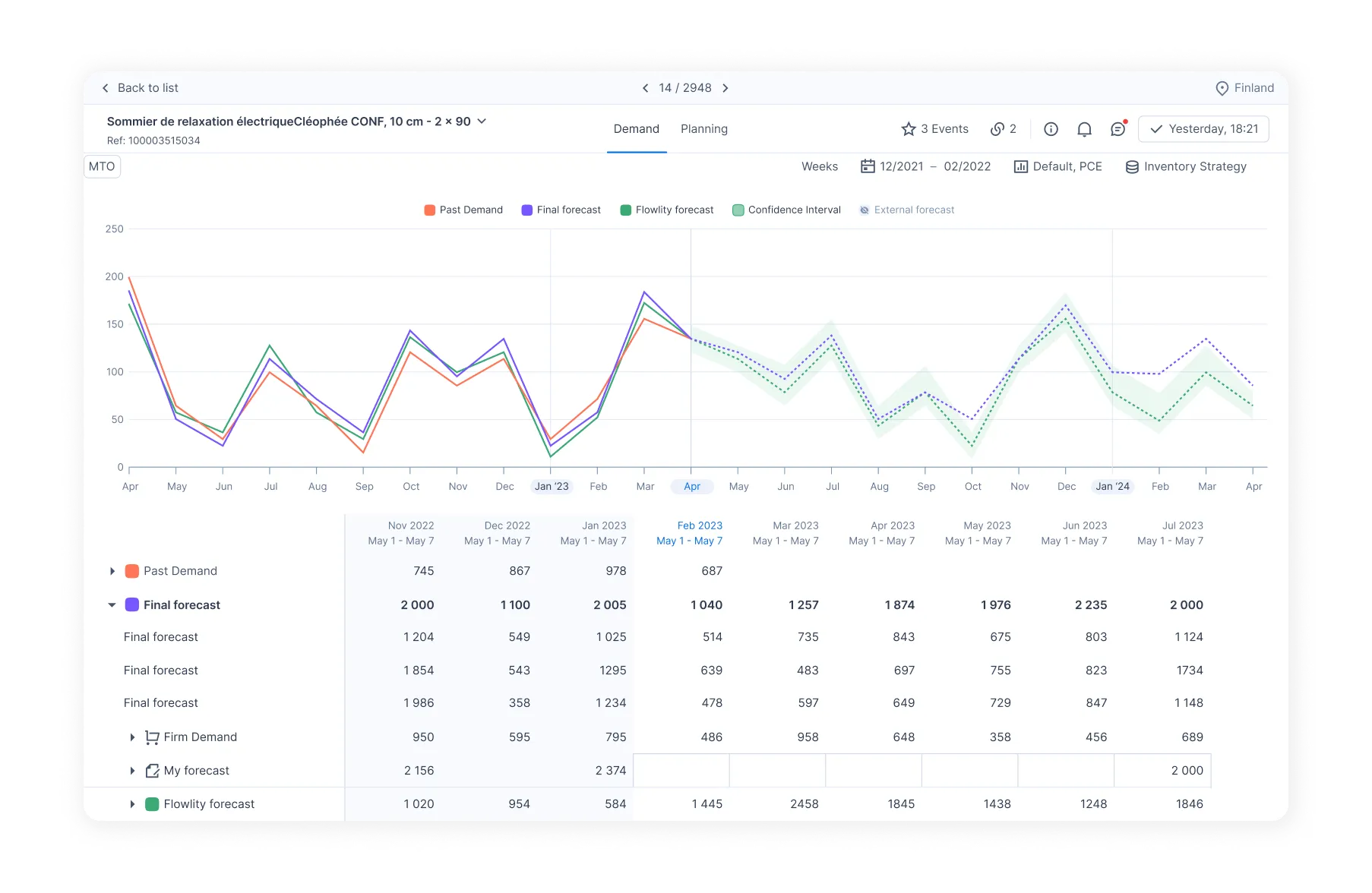
Forecast your demand automatically — even if you only work with spreadsheets today. Flowlity Lite gives you accurate SKU-level forecasts so you can stop guessing, avoid stockouts, and plan with confidence.

Supply Planning
Turn your forecasts into clear, actionable replenishment suggestions. Flowlity tells you what to order, when, and how much — taking lead times and constraints into account.
Yes, just like a dedicated supply planner.
Supply Planning
Bring your sales and operations together around one simple, shared view of demand and stock. Perfect for small teams that need alignment without implementing a heavy S&OP process.
"With Flowlity, I get to see what I can expect three months from now, six months from now, in a year."
Bradley Saveth
President & COO, Supply Caddy
AI built for supply chain. Not a chatbot that pretends.
ChatGPT and Claude are great for writing emails. They were not built to forecast your sales or plan your purchase orders.
Flowlity is a probabilistic engine, trained on real supply chain data, that learns from your sales history and recalibrates daily. It doesn't chat. It runs the plan a full supply chain team would build, every day, in seconds.
Probabilistic forecasting, not just a number
Trained on your data, not on the internet
Built for supply chain, not for everything
FAQ
Find everything you need to know right here.
Is Flowlity’s AI transparent and explainable to users?

Yes – it’s even one of Flowlity’s founding principles: providing AI that can be explained and understood by the humans who use it.
We know that in the Supply Chain, planners and managers need to trust a tool’s recommendations, and this requires understanding the “why.”
Flowlity was therefore designed not to be a black box, but rather an educational tool as well as a decision-making tool.
Concretely, how does this manifest itself?
In the Flowlity interface, each forecast and each recommendation is accompanied by explanatory elements. For example, if Flowlity recommends ordering 500 units of item X for next month, the user sees the breakdown of the expected demand: seasonality, trend, promotional effect, etc., depending on the case.
The tool also displays a confidence interval around the forecast (for example: central forecast 500, with a low scenario at 450 and a high scenario at 560), which gives an idea of the uncertainty. This allows for the justification of calculated safety stocks. Furthermore, Flowlity provides alerts and justifications. For example: "Risk of shortage in 15 days on this product because recent demand exceeds forecasts by 20%." Or: "Inventory reduction proposed on this item, because its turnover rate has decreased over the last 3 months." Technically, Flowlity's AI uses machine learning models (including deep learning), but the complexity is hidden behind a simple interface.
Ensemble learning techniques are also favored, which smooth out predictions and avoid aberrations. And above all, Flowlity sees itself as an assistant: the user always has the option to review a decision. If they don't agree with a recommendation, they can modify it (for example, order a little more or a little less), and the system will take this feedback into account to adjust in the future. It's a virtuous learning loop where the human retains final control. During training, we insist that users understand how the tool works.
Without revealing all the algorithmic details, we explain the main principles (probabilistic forecasting, dynamic buffer calculation, etc.). Very quickly, planners see that the tool reacts as they would in many cases, but better because it reacts more quickly and integrates more data. For example, the tool can detect correlations between products that humans would not have seen – but it will display “30% increase in anticipated demand for product A because it is correlated with that of product B on promotion”. This kind of explanation makes AI tangible.
Finally, on the question of technical transparency, Flowlity is open to discussing its approach:
We publish white papers and articles on our approach (e.g., use of probabilistic vs. deterministic forecasts). Our goal is not to mystify the algorithm, but to make the supply chain smarter collectively. Flowlity users become better at their jobs because they learn from AI feedback. Many report that after a few months, they have a better understanding of their supply chain dynamics (seasonality, impact of promotions, supplier behavior) thanks to the visibility the tool provides.
In short, Flowlity's AI is transparent, explainable, and human-friendly. It's a companion that informs your decisions instead of arbitrarily replacing them. This philosophy increases trust and adoption of the solution within Supply Chain teams.
If you'd like to see in practice how Flowlity presents its recommendations and what explanations are provided, we invite you to book a demo where you can judge the tool's clarity for yourself.
How is AI being used in supply chains?
AI is used to turn large volumes of historical and real-time data into better decisions—like demand forecasting, inventory optimization, replenishment recommendations, disruption detection, and workflow automation across planning, procurement, and logistics.
Will artificial intelligence ever fully take over supply chains?
Not in a way we’d recommend. At Flowlity, we believe the best results come from human intelligence + AI: automate everything that can be automated (data prep, calculations, alerts, routine decisions), so people stay focused on high-value work like strategy, trade-offs, stakeholder alignment, and exception management.
How does AI improve demand forecasting in supply chain management?
AI learns from patterns in sales history, seasonality, promotions, and external signals to generate more accurate demand forecasts than traditional statistical methods. Machine learning models continuously improve as new data arrives, detecting correlations and trends that humans might miss — such as cannibalization effects between products or the impact of weather on purchasing behavior.
This leads to better inventory decisions, fewer stockouts, and reduced excess stock across the Supply Chain. AI also automates time-consuming tasks like data cleaning, anomaly detection, and baseline forecasting, freeing demand planners to focus on exceptions and strategic decisions rather than routine data processing.
How does AI improve supply chain forecasting accuracy?
It improves accuracy by using machine learning models that detect non-obvious patterns, handle noise/outliers, and incorporate real-time updates—so forecasts stay aligned with reality, not last month’s assumptions.
What are the benefits of using AI in supply chain optimization?
AI-driven optimization helps balance service level and cost: fewer stockouts and shortages, lower excess inventory, smarter safety stocks, improved end-to-end visibility, and faster decision-making with less manual work.
How can AI improve supply chain efficiency?
By automating repetitive planning tasks, streamlining workflows, and highlighting only what needs human attention. Teams spend less time on data entry and firefighting—and more time executing the right actions at the right time.
What does probabilistic forecasting change in practice?
A traditional engine takes a single forecast number and computes plans on the assumption it is accurate. Probabilistic forecasting treats demand as a distribution and sizes decisions for the uncertainty interval. When demand is volatile, the gap shows up in stockouts avoided and inventory not parked in a warehouse waiting for a sale.